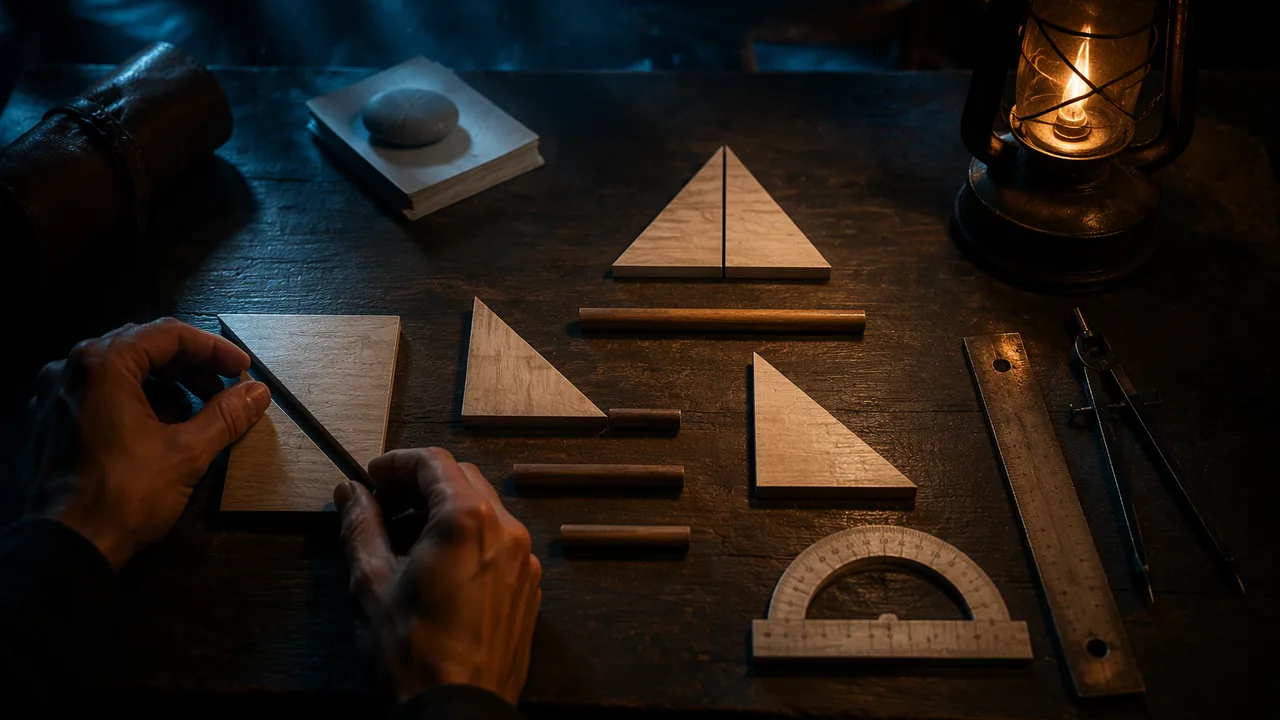
derive exact trigonometric ratios for 30-60-90 and 45-45-90 triangles and solve any right triangle with ratios, inverse ratios and the Pythagorean Theorem.
Instruction
Two triangles come up so often that their ratios are worth knowing exactly.
45-45-90. Cut a square with side 1 along its diagonal. Each half is an isosceles right triangle with legs 1, and by the Pythagorean Theorem the hypotenuse is √(1 + 1) = √2. So
sin 45° = cos 45° = 1/√2 = √2/2 ≈ 0.7071, and tan 45° = 1.
30-60-90. Cut an equilateral triangle with side 2 by the altitude from one vertex. The altitude bisects the base (the two halves are congruent by the isosceles triangle argument), so each half has hypotenuse 2, short leg 1, and long leg √(4 − 1) = √3. The short leg is opposite 30°. So
sin 30° = cos 60° = 1/2, cos 30° = sin 60° = √3/2 ≈ 0.8660, tan 30° = 1/√3 = √3/3 ≈ 0.5774, tan 60° = √3 ≈ 1.732.
Notice the complement pairs from Lesson 4.1: sin 30° = cos 60° and sin 60° = cos 30°.
Using the special triangles. A 30-60-90 triangle has hypotenuse 10. The short leg is half the hypotenuse, 5, and the long leg is 5√3 ≈ 8.66. A 45-45-90 triangle has legs 7; its hypotenuse is 7√2 ≈ 9.90. Give the exact form first, then the decimal if the context needs one.
Solving any right triangle. To solve a triangle is to find all its sides and angles. You need one side plus one more piece (another side or an acute angle).
- Angle and side known: a right triangle has a 35° angle and hypotenuse 20. Opposite side = 20 sin 35° ≈ 11.47; adjacent side = 20 cos 35° ≈ 16.38; the other angle is 55°.
- Two sides known: legs 5 and 12. The hypotenuse is √(25 + 144) = 13. The angle opposite the 5 satisfies tan θ = 5/12, so θ = tan−1(5/12) ≈ 22.62°, and the other acute angle is about 67.38°.
The inverse functions sin−1, cos−1 and tan−1 take a ratio and return the acute angle that has it. They answer the question “which angle has this ratio?”
Checks. The largest side must be the hypotenuse; the larger acute angle must be opposite the longer leg; and sin2θ + cos2θ = 1 for any angle (divide a2 + b2 = c2 by c2). For θ = 22.62°: (5/13)2 + (12/13)2 = 25/169 + 144/169 = 1.
Precision. Round only at the end. If you round sin 35° to 0.57 and multiply by 20, you get 11.4 instead of 11.47.
📖 Read for this lesson
The reading opens over the lesson; close it to come back to exactly where you were. The checks below draw on it.
Formative check
Work through these before moving on. They are not graded — they tell you whether the standard below has landed yet.
A 30-60-90 triangle has hypotenuse 10. What is the length of the side opposite the 60° angle?
sin 30° = and tan 45° = .
In a right triangle with legs 5 and 12, the angle opposite the side of length 5 is about 22.6°.
Derive the exact values of sin 60°, cos 60° and tan 60° from an equilateral triangle with side 2. Show each step and justify why the altitude bisects the base.
How confident are you that you can derive the special-triangle ratios and solve any right triangle?
Practice
Work these on paper or in your notebook, then open Check your answer. Aim for all of Fluency and Application; try at least one Challenge.
Printable version: this unit’s practice workbook (PDF)
Fluency
Build speed and accuracy with the core skill.
- A 30°-60°-90° triangle has shorter leg 6. Find the longer leg and the hypotenuse.
Check your answer
Answer: longer leg 6√3; hypotenuse 12Sides are in the ratio 1 : √3 : 2. - A 45°-45°-90° triangle has legs of length 10. Find the hypotenuse.
Check your answer
Answer: 10√2In a 45-45-90 triangle the hypotenuse is √2 times a leg. - A 45°-45°-90° triangle has legs of length 6. Find the hypotenuse.
Check your answer
Answer: 6√2In a 45-45-90 triangle the hypotenuse is √2 times a leg. - A 30°-60°-90° triangle has longer leg 4√3. Find the shorter leg and the hypotenuse.
Check your answer
Answer: shorter leg 4; hypotenuse 8Divide the longer leg by √3. - A 30°-60°-90° triangle has shorter leg 2. Find the longer leg and the hypotenuse.
Check your answer
Answer: longer leg 2√3; hypotenuse 4Sides are in the ratio 1 : √3 : 2. - A 30°-60°-90° triangle has hypotenuse 12. Find both legs.
Check your answer
Answer: shorter leg 6; longer leg 6√3The shorter leg is half the hypotenuse. - A right triangle has hypotenuse 10 and the leg adjacent to angle A is 8. Find angle A. Round to the nearest tenth of a degree.
Check your answer
Answer: 36.9°A = cos−1(8/10) - A right triangle has hypotenuse 10 and the leg adjacent to angle A is 3. Find angle A. Round to the nearest tenth of a degree.
Check your answer
Answer: 72.5°A = cos−1(3/10) - A right triangle has hypotenuse 27 and the leg adjacent to angle A is 8. Find angle A. Round to the nearest tenth of a degree.
Check your answer
Answer: 72.8°A = cos−1(8/27) - A right triangle has hypotenuse 29 and the leg opposite angle A is 12. Find angle A. Round to the nearest tenth of a degree.
Check your answer
Answer: 24.4°A = sin−1(12/29)
Application
Use the skill in context. Show your reasoning.
- A square room is 12 ft on each side. How long is its diagonal, exactly and to the nearest tenth?
Check your answer
Answer: 12√2 ≈ 17.0 ft45-45-90 triangle. - An A-frame tent’s front is an equilateral triangle with sides 2.4 m. How tall is the tent, exactly and to the nearest hundredth?
Check your answer
Answer: 1.2√3 ≈ 2.08 mThe altitude splits it into two 30-60-90 triangles with short leg 1.2. - (Illustrative.) A skate ramp rises 0.9 m over a horizontal run of 2.4 m. Find the angle it makes with the ground and the length of the ramp surface.
Check your answer
Answer: 20.6°; 2.56 mtan−1(0.9/2.4); √(0.81 + 5.76).
Challenge
Stretch problems. Expect to think before you write.
- Find the exact area of a regular hexagon with side 6, then give a decimal to the nearest hundredth.
Check your answer
Answer: 54√3 ≈ 93.53Six equilateral triangles of side 6, each with height 3√3 (30-60-90) and area ½ × 6 × 3√3 = 9√3.
Review
Keep earlier skills sharp.
- Triangle ABC is similar to triangle DEF. AB = 8 and the corresponding side DE = 12. If BC = 14, find EF, and the ratio of the triangles’ areas.
Check your answer
Answer: EF = 21; area ratio (DEF : ABC) = 9/4The scale factor is 12/8 = 3/2; areas scale by its square. - The altitude to the hypotenuse cuts it into segments 5 and 20. Find the altitude.
Check your answer
Answer: 10 - Which criterion shows two triangles with angles 35°, 80° and 35°, 65° are similar?
Check your answer
Answer: AA (the third angles are 65° and 80°)
A Record of Measured Right Triangles, and a Claim to Argue About
Constructed teaching data written for this course: leg measurements for right triangles drawn with hypotenuses of 10 cm and 15 cm at seven angles, recorded to the nearest 0.01 cm, with a reference table of ratios to four decimal places · SLS original (constructed teaching data)
Why this reading. The lesson’s output is a “ratio table from measured triangles.” If you have a protractor and ruler, draw and measure your own; if you do not, or want something to compare against, here is a measurement record made the way the without-a-device route describes. The values are constructed for this course to the precision a careful ruler gives and are labeled illustrative. Build the ratio table from them, then settle the claim at the end.
Measurement record (illustrative), hypotenuse 10.00 cm
| Angle θ | Opposite leg (cm) | Adjacent leg (cm) | opp/hyp | adj/hyp | opp/adj |
|---|---|---|---|---|---|
| 10° | 1.74 | 9.85 | |||
| 30° | 5.00 | 8.66 | |||
| 35° | 5.74 | 8.19 | 0.574 | 0.819 | 0.701 |
| 45° | 7.07 | 7.07 | |||
| 55° | 8.19 | 5.74 | |||
| 60° | 8.66 | 5.00 | |||
| 80° | 9.85 | 1.74 |
The 35° row is filled in. Fill the rest. Before you compute, predict which rows will share numbers, and why the complement relationship in the mini-lecture predicts it.
Measurement record (illustrative), hypotenuse 15.00 cm
| Angle θ | Opposite leg (cm) | Adjacent leg (cm) |
|---|---|---|
| 10° | 2.60 | 14.77 |
| 35° | 8.60 | 12.29 |
| 60° | 12.99 | 7.50 |
Compute the three ratios for each row and set them beside the 10 cm rows for the same angle. For 35°: 8.60/15 = 0.573 and 12.29/15 = 0.819. They agree with the 10 cm triangle to the precision the ruler allows. That agreement is the whole lesson: the ratio belongs to the angle.
Reference values, four decimal places
| θ | sin θ | cos θ | tan θ |
|---|---|---|---|
| 10° | 0.1736 | 0.9848 | 0.1763 |
| 20° | 0.3420 | 0.9397 | 0.3640 |
| 30° | 0.5000 | 0.8660 | 0.5774 |
| 35° | 0.5736 | 0.8192 | 0.7002 |
| 40° | 0.6428 | 0.7660 | 0.8391 |
| 45° | 0.7071 | 0.7071 | 1.0000 |
| 50° | 0.7660 | 0.6428 | 1.1918 |
| 55° | 0.8192 | 0.5736 | 1.4281 |
| 60° | 0.8660 | 0.5000 | 1.7321 |
| 70° | 0.9397 | 0.3420 | 2.7475 |
| 80° | 0.9848 | 0.1736 | 5.6713 |
Read the table top to bottom and describe, as the sim asks, how sine, cosine and tangent each change as the angle grows, and why the first two never reach 1 for an acute angle. Then check three entries of your measured ratio table against this one and report the largest disagreement; a ruler that reads to 0.01 cm on a 10 cm hypotenuse cannot do better than about ±0.001 in a ratio.
A claim to argue about
Two students draw 35° right triangles. One uses a 10 cm hypotenuse and gets opp/hyp = 0.574. The other uses 15 cm and gets 0.573. The first says: “Mine is bigger because the ratio depends on the triangle, so the definition of sine is ambiguous.” The second says: “The difference is measurement error; the ratio is a property of the angle.” Decide who is right using AA and the measurement precision stated above, and write the argument in three sentences: the similarity, what it forces about ratios, and how large a difference measurement alone can explain.