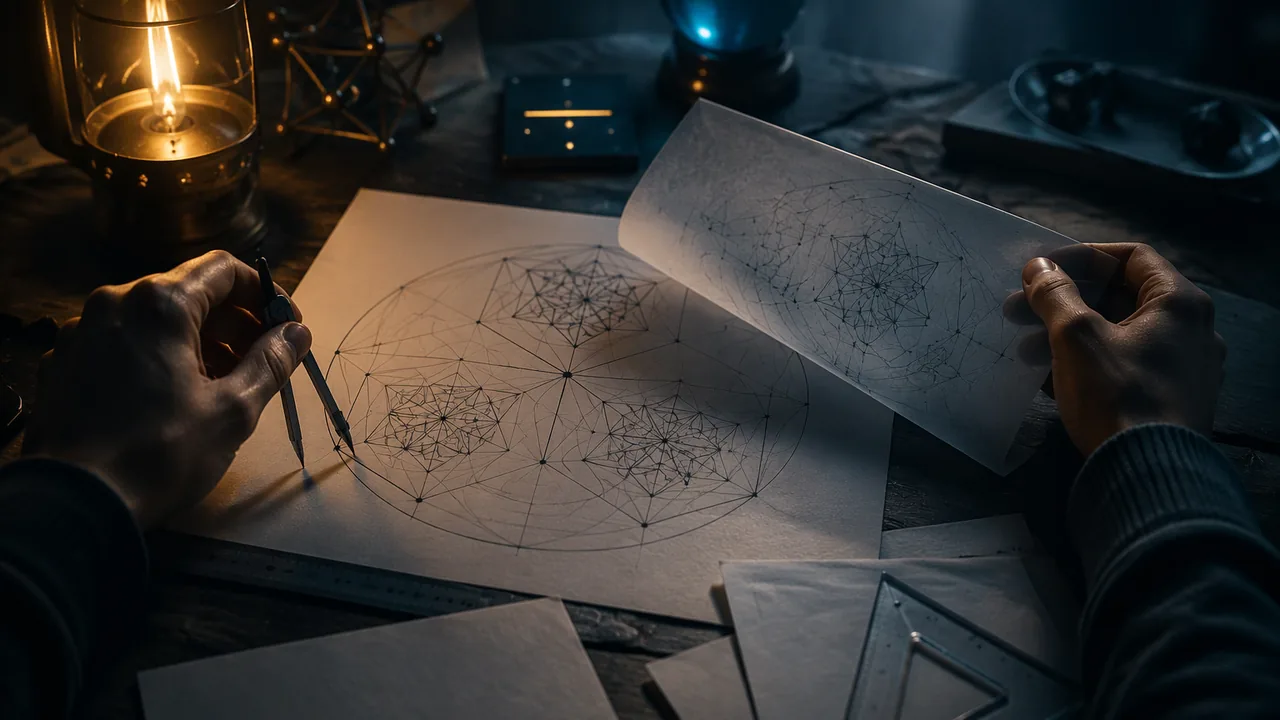
design an original figure from formal constructions, justify each construction from definitions, and specify the rigid transformations that carry its motifs onto one another.
Instruction
This task puts the whole unit to work in one product: an original tile, logo or mural panel whose structure is built entirely from constructions, and whose repeated parts are related by transformations you can name precisely.
Requirements. Your design must use at least four different formal constructions from Lessons 1.1 and 1.2, and one of them must be a regular polygon inscribed in a circle (equilateral triangle, square or regular hexagon). It must contain a motif that appears at least three times, with each copy the image of another under a rigid transformation.
Construction log. For each construction, record the steps in order and a justification that uses only definitions and results we have established. A strong justification sounds like this: “Point C lies on the circle with center A through B, so AC = AB by the definition of a circle.” A weak one sounds like this: “It looks equal.” Your partner will mark every weak justification in the peer review.
Transformation map. Label the copies of your motif M1, M2, M3 and so on. For each pair you connect, write the transformation or sequence of transformations that carries one onto the other, with full precision: a rotation needs a center and an angle and a direction; a reflection needs a line; a translation needs a directed segment or a vector. Then list every symmetry of the whole design, as in Lesson 1.4.
Test in GeoGebra. If you work digitally, apply your stated transformations with GeoGebra’s Rotate, Reflect and Translate tools to M1 and check that the image lands exactly on the target copy. Then drag the starting points. A design built from true constructions keeps its structure; one built by eye falls apart. If you work by hand, use tracing paper to check each transformation.
What strong portfolios do. They choose a design where the mathematics is visible rather than hidden, they justify every step, and in the walkthrough they explain one step that is less obvious than it looks: why stepping the radius six times closes the hexagon, for example, or why the order of two transformations matters for their design.
Walkthrough. Three minutes, recorded or live: show the design, walk through one construction and its justification, and demonstrate one transformation carrying a motif onto another. A written walkthrough script is an equal-credit alternative if recording is not possible.
📖 Read for this lesson
The reading opens over the lesson; close it to come back to exactly where you were. The checks below draw on it.
Formative check
Work through these before moving on. They are not graded — they tell you whether the standard below has landed yet.
To specify a rotation you need…
Tap to revealA center, an angle and a direction.
To specify a reflection you need…
Tap to revealThe line of reflection.
To specify a translation you need…
Tap to revealA directed segment (or a vector).
How to test a construction in GeoGebra
Tap to revealDrag the given points; a true construction keeps its properties.
Motif N is motif M turned upside down, in the opposite corner of a square tile. Which single transformation carries M onto N?
Stage 1 plan: describe your design, name the four or more constructions you will use, and state the transformation that carries your motif M1 onto M2.
How confident are you that you can build a design from justified constructions and specify the transformations between its parts precisely?
Unit 1 checkpoint
Do this before you start the task. It covers the whole unit and tells you what to review first.
Which definition of a circle can be used in a proof?
In the equilateral-triangle construction, AC = AB because C lies on the circle centered at A through B.
A regular hexagon inscribed in a circle of radius 7 has perimeter .
Which construction gives a line through P parallel to line l?
An angle of 84° is bisected. Each part measures °.
What is the image of (4, −1) under a rotation of 90° counterclockwise about the origin?
What is the image of (−3, 5) under a reflection over the y-axis?
The transformation (x, y) → (2x, y) is rigid because it keeps horizontal lines horizontal.
A reflection across line m takes P to P′ so that m is the perpendicular of PP′.
How many lines of symmetry does a regular hexagon have?
A rectangle that is not a square is symmetric across its diagonals.
The smallest positive rotation that carries a regular pentagon onto itself is °.
Reflect (2, 3) over the x-axis, then translate 4 left. Where does it land?
Submit: Construction and Transformation Portfolio with three-minute walkthrough
Task: Create an original tile, logo or mural panel built from at least four formal constructions (including one inscribed regular polygon). Justify every construction, specify the rigid transformations relating repeated motifs, and list the design’s symmetries.
Submission workflow
- Stage 1 — Plan. Sketch of the design, list of the constructions you will use, and the motif and transformations you intend.
- Stage 2 — Peer-reviewed draft. Construction log and transformation map; a partner marks any justification based on appearance and any imprecise transformation. Submit a revision note.
- Stage 3 — Final portfolio. Finished design, complete construction log with justifications, transformation map and symmetry list.
- Stage 4 — Walkthrough. Three-minute recorded or live explanation, or an equal-credit written script.
How it is scored
| Criterion | What proficient looks like |
|---|---|
| Constructions (G.CO.D.11) | Four or more correct formal constructions, including an inscribed regular polygon, each reproducible from the log. |
| Justification (MP.3) | Every step justified from definitions or established results; no appeal to appearance. |
| Transformations (G.CO.A.5, G.CO.A.4) | Each motif-to-motif mapping named precisely (center, angle, direction, line or vector) and verified. |
| Symmetry (G.CO.A.3) | All symmetries of the design identified correctly. |
| Tools (MP.5) | Construction holds under dragging in GeoGebra, or is checked with tracing paper. |
| Walkthrough | Clear explanation of one construction and one transformation, including a non-obvious step. |
An Exemplar Portfolio Entry: The Six-Petal Medallion, With Its Log and Peer-Review Sheet
Constructed teaching material written for this course: one complete portfolio entry (design by coordinates, construction log, transformation map, symmetry list) and the peer-review sheet the partner uses · SLS original (constructed teaching data)
Why this reading. The task asks for a construction log a partner can reproduce, a transformation map with full precision, and a symmetry list, and the rubric says a partner will mark every weak justification. You have never seen one of these finished. Here is a complete entry for a simple design, given by exact coordinates so every statement in it can be checked, followed by the peer-review sheet. Your design must be your own; this one shows the standard the log and the map are held to.
The design
A circle of radius 6 centered at O(0, 0). Its inscribed regular hexagon has vertices V₀ through V₅, and the perpendicular bisector of each side meets the circle at an arc midpoint W₀ through W₅. The motif M₁ is the small triangle V₀W₀V₁; the design is M₁ and its five copies, one on each side of the hexagon.
| Point | Coordinates (3 d.p.) | Point | Coordinates |
|---|---|---|---|
| V₀ | (6, 0) | W₀ | (5.196, 3) |
| V₁ | (3, 5.196) | W₁ | (0, 6) |
| V₂ | (−3, 5.196) | W₂ | (−5.196, 3) |
| V₃ | (−6, 0) | W₃ | (−5.196, −3) |
| V₄ | (−3, −5.196) | W₄ | (0, −6) |
| V₅ | (3, −5.196) | W₅ | (5.196, −3) |
Checks you can run: V₀V₁ = √((6 − 3)² + (0 − 5.196)²) = √36 = 6, the radius, as the hexagon construction promises. V₀W₀ = √(0.804² + 3²) ≈ 3.106, and V₁W₀ is the same, so M₁ is isosceles.
Construction log (four constructions)
- Regular hexagon inscribed in the circle. Steps: draw the circle with center O through V₀; with center V₀ and the same radius, mark V₁ on the circle; repeat from V₁ to get V₂, and so on around. Justification: each chord VₖVₖ₊₁ equals the radius by the definition of a circle, so each triangle OVₖVₖ₊₁ is equilateral and each central angle is 60°; six of them make 360°, so the sixth step lands on V₀.
- Perpendicular bisector of side V₀V₁ (Lesson 1.1, Construction 2). Steps: circles centered at V₀ and V₁ through each other meet at two points; the line through them is the bisector. Justification: both points are equidistant from V₀ and V₁ by the definition of a circle. The bisector meets the circle at W₀; repeat for the other five sides.
- Equilateral triangle V₀V₂V₄ by joining every other vertex. Justification: the three chords each span two 60° central angles, so they are congruent by the SAS argument to be proved in Unit 2; for now, cite the 1.1 result that this triangle is equilateral.
- Angle bisector of ∠V₀OV₁ (Lesson 1.2). Justification: the kite argument. The non-obvious step: this bisector is the same line as the perpendicular bisector in step 2, because triangle OV₀V₁ is equilateral, so O is equidistant from V₀ and V₁ and lies on that perpendicular bisector. Two constructions, one line; in GeoGebra, dragging V₀ keeps them coincident.
Transformation map
| From | To | Transformation, fully specified | Check on one vertex |
|---|---|---|---|
| M₁ | M₂ (V₁W₁V₂) | rotation, center O, 60° counterclockwise | V₀(6, 0) → (3, 5.196) = V₁ |
| M₁ | M₄ (V₃W₃V₄) | rotation, center O, 180°; rule (x, y) → (−x, −y) | W₀(5.196, 3) → (−5.196, −3) = W₃ |
| M₁ | M₆ (V₅W₅V₀) | reflection across the x-axis; rule (x, y) → (x, −y) | V₁(3, 5.196) → (3, −5.196) = V₅ |
| M₁ | M₁ | reflection across the x-axis, then rotation 60° about O | V₀ → V₀ → V₁; W₀ → W₅ → W₀; V₁ → V₅ → V₀ |
The last row is the kind of thing a walkthrough should explain: the composition of a reflection and a rotation carries M₁ onto itself, swapping V₀ and V₁. It is the reflection across the line through O and W₀, and it shows that the order of two transformations is not a detail.
Symmetry list
Twelve: rotations about O of 0°, 60°, 120°, 180°, 240° and 300°; reflections across the six lines through O and a vertex or an arc midpoint, which are the lines y = 0, y = √3·x, y = −√3·x, x = 0, y = x/√3 and y = −x/√3.
Peer-review sheet
- For each construction: can I redo it from the steps alone, without the picture? If not, mark not reproducible.
- For each justification: does it name a definition or an established result? Circle any word like looks, appears, clearly or obviously.
- For each transformation: is the center, angle and direction (or the line, or the vector) stated? Apply it to one vertex and check that it lands.
- Symmetry list: apply each claimed symmetry to one vertex of the motif; then test one motion that is not on the list and confirm it fails.