derive the formula A = ½ab sin C by drawing an altitude, prove the Law of Sines, and use them to find areas and unknown sides of non-right triangles.
Instruction
Right-triangle trigonometry reaches into every triangle once you draw an altitude, because an altitude cuts any triangle into right triangles.
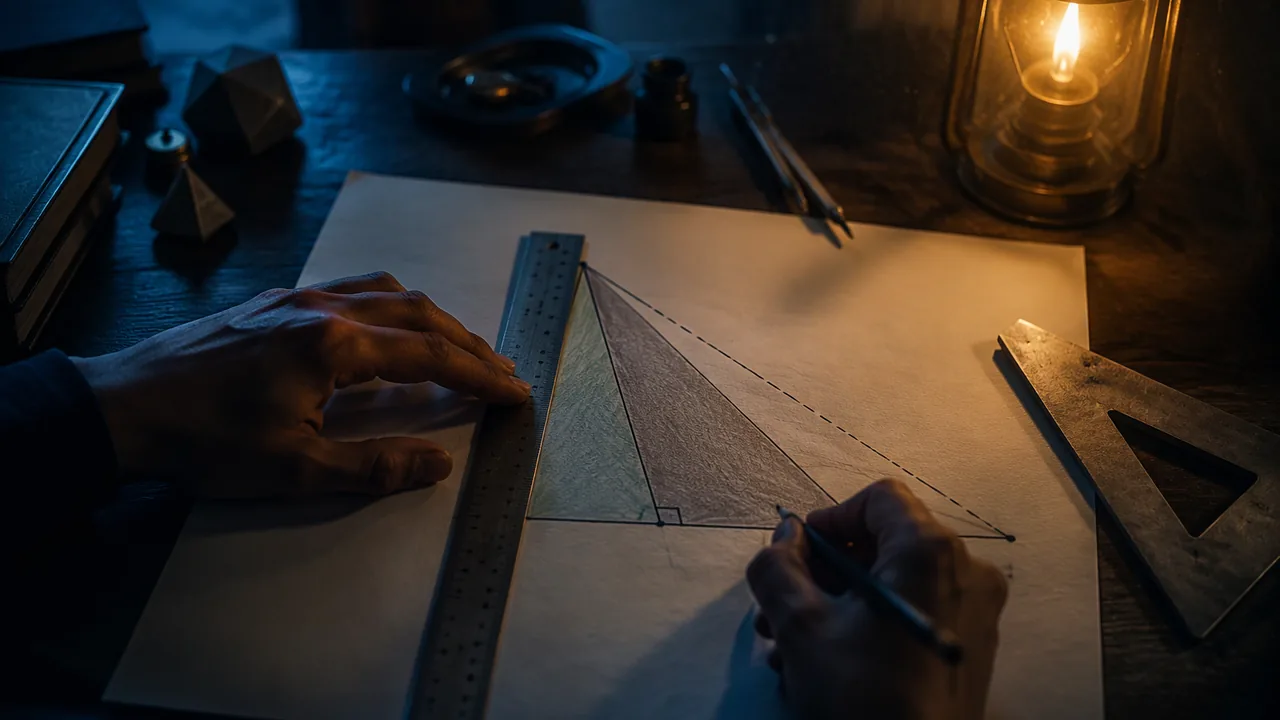
Area. In ▵ABC, let a = BC and b = AC, with angle C between them (acute, for now). Draw the altitude from B perpendicular to line AC, with length h. In the right triangle that contains angle C, the side opposite C is h and the hypotenuse is a, so sin C = h/a and h = a sin C. The area of a triangle is ½ × base × height, with base b:
A = ½ ab sin C.
In words: half the product of two sides times the sine of the angle between them. Example: two sides are 8 and 11 with a 40° angle between them. A = ½ × 8 × 11 × sin 40° ≈ 44 × 0.6428 ≈ 28.28 square units. Check the special case C = 90°: sin 90° = 1 and the formula becomes ½ab, the familiar right-triangle area.
The Law of Sines. The same altitude, computed two ways, gives a proof. Draw the altitude h from C to side AB. From the right triangle containing A, h = b sin A. From the right triangle containing B, h = a sin B. So b sin A = a sin B, and dividing by sin A sin B:
a / sin A = b / sin B, and by the same argument with another altitude, = c / sin C.
Each side is proportional to the sine of the angle opposite it. This is the precise version of Unit 2’s fact that longer sides face larger angles.
Example. In ▵ABC, A = 40°, B = 65° and a = 10. Then C = 180° − 40° − 65° = 75°.
- b = a sin B / sin A = 10 sin 65° / sin 40° ≈ 10 × 0.9063 / 0.6428 ≈ 14.10
- c = 10 sin 75° / sin 40° ≈ 15.03
Check the order: the largest angle, 75°, faces the longest side, 15.03.
When the Law of Sines is enough. It works when you know an angle and the side opposite it, plus one more piece: two angles and any side (AAS or ASA) always determine the triangle. Two sides and a non-included angle (SSA) may give two triangles, one or none. That is the ambiguous case, and it is the same failure of SSA you saw in Lesson 2.2.
Discourse task. The proof above assumed angles A and B are acute, so the altitude falls inside the triangle. Your group’s job: draw the case where angle A is obtuse, find where the altitude falls, and decide whether the argument still works. (It does, once sine is extended to obtuse angles so that sin A equals the sine of its supplement; your calculator already uses that extension. You will study it properly in a later course.) Present your group’s diagram and reasoning, and critique one other group’s.
📖 Read for this lesson
The reading opens over the lesson; close it to come back to exactly where you were. The checks below draw on it.
Formative check
Work through these before moving on. They are not graded — they tell you whether the standard below has landed yet.
Two sides of a triangle are 8 and 11, with a 40° angle between them. What is the area, to the nearest hundredth?
In the proof of the Law of Sines, the altitude from C equals b sin A and also sin B.
In triangle ABC with A = 40°, B = 65° and a = 10, side c is the longest side.
Explain in a paragraph proof why the area formula ½ab sin C and the Law of Sines both come from the same altitude. Then use the Law of Sines to find b when A = 50°, B = 70° and a = 12, rounding only at the end.
How confident are you that you can derive the sine area formula and prove and use the Law of Sines?
Practice
Work these on paper or in your notebook, then open Check your answer. Aim for all of Fluency and Application; try at least one Challenge.
Printable version: this unit’s practice workbook (PDF)
Fluency
Build speed and accuracy with the core skill.
- Find the area of a triangle with sides 9 and 14 and an included angle of 35°. Round to the nearest tenth.
Check your answer
Answer: 36.1½(9)(14) sin 35°. - Find the area of a triangle with sides 12 and 12 and an included angle of 120°. Round to the nearest tenth.
Check your answer
Answer: 62.4½(12)(12) sin 120°. - Find the area of a triangle with sides 7 and 10 and an included angle of 58°. Round to the nearest tenth.
Check your answer
Answer: 29.7½(7)(10) sin 58°. - In ▵ABC, A = 35°, B = 80° and a = 12. Find C, b and c to the nearest tenth.
Check your answer
Answer: C = 65°; b ≈ 20.6; c ≈ 19.0b = 12 sin 80° / sin 35°; c = 12 sin 65° / sin 35°. - In ▵ABC, A = 48°, B = 62° and a = 20. Find C, b and c to the nearest tenth.
Check your answer
Answer: C = 70°; b ≈ 23.8; c ≈ 25.3b = 20 sin 62° / sin 48°; c = 20 sin 70° / sin 48°. - In ▵ABC, A = 25°, B = 110° and a = 9. Find C, b and c to the nearest tenth.
Check your answer
Answer: C = 45°; b ≈ 20.0; c ≈ 15.1b = 9 sin 110° / sin 25°; c = 9 sin 45° / sin 25°.
Application
Use the skill in context. Show your reasoning.
- (Illustrative.) A triangular lot has two sides of 40 m and 55 m meeting at a 72° corner. Find its area to the nearest square meter.
Check your answer
Answer: 1,046 m2½(40)(55) sin 72°. - Two lookout towers 8 km apart both see a fire. The angle at tower A between the line to tower B and the fire is 52°; at tower B it is 61°. How far is the fire from tower A?
Check your answer
Answer: about 7.60 kmThe angle at the fire is 180° − 52° − 61° = 67°. The side from A to the fire faces the 61° angle: 8 sin 61° / sin 67°. - A triangle has A = 30°, a = 5 and b = 8. How many triangles are possible? Explain with the height from C.
Check your answer
Answer: Two triangles.The height is b sin A = 8 × 0.5 = 4. Since 4 < 5 < 8, side a can meet the other ray in two places (the ambiguous case).
Challenge
Stretch problems. Expect to think before you write.
- Derive the Law of Sines for ▵ABC with acute angles A and B, using the altitude from C.
Check your answer
Answer: a/sin A = b/sin BModel proof. Let h be the altitude from C to AB. In the right triangle containing A, sin A = h/b, so h = b sin A. In the right triangle containing B, h = a sin B. So b sin A = a sin B; divide by sin A sin B.
Review
Keep earlier skills sharp.
- Triangle ABC is similar to triangle DEF. AB = 24 and the corresponding side DE = 12. If BC = 18, find EF, and the ratio of the triangles’ areas.
Check your answer
Answer: EF = 9; area ratio (DEF : ABC) = 1/4The scale factor is 12/24 = 1/2; areas scale by its square. - A 30-60-90 triangle has shorter leg 7. Find the hypotenuse and the longer leg.
Check your answer
Answer: 14 and 7√3
Two Students Argue the Obtuse Case, and Three SSA Data Sets
Constructed teaching material written for this course: a specific obtuse triangle for the discourse task with two competing arguments about it, three two-sides-and-an-angle data sets that produce two, one and no triangles, and the numbers the lesson’s problems must reproduce · SLS original (constructed teaching data)
Why this reading. The discourse task asks your group to draw the case where angle A is obtuse and decide whether the Law of Sines proof still works. A drawing alone will start an argument without finishing it. Here is a specific obtuse triangle with its measurements, two students’ arguments about it, and three SSA data sets so that the ambiguous case is something you compute rather than something you are told about. All numbers are constructed for this course.
The obtuse triangle
∠A = 120°, ∠B = 25°, ∠C = 35°, b = AC = 10. By the Law of Sines, a = 10 sin 120° / sin 25° ≈ 20.49 and c = 10 sin 35° / sin 25° ≈ 13.57. The altitude from C to line AB has length h. Because ∠A is obtuse, the foot of that altitude lies on the extension of BA beyond A, outside the triangle, and the right triangle it forms with A has an angle of 180° − 120° = 60° at A.
Student 1. “The proof said h = b sin A. But the right triangle at A has a 60° angle, not 120°, so h = b sin 60°. The proof used the wrong angle; it fails for obtuse triangles, and the Law of Sines has only been proved for acute ones.”
Student 2. “h = 10 sin 60° = 8.660, and h = a sin B = 20.49 sin 25° = 8.660. The two expressions for h still agree. The calculator gives sin 120° = 0.8660 = sin 60°, so b sin A and b sin 60° are the same number, and every line of the proof stands.”
Your group decides: which student has correctly identified what the proof depends on? What single fact, if adopted as a definition for obtuse angles, makes Student 2’s argument a proof rather than a calculator observation? State that fact in one sentence and say why the acute-case proof did not need it.
Three SSA data sets
In each, two sides and the angle opposite one of them are given. Use the Law of Sines to find the other angle, and count the triangles.
| Set | a | b | ∠A | sin B = b sin A / a | Triangles |
|---|---|---|---|---|---|
| 1 | 6 | 10 | 30° | 0.8333 | ? |
| 2 | 4 | 10 | 30° | 1.25 | ? |
| 3 | 12 | 10 | 30° | 0.4167 | ? |
Set 1, worked. sin B = 0.8333 gives B ≈ 56.44° or its supplement 123.56°, and both leave room for C: C ≈ 93.56° or 26.44°. Then c = a sin C / sin A = 12 sin C, which is 11.977 or 5.344. Two triangles. These are the same two triangles as the SSA counterexample in Lesson 2.2, seen from the Law of Sines instead of from a compass. Set 2: a sine cannot exceed 1. Set 3: find B and its supplement, then ask whether A plus the supplement leaves anything for C.
Numbers the lesson’s problems must reproduce
| Problem | Given | Result |
|---|---|---|
| Area | sides 8 and 11, included angle 40° | ½ · 8 · 11 · sin 40° = 44 × 0.6428 = 28.28 |
| Area, obtuse included angle | sides 7 and 9, included angle 130° | ½ · 63 · sin 130° = 31.5 × 0.7660 = 24.13 |
| Law of Sines | A = 40°, B = 65°, a = 10 | b = 14.10, c = 15.03 |
| Open question | A = 50°, B = 70°, a = 12 | b = 12 sin 70° / sin 50° = 12 × 0.9397 / 0.7660 = 14.72 |
For the second area row, draw the triangle: the altitude from the end of the 7 side to the line of the 9 side falls outside the triangle, exactly as in the obtuse case above, and the formula still gives the area. Confirm it by computing the same area from the other two sides once you have found them with the Law of Cosines in Lesson 4.4, or by splitting the figure into a large right triangle minus a small one.
What to present
Your group’s diagram of the obtuse case with h, the 60° angle and both expressions for h labeled with their values; your verdict on the two students in two sentences; and the triangle count for the three SSA sets with the sine value that decided each.