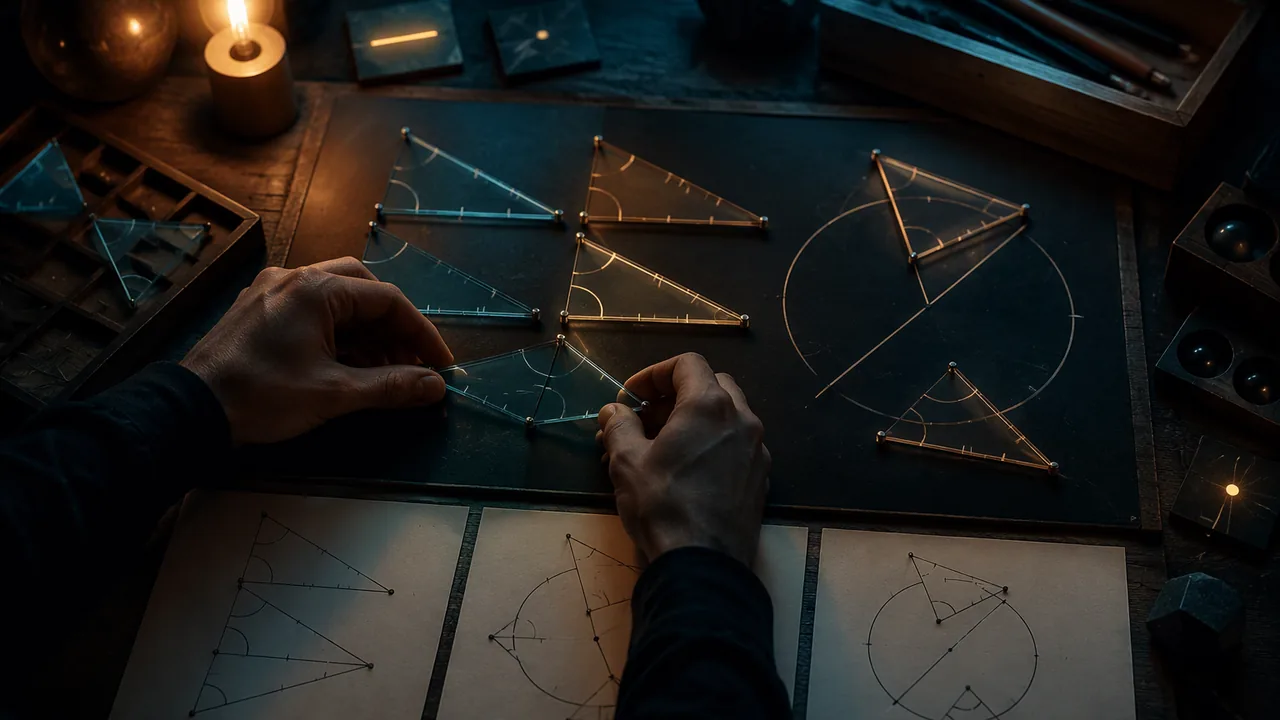
explain how SAS, ASA and SSS follow from rigid motions, show why SSA fails, and write the same congruence proof in two-column, paragraph and flow formats.
Instruction
Checking six pairs of parts is slow. The congruence criteria say three well-chosen pairs are enough.
SAS (side-angle-side). If AB = DE, ∠A = ∠D and AC = DF, then ▵ABC ≅ ▵DEF. Why: this is exactly the converse argument from Lesson 2.1. Translate A to D, rotate so B lands on E (AB = DE), reflect across DE if needed so ray AC falls on ray DF (∠A = ∠D), and C lands on F (AC = DF). Every vertex matches, so the triangles are congruent.
ASA (angle-side-angle). If ∠A = ∠D, AB = DE and ∠B = ∠E: move A to D and B to E as before. The equal angles force ray AC onto ray DF and ray BC onto ray EF. Two rays from D and E meet in only one point, so C must land on F.
SSS (side-side-side). Move A to D and B to E, and reflect if needed so C and F are on the same side of DE. C and F are both at distance AC = DF from D and at distance BC = EF from E. If C ≠ F, then D and E would both be on the perpendicular bisector of CF, making line DE that bisector; but C and F on the same side of DE is impossible for a point and its reflection. So C = F.
SSA fails. Let AB = 10, ∠A = 30° and BC = 6. The distance from B to the other side of the angle is 10 sin 30° = 5, which is less than 6, so a circle of radius 6 around B crosses that side twice. One triangle has AC ≈ 11.98, the other AC ≈ 5.34. Same two sides and a non-included angle, two different triangles: SSA is not a criterion.
One proof, three formats. Given: AB ≅ CB and ray BD bisects ∠ABC, with D on AC. Prove: ▵ABD ≅ ▵CBD.
Two-column.
| Statement | Reason |
|---|---|
| 1. AB ≅ CB | Given |
| 2. BD bisects ∠ABC | Given |
| 3. ∠ABD ≅ ∠CBD | Definition of angle bisector |
| 4. BD ≅ BD | A segment is congruent to itself |
| 5. ▵ABD ≅ ▵CBD | SAS (1, 3, 4) |
Paragraph. We are given AB ≅ CB. Since BD bisects ∠ABC, ∠ABD ≅ ∠CBD by the definition of an angle bisector. Segment BD is a side of both triangles. So two sides and the included angle of ▵ABD are congruent to the corresponding parts of ▵CBD, and the triangles are congruent by SAS.
Flow. Each box holds a statement with its reason underneath; arrows show which statements a conclusion depends on.
All three formats contain the same logic. Choose the one that makes the dependencies clearest to your reader.
📖 Read for this lesson
The reading opens over the lesson; close it to come back to exactly where you were. The checks below draw on it.
Formative check
Work through these before moving on. They are not graded — they tell you whether the standard below has landed yet.
Why is SSA not a congruence criterion?
In SAS, the angle must be the angle, formed by the two given sides. In ASA, the side must be the side.
A flow proof and a two-column proof of the same theorem can contain exactly the same statements and reasons.
Given: M is the midpoint of segment AB and of segment CD. Prove △AMC ≅ △BMD. Write the proof as a two-column proof, then rewrite it as a paragraph proof.
How confident are you that you can explain why SAS, ASA and SSS work and write a congruence proof in three formats?
Practice
Work these on paper or in your notebook, then open Check your answer. Aim for all of Fluency and Application; try at least one Challenge.
Printable version: this unit’s practice workbook (PDF)
Fluency
Build speed and accuracy with the core skill.
- Given AB = DE, BC = EF and CA = FD. Which criterion, if any, proves ▵ABC ≅ ▵DEF?
Check your answer
Answer: SSS - Given AB = DE, ∠B = ∠E and BC = EF. Which criterion, if any?
Check your answer
Answer: SAS (∠B is between the two sides) - Given ∠A = ∠D, AB = DE and ∠B = ∠E. Which criterion, if any?
Check your answer
Answer: ASA - Given AB = DE, BC = EF and ∠A = ∠D. Which criterion, if any?
Check your answer
Answer: None: this is SSA, which does not guarantee congruence. - Given ∠A = ∠D, ∠B = ∠E and ∠C = ∠F. Which criterion, if any?
Check your answer
Answer: None: equal angles give similar, not necessarily congruent, triangles. - Given ∠A = ∠D, ∠B = ∠E and BC = EF. Which criterion, if any?
Check your answer
Answer: ASA (after using the angle sum to show ∠C = ∠F); this combination is often called AAS.The third angles are equal because each is 180° minus the same sum; then ∠B, BC, ∠C is ASA. - M is the midpoint of both AB and CD. Which criterion proves ▵AMC ≅ ▵BMD, and what are the three pairs?
Check your answer
Answer: SAS: AM = BM, ∠AMC = ∠BMD (vertical angles), CM = DM. - In kite ABCD, AB = AD and CB = CD. Which criterion proves ▵ABC ≅ ▵ADC?
Check your answer
Answer: SSS, using the shared side AC.
Application
Use the skill in context. Show your reasoning.
- Complete the proof. Given: AB ≅ CB and D is the midpoint of AC. Prove: ▵ABD ≅ ▵CBD. Write a two-column proof.
Check your answer
Answer: ▵ABD ≅ ▵CBD by SSS.Model proof. 1. AB ≅ CB (Given). 2. D is the midpoint of AC (Given). 3. AD ≅ CD (Definition of midpoint). 4. BD ≅ BD (Same segment). 5. ▵ABD ≅ ▵CBD (SSS: 1, 3, 4). - Identify the flaw. “Given AB = DE, AC = DF and ∠B = ∠E. So ▵ABC ≅ ▵DEF by SAS.”
Check your answer
Answer: The angle is not included: ∠B is not between AB and AC. The given is SSA, so the conclusion does not follow.SAS needs the angle formed by the two given sides. Here that would be ∠A. - Complete the proof. Given: M is the midpoint of AB and of CD. Prove: AC ≅ BD. Write it as a paragraph proof.
Check your answer
Answer: AC ≅ BD by CPCTC after SAS.Model proof. Since M is the midpoint of AB, AM = BM; since it is the midpoint of CD, CM = DM. Angles AMC and BMD are vertical angles, so they are congruent. By SAS, ▵AMC ≅ ▵BMD, and corresponding parts AC and BD are congruent.
Challenge
Stretch problems. Expect to think before you write.
- Show that SSA fails with numbers: AB = 8, ∠A = 40° and BC = 6. Find both possible lengths of AC to the nearest hundredth. (Use your calculator for sin and cos; they are formally introduced in Unit 4.)
Check your answer
Answer: AC ≈ 9.22 or AC ≈ 3.04The distance from B to the other ray is 8 sin 40° ≈ 5.14, which is less than 6, so the circle of radius 6 around B meets the ray twice. The foot of the perpendicular is 8 cos 40° ≈ 6.13 from A, and each intersection is √(36 − 5.142) ≈ 3.09 from the foot.
Review
Keep earlier skills sharp.
- Find the image of (−8, 7) under a rotation of 180° about the origin.
Check your answer
Answer: (8, −7) - Find the image of (7, 1) under a reflection over the line y = x.
Check your answer
Answer: (1, 7) - Construct (describe) the perpendicular bisector of a segment and say why every point on it is equidistant from the endpoints.
Check your answer
Answer: Circles centered at each endpoint through the other meet at P and Q; line PQ is the bisector. A reflection across it swaps the endpoints and fixes each of its points.
The Critique Casefile: Counterexamples With Coordinates, the Repaired Hypotheses and the Date Rule
Constructed teaching material written for this course: numerical counterexamples to the two false claims among the portfolio’s three flawed proofs, the repaired hypotheses for all three, the date-rule table and the reviewer’s checklist · SLS original (constructed teaching data)
Why this reading. The lesson prints three flawed proofs and says that two of the three claims are false as written and that “saying so, with a counterexample, is part of a strong critique.” A counterexample has to be a specific figure, not a sketch. Here is one for each false claim, given by coordinates so your partner can check every length, plus the repaired hypotheses under which each conclusion really does follow. The date-rule table and the reviewer’s checklist are at the end.
Flawed Proof A: the claim is true; the proof is circular
Alternate interior angles formed by parallel lines are congruent, so there is no counterexample. The defect is in the reasoning: step 2 assumes ∠3 ≅ ∠5 in order to conclude that m ∥ n, which was given, and then uses that to conclude ∠3 ≅ ∠5. The dependency map has a loop of length one. Repair: the 180° rotation proof from Lesson 2.3, about the midpoint of the segment of t between the two lines. To test any version of the repaired proof, take the transversal to make 65° with m; the alternate interior angle at n must come out 65° and its neighbors 115°.
Flawed Proof B: SSA. The claim is false
Two triangles with AB = 10, BC = 6 and ∠A = 30° that are not congruent. Put A at (0, 0) and the ray from A along the positive x-axis. Then B = (10 cos 30°, 10 sin 30°) = (8.660, 5). C is on the x-axis at distance 6 from B, and the circle of radius 6 about B crosses the x-axis twice, at x = 8.660 ± √(36 − 25) = 8.660 ± 3.317:
| Triangle | A | B | C | AB | BC | ∠A | AC |
|---|---|---|---|---|---|---|---|
| 1 | (0, 0) | (8.660, 5) | (11.977, 0) | 10 | 6 | 30° | 11.977 |
| 2 | (0, 0) | (8.660, 5) | (5.344, 0) | 10 | 6 | 30° | 5.344 |
Same two sides, same non-included angle, third sides 11.977 and 5.344. The triangles are not congruent, so the “CPCTC” step concluding AC ≅ DF is false: one triangle is each of these, and 11.977 ≠ 5.344. Check BC in triangle 2 yourself: √((8.660 − 5.344)² + 5²) = √(10.996 + 25) = √35.996 ≈ 6. Repair: require the angle to be included (SAS), or require the angle to be a right angle (then SSA becomes the hypotenuse-leg case, which you can prove from the Pythagorean Theorem and SSS), or require the given angle to be opposite the longer of the two sides, which rules out the second crossing.
Flawed Proof C: one pair of parallel sides. The claim is false
P(0, 0), Q(6, 0), R(4, 3), S(1, 3). PQ and SR are both horizontal, so PQ ∥ SR. But PS = √(1 + 9) = √10 ≈ 3.162 and QR = √(4 + 9) = √13 ≈ 3.606, and their slopes are 3 and −3/2, so PS and QR are neither parallel nor equal. PQRS is a trapezoid, not a parallelogram. The proof’s step “in the figure PS and QR are also parallel” is an assumption read off a diagram that happened to be drawn that way. Repair: add the hypothesis PS ∥ QR (then it is a parallelogram by definition), or add PQ = SR (then prove it: draw diagonal PR, get ∠QPR = ∠SRP by alternate interior angles, and △PQR ≅ △RSP by SAS, so PS = QR and the alternate interior angles at the other diagonal force PS ∥ QR).
The date rule, worked
Divide the day of the month by 5 and add 1 to the remainder.
| Day | Remainder | Entry to defend |
|---|---|---|
| 1 | 1 | 2 |
| 5 | 0 | 1 |
| 14 | 4 | 5 |
| 23 | 3 | 4 |
| 30 | 0 | 1 |
| 31 | 1 | 2 |
Reviewer’s checklist for Stage 2
- Every step has a reason, and the reason is a definition, a postulate, a congruence criterion or a theorem with a smaller number in this portfolio.
- No reason is the word “diagram,” “figure,” “clearly” or “obviously.”
- Every congruence statement’s vertex order matches the correspondence the proof established; test one pair of corresponding sides.
- The triple-format proof (entry 4) has the same statements in all three formats; count them.
- The dependency map has no loop. Trace each arrow back to a definition or postulate.
- The critique names the step, the kind of defect, and includes a counterexample with coordinates where the claim is false.