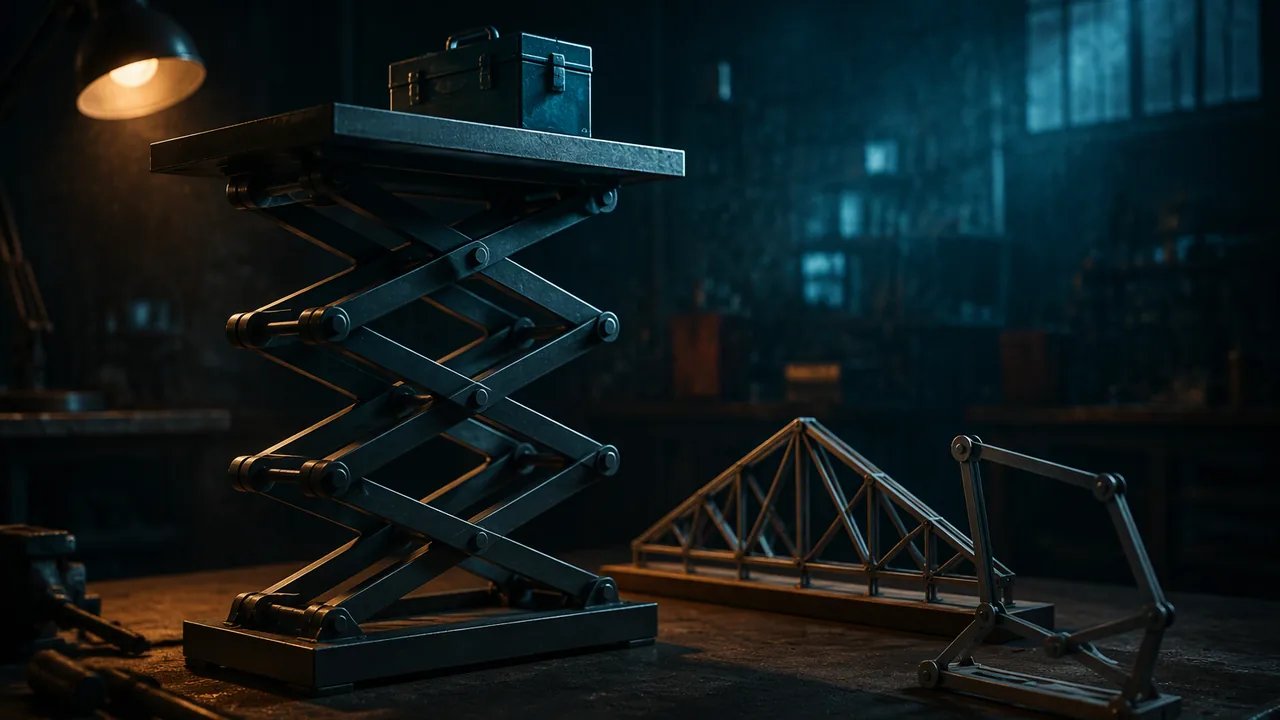
prove properties of parallelograms and triangles (including isosceles base angles, midsegments and medians) and apply them, with the triangle inequality, to linkages, trusses and balance points.
Instruction
Engineers use proved theorems because they hold every time. This workshop proves several and puts them to work.
Isosceles triangles. If AB = AC, then ∠B = ∠C. Proof: draw the bisector of ∠A meeting BC at D. ▵ABD ≅ ▵ACD by SAS (AB = AC, the bisected angles, AD shared), so ∠B = ∠C by CPCTC. Equivalently, reflection across the bisector swaps B and C.
Parallelograms. Let ABCD have AB ∥ DC and AD ∥ BC. Draw diagonal AC. Then ∠BAC = ∠DCA and ∠BCA = ∠DAC (alternate interior angles), and AC is shared, so ▵ABC ≅ ▵CDA by ASA. Therefore opposite sides are congruent (AB = CD, BC = DA) and opposite angles are congruent (∠B = ∠D). Let the diagonals meet at E. Now ▵ABE ≅ ▵CDE by ASA (alternate interior angles and AB = CD), so AE = CE and BE = DE: the diagonals bisect each other. Finally, a rectangle’s diagonals are congruent: in rectangle ABCD, ▵ABC ≅ ▵DCB by SAS (AB = DC, right angles at B and C, BC shared), so AC = DB.
Application: the scissor lift. A scissor lift and a pantograph lamp arm are built from linked parallelograms. As the joints move, each quadrilateral stays a parallelogram because its opposite bars have fixed equal lengths (a quadrilateral with both pairs of opposite sides congruent is a parallelogram). So the top bar always stays parallel to the base: the platform rises level.
Application: why trusses are triangles. By SSS, three fixed side lengths determine a triangle completely: a triangular frame cannot change shape. A four-bar frame can (a square can collapse into a rhombus with the same side lengths). That is why bridges and roofs are triangulated.
The triangle inequality. In any triangle, the sum of any two sides is greater than the third, and the larger angle is opposite the longer side. Could a triangular garden have sides 3 m, 5 m and 9 m? No: 3 + 5 = 8 < 9, so the two short sides cannot reach. For sides 5, 7 and 9, the angles are about 33.6°, 50.7° and 95.7° (you will be able to compute these in Unit 4). The largest angle is opposite the 9 m side, as the theorem predicts. Verify experimentally in GeoGebra: build a triangle, measure, and drag.
Midsegments and medians. The segment joining the midpoints of two sides is parallel to the third side and half as long. Proof sketch: in ▵ABC with midpoints D of AB and E of AC, extend DE to F with EF = DE. ▵ADE ≅ ▵CFE (SAS with vertical angles), so CF = AD = DB and CF ∥ AB. Then DBCF has a pair of opposite sides parallel and equal, so it is a parallelogram, and DE = ½DF = ½BC. Midsegments give a proof that the three medians meet at one point, the centroid, which is two-thirds of the way from each vertex to the opposite midpoint. A 12 cm median has the centroid 8 cm from the vertex. Cut a triangle from cardboard and it balances on its centroid.
📖 Read for this lesson
The reading opens over the lesson; close it to come back to exactly where you were. The checks below draw on it.
Formative check
Work through these before moving on. They are not graded — they tell you whether the standard below has landed yet.
Which set of lengths can form a triangle?
In triangle ABC, BC = 14. The midsegment joining the midpoints of AB and AC has length . A median of length 12 has the centroid units from the vertex.
A four-bar frame with fixed side lengths is rigid in the same way a triangle is.
Write a two-column proof that the diagonals of a parallelogram bisect each other. Then explain in a paragraph how this property (or another parallelogram property) makes a scissor lift, folding gate or pantograph lamp work.
Simulation & tools
Triangle inequality and midsegment experiment
Open a blank GeoGebra Geometry app.
- Draw triangle ABC with the Polygon tool. Display all three side lengths and all three angles.
- Drag C and record five triangles in a table: the three sides, the three angles, and which angle is largest. Check each time that the largest angle is opposite the longest side.
- Drag C toward segment AB until the triangle is almost flat. Record AC + CB and AB. What happens to AC + CB − AB?
- Use Midpoint or Center to mark midpoints D of AB and E of AC, and draw segment DE. Display DE and BC, and type
DE/BCin the input bar (use the names GeoGebra gives the segments). - Drag every vertex. Record whether the ratio changes and whether DE stays parallel to BC.
Answer: State the two triangle-inequality facts your table supports, and the midsegment fact your ratio supports. Which of these did we prove, and which have we only verified experimentally?
Without a device: cut straws or paper strips to lengths 3, 5, 7 and 9 cm and try to form triangles from every set of three; then draw a triangle, measure its midsegment and third side with a ruler.
Open GeoGebra ↗ · GeoGebra · free for non-commercial use
How confident are you that you can prove parallelogram and triangle properties and apply them to a real mechanism?
Practice
Work these on paper or in your notebook, then open Check your answer. Aim for all of Fluency and Application; try at least one Challenge.
Printable version: this unit’s practice workbook (PDF)
Fluency
Build speed and accuracy with the core skill.
- Two sides of a triangle are 7 and 12. What lengths are possible for the third side?
Check your answer
Answer: Greater than 5 and less than 19.12 − 7 < x < 12 + 7. - Which set can be the side lengths of a triangle: 4, 9, 13 or 6, 8, 13?
Check your answer
Answer: 6, 8, 134 + 9 = 13 is not greater than 13; 6 + 8 = 14 > 13. - A triangle has sides 5, 8 and 11. Name the largest and smallest angles by the sides they face.
Check your answer
Answer: Largest angle is opposite the side 11; smallest is opposite the side 5. - One angle of a parallelogram is 65°. Find the other three.
Check your answer
Answer: 115°, 65°, 115°Opposite angles are equal; consecutive angles are supplementary. - The diagonals of parallelogram ABCD meet at E. AE = 2x + 3 and EC = 5x − 9. Find AC.
Check your answer
Answer: AC = 22 (x = 4, AE = EC = 11) - The vertex angle of an isosceles triangle is 40°. Find each base angle.
Check your answer
Answer: 70°(180 − 40)/2. - In ▵ABC, BC = 14. Find the midsegment joining the midpoints of AB and AC.
Check your answer
Answer: 7 - A median of a triangle is 18 cm long. How far is the centroid from the vertex and from the midpoint?
Check your answer
Answer: 12 cm from the vertex; 6 cm from the midpoint.
Application
Use the skill in context. Show your reasoning.
- A scissor lift’s arms form parallelograms. Explain why the platform stays parallel to the base as the lift rises, naming the property you use.
Check your answer
Answer: Each linkage has both pairs of opposite bars congruent, so it stays a parallelogram; opposite sides of a parallelogram are parallel, so the top stays parallel to the bottom. - (Illustrative.) A triangular garden bed must have sides of 3 m and 5 m. Which of 1.5 m, 2.5 m, 7.5 m and 8.5 m could the third side be, and which of those makes the largest angle face the 5 m side?
Check your answer
Answer: 2.5 m or 7.5 m could work. Only 2.5 m makes the 5 m side the longest, so the largest angle faces it.The third side must be between 2 and 8 m. With 7.5 m, the largest angle faces the 7.5 m side. - Complete the proof. Given parallelogram ABCD with diagonal AC. Prove AB ≅ CD.
Check your answer
Answer: ▵ABC ≅ ▵CDA by ASA, so AB ≅ CD by CPCTC.Model proof. 1. AB ∥ DC, AD ∥ BC (Definition of parallelogram). 2. ∠BAC ≅ ∠DCA (Alternate interior angles, AB ∥ DC). 3. AC ≅ CA (Same segment). 4. ∠BCA ≅ ∠DAC (Alternate interior angles, AD ∥ BC). 5. ▵ABC ≅ ▵CDA (ASA: 2, 3, 4). 6. AB ≅ CD (CPCTC).
Challenge
Stretch problems. Expect to think before you write.
- Prove that the diagonals of a rectangle are congruent.
Check your answer
Answer: ▵ABC ≅ ▵DCB by SAS, so AC = DB.Model proof. In rectangle ABCD, AB = DC (opposite sides of a parallelogram), ∠ABC = ∠DCB = 90° (definition of rectangle), and BC is shared. By SAS, ▵ABC ≅ ▵DCB, and by CPCTC AC = DB.
Review
Keep earlier skills sharp.
- Find the image of (−3, −2) under a rotation of 270° counterclockwise about the origin.
Check your answer
Answer: (−2, 3) - Find the distance between (−8, 4) and (−9, −3), and the midpoint of the segment.
Check your answer
Answer: distance 5√2; midpoint (−17/2, 1/2) - A regular hexagon is inscribed in a circle of radius 9. Find its perimeter.
Check your answer
Answer: 54
Measurements for Four Mechanisms: A Scissor Lift, a Four-Bar Frame, a Truss Panel and a Balance Point
Constructed teaching data written for this course: bar lengths, joint coordinates and angles for four mechanisms, with the theorem each one depends on, plus the angle computation the lesson promises for the 5-7-9 triangle · SLS original (constructed teaching data)
Why this reading. The workshop’s output is “an analysis of a real mechanism,” and the open question asks how a parallelogram property makes a scissor lift, folding gate or pantograph work. You cannot analyze a mechanism without its dimensions. The four below are constructed for this course and labeled illustrative; the geometry in them is exactly what the theorems in the lesson describe. Every number can be checked with a ruler on graph paper, in GeoGebra, or with the Pythagorean Theorem.
1. Scissor lift (illustrative)
Each stage is two bars of length 60 cm pinned together at their midpoints, so the joints form a rhombus with side 30 cm. Let θ be the angle each bar makes with the horizontal. Then the stage height is 60 sin θ and its width is 60 cos θ; you can derive both from a right triangle whose hypotenuse is a bar.
| θ | Stage height (cm) | Stage width (cm) | Platform height, 3 stages (cm) |
|---|---|---|---|
| 20° | 20.52 | 56.38 | 61.56 |
| 40° | 38.57 | 45.96 | 115.71 |
| 60° | 51.96 | 30.00 | 155.88 |
The question to answer with a theorem: why does the platform stay level at every θ? The four joints of a stage are the vertices of a quadrilateral whose opposite sides are equal (each is half a bar). Which parallelogram theorem, or its converse, tells you the top joint-to-joint bar is parallel to the bottom one?
2. Four-bar frame versus triangle (illustrative)
A frame has bars of 4 m, √13 m (≈ 3.606 m), 4 m and √13 m, pinned at the corners. One position of its joints is (0, 0), (4, 0), (6, 3), (2, 3). Another position, with the same four bar lengths, is (0, 0), (4, 0), (7, 2), (3, 2). Verify both sets of side lengths, then explain in terms of SSS why a triangle with sides 4, √13 and √13 cannot do this.
3. A truss panel (illustrative)
Bottom chord joints at (0, 0), (4, 0), (8, 0) and (12, 0); top chord joints at (2, 3), (6, 3) and (10, 3); every diagonal joins a bottom joint to the nearest top joint. Each diagonal is √(2² + 3²) = √13 ≈ 3.606 m; each chord segment is 4 m. The truss is five triangles with sides 4, √13, √13: three standing on the bottom chord and two hanging from the top chord. Check the triangle inequality on that triple, then name the largest angle in each triangle without measuring, using the theorem in the lesson.
4. Balance point of a cardboard triangle (illustrative)
Vertices (0, 0), (9, 0) and (3, 6). Midpoints of the sides: (4.5, 0), (6, 3) and (1.5, 3).
- The midsegment from (1.5, 3) to (6, 3) has length 4.5 and is horizontal; the third side, from (0, 0) to (9, 0), has length 9 and is horizontal. Half as long and parallel, as the midsegment theorem says.
- The median from (0, 0) to (6, 3) has length √(36 + 9) = √45 ≈ 6.708. Two-thirds of the way along it is the point (4, 2), at distance √20 ≈ 4.472 from the vertex, and 4.472 / 6.708 = 0.667.
- Check that (4, 2) is also two-thirds of the way along the median from (9, 0) to (1.5, 3) and along the median from (3, 6) to (4.5, 0). It is the centroid, and it is the average of the three vertices: ((0 + 9 + 3)/3, (0 + 0 + 6)/3).
Cut this triangle from cardboard at 1 unit = 2 cm and it balances on a pencil point at (4, 2).
The 5-7-9 garden
The lesson gives the angles as about 33.6°, 50.7° and 95.7° and promises Unit 4 will let you compute them. For now, verify the theorem the lesson states: the largest angle, 95.7°, is opposite the longest side, 9; the smallest, 33.6°, is opposite 5. Also confirm the three add to 180°. Then apply the triangle inequality to these proposed garden borders and say which ones are impossible: (3, 5, 9), (4, 4, 8), (5, 7, 9), (2, 3, 6), (6, 6, 11).
What the analysis must contain
Choose one of mechanisms 1 to 3. State the theorem it relies on, prove that theorem (two-column, as the open question asks, for the diagonals of a parallelogram), and then write a paragraph that names the specific segments in the mechanism that play the roles of the segments in your proof. A mechanism analysis that never points at a real bar is not an analysis.