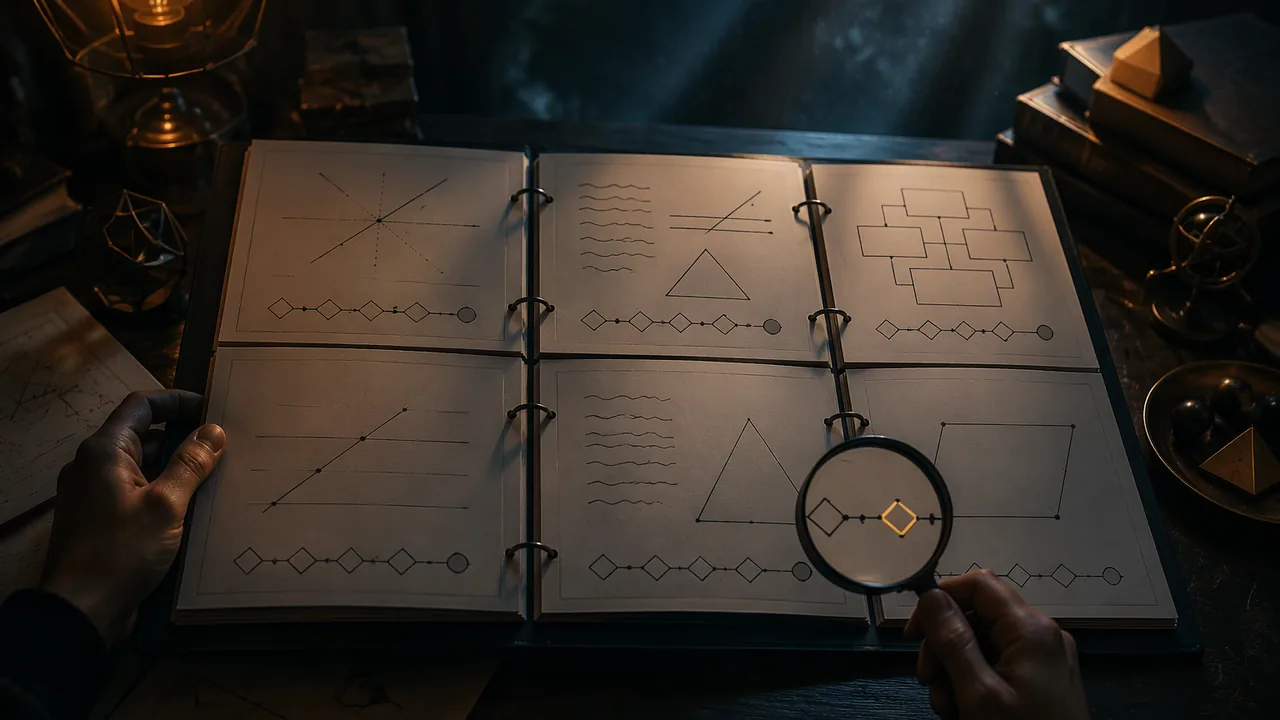
assemble, revise and defend a portfolio of formal proofs in two-column, paragraph and flow formats, including a critique of an invalid proof.
Instruction
A proof portfolio is evidence that you can do what mathematicians do: build a chain of reasoning in which every link is justified, and check someone else’s chain for weak links.
Contents. Six entries:
- Vertical angles are congruent.
- Alternate interior angles formed by parallel lines are congruent (using the 180° rotation argument).
- The triangle angle sum is 180°.
- Base angles of an isosceles triangle are congruent, in all three formats: two-column, paragraph and flow.
- One parallelogram theorem of your choice (opposite sides, opposite angles, diagonals bisect each other, or rectangle diagonals congruent).
- A critique. Choose one of the three flawed proofs printed below; all three earn full credit and all three are about equally hard. Identify the flawed step, explain precisely why it fails (circular reasoning, SSA, an assumption read from the diagram, a mismatched correspondence), and write a correct proof of a statement that is actually true.
Across entries 1-5, use each format at least twice.
The three flawed proofs. Choose one.
Flawed Proof A. Claim: if parallel lines m and n are cut by transversal t, then alternate interior angles ∠3 and ∠5 are congruent. Proof: ∠3 and ∠5 are alternate interior angles formed by m, n and t. Since ∠3 ≅ ∠5, the lines m and n are parallel, by the converse of the alternate interior angles theorem. Because m ∥ n, alternate interior angles are congruent, so ∠3 ≅ ∠5. ■
Flawed Proof B. Claim: in triangles ABC and DEF, AB ≅ DE, BC ≅ EF and ∠A ≅ ∠D; therefore △ABC ≅ △DEF. Proof: two pairs of sides are congruent and a pair of angles is congruent, so the triangles are congruent by SSA. Therefore AC ≅ DF by CPCTC. ■
Flawed Proof C. Claim: quadrilateral PQRS has PQ ∥ SR; therefore PQRS is a parallelogram. Proof: PQ ∥ SR is given. In the figure PS and QR are also parallel. A quadrilateral with both pairs of opposite sides parallel is a parallelogram, so PQRS is a parallelogram. ■
For your repair, state a set of hypotheses under which the conclusion really does follow, and prove it from those. Two of these three claims are false as written, and saying so, with a counterexample, is part of a strong critique.
Order matters. Put your proofs in logical order and give each one a number. A reason may cite only definitions, postulates, the congruence criteria and theorems with smaller numbers. In the portfolio’s opening page, draw a dependency map: an arrow from each theorem to every later theorem that uses it. If your map has a loop, you have circular reasoning somewhere.
Diagrams. Draw a labeled diagram for every proof, in GeoGebra or by hand. Mark given information with tick marks and arcs. But never use the diagram as a reason: two segments that look equal are not equal until a reason says so.
Medians (extension). For a stronger portfolio, add a seventh proof: the medians of a triangle meet at a point. Use the midsegment theorem twice and the fact that the diagonals of a parallelogram bisect each other.
Peer review. Your partner reads each proof with one question: “What justifies this step, and was that justified first?” They mark any step without a reason, any reason that cites a later theorem, and any vertex-order mismatch. You respond to every mark in a revision note.
Oral defense. Five minutes, live or recorded. The point is that you cannot choose the easiest proof, so pick the entry by a rule instead: take the day of the month on which you record or present, divide it by 5, and add 1 to the remainder. That number, from 1 to 5, is the entry you defend. Prove it without notes, then answer two questions, such as “Would this proof still work if the lines were not parallel?” and “Which earlier theorem does this one depend on?” If you present live, your reviewer may name a different entry; the task is the same either way. A live conference is available if recording is difficult.
📖 Read for this lesson
The reading opens over the lesson; close it to come back to exactly where you were. The checks below draw on it.
Formative check
Work through these before moving on. They are not graded — they tell you whether the standard below has landed yet.
Reason for ‘angles 1 and 2 sum to 180°’ when they form a straight line
Tap to revealLinear pair (angles on a line sum to 180°).
Reason used to prove base angles of an isosceles triangle congruent
Tap to revealSAS on the two halves made by the angle bisector, then CPCTC.
Warning sign of circular reasoning
Tap to revealA loop in your dependency map.
What a diagram can and cannot do in a proof
Tap to revealIt can show given information; it can never justify a step.
A proof says: ‘AB and AC look equal in the diagram, so angle B = angle C.’ What is wrong?
Stage 1 plan: list your six entries in logical order with the format for each, and draw (or describe) your dependency map. Name which entries each later proof relies on.
How confident are you that you can write, order, critique and defend formal proofs in three formats?
Unit 2 checkpoint
Do this before you start the task. It covers the whole unit and tells you what to review first.
Which information does NOT guarantee two triangles are congruent?
If △ABC ≅ △PQR, then AC = PR.
M is the midpoint of AB and CD. Which criterion proves △AMC ≅ △BMD?
Vertical angles measure (3x + 5)° and (5x − 15)°. The angle measures °.
Alternate interior angles formed by parallel lines are (2x + 30)° and (4x − 10)°. Then x = .
The angles of a triangle are x, x + 20 and 2x. What is the largest angle?
Using the triangle angle sum to prove the alternate interior angle theorem is valid in this course’s order of proofs.
P is on the perpendicular bisector of AB and PA = 12. Then PB = .
Which set of lengths can form a triangle?
One angle of a parallelogram is 72°. Its consecutive angle is °.
The base angles of an isosceles triangle with a 50° vertex angle each measure °.
A median is 21 cm. How far is the centroid from the vertex?
Every parallelogram has congruent diagonals.
Submit: Formal Proof Portfolio (six proofs, dependency map, critique) and oral defense
Task: Prove five theorems about lines, angles, triangles and parallelograms, using two-column, paragraph and flow formats (one theorem in all three), and critique and repair an invalid proof. Organize the proofs in logical order with a dependency map, then defend one proof orally.
Submission workflow
- Stage 1 — Plan. Choose your parallelogram theorem and which of the three flawed proofs you will critique, assign a format to each entry, and draw the dependency map.
- Stage 2 — Peer-reviewed draft. Complete drafts of all six entries; a partner marks unjustified steps, circular dependencies and correspondence errors. Submit a revision note.
- Stage 3 — Revised final. Portfolio with numbered proofs, diagrams, dependency map and critique.
- Stage 4 — Oral defense. Prove the entry the date rule selects and answer two questions (live, recorded or in conference).
How it is scored
| Criterion | What proficient looks like |
|---|---|
| Validity (G.CO.C.8, G.CO.C.9) | Every step is justified by a definition, postulate, criterion or earlier theorem; no circular reasoning. |
| Parallelogram theorem (G.CO.C.10) | Correct and complete proof of the chosen property. |
| Formats (MP.3) | Two-column, paragraph and flow formats each used correctly; the triple-format proof is logically identical across formats. |
| Critique (MP.3) | Flaw located precisely, explained, and repaired with a valid proof. |
| Precision (MP.6) | Correct notation, vertex correspondences and labeled diagrams. |
| Defense | Proof reproduced accurately and questions answered with reasons. |
The Critique Casefile: Counterexamples With Coordinates, the Repaired Hypotheses and the Date Rule
Constructed teaching material written for this course: numerical counterexamples to the two false claims among the portfolio’s three flawed proofs, the repaired hypotheses for all three, the date-rule table and the reviewer’s checklist · SLS original (constructed teaching data)
Why this reading. The lesson prints three flawed proofs and says that two of the three claims are false as written and that “saying so, with a counterexample, is part of a strong critique.” A counterexample has to be a specific figure, not a sketch. Here is one for each false claim, given by coordinates so your partner can check every length, plus the repaired hypotheses under which each conclusion really does follow. The date-rule table and the reviewer’s checklist are at the end.
Flawed Proof A: the claim is true; the proof is circular
Alternate interior angles formed by parallel lines are congruent, so there is no counterexample. The defect is in the reasoning: step 2 assumes ∠3 ≅ ∠5 in order to conclude that m ∥ n, which was given, and then uses that to conclude ∠3 ≅ ∠5. The dependency map has a loop of length one. Repair: the 180° rotation proof from Lesson 2.3, about the midpoint of the segment of t between the two lines. To test any version of the repaired proof, take the transversal to make 65° with m; the alternate interior angle at n must come out 65° and its neighbors 115°.
Flawed Proof B: SSA. The claim is false
Two triangles with AB = 10, BC = 6 and ∠A = 30° that are not congruent. Put A at (0, 0) and the ray from A along the positive x-axis. Then B = (10 cos 30°, 10 sin 30°) = (8.660, 5). C is on the x-axis at distance 6 from B, and the circle of radius 6 about B crosses the x-axis twice, at x = 8.660 ± √(36 − 25) = 8.660 ± 3.317:
| Triangle | A | B | C | AB | BC | ∠A | AC |
|---|---|---|---|---|---|---|---|
| 1 | (0, 0) | (8.660, 5) | (11.977, 0) | 10 | 6 | 30° | 11.977 |
| 2 | (0, 0) | (8.660, 5) | (5.344, 0) | 10 | 6 | 30° | 5.344 |
Same two sides, same non-included angle, third sides 11.977 and 5.344. The triangles are not congruent, so the “CPCTC” step concluding AC ≅ DF is false: one triangle is each of these, and 11.977 ≠ 5.344. Check BC in triangle 2 yourself: √((8.660 − 5.344)² + 5²) = √(10.996 + 25) = √35.996 ≈ 6. Repair: require the angle to be included (SAS), or require the angle to be a right angle (then SSA becomes the hypotenuse-leg case, which you can prove from the Pythagorean Theorem and SSS), or require the given angle to be opposite the longer of the two sides, which rules out the second crossing.
Flawed Proof C: one pair of parallel sides. The claim is false
P(0, 0), Q(6, 0), R(4, 3), S(1, 3). PQ and SR are both horizontal, so PQ ∥ SR. But PS = √(1 + 9) = √10 ≈ 3.162 and QR = √(4 + 9) = √13 ≈ 3.606, and their slopes are 3 and −3/2, so PS and QR are neither parallel nor equal. PQRS is a trapezoid, not a parallelogram. The proof’s step “in the figure PS and QR are also parallel” is an assumption read off a diagram that happened to be drawn that way. Repair: add the hypothesis PS ∥ QR (then it is a parallelogram by definition), or add PQ = SR (then prove it: draw diagonal PR, get ∠QPR = ∠SRP by alternate interior angles, and △PQR ≅ △RSP by SAS, so PS = QR and the alternate interior angles at the other diagonal force PS ∥ QR).
The date rule, worked
Divide the day of the month by 5 and add 1 to the remainder.
| Day | Remainder | Entry to defend |
|---|---|---|
| 1 | 1 | 2 |
| 5 | 0 | 1 |
| 14 | 4 | 5 |
| 23 | 3 | 4 |
| 30 | 0 | 1 |
| 31 | 1 | 2 |
Reviewer’s checklist for Stage 2
- Every step has a reason, and the reason is a definition, a postulate, a congruence criterion or a theorem with a smaller number in this portfolio.
- No reason is the word “diagram,” “figure,” “clearly” or “obviously.”
- Every congruence statement’s vertex order matches the correspondence the proof established; test one pair of corresponding sides.
- The triple-format proof (entry 4) has the same statements in all three formats; count them.
- The dependency map has no loop. Trace each arrow back to a definition or postulate.
- The critique names the step, the kind of defect, and includes a counterexample with coordinates where the claim is false.