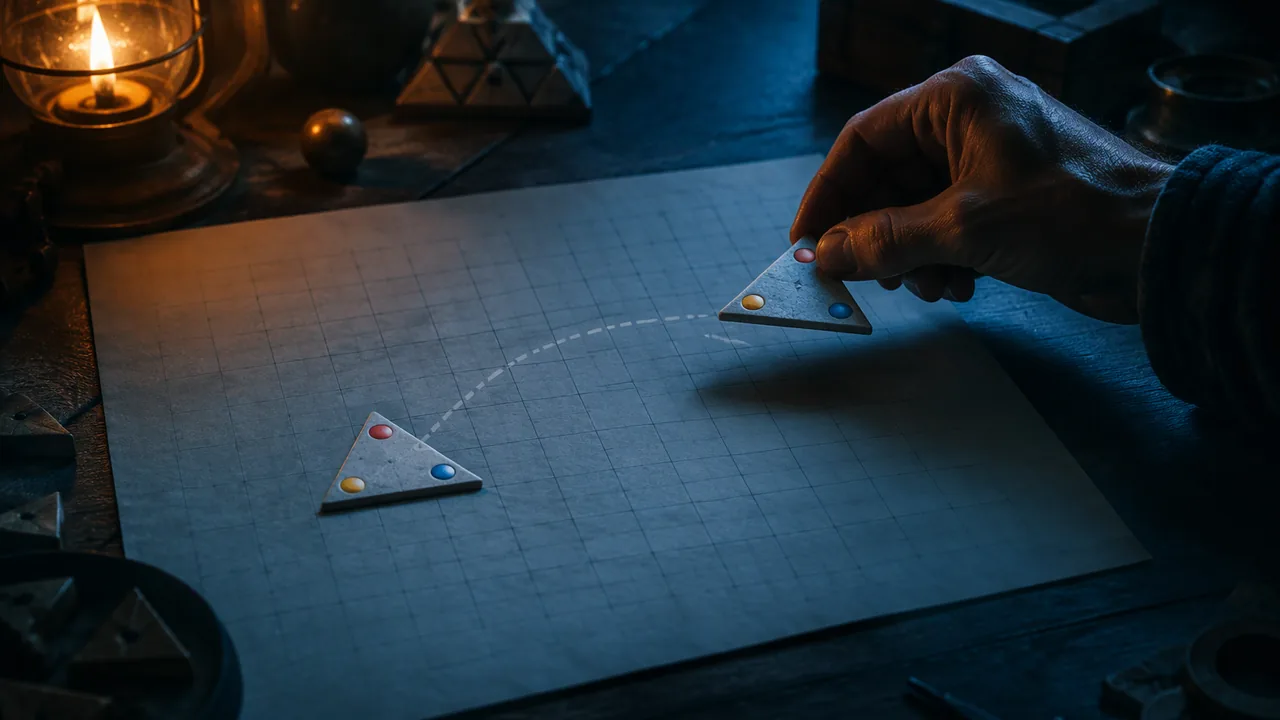
use the definition of congruence in terms of rigid motions to decide whether two figures are congruent, and explain why congruent triangles have all corresponding parts congruent, and conversely.
Instruction
Definition. Two figures are congruent if there is a sequence of rigid transformations (translations, rotations and reflections) that carries one figure exactly onto the other. We write ▵ABC ≅ ▵DEF, and the order of the letters matters: it says A goes to D, B to E and C to F.
This definition works for any shape, not just triangles. Two curved logos, two maps of the same state, two copies of a floor plan: if a sequence of rigid motions takes one onto the other, they are congruent. It also explains why we care. Rigid motions preserve distance and angle, so anything you can measure in one figure you can measure in its congruent copy and get the same answer.
Deciding congruence with coordinates. Triangle P has vertices (1, 1), (4, 1), (1, 3). Triangle Q has vertices (−1, 1), (−1, 4), (−3, 1). Are they congruent? From Lesson 1.3, a rotation of 90° counterclockwise about the origin, (x, y) → (−y, x), sends (1, 1) → (−1, 1), (4, 1) → (−1, 4) and (1, 3) → (−3, 1). One rigid motion carries P exactly onto Q, so they are congruent.
Now triangle R has vertices (0, 0), (6, 0), (0, 2). Its sides are 6, 2 and √40. Triangle P has sides 3, 2 and √13. No rigid motion can change a length, so no sequence can carry P onto R. They are not congruent. To show congruence, give a sequence. To show non-congruence, find a measurement that differs.
From the definition to corresponding parts. Suppose ▵ABC ≅ ▵DEF. Then some rigid motion takes A to D, B to E and C to F. Rigid motions preserve distance, so AB = DE, BC = EF and CA = FD. They preserve angle measure, so ∠A = ∠D, ∠B = ∠E and ∠C = ∠F. This is the justification behind the familiar shorthand CPCTC: corresponding parts of congruent triangles are congruent.
The converse. Now suppose all six pairs of corresponding parts are congruent. Is there a rigid motion carrying one triangle onto the other? Yes. Translate so that A lands on D. Rotate about D so that ray AB lies along ray DE; because AB = DE, B lands on E. Now C is either on F already or on the other side of line DE. If it is on the other side, reflect across line DE. Because ∠A = ∠D, the reflection sends ray AC onto ray DF, and because AC = DF, C lands on F. So the triangles are congruent.
Together, these two arguments prove an if and only if statement: two triangles are congruent if and only if all corresponding pairs of sides and angles are congruent. Notice that the converse argument did not really use all six facts. It used two sides and the angle between them. That observation is the seed of the next lesson.
Common error. “▵ABC ≅ ▵DEF” and “▵ABC ≅ ▵EDF” are different claims. Always match the vertex order to the correspondence you have shown.
📖 Read for this lesson
The reading opens over the lesson; close it to come back to exactly where you were. The checks below draw on it.
Formative check
Work through these before moving on. They are not graded — they tell you whether the standard below has landed yet.
Triangle P has vertices (1,1), (4,1), (1,3). Triangle Q has vertices (−1,1), (−1,4), (−3,1). Are they congruent?
What is the most efficient way to prove two figures are NOT congruent?
If △ABC ≅ △DEF, then BC = EF.
Write the converse argument in your own words: if all corresponding sides and angles of two triangles are congruent, describe the translation, rotation and possible reflection that carry one onto the other, and say which given fact each step uses.
How confident are you that you can use rigid motions to decide congruence and explain why corresponding parts of congruent triangles are congruent?
Practice
Work these on paper or in your notebook, then open Check your answer. Aim for all of Fluency and Application; try at least one Challenge.
Printable version: this unit’s practice workbook (PDF)
Fluency
Build speed and accuracy with the core skill.
- Find the distance between (4, −7) and (−8, 5), and the midpoint of the segment.
Check your answer
Answer: distance 12√2; midpoint (−2, −1) - Find the distance between (−1, 2) and (−8, 5), and the midpoint of the segment.
Check your answer
Answer: distance √58; midpoint (−9/2, 7/2) - Find the distance between (1, 2) and (0, −9), and the midpoint of the segment.
Check your answer
Answer: distance √122; midpoint (1/2, −7/2) - Triangle P has vertices (0, 0), (4, 0), (0, 3). Triangle Q has vertices (1, 1), (1, 5), (−2, 1). Are they congruent? If so, give a sequence of rigid motions.
Check your answer
Answer: Yes: rotate 90° counterclockwise about the origin, then translate by (x, y) → (x + 1, y + 1).Sides of both are 3, 4, 5. Rotation: (0,0)→(0,0), (4,0)→(0,4), (0,3)→(−3,0); translation gives (1,1), (1,5), (−2,1). - Triangle R has vertices (0, 0), (4, 0), (0, 4). Is it congruent to triangle P above? Justify.
Check your answer
Answer: No. R has a side of length 4√2 and P has none; rigid motions preserve length. - ▵ABC ≅ ▵KLM. Name the side congruent to CA and the angle congruent to ∠B.
Check your answer
Answer: MK; ∠LThe vertex order gives the correspondence A→K, B→L, C→M. - ▵DEF ≅ ▵XYZ with DE = 7, EF = 9, ∠F = 48°. Find YZ and ∠Z.
Check your answer
Answer: YZ = 9; ∠Z = 48° - A student writes ▵ABC ≅ ▵EDF after mapping A to D, B to E, C to F. What is wrong?
Check your answer
Answer: The vertex order does not match the correspondence; it should be ▵ABC ≅ ▵DEF.
Application
Use the skill in context. Show your reasoning.
- Two metal brackets are cut from sheet metal. One has corners at (0, 0), (6, 0), (6, 2) and (0, 2) cm on a template; the other at (10, 1), (10, 7), (8, 7), (8, 1). Show they are congruent with a single rigid motion or a sequence, and state it.
Check your answer
Answer: Rotate 90° counterclockwise about the origin, then translate 10 right and 1 up.Rotation sends (0,0),(6,0),(6,2),(0,2) to (0,0),(0,6),(−2,6),(−2,0); adding (10, 1) gives (10,1),(10,7),(8,7),(8,1). - Explain, using the definition of congruence, why two congruent triangles must have the same perimeter and the same area.
Check your answer
Answer: A rigid motion carries one onto the other and preserves every distance, so side lengths (hence perimeter) and the base-height pair (hence area) are preserved. - A tile pattern repeats a triangle with vertices (0, 0), (2, 0), (0, 1). A second copy has vertices (5, 5), (5, 3), (6, 5). Find a sequence of rigid motions from the first to the second.
Check your answer
Answer: Rotate 270° counterclockwise (90° clockwise) about the origin, then translate 5 right and 5 up. (Other sequences are possible.)(x, y) → (y, −x) sends (0,0),(2,0),(0,1) to (0,0),(0,−2),(1,0); adding (5, 5) gives (5,5),(5,3),(6,5).
Challenge
Stretch problems. Expect to think before you write.
- Prove that if all three pairs of corresponding sides and angles of two triangles are congruent, a rigid motion carries one onto the other. Describe each step and which given fact it uses.
Check your answer
Answer: Translate A to D; rotate about D so ray AB lies on ray DE (then B lands on E because AB = DE); if C is across line DE from F, reflect across DE (ray AC lands on ray DF because ∠A = ∠D, and C on F because AC = DF).This is the Lesson 2.1 converse argument; notice it uses only two sides and the included angle.
Review
Keep earlier skills sharp.
- Find the image of (0, 2) under a rotation of 270° counterclockwise about the origin.
Check your answer
Answer: (2, 0) - Find the image of (8, 8) under a rotation of 180° about the origin.
Check your answer
Answer: (−8, −8) - How many lines of symmetry does a regular octagon have?
Check your answer
Answer: 8
The Card Set: Eight Pairs of Figures, Congruent or Not
Constructed teaching data written for this course: eight pairs of figures given by coordinates, two worked, with the side lengths needed to decide each one · SLS original (constructed teaching data)
Why this reading. The lesson’s rule is to show congruence, give a sequence; to show non-congruence, find a measurement that differs. That needs figures to decide. Here are eight pairs, given by coordinates. Two are worked. For the rest, decide, and then either write the sequence of rigid motions with full precision or name the measurement that differs. Two pairs are designed to catch the usual mistakes.
Worked Pair A
Triangle 1: (0, 0), (4, 0), (0, 3). Triangle 2: (2, 1), (2, 5), (5, 1). Sides of triangle 1: 4, 3 and √(4² + 3²) = 5. Sides of triangle 2: (2, 1) to (2, 5) is 4, (2, 1) to (5, 1) is 3, (2, 5) to (5, 1) is √(3² + 4²) = 5. Equal side lengths do not by themselves prove congruence in this lesson (that is SSS, next lesson); we need the sequence. Reflect across the line y = x, rule (x, y) → (y, x): (0, 0), (0, 4), (3, 0). Then translate by 〈2, 1〉: (2, 1), (2, 5), (5, 1). Every vertex lands, so the triangles are congruent, and the correspondence is (0, 0) → (2, 1), (4, 0) → (2, 5), (0, 3) → (5, 1).
Worked Pair B
Triangle 1: (0, 0), (6, 0), (0, 2). Triangle 2: (0, 0), (3, 0), (0, 4). Triangle 1 has a side of length 6; the longest side of triangle 2 is 5. Rigid motions preserve every length, so no sequence exists. Not congruent. One number settles it.
Pairs C to H, for you
| Pair | Figure 1 | Figure 2 | Side lengths, figure 1 | Side lengths, figure 2 |
|---|---|---|---|---|
| C | (1, 1), (5, 1), (3, 4) | (1, −1), (5, −1), (3, −4) | 4, √13, √13 | 4, √13, √13 |
| D | (0, 0), (5, 0), (2, 3) | (0, 0), (5, 0), (3, 3) | 5, √13 ≈ 3.606, √18 ≈ 4.243 | 5, √18, √13 |
| E | rectangle (0, 0), (4, 0), (4, 2), (0, 2) | rectangle (1, 1), (3, 1), (3, 5), (1, 5) | 4, 2, 4, 2; diagonal √20 | 2, 4, 2, 4; diagonal √20 |
| F | (0, 0), (4, 0), (2, 2) | (0, 0), (4, 0), (2, 3) | 4, √8, √8 | 4, √13, √13 |
| G | (0, 0), (3, 0), (0, 4) | (0, 0), (6, 0), (0, 8) | 3, 4, 5 | 6, 8, 10 |
| H | square (0, 0), (2, 0), (2, 2), (0, 2) | rhombus (0, 0), (2, 0), (3, √3), (1, √3) | 2, 2, 2, 2; diagonals √8, √8 | 2, 2, 2, 2; diagonals √12, 2 |
Notes on the traps
Pair D. Two of the vertices are the same points, and the third differs, so students often say “not congruent.” But the side lengths are the same three numbers. Look for a reflection: the line x = 2.5 is the perpendicular bisector of the shared side, and the rule (x, y) → (5 − x, y) sends (0, 0) → (5, 0), (5, 0) → (0, 0) and (2, 3) → (3, 3). Notice which vertex corresponds to which; the correspondence is not the one the labels suggest.
Pair H. All eight sides are 2, and students often stop there. Rigid motions preserve every distance, including distances between non-adjacent vertices: the square’s diagonals are both √8 ≈ 2.828, while the rhombus has diagonals √12 ≈ 3.464 and 2. Not congruent, and the diagonal is the measurement to cite.
Pair E. A 4 × 2 rectangle and a 2 × 4 rectangle. Find the rotation and the translation that carry the first onto the second, and check all four vertices, not two.
Then the if-and-only-if
For Pair A, list all six pairs of corresponding parts and confirm each is equal (the three sides are done above; the angles need the fact that a 3-4-5 triangle has a right angle between its legs). Then read the lesson’s converse argument and mark which given fact each of its three steps, translate, rotate, reflect, actually used. It is fewer than six.