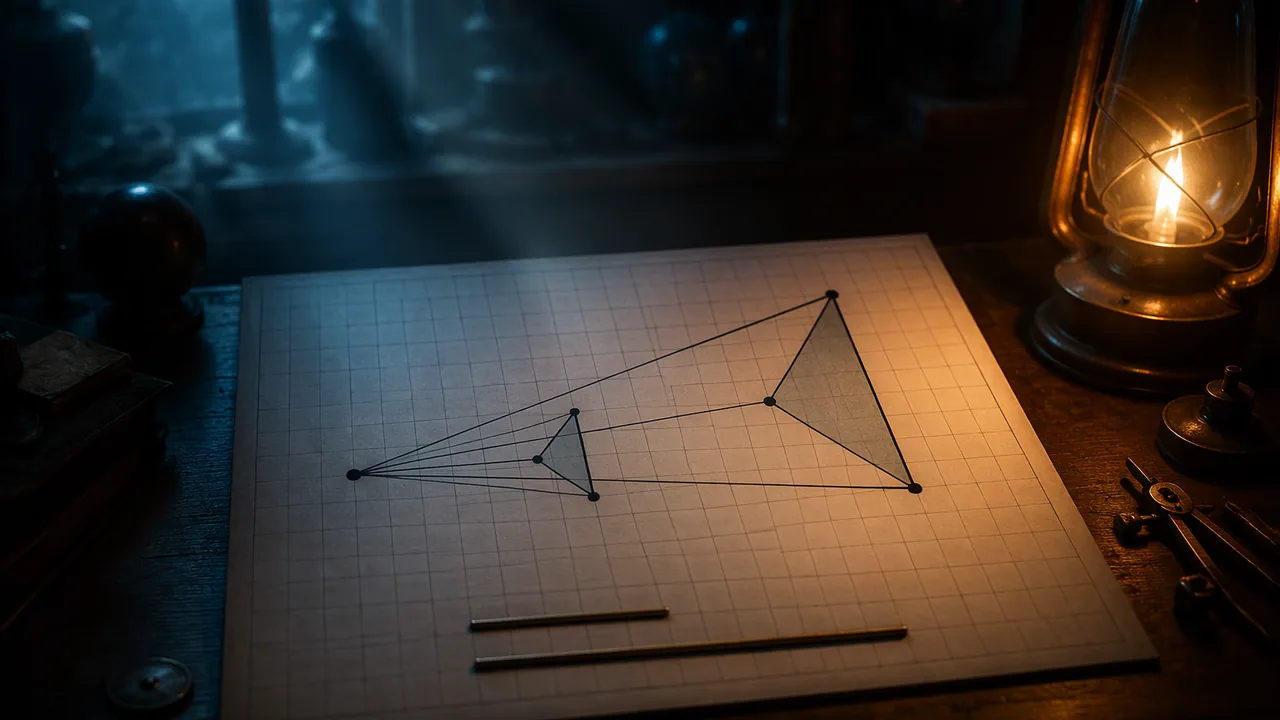
dilate figures from a given center by a given scale factor, and verify experimentally that dilations send lines to parallel lines and scale lengths by the scale factor.
Instruction
Rigid motions keep size. A dilation changes it while keeping shape.
Definition. A dilation with center O and scale factor k > 0 takes each point P to the point P′ on ray OP with OP′ = k · OP. The center stays where it is. If k > 1 the figure grows; if 0 < k < 1 it shrinks; if k = 1 nothing moves.
With coordinates, center at the origin. The rule is (x, y) → (kx, ky). Dilate A(1, 2) and B(3, 1) by k = 2: A′(2, 4), B′(6, 2).
Now measure. The slope of AB is (1 − 2)/(3 − 1) = −½. The slope of A′B′ is (2 − 4)/(6 − 2) = −½. The lines are parallel. The length AB is √(22 + 12) = √5 ≈ 2.24, and A′B′ is √(42 + 22) = √20 = 2√5 ≈ 4.47, exactly twice as long.
Two properties to verify.
- Lines. A dilation takes a line that does not pass through the center to a parallel line. A line that does pass through the center is taken to itself: every point on it slides along its own ray from O, which lies on the same line.
- Lengths. The image of a segment is k times as long as the original.
Angles are preserved too, which follows from property 1: the two sides of an angle go to parallel lines, so the angle between them is unchanged.
Center not at the origin. Move to the center, scale, and move back: P′ = O + k(P − O). With center O(1, 1), k = 3 and P(3, 2): P − O = (2, 1), scaled is (6, 3), so P′ = (1 + 6, 1 + 3) = (7, 4). Check: OP = √5 and OP′ = √(36 + 9) = √45 = 3√5. Three times as far, on the same ray.
Why this is experimental, not yet proof. The standard asks you to verify experimentally. Checking slopes and lengths in several examples, and dragging in GeoGebra, is strong evidence. The general reason for the length property comes from the coordinate rule: the distance between (kx1, ky1) and (kx2, ky2) is √(k2(x2 − x1)2 + k2(y2 − y1)2) = k times the original distance. Look for the pattern in repeated calculations (MP.8), then see why it must hold.
Investigation. In GeoGebra, draw a triangle and a point O. Use the Dilate from Point tool with k = 2, then k = 0.5. Measure corresponding lengths and slopes; record their ratios in a table. Drag O inside, outside and onto the triangle. Write conjectures, then test them against a classmate’s table.
📖 Read for this lesson
The reading opens over the lesson; close it to come back to exactly where you were. The checks below draw on it.
Formative check
Work through these before moving on. They are not graded — they tell you whether the standard below has landed yet.
Segment AB does not pass through the center of a dilation with scale factor 3. What will be true of its image?
Dilate P(3, 2) from center O(1, 1) with scale factor 3. Where is P′?
A dilation takes a line through its center to a different, parallel line.
Dilate triangle A(0,0), B(4,0), C(0,3) from the origin by k = 0.5 and by k = 2. Make a table of the side lengths and perimeters of all three triangles. What pattern do you see in the perimeters, and why must it hold?
Simulation & tools
Dilation investigation
Open a blank GeoGebra Geometry app.
- Draw triangle ABC and a separate point O.
- Use Dilate from Point: select the triangle, then O, and enter factor 2. Repeat with factor 0.5.
- Display the length of AB and of its two images. In the input bar compute each image length divided by AB. Record the ratios in a table.
- Draw line AB and the line through the images of A and B. Use the Parallel Line tool through A′ to test whether they are parallel, or compare their slopes with the Slope tool.
- Drag O inside the triangle, outside it, and onto line AB. Record what happens to the image of line AB when O is on it.
Answer: Write the two properties of dilations in your own words, using your table as evidence, and describe the special case when the center lies on the line.
Without a device: on graph paper, dilate A(1, 2) and B(3, 1) from the origin by 2 and by 0.5, compute the slopes and lengths, and compare.
Open GeoGebra ↗ · GeoGebra · free for non-commercial use
How confident are you that you can dilate a figure from any center and verify the parallel-line and length properties?
Practice
Work these on paper or in your notebook, then open Check your answer. Aim for all of Fluency and Application; try at least one Challenge.
Printable version: this unit’s practice workbook (PDF)
Fluency
Build speed and accuracy with the core skill.
- Dilate (3, −2) from the origin with scale factor 2.
Check your answer
Answer: (6, −4) - Dilate (−4, 6) from the origin with scale factor 1/2.
Check your answer
Answer: (−2, 3) - Dilate (5, 1) from the origin with scale factor 3.
Check your answer
Answer: (15, 3) - Dilate (−6, −9) from the origin with scale factor 1/3.
Check your answer
Answer: (−2, −3) - Dilate (4, 5) from (1, 2) with scale factor 2.
Check your answer
Answer: (7, 8)P − O = (3, 3); scale by 2 and add O. - Dilate (0, 3) from (−2, 1) with scale factor 3.
Check your answer
Answer: (4, 7)P − O = (2, 2); scale by 3 and add O. - Dilate (6, 5) from (2, −1) with scale factor 1/2.
Check your answer
Answer: (4, 2)P − O = (4, 6); scale by 1/2 and add O. - A segment of length 5 is dilated with scale factor 2.5 from a center not on the segment’s line. Find the image’s length and describe its direction.
Check your answer
Answer: 12.5; parallel to the original segment
Application
Use the skill in context. Show your reasoning.
- A projector lens acts as a dilation. A 3.5 cm tall figure on a slide appears 1.4 m tall on the screen. What is the scale factor, and how wide is the image of a 5 cm wide figure?
Check your answer
Answer: k = 40; the image is 200 cm = 2 m wide.1.4 m = 140 cm and 140/3.5 = 40; 5 × 40 = 200 cm. - Segment AB has A(1, 2) and B(3, 1). Dilate it from the origin by 3. Show the image is parallel to AB and three times as long.
Check your answer
Answer: A′(3, 6), B′(9, 3); both slopes are −1/2; lengths √5 and 3√5.Slope AB = (1 − 2)/(3 − 1) = −1/2; slope A′B′ = (3 − 6)/(9 − 3) = −1/2. √(36 + 9) = √45 = 3√5. - A line passes through the center of a dilation with scale factor 4. What is its image? Explain.
Check your answer
Answer: The line itself.Every point on it moves along its own ray from the center, which lies on the same line.
Challenge
Stretch problems. Expect to think before you write.
- A dilation sends A(1, 1) to (3, 5) and B(2, 1) to (5, 5). Find the scale factor and the center.
Check your answer
Answer: k = 2; center (−1, −3)AB = 1 and A′B′ = 2, so k = 2. From A′ = O + 2(A − O), O = 2A − A′ = (−1, −3). Check with B: (−1, −3) + 2((2, 1) − (−1, −3)) = (5, 5).
Review
Keep earlier skills sharp.
- Find the image of (0, −1) under a reflection over the x-axis.
Check your answer
Answer: (0, 1) - Which criterion proves two triangles congruent from three pairs of equal sides?
Check your answer
Answer: SSS - Parallel lines are cut by a transversal. One angle is 48°. Find its alternate interior angle and its same-side interior angle.
Check your answer
Answer: 48° and 132°
Dilation Data: Three Figures to Dilate, and a Classmate’s Table With One Wrong Row
Constructed teaching data written for this course: figures and centers to dilate on paper, the lengths and slopes each dilation must produce, and a classmate’s investigation table to test your conjectures against · SLS original (constructed teaching data)
Why this reading. The investigation ends “write conjectures, then test them against a classmate’s table.” If you work alone, or without GeoGebra, there is no classmate’s table. Here is one, together with three figures to dilate by hand so that you have your own table to compare with it. One row of the classmate’s table is wrong; your conjectures should catch it.
Figure 1: the open question’s triangle, center at the origin
A(0, 0), B(4, 0), C(0, 3), with sides AB = 4, AC = 3 and BC = 5. The rule for center O(0, 0) is (x, y) → (kx, ky).
| k | A′ | B′ | C′ | A′B′ | A′C′ | B′C′ | Perimeter |
|---|---|---|---|---|---|---|---|
| 1 | (0, 0) | (4, 0) | (0, 3) | 4 | 3 | 5 | 12 |
| 0.5 | (0, 0) | (2, 0) | (0, 1.5) | 2 | 1.5 | 2.5 | 6 |
| 2 | (0, 0) | (8, 0) | (0, 6) | 8 | 6 | 10 | 24 |
Say in one sentence what happens to the perimeter and why it must, using the distance argument at the end of the mini-lecture.
Figure 2: center not at the origin
Triangle A(3, 1), B(5, 2), C(4, 4); center O(2, 1); scale factor k = 3. The rule is P′ = O + 3(P − O).
| Point | P − O | 3(P − O) | Image |
|---|---|---|---|
| A(3, 1) | (1, 0) | (3, 0) | A′(5, 1) |
| B(5, 2) | (3, 1) | (9, 3) | B′(11, 4) |
| C(4, 4) | (2, 3) | (6, 9) | C′(8, 10) |
Checks: AB = √(2² + 1²) = √5 ≈ 2.236 and A′B′ = √(6² + 3²) = √45 ≈ 6.708, and 6.708 / 2.236 = 3.000. Slope of AB is 1/2; slope of A′B′ is 3/6 = 1/2. Do the same for BC and CA. Then dilate the same triangle from the same center with k = 0.5 and confirm the images are (2.5, 1), (3.5, 1.5) and (3, 2.5).
Figure 3: a segment through the center
Same center O(2, 1), k = 3. The segment from A(3, 1) to D(6, 1) lies on the line y = 1, which passes through O. Its image runs from A′(5, 1) to D′(14, 1). Same line, three times as long: 9 versus 3. This is the special case the sim asks about.
The classmate’s table
A classmate dilated Figure 2 from O(2, 1) with k = 3 and recorded:
| Quantity | Original | Image | Ratio image/original |
|---|---|---|---|
| AB | 2.236 | 6.708 | 3.00 |
| BC | 2.236 | 6.708 | 3.00 |
| CA | 3.162 | 9.487 | 3.00 |
| OC | 3.606 | 10.000 | 2.77 |
| slope AB | 0.5 | 0.5 | — |
| slope CA | −3 | −3 | — |
The classmate’s C′ was recorded as (8, 9). Test the OC row against the definition of a dilation: OC′ must equal k · OC = 3 × √13 ≈ 10.817, and the point on ray OC at that distance is (8, 10), not (8, 9). One misplaced point produces one ratio that is not 3, which is exactly how a wrong row announces itself. Notice that the CA row above was computed with the correct C′; recompute it with (8, 9) and see whether the ratio survives.
Conjectures to write
- The image of a segment not through the center is parallel to it (state how you tested: slopes).
- Every length is multiplied by k (state the ratios you found).
- A line through the center is carried to itself (state the case you checked).
Then write the one-line reason from the coordinate rule that turns conjecture 2 from evidence into proof.