design, build, test and refine a steel-wool warmer, calculate the energy it delivers and the fraction of the theoretical energy captured, and evaluate the design against ranked criteria and constraints.
Instruction
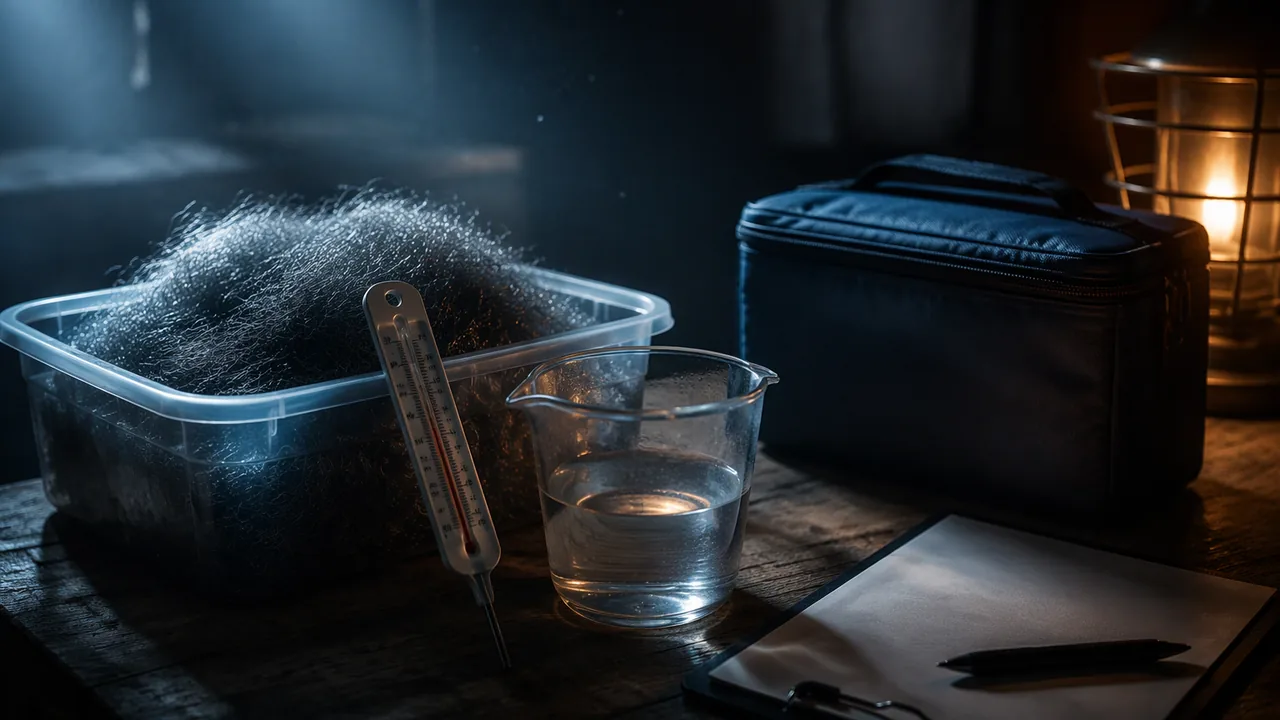
The challenge. Engineers do not just calculate energy; they build a device, test it, and improve it against stated criteria. This unit’s performance task asks you to design and test a chemical-to-thermal energy device: a steel-wool warmer in which the oxidation of iron releases energy that warms a known mass of water. It combines the unit’s models: the bond and formation enthalpies, the calorimeter, and the idea of efficiency.
The chemistry. Iron rusts: 4Fe + 3O2 → 2Fe2O3. NIST-JANAF lists −825.503 kJ/mol for Fe2O3, so the reaction as written releases 1,651.0 kJ, or 412.8 kJ per mole of iron and 7.39 kJ per gram. That is the theoretical maximum energy for the iron in your device. Steel wool reacts only slowly, so the real device will capture a fraction of it. Salt and moisture speed the rusting; a tight pack blocks oxygen.
Worked example. A trial uses 4.0 g of steel wool in a bag inside a foam cup holding 150.0 g of water with a cup constant of 36.2 J/°C. The water rises 6.5 °C. Energy absorbed = (150.0 × 4.184 + 36.2) × 6.5 = 663.8 × 6.5 = 4,315 J. The maximum for 4.0 g of iron is 4.0 × 7,391 J/g = 29,564 J. The fraction captured is 4,315 ÷ 29,564 = 14.6 percent. Because the cup also loses heat, this is a lower bound on the energy released.
Criteria, constraints and iterations. Rank your criteria before you build, for example (1) the peak temperature rise, (2) how long the water stays at least 5 °C warmer, (3) cost. Constraints are limits, such as at most 10 g of steel wool, household materials only and under $5. Change one variable between iterations, such as the amount of steel wool, how tightly it is packed, the salt or the insulation, so you know which change caused which effect. Failed trials are evidence; keep them.
Safety. An adult supervises. Wear safety glasses and gloves when handling steel wool, since fibers cut skin. Keep the wool in a sealed zip bag inside the cup, do not put it on skin, and never use a stove, oven or microwave. The reaction is mild and the device may warm only a few degrees.
📖 Read for this lesson
The reading opens over the lesson; close it to come back to exactly where you were. The checks below draw on it.
Formative check
Work through these before moving on. They are not graded — they tell you whether the standard below has landed yet.
In Design B of the reference logs, 150.0 g of water and a cup of constant 36.2 J/°C warm from 21.0 °C to 29.9 °C. The energy absorbed is about
Design A used 3.0 g of steel wool, absorbed 3,518 J, and had a theoretical energy of 22,173 J. The fraction captured is
A trial in which the water barely warmed should be left out of the engineering report.
Draft your plan using the criteria and reference logs in this lesson’s reading: list your ranked criteria and constraints, sketch two designs, predict which gives the higher peak temperature and why (use the amount of iron and the oxygen supply), and describe your test procedure and data table.
How confident are you that you can design, test and refine an energy conversion device and evaluate it against criteria?
Unit 1 checkpoint
Do this before you start the task. It covers the whole unit and tells you what to review first.
A reaction has ΔH = +45 kJ. It is
Using H–H = 436.0, O=O = 498.4 and O–H = 463.5 kJ/mol, the ΔH for H2 + ½O2 → H2O(g) is kJ.
Breaking chemical bonds absorbs energy, and forming bonds releases energy.
How much energy warms 200.0 g of water by 10.0 °C? (c = 4.184 J/(g·°C))
A 60.0 g metal absorbs 540 J and warms by 20.0 °C. Its specific heat is J/(g·°C).
In a real foam-cup calorimeter the cool water usually gains slightly less heat than the hot water loses, because the cup also absorbs some.
ΔrH is calculated from formation enthalpies as
Using ΔfH° of −393.51 for CO2 and −110.53 for CO (kJ/mol), ΔH for CO + ½O2 → CO2 is kJ.
Burning methane to produce liquid water releases more energy than producing gaseous water.
A power plant has a heat rate of 8,500 Btu/kWh. Its efficiency is about
A heat engine can convert all of its input thermal energy into useful work if it is built carefully enough.
A steel-wool warmer absorbs 3,518 J while the iron could theoretically release 22,173 J. The fraction captured is about
Engineering report (900-1,300 words) and four-minute recorded presentation: The Steel-Wool Warmer
Task: Design, build and test at least two iterations of a steel-wool warmer. Place the wet steel wool (rinsed in vinegar, wrung out, mixed with a teaspoon of salt) in a sealed zip bag inside a foam cup holding 150.0 g of water with a lid and thermometer, and log the water temperature every five minutes for 60 minutes. Use no more than 10 g of steel wool, only household materials and less than $5. For each iteration report the peak temperature, the energy absorbed using (150.0 × 4.184 + your calorimeter constant) × ΔT, the theoretical energy for the iron used from the NIST-JANAF enthalpy (about 7.39 kJ per gram of iron), and the fraction captured. Use the bond-energy and Hess’s-law models from this unit to explain why the reaction releases energy, then evaluate your final design against ranked criteria and constraints and compare it with the best reference design in this lesson’s reading.
No device or no materials? Complete every calculation and the full evaluation from the three reference test logs in this lesson’s reading, treat them as your iterations, and say so in the report.
This task also meets 9-12.ETS1.A.2 (breaking the problem into sub-problems) and 9-12.ETS1.B.1 (evaluating against criteria and constraints).
Submission workflow
- Stage 1 — Plan. Ranked criteria and constraints, two sketched designs with a prediction of which gives the higher peak temperature and why, the test procedure and a data table.
- Stage 2 — Reviewed draft. Recompute every energy and fraction a second time from your raw data (or have a parent, guardian or other reader recompute them with you), check the units and the sign, and list any unsupported claims with a revision plan.
- Stage 3 — Final report. 900-1,300 words with data from every iteration, calculations, the energy-model explanation and the criteria evaluation.
- Stage 4 — Presentation and defense. Four minutes, recorded, with a demonstration or data display, ending with your recorded answer to one question you pose about your own design.
How it is scored
| Criterion | What proficient looks like |
|---|---|
| Design and refinement (9-12.PS3.A.3) | At least two iterations; changes justified by data; the device clearly converts chemical energy to thermal energy. |
| Energy calculations (9-12.PS3.B.1, 9-12.PS3.A.1) | q = mcΔT, the calorimeter constant and the theoretical maximum are computed correctly with units and significant figures; fraction captured stated. |
| Chemical explanation (9-12.PS1.A.5) | Uses bond energies or formation enthalpies to explain why rusting releases energy and to compare the model with measurements. |
| Evaluation (9-12.ETS1.B.1, 9-12.ETS1.A.2) | Ranked criteria and constraints, honest trade-offs, sub-problems tested separately, comparison with a reference design. |
| Procedure and communication (RST.11-12.3, SEP.6) | Test procedure followed exactly; clear tables and graphs; report and presentation organized. |
Steel-Wool Warmer: Rusting Data and Three Reference Test Logs
Enthalpy of formation of hematite from NIST-JANAF Thermochemical Tables (Fe-030) and molar mass of iron from the NIST Chemistry WebBook, retrieved 2026-11-15. The three temperature logs are SLS original teaching data, labeled illustrative; all derived values recomputed with Python. · SLS original (logs, labeled illustrative); NIST data are public domain reference data
Why this reading. It has the chemistry data for the steel-wool warmer (rusting is exothermic) and three complete recorded test logs, so you can do every calculation and the full design evaluation without building anything. The test logs are illustrative teaching data, not a published experiment.
The reaction
Iron rusts by 4Fe(s) + 3O2(g) → 2Fe2O3(s). The NIST-JANAF table for hematite (Fe2O3) gives ΔfH° = −825.503 kJ/mol at 298.15 K. For the equation as written, ΔH = 2(−825.503) = −1,651.0 kJ. Per mole of iron that is −412.75 kJ; per gram of iron (55.845 g/mol) it is 7.39 kJ released. So 5.0 g of iron could release at most 5.0 × 7.391 = 36.96 kJ if every atom reacted. Real steel wool never rusts completely in an hour: the reaction needs oxygen to reach the surface, salt and moisture speed it, and rust slows it by covering the metal.
Test rig used for the reference logs
The wet steel wool (rinsed in vinegar, wrung out, mixed with a teaspoon of salt) sits in a sealed zip bag inside a foam cup holding 150.0 g of water, with a lid and thermometer. Starting water temperature 21.0 °C. The cup constant is 36.2 J/°C (Run 1 of the calorimetry lab record). Energy absorbed by the water and cup = (150.0 × 4.184 + 36.2) × ΔT = 663.8 × ΔT joules.
Temperature logs (°C), illustrative
| Time (min) | Design A | Design B | Design C |
|---|---|---|---|
| 0 | 21.0 | 21.0 | 21.0 |
| 5 | 22.8 | 23.9 | 22.0 |
| 10 | 24.2 | 26.0 | 22.8 |
| 15 | 25.0 | 27.5 | 23.5 |
| 20 | 25.6 | 28.6 | 24.1 |
| 25 | 26.0 | 29.2 | 24.7 |
| 30 | 26.2 | 29.6 | 25.1 |
| 35 | 26.3 | 29.8 | 25.5 |
| 40 | 26.3 | 29.9 | 25.8 |
| 45 | 26.2 | 29.8 | 26.0 |
| 50 | 26.1 | 29.6 | 26.2 |
| 55 | 25.9 | 29.4 | 26.4 |
| 60 | 25.7 | 29.2 | 26.5 |
Results
| Design | Description | Peak water temperature | Energy absorbed at the peak | Theoretical energy for the iron used | Fraction captured |
|---|---|---|---|---|---|
| Design A | 3.0 g, loosely packed, uncovered cup lid only | 26.3 °C at 35 min | 3,518 J | 22,173 J | 15.9% |
| Design B | 5.0 g, loosely packed, lid only | 29.9 °C at 40 min | 5,908 J | 36,955 J | 16.0% |
| Design C | 5.0 g, tightly packed in a small bag, cup wrapped in a towel | 26.5 °C at 60 min | 3,651 J | 36,955 J | 9.9% |
Design C was still rising at 60 minutes, so its peak and energy are lower bounds. Every energy value above is also a lower bound, because the cup kept losing a little heat while the reaction ran.
Criteria and constraints for the challenge
- Criterion 1 (most important): highest peak temperature rise of the 150.0 g of water.
- Criterion 2: keep the water at least 5.0 °C above its start for as long as possible.
- Criterion 3: lowest cost.
- Constraints: at most 10 g of steel wool; only household materials; total cost under $5; the device must not touch skin directly.
On those criteria, Design B has the highest peak rise (8.9 °C), Design A the lowest cost, and Design C the slowest release.
Sources: NIST-JANAF: iron oxide, hematite (Fe-030) (janaf.nist.gov); NIST WebBook: iron (webbook.nist.gov)