collect or analyze data from a coin or dice decay model, linearize it with ln N to find a half-life, and use half-lives and a decay series to interpret documented Missouri radioactive-waste facts.
Instruction
A Missouri record. Between 1942 and 1973, uranium processing for the federal government’s early nuclear weapons program took place in St. Louis and North St. Louis County, according to the Missouri Department of Natural Resources (MDNR). In 1973, about 8,700 tons of leached barium sulfate from the Manhattan Project, together with other material, were mixed with about 38,000 tons of soil and taken to West Lake Landfill in Bridgeton, before state landfill rules existed. The U.S. Army Corps of Engineers, EPA and DOE have since been investigating and cleaning up the St. Louis sites; the Corps has removed more than 1.27 million cubic yards of material to permitted out-of-state facilities. The chemistry question is simple: how long do these materials stay radioactive, and why do the risks change over time? The documented answer is in half-lives.
Why decay is exponential. Each nucleus has the same chance of decaying in any given time interval, and no nucleus has a memory. So the number that decay is proportional to the number present, which gives N = N0 e−λt. The decay constant λ is related to the half-life by λ = ln 2 ÷ t½. For radon-222 (half-life 3.8 days), λ = 0.693 ÷ 3.8 = 0.182 per day. The activity A = λN is the number of decays per unit time: a sample with a short half-life has high activity per atom, which is why a short-lived isotope is more intense but disappears sooner.
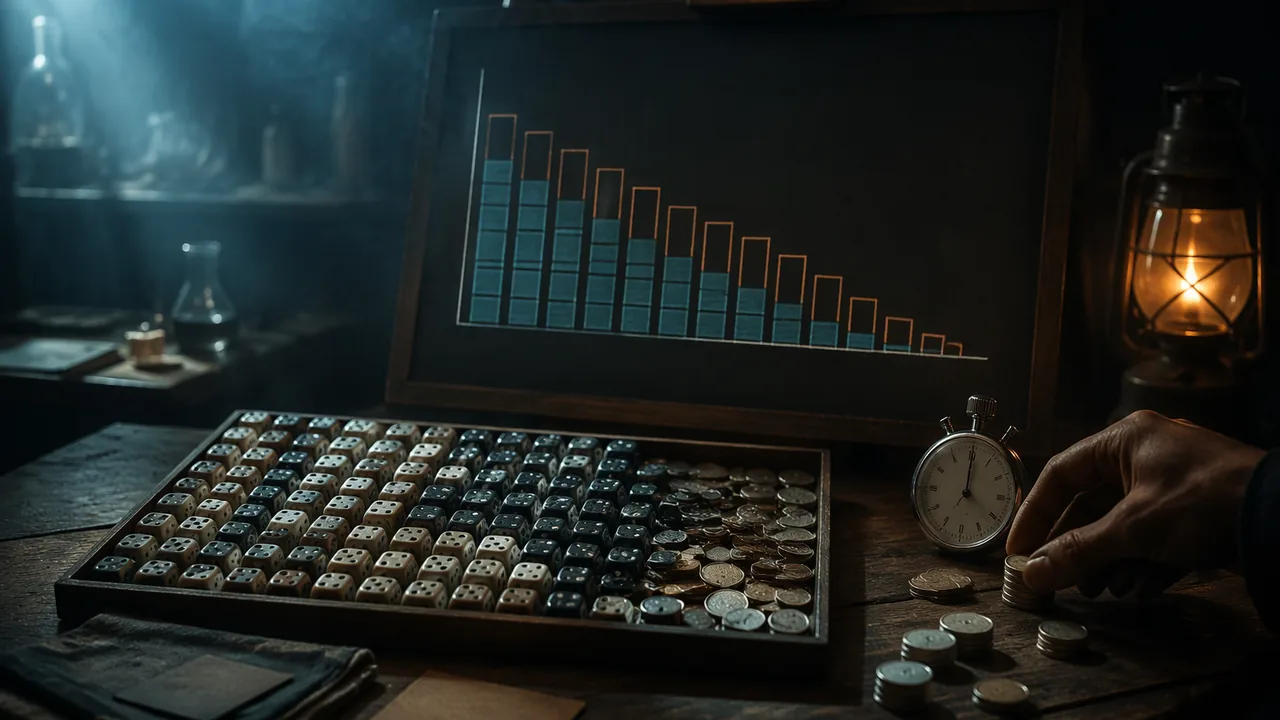
Modeling decay with chance. A coin model captures the idea. Start with 100 coins; shake and pour them; remove every coin that landed heads. About half are removed each round, so one round models one half-life: N = 100 × (1/2)round. A die model changes the odds: remove every die that shows a 1. Each die decays with probability 1/6 per round, so the expected number left after n rounds is N0(5/6)n. The half-life t solves (5/6)t = 1/2, so t = ln 2 ÷ ln(6/5) = 3.80 rounds. A real sample has trillions of atoms, so its curve is smooth; with 60 dice the counts wobble.
Straightening the curve. To measure a half-life from data, plot ln N against time. Because ln N = ln N0 − λt, the points fall on a line with slope −λ. Then t½ = ln 2 ÷ (−slope). Worked example: if ln N falls from 4.60 (N = 100) to 1.39 (N = 4) over 7.0 rounds, the slope is (1.39 − 4.60) ÷ 7.0 = −0.459 per round, so t½ = 0.693 ÷ 0.459 = 1.5 rounds. This method works even when the counts are noisy.
Why the risk changes: a decay series. EPA and MDNR documents on West Lake Landfill report that thorium-230 (half-life 77,000 years) decays to radium-226 (half-life 1,600 years), so radium-226 levels were expected to increase in the future. With a long-lived parent, the daughter builds up until it decays as fast as it is made. For a worked check, after 1,600 years (one radium half-life), a sample of thorium-230 still has 0.9857 of its atoms, a decrease of only 1.43 percent. The agencies state that current exposures are within or below EPA’s acceptable cancer risk range for current uses and that future risks were projected to exceed it, which is why remedial action was selected.
Your questions. In the lab you will build the model; in the reading you will check what MDNR and EPA documented and what you can and cannot conclude from half-lives alone.
📖 Read for this lesson
The reading opens over the lesson; close it to come back to exactly where you were. The checks below draw on it.
Lab: Half-Life Model with Coins or Dice
Question. Does a random process in which each item has a fixed chance of being removed each round follow exponential decay, and can you measure a half-life from the data?
Materials
- At least 40 coins, or 40 dried beans marked on one side with a marker (100 coins gives the best data); a cup or small box with a lid
- A pencil, paper and a calculator, or a spreadsheet
- Optional: 60 six-sided dice for the second run
- Safety glasses
- A table with a rim or a large baking sheet so nothing rolls away
- An adult should supervise, especially if younger children are nearby. Coins and small beans are choking hazards for small children, so keep them away from anyone who might put them in their mouth.
- Wear safety glasses when shaking and pouring the coins or dice.
- Nothing is tasted, and you should not use the beans afterward as food.
Procedure
- Put all your coins (N0) in the container, shake, and pour them onto the tray.
- Remove every coin that landed heads up. Count the coins remaining (tails) and record it for round 1.
- Put the remaining coins back in the container and repeat steps 1 and 2 until you have 6 rounds or fewer than 3 coins remain.
- Optional second run: start with 60 dice, remove every die that shows a 1, count the rest, and repeat for 12 rounds.
- Calculate the expected count N0 ÷ 2round for each round. Calculate ln N for each round and graph ln N against round number. Find the slope and calculate t½ = 0.693 ÷ (−slope).
- No coins or dice? Complete the analysis using run A and run B in this lesson’s reading.
Data
| Round | Coins remaining | Expected N0 ÷ 2round | ln N |
|---|---|---|---|
| 0 | |||
| 1 | |||
| 2 | |||
| 3 | |||
| 4 | |||
| 5 | |||
| 6 |
Analysis
- Claim: does your count follow N = N0(1/2)round? Evidence: compare observed and expected counts and the straightness of the ln N graph. Reasoning: explain why individual outcomes are unpredictable but the total is predictable.
- Find your half-life in rounds from the slope and state the percent difference from the expected 1.00 round. If you also ran the dice (theory 3.80 rounds), compare. List two reasons your result differs from theory.
- If one round stands for the 8.02-day half-life of iodine-131, how many days until about 6 percent of the atoms remain (four rounds)? Then explain in two sentences one way a model with coins differs from a real radioactive sample.
If you cannot do this lab in person: Use the two complete runs in this lesson’s reading, ‘Half-Life Model: Two Complete Coin and Dice Runs’ (rlp-chemb-half-life-model-data): run A (100 coins) and run B (60 dice) with expected values and fits, so you can do all the analysis without any materials.
Formative check
Work through these before moving on. They are not graded — they tell you whether the standard below has landed yet.
In the dice model (a die showing a 1 is removed each round), the half-life is closest to
After 154,000 years, which is two half-lives of thorium-230 (77,000 years), the fraction of the original thorium-230 atoms remaining is (as a decimal).
In a sealed sample that starts as pure thorium-230, the amount of radium-226 can increase for a long time.
Using the facts in this lesson’s reading on St. Louis radioactive waste, write a four-sentence claim-evidence-reasoning statement answering: Why did EPA and MDNR say that risks at West Lake Landfill were within acceptable ranges now but projected to increase in the future? Use the half-lives of thorium-230 and radium-226 and keep the wording to documented facts.
How confident are you that you can measure a half-life from data and use a decay series to explain how risk can change over time?
Practice
Work these on paper or in your notebook, then open Check your answer. Aim for all of Fluency and Application; try at least one Challenge.
Printable version: this unit’s practice workbook (PDF)
Fluency
Build speed and accuracy with the core skill.
- An isotope has a half-life of 4 days. How long until only 1/8 of the original sample remains?
Check your answer
Answer: 12.0 days (3 half-lives)1/8 = (1/2)3. - A wood sample has 12.5% of the carbon-14 of living wood. Using a half-life of 5,730 years, estimate its age.
Check your answer
Answer: ≈ 17,190 yearst = 5730 × log2(100/percent remaining). - In the coin model, you start with 100 coins and remove the ones that land heads each round. How many are expected to remain after 5 rounds?
Check your answer
Answer: 3.125, about 3 coins100 × (1/2)5 = 3.125. - In the dice model (a die showing 1 is removed), what is the half-life in rounds?
Check your answer
Answer: 3.80 roundst = ln 2 ÷ ln(6/5) = 0.6931 ÷ 0.1823. - Radon-222 has a half-life of 3.8 days. Find its decay constant λ.
Check your answer
Answer: 0.182 per dayλ = ln 2 ÷ 3.8 = 0.6931 ÷ 3.8. - What fraction of thorium-230 (half-life 77,000 years) remains after 154,000 years?
Check your answer
Answer: 1/4 (0.250)154,000 ÷ 77,000 = 2 half-lives.
Application
Use the skill in context. Show your reasoning.
- A sample contains 8.00 g of radium-226 (half-life 1,600 years). How much remains after 4,800 years?
Check your answer
Answer: 1.00 g4,800 ÷ 1,600 = 3 half-lives; 8.00 ÷ 8. - What fraction of a thorium-230 sample is left after 1,600 years? What percent has decayed?
Check your answer
Answer: 0.9857 remains; 1.43% decayed(1/2)1600/77000 = (1/2)0.02078 = 0.9857. - In run B of the lab reading, 60 dice fell to 5 dice after 12 rounds. Using only these two numbers, estimate the half-life in rounds.
Check your answer
Answer: 3.35 rounds60 ÷ 5 = 12.00; log2 = 3.585 half-lives in 12 rounds; 12 ÷ 3.585. - MDNR reports the Army Corps has removed more than 1.27 million cubic yards of material from St. Louis FUSRAP sites. Convert to cubic meters (1 yd3 = 0.7646 m3).
Check your answer
Answer: 970,985 m3 (about 9.7 × 10⁵ m3)1.27 × 106 × 0.7646.
Challenge
Stretch problems. Expect to think before you write.
- A sample has 1.00 × 10⁶ atoms of radon-222 (λ = 0.182 per day). How many atoms decay in the first day, approximately, and how many per second?
Check your answer
Answer: About 182,407 per day (about 2.11 per second)Activity A = λN = 0.182 × 1.00 × 106; ÷ 86,400 s. - How many days until 99% of a radon-222 sample (half-life 3.8 days) has decayed?
Check your answer
Answer: 25.2 daysRemaining 1%: n = log2(100) = 6.644 half-lives; × 3.8 d. - Explain, in three sentences using half-lives, why EPA and MDNR documents say radium-226 levels at West Lake were expected to increase in the future even though the waste does not change.
Check your answer
Answer: Thorium-230 in the waste has a half-life of 77,000 years and decays to radium-226, whose half-life is 1,600 years. Thorium decays so slowly that it keeps supplying new radium-226 as the radium decays, so the radium amount builds up until the two rates are similar. The risk therefore changes with time even if nothing is added.
Review
Keep earlier skills sharp.
- How many moles are in 180.0 g of C6H12O6?
Check your answer
Answer: 0.999 molDivide by the molar mass, 180.16 g/mol. - A gas at 101.3 kPa and 25 °C occupies 5.0 L. What volume does it occupy at 150.0 kPa and 37 °C?
Check your answer
Answer: 3.51 LCombined gas law: P1V1/T1 = P2V2/T2, with T in kelvin. - For 2 Mg + O2 → 2 MgO, what mass of MgO forms from 12.15 g Mg? (Mg 24.305, MgO 40.304 g/mol)
Check your answer
Answer: 20.15 g12.15 ÷ 24.305 = 0.4999 mol Mg; same moles MgO; × 40.304 g/mol. - What is the pH of 0.0010 M HCl, a strong acid?
Check your answer
Answer: 3.00pH = −log(0.0010) = 3.00.
Half-Life Model: Two Complete Coin and Dice Runs
SLS model runs generated 2026-11-15 with a seeded random-number program; iodine-131 half-life from U.S. EPA Radionuclide Basics: Iodine, retrieved 2026-11-15 · SLS original
Why this reading. The half-life lab asks you to model radioactive decay with coins or dice. This reading gives two complete runs of the same procedure so you can finish the analysis if you do not have the materials, or check your own run against a second one.
How these runs were produced
These are model runs generated by a computer program that performs the same random step as your hands would (random-number seeds 2028 and 1115); they were not collected by hand. They behave like a real run: each uses chance, so the counts wobble around the expected values.
Run A: 100 coins, remove every coin that lands heads
Each round, every remaining coin has a one-half chance of “decaying” (landing heads) and being removed.
| Round | Coins remaining (run A) | Expected N0 ÷ 2round |
|---|---|---|
| 0 | 100 | 100.0 |
| 1 | 59 | 50.0 |
| 2 | 34 | 25.0 |
| 3 | 16 | 12.5 |
| 4 | 8 | 6.2 |
| 5 | 7 | 3.1 |
| 6 | 2 | 1.6 |
A least-squares line through ln(N) versus round gives a half-life of 1.11 rounds (theory: 1.00 round, because each round removes about half).
Run B: 60 dice, remove every die that shows a 1
Each round, every remaining die has a one-sixth chance of decaying. The expected number remaining after n rounds is 60 × (5/6)n.
| Round | Dice remaining (run B) | Expected 60 × (5/6)round |
|---|---|---|
| 0 | 60 | 60.0 |
| 1 | 50 | 50.0 |
| 2 | 41 | 41.7 |
| 3 | 33 | 34.7 |
| 4 | 30 | 28.9 |
| 5 | 24 | 24.1 |
| 6 | 18 | 20.1 |
| 7 | 17 | 16.7 |
| 8 | 15 | 14.0 |
| 9 | 11 | 11.6 |
| 10 | 10 | 9.7 |
| 11 | 7 | 8.1 |
| 12 | 5 | 6.7 |
The same fitting method gives a half-life of 3.56 rounds. Theory: the half-life t satisfies (5/6)t = 1/2, so t = ln 2 ÷ ln(6/5) = 3.80 rounds. With only 60 dice the random scatter is large, so a fit that is within about 10 percent of theory is a good result.
Turning rounds into time
A round is a unit of model time. If you let one round stand for the half-life of iodine-131 (8.02 days, EPA), run A is a model of an iodine-131 sample: after 3 rounds (24.06 days) about one eighth of the atoms remain. For run B, one round would stand for 8.02 ÷ 3.80 = 2.11 days.
Reading a decay curve
A straight line on a graph of ln(N) against time means the decay is exponential. The slope equals −λ, where λ = ln 2 ÷ half-life is the decay constant. A larger λ means faster decay and a shorter half-life.
Sources: EPA Radionuclide Basics: Iodine (epa.gov)
St. Louis Radioactive Waste: What MDNR and EPA Document
MDNR West Lake Landfill page and FUSRAP page; EPA Region 7 West Lake Landfill community update (September 2018); EPA Radionuclide Basics pages, all retrieved 2026-11-15 · Public domain (MDNR, EPA text), with SLS commentary
Why this reading. Missouri has a documented history of radioactive waste from the Manhattan Project era. This reading summarizes only what the Missouri Department of Natural Resources (MDNR) and the U.S. Environmental Protection Agency (EPA) state on their public pages, so you can apply half-life and decay-series chemistry to a real record. It describes events and agency decisions; it does not assign blame.
Uranium processing in St. Louis, 1942 to 1957 and after
MDNR states that from 1942 to 1973, uranium processing for the federal government’s early nuclear weapons program and related activities took place in St. Louis City and North St. Louis County, run by the Manhattan Engineer District and later the Atomic Energy Commission, predecessors of the U.S. Department of Energy (DOE). Those practices left soil, sediment, surface water and groundwater contamination. In 1974 the Formerly Utilized Sites Remedial Action Program (FUSRAP) was created. Three St. Louis-area locations were designated: the St. Louis Downtown Site, the St. Louis Airport Site (SLAPS) and the Hazelwood Interim Storage Site with the former Futura Co. More than 100 nearby properties were potentially contaminated by storage and handling at those sites. Congress moved FUSRAP from DOE to the U.S. Army Corps of Engineers (USACE) in October 1997, with EPA as the main regulator. MDNR reports that the Corps has removed more than 1.27 million cubic yards of contaminated soil and material to permitted out-of-state facilities. The main contaminants are uranium, radium and thorium and their decay products.
Unit check (SLS calculation): 1.27 million yd3 × 0.764555 m3 per yd3 = 970,985 m3, or about 9.7 × 10⁵ m3.
MDNR also notes that uranium, radium and thorium occur naturally in soil to some extent, and that some areas contain levels above those allowing unrestricted use. Those areas are not believed to pose an immediate health risk under current land uses, but they will stay radioactive for thousands of years, so land-use restrictions apply where cleanup goals cannot be met.
West Lake Landfill, Bridgeton
MDNR describes the West Lake Landfill site as over 200 acres at 13570 St. Charles Rock Road in Bridgeton, on the eastern edge of the Missouri River floodplain. A limestone quarry began there in 1939, and from the early 1950s the excavated areas were used for landfilling. In 1973, about 8,700 tons of leached barium sulfate from the Manhattan Project and other material from the Hazelwood Interim Storage Site were mixed with about 38,000 tons of soil and taken to West Lake, where the mixture was used in landfilling. This happened before state solid waste landfill regulations existed (1974). EPA placed the site on the National Priorities List in 1990. EPA leads the regulatory work; MDNR supports it.
The EPA and MDNR risk assessment concluded that exposures to the public and workers from radionuclides were within or below EPA’s acceptable cancer risk range for current site use. Because thorium-230 (half-life 77,000 years) decays to radium-226 (half-life 1,600 years), radium-226 levels were expected to increase in the future, and risks to some hypothetical future users were projected to exceed the acceptable range. That projection is why EPA decided that remedial action was appropriate.
EPA issued its record of decision for this part of the site (OU-1) in May 2008 and an amended decision in 2018. EPA’s September 2018 community update says the amended remedy calls for excavating generally down to 12 feet and removing material above 52.9 picocuries per gram, about 75,000 cubic yards sent to licensed off-site facilities and 143,000 cubic yards below that level used on site. MDNR reports the site is in the remedial design phase.
Unit check (SLS calculation): 75,000 yd3 = 57,342 m3; 143,000 yd3 = 109,331 m3.
Decay facts for the calculations
| Nuclide | Half-life (EPA) | Emits |
|---|---|---|
| Uranium-238 | 4.47 billion years | alpha |
| Thorium-230 | 77,000 years | alpha |
| Radium-226 | 1,600 years | alpha (with beta, gamma in the series) |
| Radon-222 | 3.8 days | alpha |
The decay chain on this page: thorium-230 (alpha) → radium-226 (alpha) → radon-222.
Sources: MDNR: West Lake Landfill (dnr.mo.gov); MDNR: Formerly Utilized Sites Remedial Action Program (FUSRAP) (dnr.mo.gov); EPA: The West Lake Landfill Superfund Site community update (2018) (semspub.epa.gov); EPA Radionuclide Basics: Thorium (epa.gov); EPA Radionuclide Basics: Radium (epa.gov)