use q = mcΔT and a calorimeter constant to measure energy transferred when hot and cool materials reach a uniform temperature, and evaluate the sources of error.
Instruction
The investigation question. When a hot object and a cool object touch inside a closed container, energy flows from the hot one to the cool one until both have the same temperature, a uniform distribution of thermal energy. How can you measure that energy? Today you use calorimetry: letting a reaction or a mixing process exchange energy with a known mass of water and tracking the temperature.
The heat equation. The energy transferred as heat is q = mcΔT, where m is mass in grams, c is the specific heat in J/(g·°C) and ΔT is the final minus the starting temperature. For liquid water c = 4.184 J/(g·°C). NIST-JANAF tables give liquid water a molar heat capacity of 75.351 J/(mol·K); divided by 18.0153 g/mol that is 4.183 J/(g·°C), which agrees. Iron is very different: 25.094 J/(mol·K) ÷ 55.845 g/mol = 0.449 J/(g·°C). A gram of water holds about nine times the thermal energy per degree that a gram of iron does, which is why a cup of water warms slowly and a steel pan heats fast.
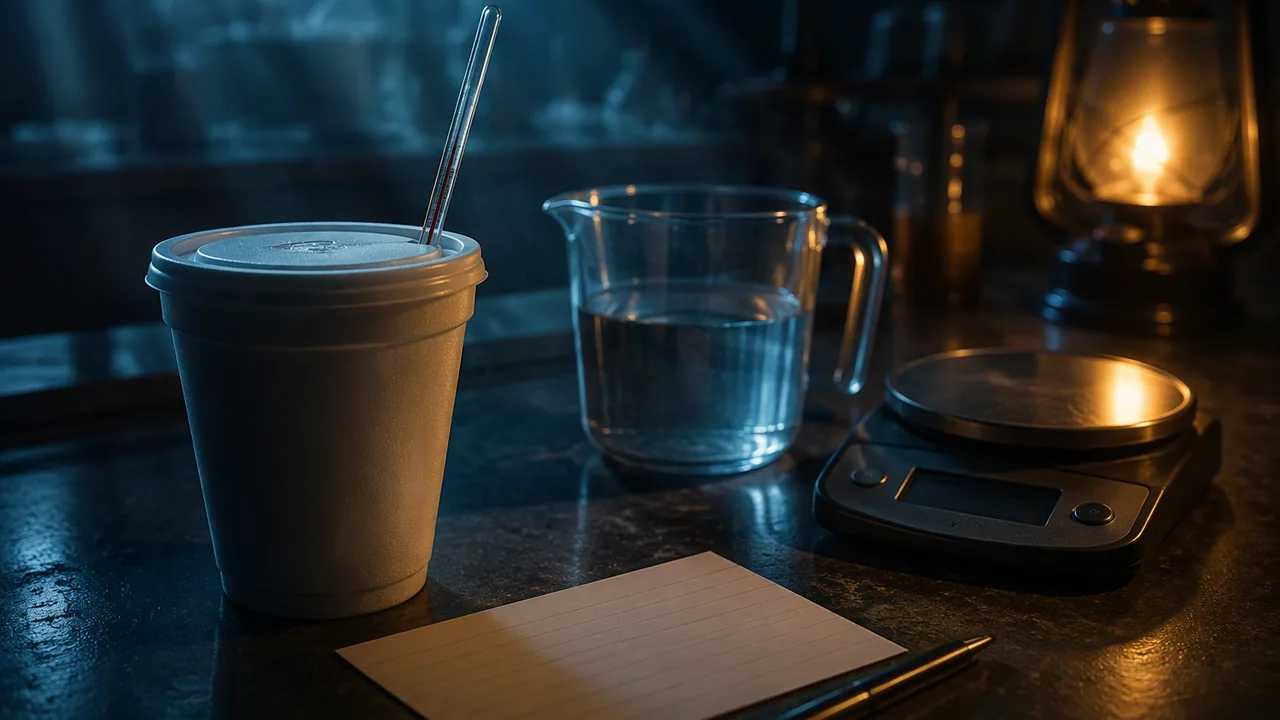
The coffee-cup calorimeter. Two nested foam cups with a lid keep most of the energy inside. In an ideal calorimeter, energy lost by the hot part equals energy gained by the cool part, qlost = qgained. Real cups absorb some energy themselves, so you measure a calorimeter constant Ccal in J/°C: the energy the cup takes in per degree.
Worked example, Part A. A cup holds 100.0 g of water at 21.3 °C. You add 100.0 g of hot water at 47.8 °C, and the highest steady temperature is 34.0 °C. Heat lost by the hot water: 100.0 × 4.184 × (47.8 − 34.0) = 5,774 J. Heat gained by the cool water: 100.0 × 4.184 × (34.0 − 21.3) = 5,314 J. The difference, 460 J, went into the cup and thermometer, so Ccal = 460 ÷ 12.7 = 36.2 J/°C.
Worked example, Part B. Now 152.3 g of steel washers at 49.8 °C go into 100.0 g of water at 21.0 °C and the mixture settles at 24.8 °C. The water and cup gained (100.0 × 4.184 + 36.2) × 3.8 = 1,727 J. The washers lost the same amount, so c = 1,727 ÷ [152.3 × (49.8 − 24.8)] = 0.454 J/(g·°C), only 1.0 percent from the NIST-derived 0.449. Keep three significant figures in the answer, since the temperatures have three.
Part C and what it shows. When baking soda dissolves in water, the temperature drops, so the dissolving is endothermic. In Run 1, 183 J were absorbed for each gram dissolved, a number that lets you compare different amounts fairly. You are not calculating a published constant here, only practicing the measurement and the sign of the energy change.
Your questions. Which measurement limits your precision most: mass, temperature or heat loss? What would you change to shrink it? Plan one home check, such as adding a lid, before you start the lab.
📖 Read for this lesson
The reading opens over the lesson; close it to come back to exactly where you were. The checks below draw on it.
Lab: Hot, Cool and Dissolving: A Kitchen Calorimeter
Question. When a hot object and a cool object reach the same temperature in a closed container, how much energy moves, and how does it compare with the energy gained by the cool object?
Materials
- Two foam cups (nested) and a cardboard lid with a small hole for a thermometer
- A digital kitchen or cooking thermometer that reads to 0.1 °C if possible (1 °C works, with larger uncertainty)
- A kitchen scale (to 1 g or better) and a measuring cup
- 8-10 steel washers or nuts (about 150 g in total) on a string; baking soda; hot tap water, cool tap water
- Safety glasses and a towel
- An adult supervises. Wear safety glasses. Nothing is tasted, including the baking soda solution.
- Use hot tap water only, never boiled or microwaved water: an adult checks that it is no hotter than about 50 °C before you handle it.
- Do not heat glass or use a stove, kettle or flame. Wipe spills right away and wash your hands afterward.
Procedure
- Part A: put 100.0 g of cool tap water in the nested cups, close the lid and record its temperature once it is steady. Measure 100.0 g of hot tap water in the measuring cup and record its temperature immediately.
- Pour the hot water into the cup, close the lid, swirl gently and record the highest steady temperature. Calculate the heat lost, the heat gained and the calorimeter constant.
- Part B: hang the washers in a cup of hot tap water for three minutes and record the bath temperature. Empty and dry the calorimeter cup, then put in 100.0 g of cool water and record its temperature.
- Lift the washers out, shake off water, lower them quickly into the cup, close the lid and record the highest steady temperature. Calculate the washers’ specific heat with your calorimeter constant.
- Part C: refill the cup with 100.0 g of cool water, record the temperature, add 8.0 g of baking soda, swirl for one minute and record the lowest temperature. Calculate the energy absorbed per gram of baking soda.
- Repeat any part whose result looks wrong and record both runs. Compare your Part B result with the NIST-derived value of 0.449 J/(g·°C).
Data
Part A. Mass of cool water in the cup: ______ g. Starting temperature: ______ °C. Mass of hot water added: ______ g. Hot water temperature: ______ °C. Highest steady temperature after mixing: ______ °C.
| Quantity | Calculation | Result |
|---|---|---|
| Heat lost by hot water (J) | ||
| Heat gained by cool water (J) | ||
| Calorimeter constant (J/°C) |
Part B. Mass of washers: ______ g. Hot-bath temperature: ______ °C. Mass of cup water: ______ g. Starting temperature: ______ °C. Final temperature: ______ °C.
| Quantity | Calculation | Result |
|---|---|---|
| Energy gained by water and cup (J) | ||
| Specific heat of washers (J/(g·°C)) | ||
| Percent difference from 0.449 |
Part C. Mass of baking soda: ______ g. Mass of water: ______ g. Starting temperature: ______ °C. Lowest temperature: ______ °C.
| Quantity | Calculation | Result |
|---|---|---|
| Energy absorbed (J) | ||
| Energy absorbed per gram of baking soda (J/g) |
Analysis
- Claim: is energy conserved in Part A? Evidence: your heat lost and heat gained. Reasoning: explain the difference using the calorimeter constant and heat loss through the lid.
- Find the percent difference between your washers’ specific heat and 0.449 J/(g·°C), and name the two largest sources of error, with one way to reduce each.
- Explain in terms of energy flow why the washers’ temperature fell by more degrees than the water’s temperature rose.
- In Part C, is dissolving baking soda exothermic or endothermic? Give your evidence, state the sign of ΔH, and sketch an energy diagram.
- A hand warmer uses a reaction that releases energy. Describe how you would measure the energy released by 5 g of its contents with this same calorimeter.
If you cannot do this lab in person: Use Run 1 and Run 2 in this lesson’s reading, which give every measurement and result for all three parts. Recompute the calorimeter constant, the washers’ specific heat and the energy per gram of baking soda from the raw numbers in each run and complete the same analysis; the PhET Energy Forms and Changes simulation (Intro screen) can replace Part B.
Formative check
Work through these before moving on. They are not graded — they tell you whether the standard below has landed yet.
You mix 100.0 g of water at 50.0 °C with 100.0 g of water at 20.0 °C in an ideal, perfectly insulated calorimeter. What is the final temperature?
A 100.0 g sample of water warms by 5.00 °C. The energy absorbed, to the nearest 10 J, is J.
In Part B the washers cooled by about 25 °C but the water warmed by only about 4 °C. The best explanation is that
Using the data tables for Run 2 in this lesson’s reading, start from the raw masses and temperatures of Part A (not from the printed results). Calculate the heat lost by the hot water, the heat gained by the cool water and the calorimeter constant, then use your constant to calculate the specific heat of the washers in Part B and its percent difference from 0.449 J/(g·°C). In two sentences, state whether Run 2 supports the claim that energy is conserved in the calorimeter and what limits it.
How confident are you that you can use q = mcΔT and a calorimeter constant to analyze an energy transfer to a uniform temperature?
Practice
Work these on paper or in your notebook, then open Check your answer. Aim for all of Fluency and Application; try at least one Challenge.
Printable version: this unit’s practice workbook (PDF)
Fluency
Build speed and accuracy with the core skill.
- How much energy warms 250.0 g of water from 20.0 °C to 44.0 °C? (c = 4.184 J/(g·°C))
Check your answer
Answer: 25,100 J250.0 × 4.184 × 24.0 = 25,104 J, or 25,100 J to three significant figures. - A 50.0 g metal sample absorbs 450 J and warms by 20.0 °C. What is its specific heat?
Check your answer
Answer: 0.450 J/(g·°C)450 ÷ (50.0 × 20.0) = 0.450 J/(g·°C). - Mix 150.0 g of water at 60.0 °C with 50.0 g of water at 20.0 °C in an ideal calorimeter. What is the final temperature?
Check your answer
Answer: 50.0 °C(150.0 × 60.0 + 50.0 × 20.0) ÷ 200.0 = 50.0 °C. - NIST-JANAF lists iron’s molar heat capacity as 25.094 J/(mol·K) and its molar mass is 55.845 g/mol. Calculate its specific heat in J/(g·°C).
Check your answer
Answer: 0.449 J/(g·°C)25.094 ÷ 55.845 = 0.4494.
Application
Use the skill in context. Show your reasoning.
- Part A: 80.0 g of water at 55.0 °C is added to 120.0 g of water at 20.0 °C in a calorimeter and the highest steady temperature is 33.6 °C. Find the calorimeter constant.
Check your answer
Answer: 24.6 J/°CHot water lost 80.0 × 4.184 × 21.4 = 7,163 J; cool water gained 120.0 × 4.184 × 13.6 = 6,828 J; difference 335 J ÷ 13.6 = 24.6 J/°C. - Part B, using your constant of 24.6 J/°C: 150.0 g of steel washers at 50.0 °C go into 100.0 g of water at 20.0 °C and the mixture reaches 24.0 °C. Find the washers’ specific heat and its percent difference from 0.449.
Check your answer
Answer: 0.454 J/(g·°C); 1.1 percent above the NIST-derived valueq = (100.0 × 4.184 + 24.6) × 4.0 = 1,772 J; c = 1,772 ÷ (150.0 × 26.0) = 0.454. - Part C: 10.0 g of baking soda dissolves in 100.0 g of water, and the temperature falls from 21.0 °C to 17.2 °C. With Ccal = 36.2 J/°C, find the energy absorbed per gram of baking soda.
Check your answer
Answer: 189 J/gq = (110.0 × 4.184 + 36.2) × 3.8 = 1,886 J; ÷ 10.0 g = 189 J/g. The dissolving is endothermic. - Using Run 1 in this lesson’s reading, the hot water lost 5,774 J and the cool water gained 5,314 J. What percent of the lost heat went somewhere other than the cool water?
Check your answer
Answer: 8.0 percent(5,774 − 5,314) ÷ 5,774 × 100 = 8.0%.
Challenge
Stretch problems. Expect to think before you write.
- A student forgets the calorimeter constant in Run 1’s Part B, using only 100.0 × 4.184 × 3.8 for the energy gained. Calculate the specific heat they would report and how far off it is from the correct 0.454.
Check your answer
Answer: 0.418 J/(g·°C), about 8.0 percent too lowq = 1,590 J instead of 1,727 J; c = 1,590 ÷ (152.3 × 25.0) = 0.418. - A 200.0 g iron block at 90.0 °C goes into 300.0 g of water at 20.0 °C in an ideal calorimeter (cFe = 0.449). Find the final temperature and the energy transferred, and state how the thermal energy is distributed at the end.
Check your answer
Answer: 24.7 °C; about 5,871 J moves from the iron to the water; both are at the same temperature200.0(0.449)(90.0 − T) = 300.0(4.184)(T − 20.0) gives T = 24.68 °C. Iron lost 5,871 J and water gained 5,871 J (equal). The final distribution is uniform in temperature, not equal in energy: the water holds most of the energy.
Review
Keep earlier skills sharp.
- How many moles of iron are in 150.0 g of steel washers, treated as pure iron (55.845 g/mol)?
Check your answer
Answer: 2.69 mol150.0 ÷ 55.845 = 2.686 mol. - How many grams of water form when 2.00 g of H2 (2.01588 g/mol) burns completely? 2H2 + O2 → 2H2O (H2O = 18.0153 g/mol)
Check your answer
Answer: 17.9 g2.00 ÷ 2.01588 = 0.9921 mol; 1 : 1 ratio; × 18.0153 = 17.87 g. - What volume does 0.250 mol of an ideal gas occupy at 1.00 atm (101,325 Pa) and 25.0 °C? (R = 8.314 J/(mol·K))
Check your answer
Answer: 6.12 L0.250 × 8.314 × 298.15 ÷ 101,325 = 6.12 L.
Calorimetry Recorded Runs: Mixing, Steel Washers and Baking Soda
Heat capacities of liquid water and iron from NIST-JANAF Thermochemical Tables (H-063, Fe-004), retrieved 2026-11-15. The two recorded runs are SLS original teaching data, labeled illustrative; every derived number was recomputed with Python. · SLS original (recorded runs, labeled illustrative); NIST-JANAF values are public domain reference data
Why this reading. It holds two complete recorded runs of the three-part calorimetry lab, with every measurement and every calculation shown, so you can finish the analysis with no thermometer, cup or washers at hand, or check your own run against a full one. The runs are illustrative teaching data built to behave like a careful kitchen experiment; they are not from a published study.
Reference values used
- Specific heat of liquid water: 4.184 J/(g·°C). NIST-JANAF lists liquid water at 298.15 K with a heat capacity of 75.351 J/(mol·K); divided by the molar mass 18.0153 g/mol this is 4.183 J/(g·°C), the same value to within rounding.
- Specific heat of iron: NIST-JANAF lists a heat capacity of 25.094 J/(mol·K) at 298.15 K. Divided by 55.845 g/mol this is 0.449 J/(g·°C). Steel washers are mostly iron, so expect a value near this one.
- The heat equation is q = mcΔT. In a calorimeter, heat lost by the hot part equals heat gained by the cool part plus the cup.
Run 1
Part A, mixing hot and cool water.
| Measurement | Value |
|---|---|
| Hot water mass / starting temperature | 100.0 g / 47.8 °C |
| Cool water mass / starting temperature (in the cup) | 100.0 g / 21.3 °C |
| Highest steady temperature after mixing | 34.0 °C |
| Heat lost by hot water, m(4.184)(ΔT) | 5,774 J |
| Heat gained by cool water | 5,314 J |
| Heat not accounted for (8.0% of the heat lost) | 460 J |
| Calorimeter constant Ccal = 460 ÷ 12.7 °C | 36.2 J/°C |
Part B, steel washers in cool water.
| Measurement | Value |
|---|---|
| Washers: mass / temperature in the hot bath | 152.3 g / 49.8 °C |
| Cup water: mass / starting temperature | 100.0 g / 21.0 °C |
| Final temperature | 24.8 °C |
| Heat gained by water and cup, (m(4.184) + 36.2)(ΔT) | 1,727 J |
| Specific heat of the washers, q ÷ [m(Thot − Tfinal)] | 0.454 J/(g·°C) |
| Difference from the NIST-derived value 0.449 | +1.0% |
Part C, baking soda dissolving.
| Measurement | Value |
|---|---|
| Baking soda mass / water mass | 8.0 g / 100.0 g |
| Starting water temperature / lowest temperature | 22.0 °C / 19.0 °C |
| Energy absorbed, [(msoda + mwater)(4.184) + 36.2](ΔT) | 1,464 J |
| Energy absorbed per gram of baking soda | 183 J/g |
Run 2
Part A, mixing hot and cool water.
| Measurement | Value |
|---|---|
| Hot water mass / starting temperature | 120.0 g / 50.2 °C |
| Cool water mass / starting temperature (in the cup) | 80.0 g / 20.4 °C |
| Highest steady temperature after mixing | 37.5 °C |
| Heat lost by hot water, m(4.184)(ΔT) | 6,376 J |
| Heat gained by cool water | 5,724 J |
| Heat not accounted for (10.2% of the heat lost) | 653 J |
| Calorimeter constant Ccal = 653 ÷ 17.1 °C | 38.2 J/°C |
Part B, steel washers in cool water.
| Measurement | Value |
|---|---|
| Washers: mass / temperature in the hot bath | 148.6 g / 48.5 °C |
| Cup water: mass / starting temperature | 100.0 g / 20.6 °C |
| Final temperature | 24.3 °C |
| Heat gained by water and cup, (m(4.184) + 38.2)(ΔT) | 1,689 J |
| Specific heat of the washers, q ÷ [m(Thot − Tfinal)] | 0.470 J/(g·°C) |
| Difference from the NIST-derived value 0.449 | +4.5% |
Part C, baking soda dissolving.
| Measurement | Value |
|---|---|
| Baking soda mass / water mass | 10.0 g / 100.0 g |
| Starting water temperature / lowest temperature | 21.5 °C / 17.9 °C |
| Energy absorbed, [(msoda + mwater)(4.184) + 38.2](ΔT) | 1,794 J |
| Energy absorbed per gram of baking soda | 179 J/g |
Reading the results
In both runs the hot water lost more heat than the cool water gained: 8.0% in Run 1 and 10.2% in Run 2. The missing heat warmed the cup and thermometer, and a little escaped through the lid. Run 1’s washers came out +1.0% from the NIST-derived value and Run 2’s +4.5%, which is typical when a temperature is read to 0.1 °C and the washers cool a little during the transfer. In Part C the temperature fell in both runs, so energy flowed from the water into the dissolving baking soda: an endothermic change, with a positive ΔH for the dissolving.
Sources: NIST-JANAF: iron (Fe-004) (janaf.nist.gov); NIST-JANAF: water (H-063) (janaf.nist.gov)