plan and carry out, or analyze, an investigation of reaction rate, convert timing data into rates and use an Arrhenius plot to estimate an activation energy.
Instruction
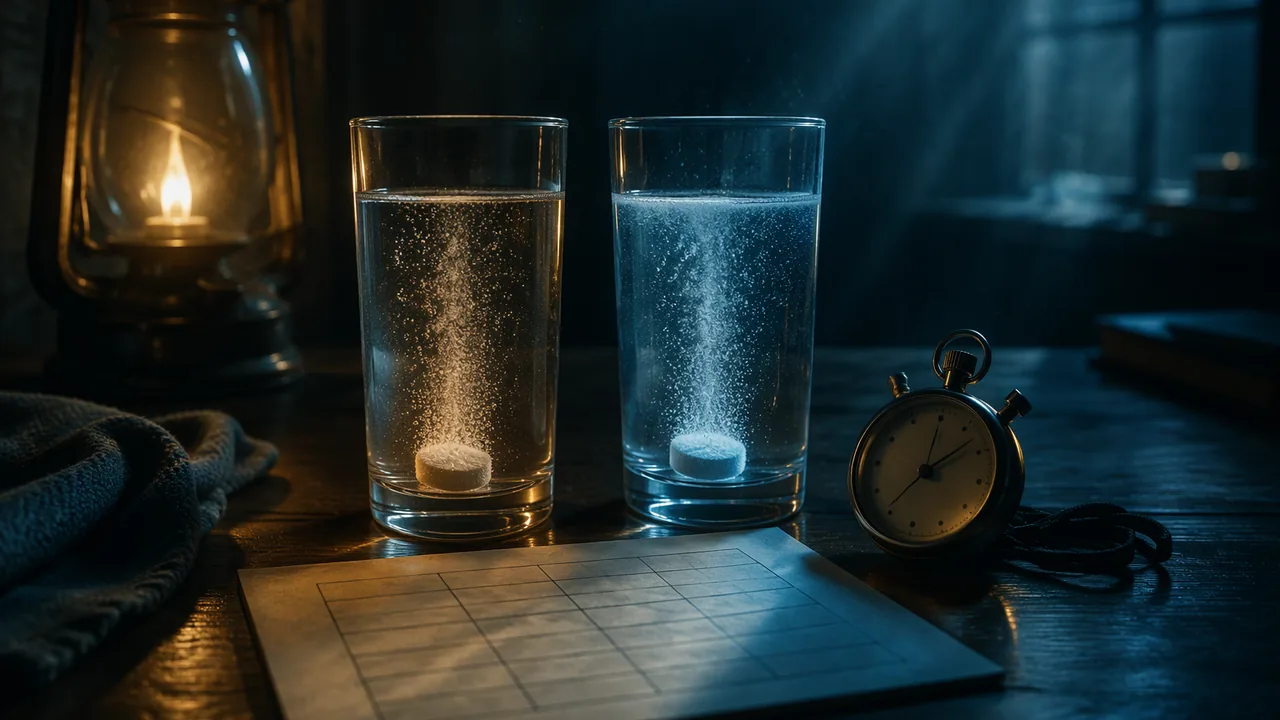
The Missouri question. A tablet dropped into water fizzes for a minute or two. The same tablet in ice water seems to fizz forever, and in warm water it is gone in seconds. The Missouri food-safety rule you met in Lesson 2.1 rests on exactly this kind of pattern. In this lesson you measure the pattern yourself, or analyze a complete recorded data set, and turn timing data into rates and an activation energy.
Controlling variables. A fair test changes one factor and holds the others constant. For temperature, use the same tablet brand, the same 200 mL of water, the same stirring (none), and start the timer when the tablet touches the water. For concentration, change only the fraction of vinegar and keep the baking soda, the cup and the temperature the same. Use at least three trials at each setting, because hand timing is uncertain.
From times to rates. A tablet of fixed size reacts completely, so the same amount reacts in every trial and the rate is proportional to 1 ÷ (time to finish). In the recorded data the rate is written as 1000 ÷ mean time, in units of 10−3 s−1. A shorter time is a larger rate.
Worked example 1: a rate from trial times. At 35 °C the three times are 37 s, 39 s and 37 s. The mean is (37 + 39 + 37) ÷ 3 = 37.7 s, so the rate is 1000 ÷ 37.7 = 26.5 × 10⁻³ s−1. At 20 °C the mean time is 92.7 s and the rate is 10.8 × 10⁻³ s−1. The rate at 35 °C is 26.5 ÷ 10.8 = 2.46 times the rate at 20 °C.
Worked example 2: an activation energy from two temperatures. Rearranging the Arrhenius ratio gives Ea = R ln(k2/k1) ÷ (1/T1 − 1/T2). Using 20 °C (293.15 K, rate 10.79) and 50 °C (323.15 K, rate 61.35): ln(61.35 ÷ 10.79) = 1.738, and 1/293.15 − 1/323.15 = 3.167 × 10⁻⁴ K−1. Ea = (8.314)(1.738) ÷ 3.167 × 10−4 = 45,633 J/mol, which is 45.6 kJ/mol (three significant figures: 45.6). A straight line through all four points of ln(rate) against 1/T uses all of the data and gives 45.5 kJ/mol.
Concentration. In the vinegar data the mean time at 100% vinegar is 69.3 s and at 50% it is 143.0 s, so the rate falls from 14.43 to 6.99, a factor of 2.06. Halving the concentration roughly halves the rate, which fits the collision picture: half as many acid particles means about half as many collisions per second.
Reading a result honestly. At 5 °C the three recorded times are 252 s, 246 s and 262 s, a spread of 6.3% of the mean. Any conclusion has to be larger than that scatter. The change from 20 °C to 35 °C is a factor of 2.46, far beyond the scatter, so the temperature effect is real; a difference of 1 s between two trials is not.
Try it. Do the lab below with an adult nearby, or use the full recorded data in this lesson’s reading. Either way, finish with a table of mean times and rates, a graph of rate against temperature, and a claim about Ea backed by your numbers.
📖 Read for this lesson
The reading opens over the lesson; close it to come back to exactly where you were. The checks below draw on it.
Lab: Timing an Effervescent Tablet at Four Water Temperatures, and Baking Soda in Four Vinegar Strengths
Question. How do water temperature and the concentration of vinegar change the rate of a gas-producing reaction, and what activation energy do your temperature data suggest?
Materials
- Four effervescent antacid tablets of the same brand for each temperature (12 in all), or fewer if you do one trial per temperature
- A kitchen thermometer, a timer or phone stopwatch, a measuring cup marked in mL, and four clear cups or glasses
- Ice, cold tap water, and warm tap water (never hotter than 50 °C; check with the thermometer)
- Baking soda, white vinegar and a 1/4-teaspoon measure for Part B; paper towels for spills
- Safety glasses or goggles
- An adult supervises the whole investigation. Wear safety glasses, because fizzing liquid can splash.
- Nothing is tasted or swallowed. Do not eat any tablet, and do not drink any mixture; throw it all down the drain with water.
- Do not use water hotter than 50 °C and do not heat anything on a stove or flame. Keep the cups on a tray or in a sink.
- Wash your hands after you finish. Keep tablets away from young children and pets.
Procedure
- Prepare four cups with 200 mL of water each at about 5 °C (water with ice, ice removed before timing), about 20 °C, about 35 °C and about 50 °C. Read the thermometer in each cup and write the actual temperature in your table.
- Drop one tablet into the 20 °C cup and start the timer at the moment it touches the water. Stop the timer when the last visible bubbles stop. Record the time to the nearest second.
- Repeat for the other temperatures. Do three trials at each temperature using fresh water each time; rinse the cup between trials.
- Part B: Set out four cups at room temperature with 100 mL of liquid each: 100 mL vinegar; 75 mL vinegar + 25 mL water; 50 mL vinegar + 50 mL water; 25 mL vinegar + 75 mL water. Add 1/4 teaspoon of baking soda to each in turn, start the timer and stop it when the fizzing stops. Record three trials each.
- Calculate each mean time, then the rate = 1000 divided by the mean time (in units of 10^-3 per second). Also calculate 1/T in K^-1 (T in kelvin = temperature in °C + 273.15) and ln(rate in s^-1).
Data
| Water temperature (°C) | Time 1 (s) | Time 2 (s) | Time 3 (s) | Mean time (s) | Rate (× 10−3 s−1) |
|---|---|---|---|---|---|
| about 5 | ____ | ____ | ____ | ____ | ____ |
| about 20 | ____ | ____ | ____ | ____ | ____ |
| about 35 | ____ | ____ | ____ | ____ | ____ |
| about 50 | ____ | ____ | ____ | ____ | ____ |
| Vinegar (% of 100 mL) | Time 1 (s) | Time 2 (s) | Time 3 (s) | Mean time (s) | Rate (× 10−3 s−1) |
|---|---|---|---|---|---|
| 100 | ____ | ____ | ____ | ____ | ____ |
| 75 | ____ | ____ | ____ | ____ | ____ |
| 50 | ____ | ____ | ____ | ____ | ____ |
| 25 | ____ | ____ | ____ | ____ | ____ |
Analysis
- Graph rate against temperature, and ln(rate) against 1/T. Draw the best straight line through the second graph and use its slope to estimate the activation energy, Ea = −slope × 8.314 J/(mol·K).
- By what factor does the rate change from your coldest to your warmest water? Explain the factor with collision theory, including the fraction of collisions with enough energy.
- Describe how the rate depends on the vinegar fraction. Does halving the concentration roughly halve the rate? Support your answer with two of your rates.
- Identify your largest source of uncertainty and say how you would reduce it.
If you cannot do this lab in person: No supplies, or you want to check yourself? Use the complete recorded data set in this lesson’s reading (Parts A and B with three trials each) and do every analysis question with those numbers.
Formative check
Work through these before moving on. They are not graded — they tell you whether the standard below has landed yet.
You time a tablet at 20 °C and at 35 °C. The time at 35 °C will be
At 35 °C the mean time was 37.7 s, so the rate is × 10−3 s−1 (three significant figures).
To test only the effect of temperature on the tablet, which setup is the fair one?
Using the recorded data in this lesson’s reading (or your own), calculate the rate at 5 °C and at 50 °C, then the activation energy from those two points with Ea = R ln(k2/k1) ÷ (1/T1 − 1/T2). Compare it with the 45.5 kJ/mol from the all-points line and say how much confidence you place in each.
How confident are you that you can turn timing data into rates and an activation energy and explain the temperature and concentration trends?
Practice
Work these on paper or in your notebook, then open Check your answer. Aim for all of Fluency and Application; try at least one Challenge.
Printable version: this unit’s practice workbook (PDF)
Fluency
Build speed and accuracy with the core skill.
- Three trials give 90 s, 95 s and 93 s. Find the mean time to 0.1 s.
Check your answer
Answer: 92.7 s(90 + 95 + 93) ÷ 3 = 92.7 s. - Calculate the rate (1000 ÷ mean time) for the 20 °C data above.
Check your answer
Answer: 10.8 × 10⁻³ s−11000 ÷ 92.7 = 10.79, or 10.8 to three significant figures. - Convert 5 °C, 20 °C, 35 °C and 50 °C to kelvin.
Check your answer
Answer: 278.15 K, 293.15 K, 308.15 K, 323.15 KAdd 273.15 to each. - Name two variables you must hold constant in the tablet experiment when you change only the water temperature.
Check your answer
Answer: The volume of water and the brand and size of the tablet (also: no stirring, same start of the timer, same cup).
Application
Use the skill in context. Show your reasoning.
- Using the recorded rates 26.53 (35 °C) and 10.79 (20 °C), by what factor does the rate rise?
Check your answer
Answer: 2.46 times26.53 ÷ 10.79 = 2.46. - Calculate Ea from the 5 °C (3.95) and 35 °C (26.53) rates.
Check your answer
Answer: 45.2 kJ/molEa = 8.314 ln(26.53/3.95) ÷ (1/278.15 − 1/308.15) = 45,249 J/mol = 45.2 kJ/mol. - For vinegar fractions of 100% and 25% the recorded rates are 14.43 and 3.62. Find the ratio and say whether the rate looks proportional to concentration.
Check your answer
Answer: 3.98; yes, a four-fold concentration change gives about a four-fold rate change14.43 ÷ 3.62 = 3.98, close to 100 ÷ 25 = 4. - If the rate is proportional to the vinegar fraction, predict the time at 60% vinegar starting from the 100% mean time of 69.3 s.
Check your answer
Answer: about 116 sTime is inversely proportional to the rate, so 69.3 ÷ 0.60 = 115.5 s, about 116 s.
Challenge
Stretch problems. Expect to think before you write.
- The least-squares line through ln(rate) against 1/T for the four recorded points has slope -5,473 K and intercept 14.139. Use it to find the activation energy and then to predict the rate at 27 °C (300.15 K).
Check your answer
Answer: 45.5 kJ/mol; about 16.7 × 10⁻³ s−1Ea = −(slope)(8.314) = 45,500 J/mol. ln(rate) = 14.139 + (-5,473)/300.15 = -4.095, so rate = 0.01666 s−1 = 16.7 × 10⁻³ s−1. - The three 5 °C times spread over 6.3% of the mean. Explain whether this scatter could account for the difference between the 20 °C and 35 °C means (92.7 s and 37.7 s).
Check your answer
Answer: No. The difference is about 59% of the 20 °C mean, far larger than the 6.3% spread.(92.7 − 37.7) ÷ 92.7 = 0.59. - Describe an improvement that would make the vinegar experiment more reliable and say which uncertainty it reduces.
Check your answer
Answer: For example, use a digital kitchen scale to measure the baking soda by mass instead of by teaspoon, which reduces the variation in the amount of reactant.
Review
Keep earlier skills sharp.
- Baking soda is NaHCO3. Calculate its molar mass using 22.990, 1.008, 12.011 and 15.999 g/mol.
Check your answer
Answer: 84.01 g/mol22.990 + 1.008 + 12.011 + 3(15.999) = 84.006 g/mol. - NaHCO3 reacts with acid in a 1 : 1 ratio to give CO2. How many moles of CO2 can 2.00 g of baking soda release?
Check your answer
Answer: 0.0238 mol2.00 g ÷ 84.01 g/mol = 0.0238 mol. - What volume would that CO2 occupy at 298.15 K and 101.3 kPa? (R = 8.314 L·kPa/(mol·K))
Check your answer
Answer: 0.583 LV = nRT/P = (0.0238)(8.314)(298.15) ÷ 101.3 = 0.583 L.
Recorded Data: Reaction Rate vs. Temperature and Concentration (Home Lab)
SLS original illustrative data set for the Unit 2 home investigation, prepared and calculated 2026-11-15; no outside source · SLS original
Why this reading. It is a complete recorded data set for the effervescent-tablet and vinegar investigations, with the same procedure you follow at home. If you cannot do the wet lab, or you want to check your own results, use these numbers for every analysis question.
How the data were recorded
This is an illustrative data set prepared by SLS to show the size and shape of typical results from this procedure. It is not from a published study, and your own times will differ. Each trial dropped one effervescent antacid tablet into 200 mL of water at the stated starting temperature and recorded the seconds from the drop until the fizzing stopped. Water temperatures were held between 5 °C (ice bath) and 50 °C (warm tap water measured with a thermometer). Three trials were run at each temperature.
Part A: temperature
| Water (°C) | Water (K) | Time 1 (s) | Time 2 (s) | Time 3 (s) | Mean time (s) | Rate = 1000 ÷ mean (× 10−3 s−1) | 1000 ÷ T (K−1) | ln(rate in s−1) |
|---|---|---|---|---|---|---|---|---|
| 5 | 278.15 | 252 | 246 | 262 | 253.3 | 3.95 | 3.595 | -5.535 |
| 20 | 293.15 | 90 | 95 | 93 | 92.7 | 10.79 | 3.411 | -4.529 |
| 35 | 308.15 | 37 | 39 | 37 | 37.7 | 26.53 | 3.245 | -3.630 |
| 50 | 323.15 | 17 | 16 | 16 | 16.3 | 61.35 | 3.095 | -2.791 |
The mean times are rounded to 0.1 s and rates to 0.01. Rates are 1 ÷ mean time, in units of 10−3 per second, so a higher rate means a faster reaction.
Part B: concentration of vinegar
At room temperature (20 °C), 1/4 teaspoon of baking soda was added to 100 mL of mixed vinegar and water. The vinegar fraction is the percent of the 100 mL that was vinegar, the rest being water. The time is in seconds until the fizzing stopped.
| Vinegar (%) | Time 1 (s) | Time 2 (s) | Time 3 (s) | Mean time (s) | Rate (× 10−3 s−1) |
|---|---|---|---|---|---|
| 100 | 69 | 73 | 66 | 69.3 | 14.43 |
| 75 | 90 | 95 | 99 | 94.7 | 10.56 |
| 50 | 142 | 138 | 149 | 143.0 | 6.99 |
| 25 | 262 | 294 | 272 | 276.0 | 3.62 |
What the data show
- Between 20 °C and 35 °C the rate rises by a factor of 2.46.
- A straight line through the four points of ln(rate) against 1/T has a slope of -5,473 K. Multiplying by −R (8.314 J/(mol·K)) gives an apparent activation energy of 45.5 kJ/mol.
- Halving the vinegar fraction from 100% to 50% cuts the rate by a factor of 2.06; going from 100% to 25% cuts it by 3.98.
Reliability
At 5 °C the three times range from 246 s to 262 s, a spread of 6.3% of the mean. Hand timing and judging when “fizzing stops” are the largest sources of uncertainty, so trust the trends more than the last digit.
Sources: SLS illustrative data set (calculated; not from a published study) (sejal-learn.com)