explain, using polarity, hydrogen bonding and carbonate chemistry, how water dissolves rock, and calculate hardness and the amount of rock dissolved from USGS data.
Instruction
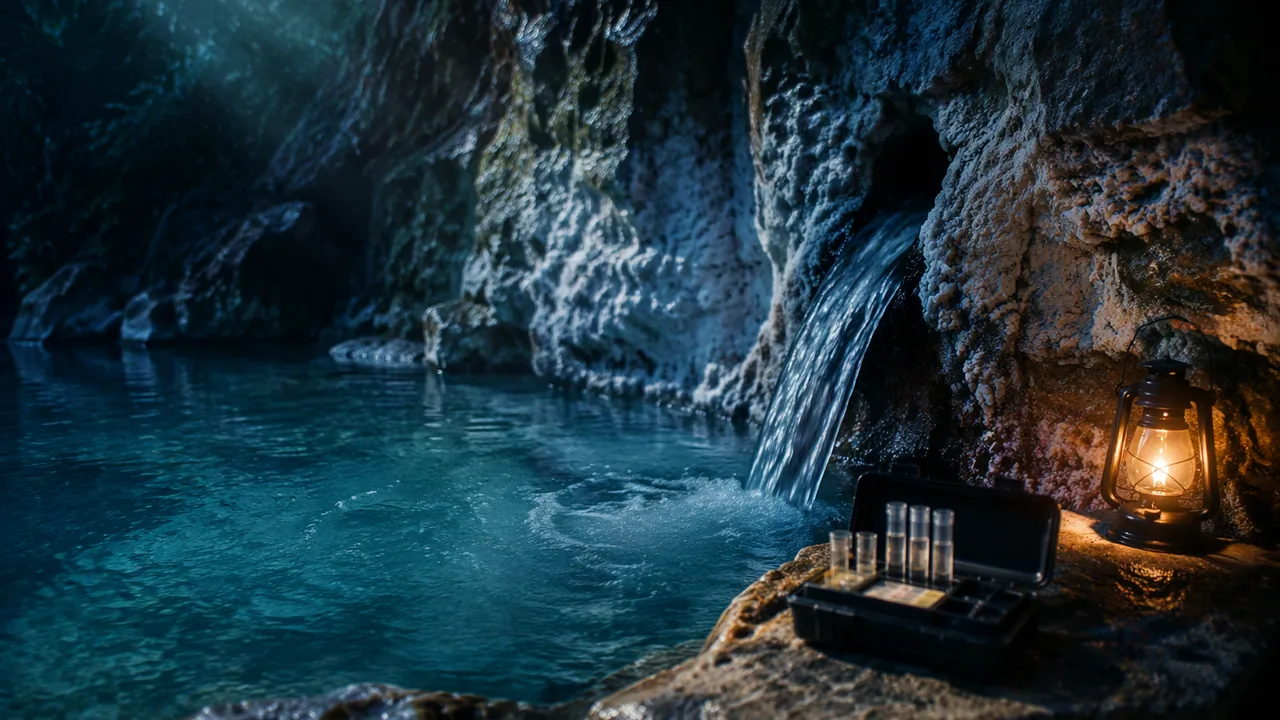
The phenomenon. Big Spring, in Carter County in the Missouri Ozarks, is the state’s largest spring by flow. The U.S. Geological Survey reports a mean annual discharge of 445 cubic feet per second, or about 288 million gallons per day, with a water temperature that stays between 13 and 15 °C all year. The water comes out of a dolostone bluff and falls on a recharge area of 426 square miles. Where does that water get its taste, its hardness and its power to carve caves? The answer starts with the water molecule itself.
Why water dissolves things. A water molecule is bent, and oxygen pulls the shared electrons toward itself, so the molecule has a partial negative end and a partial positive end. That polarity lets water surround and pull apart ionic compounds, and hydrogen bonds between neighboring molecules give water its high boiling point and its unusual solid, since ice is less dense than liquid water. Rain also carries dissolved carbon dioxide, and the resulting carbonic acid is just strong enough to attack carbonate rock. The reaction for dolomite, the main rock in the Big Spring area, is CaMg(CO3)2 + 2CO2 + 2H2O → Ca2+ + Mg2+ + 4HCO3−, balanced with 4 C, 12 O and 4 H on each side.
Hardness. Hardness measures dissolved calcium and magnesium, reported as if all of it were calcium carbonate (CaCO3, molar mass 100.086 g/mol). The USGS scale is: soft, 0 to 60 mg/L; moderately hard, 61 to 120; hard, 121 to 180; very hard, more than 180.
Worked example from USGS data. On 08/14/2001, with Big Spring flowing at 276 ft3/s, USGS measured calcium 39.8 mg/L and magnesium 23.2 mg/L. Convert to moles: Ca = 39.8 ÷ 40.078 = 0.993 mmol/L, and Mg = 23.2 ÷ 24.305 = 0.955 mmol/L. Hardness = (0.993 + 0.955) mmol/L × 100.086 g/mol = 195 mg/L as CaCO3, which is very hard. The Ca:Mg mole ratio is 1.04, close to 1, the signature of dolomite, because a mineral with one calcium for each magnesium dissolves in a 1:1 ratio, while limestone would give a much larger ratio.
Charge balance and bicarbonate. The positive charge is 2(Ca) + 2(Mg) = 2(0.993) + 2(0.955) = 3.90 meq/L, and bicarbonate is nearly the only negative ion, so [HCO3−] ≈ 3.90 mmol/L × 61.016 g/mol = 238 mg/L. (The sodium in the sample is only 2.1 mg/L, so ignoring it changes little.)
How much rock does the spring remove? At 276 ft3/s the flow is 276 × 0.028317 = 7.815 m3/s. Each cubic meter carries 0.993 mol of calcium, so the spring carries away 670,571 mol of dolomite each day, or 124 metric tons (molar mass 184.40 g/mol). USGS reports that the dissolved calcium and magnesium from Big Spring represent the dissolution of about 1,950 cubic feet of dolomite per day (a volume; changing it to a mass needs the rock’s density). Either way, a river of invisible ions is slowly carving a cave system.
Flow matters. When flow is high, runoff dilutes the groundwater: on 03/20/2002 the flow was 1,020 ft3/s and hardness dropped to 107 mg/L, moderately hard, about 55% of the 2001 value.
Your questions. What other Missouri waters do you expect to be harder or softer, and why? What would you measure to tell limestone from dolomite? Use this lesson’s reading, which holds the USGS data table, to write at least two data questions.
📖 Read for this lesson
The reading opens over the lesson; close it to come back to exactly where you were. The checks below draw on it.
Formative check
Work through these before moving on. They are not graded — they tell you whether the standard below has landed yet.
Rain is slightly acidic because it carries dissolved carbon dioxide. What does this do when it soaks into limestone or dolomite?
A Big Spring sample (03/20/2002) has calcium 21.8 mg/L and magnesium 12.7 mg/L. Its hardness is 107 mg/L as CaCO3. Using the USGS scale, this water is
A sample has calcium 31.7 mg/L and magnesium 18.0 mg/L. Its Ca:Mg mole ratio is (two decimal places), close to the 1:1 ratio of dolomite.
Using the data table in this lesson’s reading, choose any two Big Spring samples with different flows. Calculate hardness (mg/L as CaCO3) for each, classify it with the USGS scale, and explain the difference using the idea of dilution by quick flow.
How confident are you that you can explain, with polarity and a balanced equation, how water dissolves carbonate rock, and calculate hardness from mg/L of calcium and magnesium?
Practice
Work these on paper or in your notebook, then open Check your answer. Aim for all of Fluency and Application; try at least one Challenge.
Printable version: this unit’s practice workbook (PDF)
Fluency
Build speed and accuracy with the core skill.
- Calculate the molar mass of CaCO3 (Ca 40.078, C 12.011, O 15.999).
Check your answer
Answer: 100.09 g/mol40.078 + 12.011 + 3(15.999) = 100.086. - Water with 40.0 mg/L Ca2+ and no magnesium has what hardness as mg/L CaCO3, and what is its USGS class?
Check your answer
Answer: 99.9 mg/L; moderately hard40.0 ÷ 40.078 × 100.086 = 99.9 mg/L, within 61-120. - Convert 18.0 mg/L Mg2+ to mol/L.
Check your answer
Answer: 7.41 × 10⁻⁴ M18.0 mg = 0.0180 g; ÷ 24.305 g/mol = 7.41 × 10⁻⁴ mol per liter. - Is a hardness of 195 mg/L as CaCO3 soft, moderately hard, hard or very hard?
Check your answer
Answer: Very hard (more than 180 mg/L)
Application
Use the skill in context. Show your reasoning.
- USGS measured Ca 21.8 mg/L and Mg 12.7 mg/L at Big Spring on 03/20/2002 (1,020 ft3/s). Calculate the hardness and classify it.
Check your answer
Answer: 107 mg/L; moderately hard(21.8 ÷ 40.078 + 12.7 ÷ 24.305) × 100.086 = (0.544 + 0.523) × 100.086 = 106.7 mg/L. - For the 03/20/2002 sample, estimate the bicarbonate concentration by charge balance, using HCO3− = 61.016 g/mol.
Check your answer
Answer: 130 mg/L2(0.544) + 2(0.523) = 2.133 mmol/L × 61.016 = 130 mg/L. - For the 07/10/2002 sample (Ca 34.5 mg/L, Mg 19.5 mg/L) calculate the Ca:Mg mole ratio and say what it suggests about the rock.
Check your answer
Answer: 1.07; dolomite(34.5 ÷ 40.078) ÷ (19.5 ÷ 24.305) = 0.861 ÷ 0.802 = 1.07, near 1, as for dolomite CaMg(CO3)2. - At 276 ft3/s and 39.8 mg/L calcium, how many metric tons of dolomite (184.40 g/mol) dissolve per day? (1 ft3 = 0.028317 m3)
Check your answer
Answer: 124 t/dayQ = 276 × 0.028317 = 7.816 m3/s; Ca = 0.993 mol/m3; mol/day = 0.993 × 7.816 × 86,400 = 670,571; × 184.40 g/mol = 124 t.
Challenge
Stretch problems. Expect to think before you write.
- Hardness fell from 195 mg/L (276 ft3/s) to 107 mg/L (1,020 ft3/s). Calculate the ratio and explain it.
Check your answer
Answer: 0.55 (about 55%); quick flow from runoff dilutes the groundwater106.7 ÷ 194.9 = 0.55. At high flow, runoff has had less time to dissolve rock, so it dilutes the ion-rich base flow. - Write the balanced equation for dolomite dissolving in water containing CO2, and find the mass of HCO3− formed from 1.00 mol of dolomite.
Check your answer
Answer: CaMg(CO3)2 + 2CO2 + 2H2O → Ca2+ + Mg2+ + 4HCO3−; 244 g4 mol HCO3− per mole of dolomite × 61.016 g/mol = 244.1 g.
Review
Keep earlier skills sharp.
- A balloon holds 5.0 L at 25 °C. At constant pressure, what is its volume at -20 °C?
Check your answer
Answer: 4.25 LCharles’s law with absolute temperature: convert to kelvin (add 273.15) before dividing. - What is [H+] of normal rain at pH 5.6?
Check your answer
Answer: 2.5 × 10⁻⁶ M10−5.6 = 2.5 × 10⁻⁶ M. - Why is the zinc-copper lemon cell’s voltage predicted to be 1.10 V?
Check your answer
Answer: E°cell = 0.34 − (−0.76) = 1.10 V.
Big Spring, Missouri: USGS Water-Chemistry Data
USGS Scientific Investigations Report 2007-5049, Table 9 and text; USGS Water Science School, Hardness of Water; retrieved 2026-11-15; SLS calculated columns · Public domain (USGS data), with SLS commentary and calculations
Why this reading. The lesson’s argument is about what controls the chemistry of Big Spring. This reading gives five real USGS water samples taken at different flows, the USGS facts about the spring, and calculated hardness, Ca:Mg ratio and bicarbonate for each, so you can test the dolomite claim yourself.
Facts from USGS Scientific Investigations Report 2007-5049
- The mean annual discharge of Big Spring is 445 cubic feet per second, or 288 million gallons per day. The largest discharge measured in water years 1922 through 2004 was 1,170 cubic feet per second on December 7, 1982.
- Water temperature ranged from 13 to 15 °C during water years 2001 through 2004 and varied less than 1 °C through the year.
- The recharge area is 426 square miles, and the spring discharges from the base of a dolostone bluff.
- More than 130 water-quality samples have been collected since 1973. Forty-four samples plot along the line of carbonic-acid dissolution of dolomite and have Ca:Mg mole ratios of 1.00 to 1.18.
- The calcium and magnesium leaving the spring represent about 1,950 cubic feet of dolomite dissolved per day.
- Concentrations of most ions decrease as discharge increases, because quick flow of lower ionic strength dilutes the base flow.
USGS hardness scale (mg/L as CaCO3)
| Class | Range |
|---|---|
| Soft | 0 to 60 |
| Moderately hard | 61 to 120 |
| Hard | 121 to 180 |
| Very hard | more than 180 |
Table 9 values, Big Spring (USGS)
| Date | Discharge (ft3/s) | pH | Specific conductance (µS/cm) | Temperature (°C) | Ca (mg/L) | Mg (mg/L) | Na (mg/L) | Total dissolved solids (mg/L) |
|---|---|---|---|---|---|---|---|---|
| 03/22/2000 | 323 | 7.2 | 272 | 15.0 | 31.7 | 18.0 | 1.9 | 151 |
| 08/14/2001 | 276 | 7.5 | 351 | 15.0 | 39.8 | 23.2 | 2.1 | 182 |
| 07/10/2002 | 509 | 7.7 | 318 | 14.5 | 34.5 | 19.5 | 1.3 | 163 |
| 03/20/2002 | 1,020 | 7.3 | 204 | 13.6 | 21.8 | 12.7 | 1.1 | 108 |
| 03/27/2002 | 889 | 7.1 | 171 | 13.0 | 18.7 | 10.2 | 1.0 | 92 |
SLS calculated columns
Hardness = (Ca ÷ 40.078 + Mg ÷ 24.305) × 100.086. Bicarbonate is estimated by charge balance, 2(Ca) + 2(Mg) in mmol/L times 61.016 g/mol, ignoring minor ions.
| Date | Discharge (ft3/s) | pH | Temp (°C) | Ca | Mg | Na | Ca:Mg mole ratio | Hardness (mg/L as CaCO3) | HCO3− estimate (mg/L) |
|---|---|---|---|---|---|---|---|---|---|
| 03/22/2000 | 323 | 7.2 | 15.0 | 31.7 | 18.0 | 1.9 | 1.07 | 153 | 187 |
| 08/14/2001 | 276 | 7.5 | 15.0 | 39.8 | 23.2 | 2.1 | 1.04 | 195 | 238 |
| 07/10/2002 | 509 | 7.7 | 14.5 | 34.5 | 19.5 | 1.3 | 1.07 | 166 | 203 |
| 03/20/2002 | 1,020 | 7.3 | 13.6 | 21.8 | 12.7 | 1.1 | 1.04 | 107 | 130 |
| 03/27/2002 | 889 | 7.1 | 13.0 | 18.7 | 10.2 | 1.0 | 1.11 | 89 | 108 |
For the 08/14/2001 sample, 276 ft3/s × 0.028317 = 7.816 m3/s and 0.993 mol/m3 Ca give 670,571 mol of dolomite per day, or 124 metric tons at 184.40 g/mol.
Sources: USGS SIR 2007-5049: Recharge Area, Base-Flow and Quick-Flow Discharge Rates and Ages, and General Water Quality of Big Spring in Carter County, Missouri, 2000-04 (pubs.usgs.gov); USGS Water Science School: Hardness of Water (usgs.gov)