4.04 Lithium, Sunshine and Gas: Weighing Resources
evaluate competing ways of developing and using energy and mineral resources by comparing their costs, benefits and trade-offs, and argue for a choice with evidence.
- I can identify evidence about society’s need for a specific energy or mineral resource.
- I can describe the costs involved in extracting or developing an energy reserve or mineral resource.
- I can compare the costs and benefits of different design solutions, including the feasibility, costs, and benefits of recycling or reusing the resource when possible.
- I can evaluate the strengths of each design solution by analyzing their economic, environmental, and geopolitical costs, risks, and benefits.
- I can judge how reliable and valid the evidence is when comparing design solutions.
- I can identify and consider constraints such as cost, safety, reliability, aesthetics, cultural effects, and environmental effects when evaluating solutions.
- I can use logical arguments, supported by evidence and scientific ideas, to defend my choice of one design solution over others.
Phase 2: Investigate
Warm-Up ~5 min
Do Now. List every material in a phone that had to be dug out of the ground. Then circle the one you think is hardest to replace.
A gas plant sells electricity for less per MWh than a solar farm with batteries. Is gas therefore the cheapest choice for the town?
Instruction ~10 min
Every resource has a cost. All energy and all materials come from Earth: fuels, metals, the silicon in solar panels, the lithium in batteries. No option is free of impacts. The science question is not “Is it good or bad?” but “What are its costs and benefits, and for whom?”
Energy resources for a region. Sunlight is abundant in deserts and dry valleys, but solar panels produce nothing at night, so a reliable supply needs storage, usually lithium-ion batteries. Natural gas plants can run whenever needed but emit carbon dioxide and air pollutants. Geothermal plants, which tap hot water and steam, run day and night with low emissions, but only where Earth’s heat is close to the surface, near plate boundaries and volcanic areas. Iceland, which sits on a mid-ocean ridge, heats most of its homes with geothermal water.
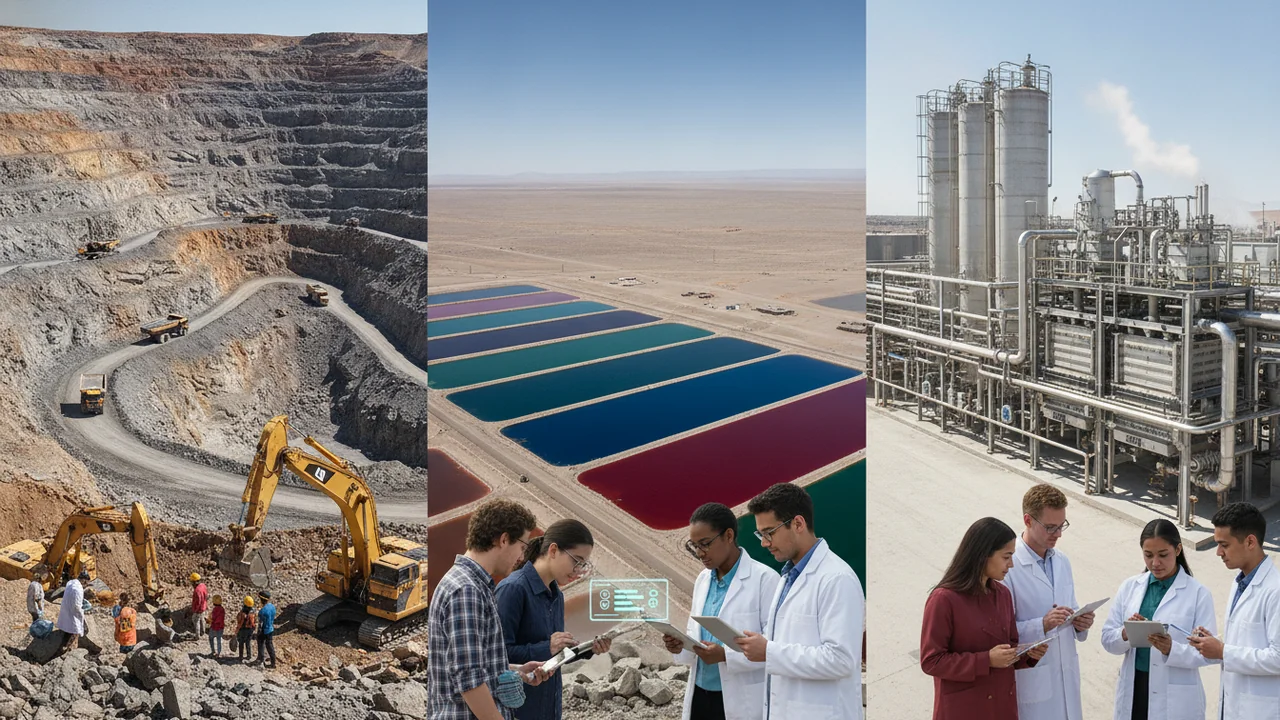
Mineral resources: lithium. Lithium for batteries comes from three main kinds of deposit. Hard-rock mines, the largest of them in Australia, dig large open pits. Evaporation ponds on the salt flats of South American deserts pump up brine and let the sun evaporate it, using large amounts of scarce water. And in some geothermal fields, the hot brine pumped up to make electricity carries dissolved lithium; companies are testing ways to extract it directly before the brine is reinjected underground. Supporters point to lithium with little surface mining and to local jobs. Concerns include water and chemical use, whether the technology works at scale, and whether nearby communities, some of them low-income and already living with environmental problems, will share the benefits. Recycling old batteries is a fourth source that grows as more batteries reach the end of their life.
Worked example 1: a cost-benefit comparison (illustrative round numbers, not quotes from any project). A town needs 100,000 MWh of electricity a year. Suppose solar with battery storage costs $70 per MWh, a natural gas plant $60 per MWh, and geothermal $80 per MWh. Gas also emits roughly 0.4 metric tons of CO2 per MWh, or 40,000 tons a year. If each ton of CO2 causes an estimated $100 of damage (an illustrative value; published estimates vary widely), gas carries a hidden $4,000,000 a year. Totals: solar with storage $7.0 million, geothermal $8.0 million, gas $6.0 million + $4.0 million = $10.0 million. If the benefit (reliable power) is the same, the benefit-cost ratio is highest for the option with the lowest full cost.
Worked example 2: what the numbers leave out. A good analysis also lists what is hard to price: land (100,000 MWh of solar at a 25% capacity factor needs about 46 MW of panels, on the order of 100 hectares), wildlife, water, local air quality, jobs, cultural sites, and reliability during a heat wave. Different people weigh these differently, which is why resource decisions are argued in public.
Decisions change over time. The best choice today may not be the best in ten years. When battery costs fall, recycling improves, or a new extraction method is proven at scale, the costs and risks shift, and so can the decision. A strong argument says what new evidence would change its recommendation.
Your argument. Show your numbers, state your assumptions, judge how reliable each number is, and name who gains and who pays.
Reading: Earle, Physical Geology, chapter 20.
Guided Exercises ~15 min
Work with a partner. Show every calculation.
Independent Practice ~10 min
Build the table and write the argument.
Build a cost-benefit table for three options for one decision: either supplying the town's electricity (solar with storage, natural gas, geothermal) or supplying lithium for batteries (geothermal brine, a hard-rock mine, evaporation ponds, recycling). Include at least one priced cost and two unpriced costs or benefits for each, and rate how reliable each number is.
Write a CER argument for one option. State your assumptions, name who gains and who pays, answer a classmate's objection, and say what new evidence or technology would change your choice.
Closure ~5 min
Every option costs something; the job is to count honestly. Next phase we test solutions to hazards we cannot start on purpose.
How confident are you that you can I can evaluate energy and mineral options with cost-benefit ratios and argue for a choice.
Exit ticket: which option had the best benefit-cost ratio in your table, and what unpriced cost could change the town's mind?
Teacher notes
Materials: cost-benefit table template, calculators, argument organizer.
Facts to keep careful: all prices, the 0.4 t per MWh factor and the $100 per ton damage value are illustrative round numbers, as Poly labeled them. Real costs change year to year; do not present them as quotes.
Listen for: “solar has no impacts” or “gas is cheapest, end of story”; arguments that leave out who pays; numbers with no stated assumption.
Support / stretch: give the table with the priced row filled for one option. Stretch: show at what carbon damage value gas and solar with storage cost the same.