2.05 The Greenhouse Effect by the Numbers
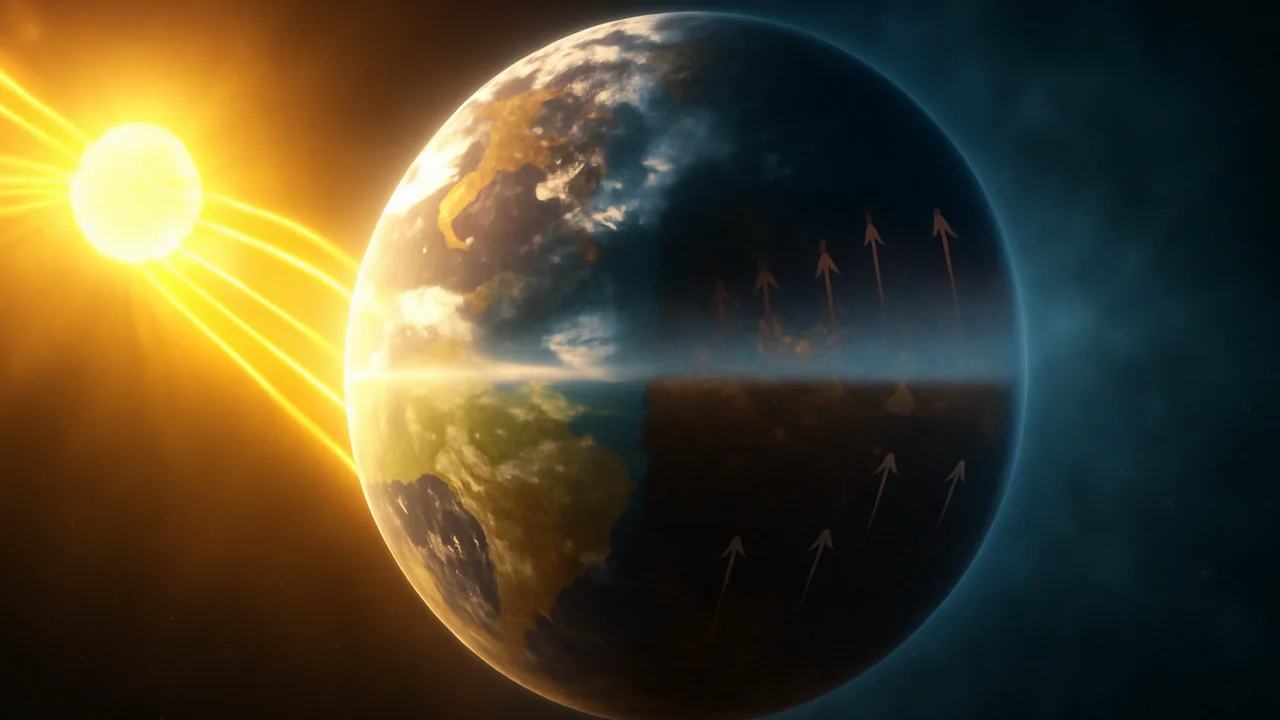
use the Stefan-Boltzmann law and an energy-balance model to calculate Earth’s temperature without greenhouse gases, and explain how greenhouse gases and albedo change the flow of energy and the climate.
- I can use a climate model to explain how specific factors cause changes in the flow of energy into and out of Earth’s systems, and how the combined effects of these factors lead to changes in climate such as surface temperature, precipitation patterns, glacial ice volume, sea level, and biosphere distribution.
- I can identify and describe the parts of a climate model that affect how energy enters, leaves, and is stored or moved within Earth’s systems, including factors like Earth’s orbit, sun’s energy output, tectonic activity, ocean and atmospheric circulation, volcanic activity, glaciation, vegetation cover, atmospheric composition, and human activities.
Phase 3: Make Sense
Warm-Up ~5 min
Do Now. A car parked in the sun with its windows shut gets much hotter inside than the air outside. Where does the energy come from, and why does it not leave as fast as it came in?
If Earth had no greenhouse gases at all, what would its average surface temperature be?
Instruction ~10 min
Balance. Over time, a planet must lose as much energy as it gains; otherwise it keeps warming or cooling until it does. That simple idea lets us calculate what Earth’s temperature should be.
Energy in. Sunlight arrives at 1,361 W per square meter facing the Sun. Earth intercepts it over a disc of area πR2 but spreads it over a sphere of area 4πR2, so the average per square meter of surface is 1,361 / 4 ≈ 340 W/m2. Earth reflects about 30% of it (its albedo is about 0.30), from clouds, ice and bright surfaces. Absorbed: 1,361 × (1 − 0.30) / 4 ≈ 238 W/m2.
Energy out. Every object emits infrared radiation according to its temperature. The Stefan-Boltzmann law gives the power per square meter: P = σT4, with σ = 5.67 × 10⁻⁸ W/(m2·K4) and T in kelvin.
Worked example 1: Earth without greenhouse gases. Set energy out equal to energy in: σT4 = 238. Then T4 = 238 / (5.67 × 10⁻⁸) ≈ 4.2 × 10⁹, and T ≈ 255 K, or about −18 °C. But Earth’s actual average surface temperature is about 288 K (15 °C). The difference, about 33 °C, is the natural greenhouse effect. Without it, the oceans would freeze.
How the greenhouse effect works. Sunlight is mostly visible light, which passes through the air and warms the surface. The warm surface emits infrared radiation: at 288 K, σT4 ≈ 390 W/m2, far more than the 238 W/m2 that finally leaves the top of the atmosphere. The difference is caught on the way out. Molecules with three or more atoms, or two different atoms, such as water vapor (H2O), carbon dioxide (CO2) and methane (CH4), bend and stretch in ways that absorb infrared energy and then re-emit it in all directions, including back down. Nitrogen and oxygen, 99% of the air, do not. So the surface receives energy from both the Sun and the atmosphere, and it warms until the energy escaping to space again equals the energy absorbed. The name is misleading: a real greenhouse stays warm mainly by stopping warm air from rising away, not by absorbing infrared.
Worked example 2: changing the balance.
- Albedo. If the albedo fell from 0.30 to 0.25 (less ice and snow), the no-greenhouse temperature would rise from 255 K to about 259 K; if it rose to 0.35 (more cloud or ice), it would fall to about 250 K.
- More greenhouse gases. Adding CO2 makes it harder for infrared to escape, so for a while less energy leaves than arrives. Satellites measure Earth now gaining roughly 1 W/m2 more than it loses, and most of that extra energy goes into the ocean, which, as our sand-and-water lab showed, can store a great deal of energy with a small temperature change.
Feedbacks. Warming increases evaporation, and more water vapor, itself a greenhouse gas, adds more warming: a reinforcing feedback. Melting snow and ice lowers albedo: another. Doubling CO2 alone (3.7 W/m2) would warm Earth by only about 1 °C; with feedbacks, the IPCC’s best estimate is about 3 °C, with a likely range of 2.5–4 °C. Those warmer temperatures go on to change rainfall patterns, glacial ice, sea level and where species can live.
Guided Exercises ~15 min
Model the planet, then check your numbers.
Independent Practice ~10 min
Explain with the model.
In three or four sentences, explain what happens to the energy flows, and then to surface temperature, when CO₂ increases. Name two climate results of that warming beyond temperature, such as sea level or glacial ice.
Explain how a reinforcing feedback from melting snow and ice would change your albedo calculation.
Closure ~5 min
A planet, a coastline and a schoolyard all obey the same energy budget. Next lesson we connect them and start designing.
How confident are you that you can I can calculate Earth's energy balance and explain how greenhouse gases and albedo change climate.
Exit ticket: in one sentence each, how does albedo change energy in, and how do greenhouse gases change energy out?
Teacher notes
Timing: spans two 50-minute periods: day 1 the energy-balance math and worked examples; day 2 the PhET simulation, diagram and explanations.
Materials: devices for the PhET Greenhouse Effect simulation, scientific calculators (fourth roots: raise to the power 0.25).
Listen for: “greenhouse gases trap sunlight” (they absorb outgoing infrared); “the ozone hole causes global warming.”
Support / stretch: a step-by-step calculation card. Stretch: build the energy balance in a spreadsheet with albedo as a user-controlled cell.