1.10 Unit 1 Checkpoint: Earth’s Systems and Our Water
show what I know about Earth-system feedbacks, how water moves through Earth materials, how resources shape societies, and how a basin simulation guides decisions.
- I can use analyzed data to describe how feedback between two Earth systems works and explain whether the feedback is positive (increasing the original change) or negative (decreasing the original change).
- I can plan an investigation that includes collecting data about the heat capacity, density, and polarity of water.
- I can explain how the properties of water affect energy transfer, temperature patterns, air movement, and water movement at Earth’s surface.
- I can identify and plan to collect data showing the mechanical and chemical effects of water on Earth materials, such as erosion, weathering, and changes in rock.
- I can use my simulation results to illustrate how changing one component affects others, analyze the effects of technology on interactions among human populations, natural resources, and biodiversity, and identify feedbacks that stabilize or destabilize the system.
Phase 5: Prove It
Warm-Up ~5 min
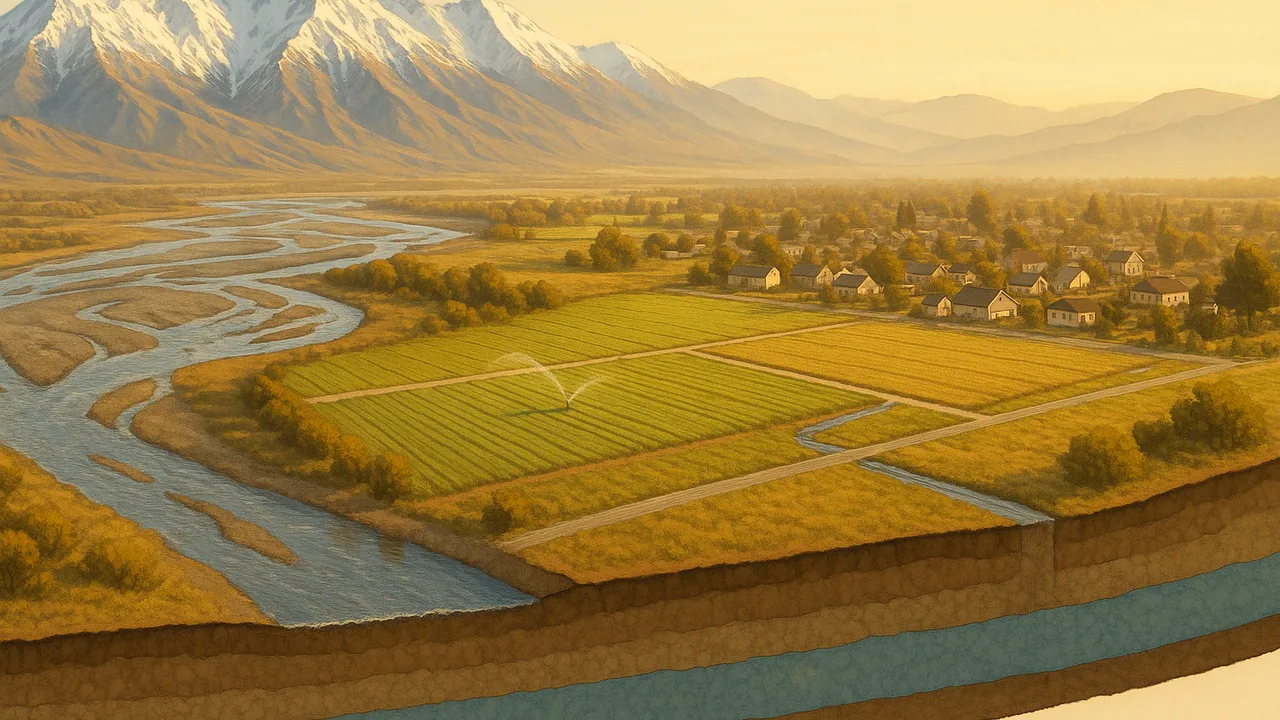
Do Now. Back to our phenomenon: a snow-poor winter, a thirsty valley and sinking ground. In two sentences, connect the three.
Refilling an overdrawn aquifer reverses all of the land subsidence it caused.
Instruction ~10 min
How the checkpoint works. Part A is multiple choice on data, including a scenario set where several questions share one situation. Part B is short constructed responses, each scored 0–3. Read each question twice and show your reasoning.
How a 0–3 answer is scored. 3: a correct claim, accurate evidence with numbers where they apply, and reasoning that names the mechanism. 2: correct claim and evidence, weak or missing mechanism. 1: a partly correct claim with little support. 0: incorrect or blank.
Worked example: from 1 point to 3. Question: “Why does clay make a poor aquifer?” “Water doesn’t go through” earns 1. “Clay has high porosity, about 40–60%, but tiny pores where water clings to grains, so its permeability is very low and wells cannot draw water from it fast enough” earns 3.
Scenario set data (sample data) for questions 6–9. A different valley’s basin records.
| Year | Snowpack (% of average) | Pumping (thousand acre-feet) | Storage change (thousand acre-feet) | Ground sinking (cm) |
|---|---|---|---|---|
| 1 | 110 | 300 | +40 | 1 |
| 2 | 45 | 480 | −210 | 9 |
| 3 | 30 | 520 | −260 | 12 |
| 4 | 160 | 280 | +150 | 2 |
| 5 | 70 | 420 | −120 | 6 |
Lab data for question 3 (sample data). 100 mL samples: Material X took 36 mL to fill its pores and drained in 9 s; Material Y took 52 mL and drained in 400 s.
Guided Exercises ~15 min
Part A: answer on your own. Your teacher reviews answers after everyone finishes.
Independent Practice ~10 min
Part B: constructed responses, each scored 0–3.
13. Using the scenario-set data, describe one feedback between the hydrosphere and the geosphere. Say whether it is reinforcing or balancing, and name one limitation of the data. (0–3)
14. Plan an investigation to test whether a mix of gravel and sand drains faster than sand alone. Name the variables, the measurements, how you will check precision, and how the result would apply to a real aquifer. (0–3)
15. Explain how deep wells changed the relationship between a dry valley's people and its water, including one benefit, one unintended effect and one piece of evidence. (0–3)
16. A district must choose between a 20% pumping cut and recharge ponds. Describe how you would use a simulation to compare them, including one biodiversity measure, and one way the simulation differs from the real basin. (0–3)
Closure ~5 min
Unit 1 is done. Next unit we follow energy instead of water: why are some places so much hotter than others?
How confident are you that you can I can explain how Earth's systems, water and human choices shape a basin's future.
Exit ticket: which question was hardest, and which lesson would you revisit to prepare for it?
Teacher notes
Setup: about 40 minutes for Parts A and B, then a short review. Calculators allowed.
Item tags: HS-ESS2-2: 1, 6, 7, 9, 13 (1a, 1b, 2a, 3a, 3c), 15 (2b, 3b). HS-ESS2-5: 2, 3, 4, 14 (1a, 2a, 2b, 3a, 3b, 4a, 5a, 5b, 5c). HS-ESS3-1: 8, 10, 15 (1a, 2a, 2b, 3a, 3b). HS-ESS3-3: 5, 11, 12, 16 (1a, 2a, 2b, 2c, 3a, 3b, 3c). Use the tags to regroup students for review.
Scoring 14: 3 = named variables, measurements, a precision check (repeat trials) and a judgment about applying cup results to an aquifer, including whether to work alone or in a group.
Listen for: “high porosity means a good aquifer”; correlation treated as cause. All scenario and lab numbers are sample data.
Support: read items aloud on request; allow a formula card for porosity and the storage rule.