3.03 Carbon Dioxide Meets the Ocean
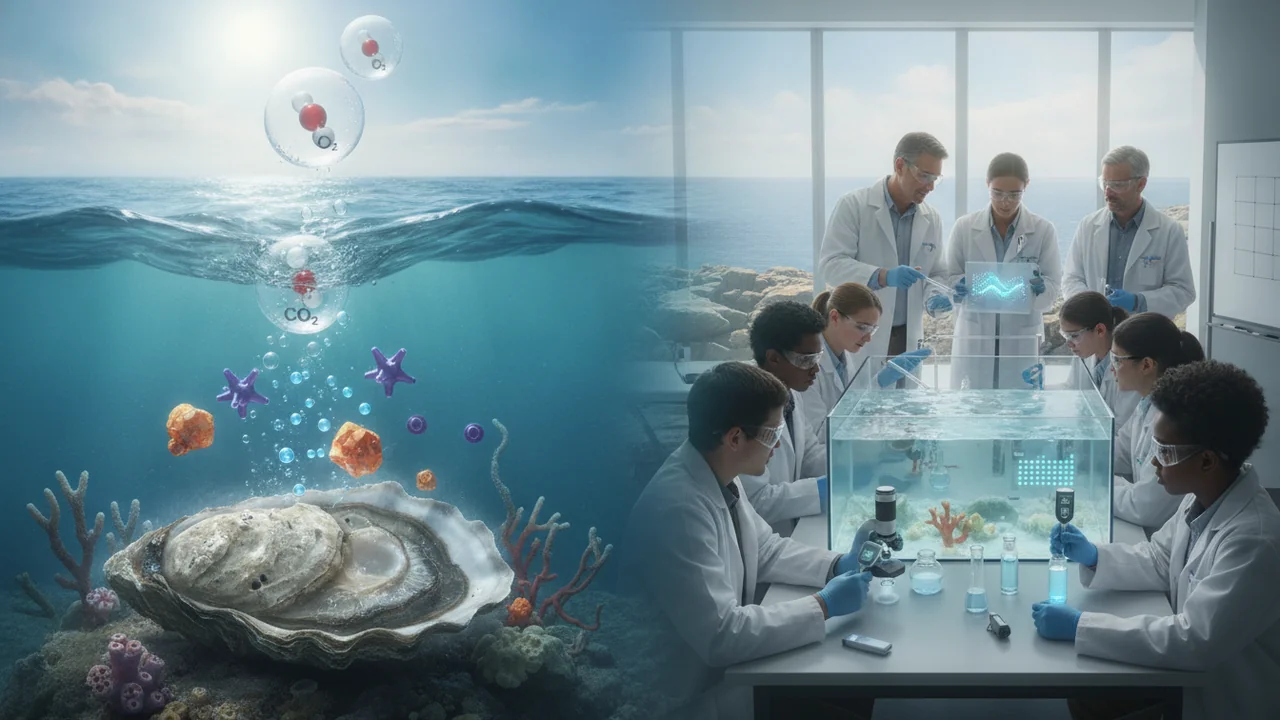
investigate how carbon dioxide dissolves in water, acidifies it and dissolves carbonate shells, and use a quantitative model of carbon reservoirs and flows to explain where emitted carbon goes.
- I can identify and compare the amounts of carbon found in the hydrosphere, atmosphere, geosphere, and biosphere.
- I can create a model that shows how carbon moves between the hydrosphere, atmosphere, geosphere, and biosphere.
- I can use a model to describe how carbon cycles between the hydrosphere, atmosphere, geosphere, and biosphere.
- I can explain the amounts and rates at which carbon moves between different spheres of the Earth.
- I can show in my model how plants capture carbon dioxide and how human activities increase carbon dioxide in the atmosphere, affecting the climate.
Phase 2: Investigate
Warm-Up ~5 min
Do Now. You open a warm can of seltzer and a cold one. Which fizzes more? Write your answer and a reason, then write what the bubbles are made of.
People emit about 11 GtC a year. About how much of it stays in the atmosphere?
Instruction ~10 min
Carbon moves. Carbon is stored in reservoirs and moves between them in fluxes. A quantitative model of the carbon cycle tracks both, in gigatons of carbon (GtC). Approximate reservoir sizes, from the Global Carbon Budget and the IPCC’s assessments: the atmosphere about 900 GtC; living plants about 450 GtC and soils well over 1,500 GtC; the ocean about 38,000 GtC, most of it dissolved in deep water; and sedimentary rocks such as limestone tens of millions of GtC, by far the largest store. Fossil fuels are a small part of the rock reservoir: carbon that plants and plankton stored over millions of years.
Fast and slow cycles. Every year, photosynthesis and respiration move on the order of a hundred GtC in and out of the atmosphere, and the ocean surface exchanges a similar amount. Those fast flows nearly balance. The slow cycle, in which carbon moves into and out of rocks by weathering, burial, subduction and volcanoes, takes hundreds of thousands to millions of years. Burning fossil fuels short-circuits the slow cycle: it moves rock carbon into the air in decades.
Worked example 1: where does our carbon go? In recent years, fossil fuels and cement released about 10 GtC per year and land-use change (mostly deforestation) roughly 1 more, about 11 GtC in all. Over 2014–2024 the atmosphere gained 2.58 ppm per year, and 2.58 × 2.13 ≈ 5.5 GtC. So 5.5 / 11 ≈ 50% of emissions stayed in the air: this is the airborne fraction. The rest, roughly half, was taken up in about equal shares by the ocean and by land plants and soils. Carbon is conserved: every gigaton emitted ends up in some reservoir.
The ocean’s chemistry. Carbon dioxide dissolves in seawater and forms carbonic acid: CO2 + H2O → H2CO3, which releases hydrogen ions. More hydrogen ions mean lower pH. The pH scale is logarithmic: a drop of 1 unit means 10 times the hydrogen-ion concentration. Worked example 2. Surface ocean pH has fallen by about 0.1 since pre-industrial times, and 100.1 ≈ 1.26, a rise of about 26% in hydrogen ions (often reported as about 30%, since the drop is slightly more than 0.1). This is ocean acidification. The extra hydrogen ions also use up carbonate ions that corals, oysters, sea urchins and tiny plankton need to build calcium carbonate shells. Along coasts with strong upwelling, deep water that is naturally rich in carbon dioxide rises to the surface, so acidification adds to an existing stress: oyster hatcheries on the Pacific coast of North America have reported losing larvae when corrosive water reached them.
Temperature and a feedback. Gases dissolve better in cold water. As the ocean warms, it can hold less carbon dioxide, so it takes up a smaller share of emissions: a reinforcing feedback between the hydrosphere and atmosphere.
Lab: Seltzer, shells and the acidifying ocean. Question: how does dissolved carbon dioxide change the pH of water and the rate at which calcium carbonate dissolves, and how does temperature affect how much carbon dioxide water holds? Seltzer is water with carbon dioxide dissolved under pressure: a model of an ocean that has absorbed a lot of it.
- Pour 100 mL of tap water and 100 mL of room-temperature seltzer into labeled cups. Measure and record the pH of each.
- Weigh two chalk or shell pieces of similar mass. Place one in each cup and observe for 5 minutes, then leave them for 24 hours.
- Next day, remove each piece, blot and air-dry it, weigh it, and compute the percent mass lost. Record the pH of each liquid again.
- Open the cold and the room-temperature seltzer bottles at the same moment and stretch a balloon over each neck at once. Shake each gently for 10 seconds, then measure the circumference of each balloon after 5 minutes.
- Record the temperature of each bottle and compare which released more carbon dioxide (larger balloon).
| Liquid | pH start | pH after 24 h | Shell or chalk start mass (g) | After 24 h (g) | Mass lost (%) |
|---|---|---|---|---|---|
| Tap water | |||||
| Seltzer |
| Seltzer bottle | Temperature (°C) | Balloon circumference after 5 min (cm) |
|---|---|---|
| Cold | ||
| Room temperature |
No materials? Place a piece of chalk or eggshell in seltzer and another in tap water at home and photograph them after 24 hours, or analyze the teacher’s data table and photographs from a class run.
Guided Exercises ~15 min
Answer during and after the lab. Use your own data where you can.
Independent Practice ~10 min
Write the lab conclusion and the model in your Forecast Notebook.
CER: how does dissolved carbon dioxide affect pH and shells? Use your pH readings and percent mass lost as evidence, and explain with the carbonic-acid reaction. Then explain what happened to the seltzer's pH after 24 hours open to the air and connect it to exchange between the ocean surface and the atmosphere.
Draw a quantitative carbon-cycle model with at least five reservoirs (atmosphere, ocean, plants, soils, rocks and fossil fuels) labeled with their sizes, and arrows for at least five fluxes. Show the human flux (about 11 GtC per year) and where it goes, check that the arrows add up, and mark the feedback you found in the lab.
Closure ~5 min
Half of our carbon stays in the air, and the ocean pays for taking the rest. Next lesson: how do we know the carbon is ours, and what is it doing to the sea?
How confident are you that you can I can investigate how carbon dioxide affects the ocean and use a quantitative carbon-cycle model to explain where emissions go.
Exit ticket: name three reservoirs, give a size for each, and explain where most of a year's 11 GtC of emissions ends up.
Teacher notes
Timing: this lab spans two 50-minute periods: day 1 setup, pH and the balloon test; day 2 mass loss, the carbon model and the CER.
Materials (per team): two bottles of plain unflavored seltzer (one refrigerated, one at room temperature), tap water, pH strips (range 4–9) or teacher-made red-cabbage indicator, four clear cups, plain white chalk or clean shell or eggshell pieces, a kitchen balance (0.01 or 0.1 g), two balloons, a tape measure, goggles.
Listen for: “the ocean will turn into acid” (it stays basic; it is becoming less basic); reservoir sizes confused with fluxes.
Support / stretch: give a partly drawn reservoir model with sizes placed. Stretch: use the balloon data to estimate the ratio of gas released by the warm and cold bottles. Reading: Earle, Physical Geology, chapter 19.