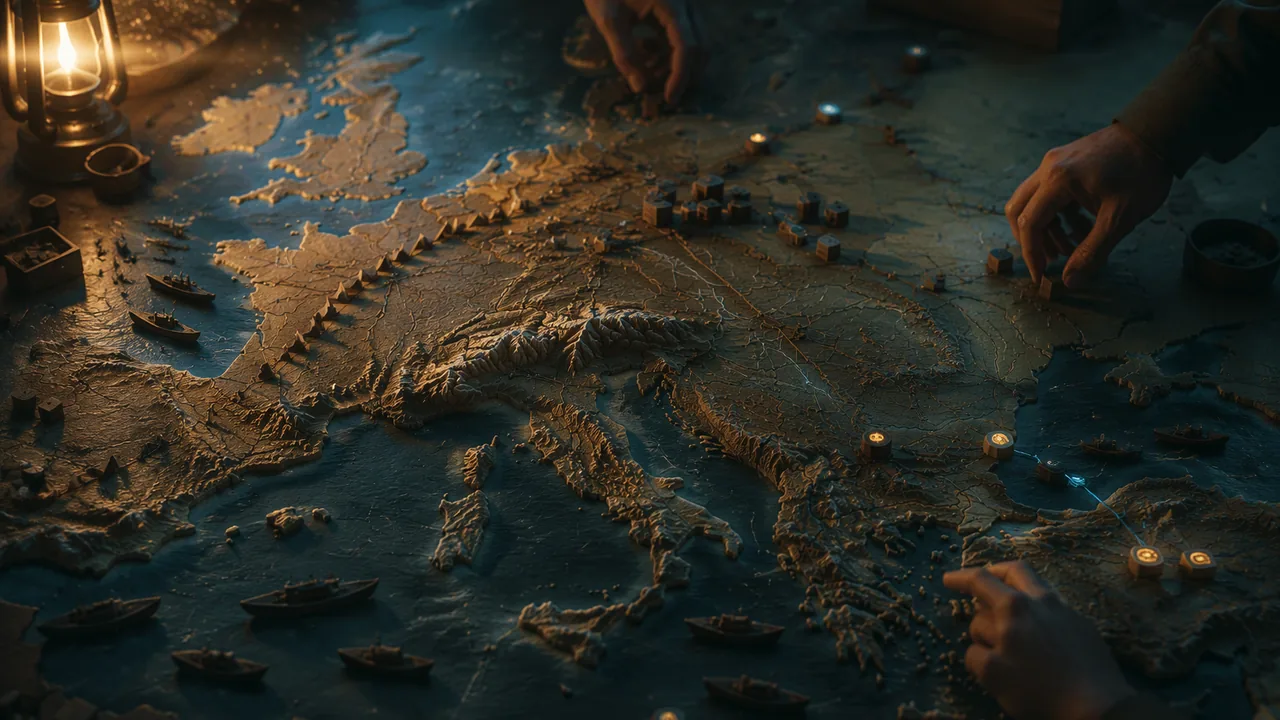
explain the principal theaters and turning points of the First World War and the role of geography, and explain how the Russian Revolution and the entry of the United States affected its course and outcome.
Instruction
Nearly everyone expected a short war in 1914. Geography and technology made it long.
The Western Front. Germany’s Schlieffen Plan sent armies through Belgium toward Paris. French and British forces stopped them at the Marne in September 1914. Both sides then tried to outflank each other until a line of trenches ran from the North Sea coast to the Swiss border. For three and a half years it barely moved. Why? Machine guns, artillery and barbed wire made defense far stronger than attack, and railways let defenders bring reserves to a threatened point faster than attackers could advance on foot. On the first day of the Battle of the Somme, 1 July 1916, the British army suffered about 57,000 casualties, including about 19,000 dead. At Verdun, from February to December 1916, French and German armies together lost hundreds of thousands of men.
The Eastern Front. Distances were vast and railways sparse, so armies moved more but were harder to supply. Germany crushed a Russian invasion at Tannenberg in 1914, and Russia suffered enormous losses over the next three years.
Waterways and other fronts. In 1915 the Allies tried to force the Dardanelles, the narrow straits leading to the Ottoman capital, to open a supply route to Russia. At Gallipoli, Ottoman forces held the high ground above the landing beaches, and after eight months the Allies withdrew; Australian and New Zealand (ANZAC) troops fought there, and the Ottoman commander Mustafa Kemal later founded modern Turkey. On the Italian front, armies fought in the Alps. In the Middle East, Britain encouraged an Arab Revolt against the Ottomans from 1916. In East Africa, a small German force evaded British and colonial armies until the war’s end, while the campaign’s heaviest burden fell on African porters. At sea, Britain’s blockade slowly starved Germany of food and materials, and German submarines (U-boats) attacked shipping around Britain.
Turning point 1: the Russian Revolution. By early 1917 Russia’s economy and army were collapsing. In February-March 1917, strikes and mutinies forced Tsar Nicholas II to abdicate. The new Provisional Government kept fighting, which made it unpopular. In October-November 1917 Lenin’s Bolsheviks seized power promising “peace, land and bread,” and in March 1918 signed the Treaty of Brest-Litovsk, giving up Poland, the Baltic lands and Ukraine to German control. Germany could now move many divisions west.
Turning point 2: the United States enters. Germany resumed unrestricted submarine warfare in February 1917, gambling that it could starve Britain before America could make a difference. Then British intelligence revealed the Zimmermann Telegram, in which Germany proposed that Mexico join a war against the United States and recover Texas, New Mexico and Arizona. The United States declared war on 6 April 1917. By late 1918 about two million American soldiers were in France.
The end. Germany’s spring offensive of 1918 used troops freed from the east and nearly broke through, but it exhausted Germany’s army. From August, Allied counter-attacks, with fresh American troops, tanks and better coordination, pushed the Germans back. With its allies collapsing and revolution breaking out at home, Germany signed an armistice on 11 November 1918.
Writing it (WHST.9-10.2.d, 2.f). Use precise, domain-specific words: front, offensive, blockade, armistice, mobilization. Explain each geographic factor as a cause: not “there were mountains” but “the Alps favored defenders, so the Italian front stalled.” Your conclusion should state why the two 1917 turning points mattered most, following from what you explained.
📖 Read for this lesson
The reading opens over the lesson; close it to come back to exactly where you were. The checks below draw on it.
Formative check
Work through these before moving on. They are not graded — they tell you whether the standard below has landed yet.
Why did the Western Front stay almost fixed from late 1914 to 1918?
How did the Russian Revolution affect the war?
Ottoman forces held the high ground at ; the Allied aim there was to open the straits called the ; the Alps made the front favor defenders.
Write your explanatory essay (500-650 words) with an annotated map of the fronts. Explain at least three geographic factors as causes, and explain how the Russian Revolution and United States entry changed the war’s course. Use at least two sources, one of them OpenStax World History Vol. 2, and note why you judged each source reliable.
How confident are you that you can explain the war’s fronts, turning points and geography, and the effects of the Russian Revolution and American entry?
Practice
Work these on paper or in your notebook, then open Check your answer. Aim for all of Fluency and Application; try at least one Challenge.
Printable version: this unit’s practice workbook (PDF)
Fluency
Build speed and accuracy with the core skill.
- Order: (a) Treaty of Brest-Litovsk; (b) Battle of the Marne; (c) first day of the Somme; (d) United States declares war; (e) armistice.
Check your answer
Answer: (b) September 1914 → (c) 1 July 1916 → (d) 6 April 1917 → (a) March 1918 → (e) 11 November 1918.The two 1917-1918 turning points — U.S. entry and Russia’s exit — come close together. - Use armistice and unrestricted submarine warfare correctly in one sentence each.
Check your answer
Answer: Examples: Germany signed an armistice on 11 November 1918, ending the fighting. Germany’s return to unrestricted submarine warfare in 1917, sinking ships without warning, helped bring the United States into the war.A strong sentence shows the meaning through its context.
Application
Use the skill in context. Show your reasoning.
- Wilson told Congress in April 1917: “The world must be made safe for democracy.” What other reasons for American entry does the lesson give, and why does it matter which reasons a historian stresses?
Check your answer
Answer: Germany’s resumption of unrestricted submarine warfare and the Zimmermann Telegram proposing a German-Mexican alliance. Stressing ideals, security or economic ties leads to different interpretations of U.S. motives.A strong answer separates stated ideals from strategic causes and recognizes that a speech is persuasion. - Cause or sequence? “The Russian Revolution happened in 1917, and Germany launched its spring offensive in 1918.” Explain the link.
Check your answer
Answer: The Bolsheviks took Russia out of the war at Brest-Litovsk in March 1918, so Germany could move many divisions from the east to the Western Front for its offensive.A strong answer names the treaty as the mechanism. - Explain one geographic factor as a cause at Gallipoli.
Check your answer
Answer: Ottoman forces held the high ground above the landing beaches, so Allied troops could not advance inland, and after eight months they withdrew.A strong answer uses ‘so’ or ‘because’ to link the feature to the outcome.
Review
Keep earlier skills sharp.
- Review (Unit 3): how did industrialization change the nature of warfare on the Western Front?
Check your answer
Answer: Machine guns, artillery, barbed wire and railways made defense much stronger than attack, producing trench deadlock.A strong answer links industrial technology to a military outcome.
The Map the Essay Needs, and Geography Written as Cause
Written by the course authors, with the schematic map drawn for this reading; the Treaty of Brest-Litovsk (3 March 1918), the Zimmermann Telegram and Woodrow Wilson’s address to Congress of 2 April 1917 are named as public-domain documents to cite, and the Somme casualty figures are attributed to the British official history · SLS original
Why this reading. The essay requires “an annotated map of the fronts” and at least two sources, one of them a textbook this course does not contain. The lesson has no map, no reading and nothing to annotate, so as written the task sends you outside the course for the one thing it grades you on. This reading supplies the map, drawn for you to annotate, and then does what the map cannot: it turns each geographic fact into a cause, in the form the rubric asks for — not “there were mountains” but “the Alps favored defenders, so the Italian front stalled”. What to look for: every front in this war behaved differently, and the difference is nearly always a ratio — length of line to number of men, or speed of the defender’s trains to speed of the attacker’s feet.
About this reading. It is written by the course authors and the map is ours. Where it names a figure, it names where the figure comes from; where the evidence is contested, it says so rather than picking a number. You may cite it as a source in your essay, and you should also cite at least one primary document — the reading for Lesson 4.3 gives you several, and Wilson’s war message of 2 April 1917, a United States government document in the public domain, is the obvious one for the American entry.
1. The map
How to annotate it. Add, in your own copy: the Marne (September 1914), where the German advance was stopped short of Paris; Verdun and the Somme (1916) on the western line; Tannenberg (August 1914) on the eastern; the Isonzo river and Caporetto (1917) on the Italian; Gallipoli (1915) at the straits; and arrows for the German divisions moved west after March 1918 and the American divisions arriving in France through 1917 and 1918. Then label each front with the ratio in section 2 that explains it. A map with causes written on it is an argument; a map with names on it is a decoration.
2. Three geographic factors, each written as a cause
(a) The Western Front was short, so it could be filled. A line of about four hundred miles ran from the North Sea coast to the Swiss frontier. Two of the most industrialized states in the world put millions of men on either side of it. Once the line reached the sea in late 1914 there was no flank left to go round, and the density of men and guns per mile was high enough that no gap stayed open. Therefore attacks could only be frontal, and the front barely moved for three and a half years. Notice the causal chain has three links, not one: short line → high density → no flank and no gap.
(b) Railways gave the defender a shorter journey than the attacker. This is the mechanism that made the density matter, and it is the one most often left out. A defender can move reserves by train along the line behind his own trenches and reach the threatened point in hours. An attacker who breaks in must cross the churned ground he has just shelled, on foot, dragging guns and supplies, at walking pace. Therefore every attack that broke the first line was sealed off before it could become a breakthrough, and the deeper the attack went the worse its position became. When the deadlock was finally broken in 1918 it was by weapons and methods that attacked this specific problem: tanks, aircraft, artillery that could fire accurately without a days-long registration that warned the enemy, and infantry trained to bypass strongpoints.
(c) The Eastern and Italian fronts prove the rule by differing from it. The Eastern Front was far longer and far more thinly held, with fewer railways behind it, especially on the Russian side. Therefore armies could find open flanks and advance, and the front moved hundreds of miles — but the same sparse railways made it hard to supply an advance, so victories were expensive and hard to convert. On the Italian front the Alps gave defenders observation and cover that no number of men could compensate for, therefore eleven battles on the Isonzo moved the line a few miles at enormous cost. And at the Dardanelles, the straits were the only sea route by which Britain and France could supply Russia; Ottoman forces held the heights above the landing beaches, therefore the attackers were observed from the moment they came ashore, and after eight months the campaign was abandoned.
(d) One more, at sea, which decided the rest. Germany’s trade with the world had to pass Britain. Therefore the British blockade could slowly cut off food and materials without a battle — and therefore Germany’s only reply was the submarine, which is why the decision to resume unrestricted submarine warfare in February 1917 was taken despite knowing it would probably bring the United States in. Geography did not force that decision. It narrowed the choices until it looked forced, which is what geography usually does to strategy.
3. The two turning points of 1917, and what each one actually changed
Russia leaves. The February Revolution removed the Tsar; the Provisional Government continued the war, which was the decision that destroyed it; the Bolsheviks took power in October and November promising peace, and signed the Treaty of Brest-Litovsk on 3 March 1918. Under that treaty Russia gave up its claims to Poland, the Baltic provinces, Finland and Ukraine — a huge transfer of territory, population and grain-growing land to German control. The military effect is the one your essay needs: the Eastern Front closed, and Germany could move divisions west for a spring offensive. The limit of that effect is equally important: Germany had to leave a large occupation force in the east to hold what it had taken, so it did not get all those divisions, and it got them at a moment when its civilian population was already worn down by the blockade. The treaty text was published by the parties and reprinted in the official collections; cite it by name and date if you use it.
America arrives. Two decisions in early 1917 brought the United States in. Germany resumed unrestricted submarine warfare from 1 February, calculating that it could starve Britain before American strength could arrive. Then British intelligence handed Washington the decoded Zimmermann Telegram, in which the German Foreign Office proposed that Mexico join a war against the United States and regain territory lost in the nineteenth century. Congress declared war on 6 April 1917. The effect was not immediate and that is the point: the American army had to be raised, trained and shipped, and it was not present in force until 1918, by which time roughly two million American soldiers were in France. So the effect worked in two ways at once. Materially, it gave the Allies fresh divisions in the second half of 1918 and secured the shipping and credit that kept them supplied. Psychologically, it set a clock running: Germany knew that its advantage from Brest-Litovsk was temporary, which is exactly why it attacked in March 1918 rather than waiting. The German spring offensive and the American arrival are the same fact seen from two sides.
4. A caution about casualty figures, which your essay will be tempted by
Numbers for this war vary widely between sources, because armies counted differently (killed, died of wounds, died of disease, missing, prisoners), because some records were destroyed, and because later compilers made different choices. The lesson gives the British losses on the first day of the Somme, 1 July 1916, as about 57,000 casualties including about 19,000 dead; those figures come from the British official history compiled in the 1930s from the army’s own returns, and they are the standard ones. If you use any casualty figure, say whose count it is and what it counts. Writing “about 57,000 casualties on the first day, of whom about 19,000 were killed, according to the British official history” is worth more than a bigger number with no source, and it is the difference between a historian and a headline.
5. The shape of the essay
| Paragraph | Its claim | The evidence and the transition |
|---|---|---|
| 1. Why the west froze | A short line, filled to capacity, with railways favoring the defender | Map: the solid line from sea to Switzerland. “Because reserves traveled by train and attackers on foot, every break-in was sealed before it became a breakthrough.” |
| 2. Why the other fronts moved | Length, density and terrain explain the difference | Map: dashed eastern line; the Alps; the straits. “By contrast, the eastern line was too long to hold continuously, so flanks remained open.” |
| 3. Russia leaves | Brest-Litovsk freed German divisions but not as many as it seemed | Treaty of 3 March 1918. “As a result, Germany could attack in the west — but had to garrison the east to keep what it had gained.” |
| 4. America arrives | The effect was delayed, and the delay is what caused the German offensive | Unrestricted submarine warfare from 1 February 1917; the Zimmermann Telegram; the declaration of 6 April 1917; two million men in France by late 1918. “Because that strength was coming, Germany had to win before it landed.” |
| 5. Conclusion | Which mattered more, and why | Follow it from paragraphs 3 and 4 rather than asserting it: the German spring offensive was both the consequence of the first turning point and the proof that the second one was working |