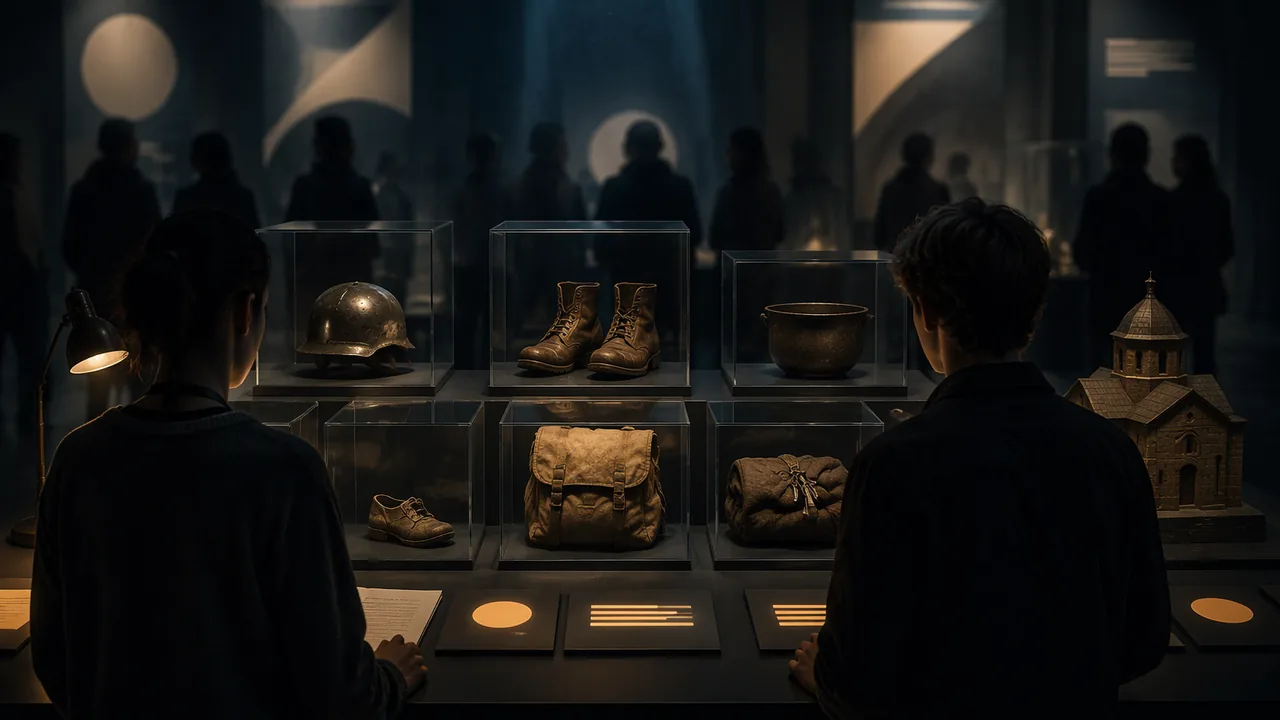
research and curate a digital exhibit on the human costs of the First World War — military and civilian, on all sides, including colonial peoples and the Armenian Genocide — and present it as a guided tour.
Instruction
Content note. This lesson deals with mass death and genocide. Take breaks when you need them, and talk to a parent, guardian or other trusted adult if the material touches your family’s history. You may choose which panels to research in depth.
The scale. Roughly nine to ten million soldiers died in the First World War, and millions more civilians died from massacre, famine, disease and occupation. Many survivors lived with wounds, gas damage and what doctors then called “shell shock.” Wilfred Owen, a British officer killed a week before the armistice, wrote “Dulce et Decorum Est” about a gas attack, calling the old Latin line that it is sweet and fitting to die for one’s country “the old Lie.”
A world war. More than a million Indian soldiers served in the British Indian Army, in France, Mesopotamia, East Africa and at Gallipoli. France recruited hundreds of thousands of colonial soldiers from North and West Africa, Madagascar and Indochina. About 140,000 Chinese laborers worked behind Allied lines in France. In East Africa, very large numbers of African porters were forced or recruited to carry supplies, and many tens of thousands died, mostly of disease and exhaustion. Colonial peoples expected their service to be rewarded with rights; when it was not, many turned to nationalism — a thread you will follow in World History B.
The Armenian Genocide. The Armenians were a Christian people who had lived in eastern Anatolia for millennia and were subjects of the Ottoman Empire. After defeats early in the war, the Ottoman government, led by the Committee of Union and Progress, accused Armenians of disloyalty. On 24 April 1915 hundreds of Armenian community leaders and intellectuals were arrested in Constantinople; most were later killed. Across the empire, Armenian men were massacred, and women, children and the elderly were deported on death marches into the Syrian desert, where many died of starvation, disease and killings. Historians’ estimates of Armenian deaths vary; many place the figure at about one million or more, and the figure of 1.5 million is widely cited. Assyrian and Greek Christians were also killed in large numbers. American diplomats reported what they learned in real time, as the reading shows. When the lawyer Raphael Lemkin coined the word genocide in 1944, the fate of the Armenians was one of the cases that had led him to it. The Turkish government still rejects the term genocide; the United States formally recognized it in 2021. Many survivors and their descendants settled across the Middle East, Europe and the Americas, and Armenian communities around the world observe 24 April as a day of remembrance.
Curating with care. A museum exhibit makes an argument through its choice of objects. Your exhibit’s central question might be: Who paid the costs of the First World War, and how should they be remembered? Rules for your sources:
- Use only public-domain or openly licensed items — the Library of Congress and the U.S. National Archives have many — and record each item’s license. Do not use photographs whose rights are unclear.
- Choose images that respect the dignity of victims. Avoid images of the dead where a document, map or portrait of a survivor can make the point.
- Every label cites its source and says what the item shows and what it cannot show.
Research (WHST.9-10.7, 9-10.8). Gather sources from at least three different authoritative places, judge each source’s usefulness, and quote or paraphrase accurately, avoiding plagiarism.
📖 Read for this lesson
The reading opens over the lesson; close it to come back to exactly where you were. The checks below draw on it.
Reading: An American ambassador’s evidence on the Armenian Genocide
Henry Morgenthau, U.S. Ambassador to the Ottoman Empire, telegram to the Secretary of State, 16 July 1915 (Papers Relating to the Foreign Relations of the United States); Henry Morgenthau, Ambassador Morgenthau’s Story (1918), ch. 24 · Public domain
Morgenthau was a diplomat relying on reports from U.S. consuls, missionaries and survivors, and on his conversations with Ottoman leaders. Consider how his position shaped what he could know.
Telegram, 16 July 1915: Deportation of and excesses against peaceful Armenians is increasing and from harrowing reports of eye witnesses it appears that a campaign of race extermination is in progress under a pretext of reprisal against rebellion.
Ambassador Morgenthau’s Story (1918): When the Turkish authorities gave the orders for these deportations, they were merely giving the death warrant to a whole race; they understood this well, and, in their conversations with me, they made no particular attempt to conceal the fact.
Formative check
Work through these before moving on. They are not graded — they tell you whether the standard below has landed yet.
Simulation & tools
Build the exhibit as a story map
Optional tool route for Stage 3. Open StoryMapJS and create a new story map (it needs a free Google sign-in; if you cannot use one, use the alternative below). Make one slide per panel. For each slide: set the location (for example Gallipoli, Flanders, the Syrian desert near Deir ez-Zor, a French port where Chinese laborers landed); add the panel title as the headline; paste your 150-200 word label; add your public-domain image by URL with its credit and license in the credit field. Open with a title slide stating your central question, and end with a sources slide. Before publishing, check the map: does the order of slides move your visitor through your argument? Submit the published link. No-tool alternative: a slide exhibit or document with a printed map marking each panel’s location earns equal credit.
Open Knight Lab ↗ · Knight Lab, Northwestern University (TimelineJS, StoryMapJS) · MPL-2.0 open source
American diplomats reported the mass killing of Armenians to Washington while it was happening in 1915.
Which statement about colonial peoples in the First World War is accurate?
How confident are you that you can research, curate and present a digital exhibit on the human costs of the First World War accurately and with care?
Unit 4 checkpoint
Do this before you start the task. It covers the whole unit and tells you what to review first.
Which is a strategic motive for imperialism?
By 1914 only Ethiopia and Liberia in Africa were not under European rule.
Kipling’s poem is best described as…
The Ghadar Party was founded in by Indian immigrants in the United States; the Republic of China was proclaimed on 1 January .
In 2021, Germany acknowledged as genocide its actions against…
Why did Britain declare war on 4 August 1914?
Fritz Fischer and Christopher Clark agree that Germany alone deliberately caused the war.
How did the Russian Revolution affect the war?
On the first day of the Somme the British army suffered about casualties.
U.S. diplomats reported the mass killing of Armenians to Washington while it was happening in 1915.
About how many Chinese laborers worked behind Allied lines in France?
Historians’ estimates of Armenian deaths vary, with many placing the figure at about one million or more and 1.5 million widely cited.
Submit: The World’s War digital exhibit (6-8 panels) + 4-minute guided tour
Task: Curate a digital exhibit of six to eight panels on the human costs of the First World War. Required panels: colonial soldiers or laborers; civilians; the Armenian Genocide. Each panel pairs a public-domain or openly licensed source with a 150-200 word label.
Submission workflow
- Stage 1 — Exhibit plan. Central question and argument; a list of panels with the source for each, where it came from, its license, and a note on its reliability.
- Stage 2 — Self-checked draft panels. Check each label for accuracy, citation and respect for victims, and whether the panels build one argument. Save a revision note listing what you changed.
- Stage 3 — Revised final exhibit. Published in a free tool (StoryMapJS, a website or a slide exhibit), with an introduction panel and a sources page.
- Stage 4 — Guided tour. Four minutes, live or recorded (equal credit), followed by one visitor question from a family member or friend, or one you write yourself.
How it is scored
| Criterion | What proficient looks like |
|---|---|
| Historical accuracy (WH.10.5.4, WH.10.5.5) | Accurate account of military and civilian costs, colonial contributions and the Armenian Genocide, with figures attributed and ranges stated. |
| Research (WHST.9-10.7, WHST.9-10.8) | Sources from at least three authoritative places, assessed for usefulness, cited accurately and legally licensed. |
| Curation and argument (9-12.WH.1.CC.C / 9-12.WH.1.CC.D) | Panels build a clear central argument; labels explain what each source shows and cannot show. |
| Digital media (SL.9-10.5) | Digital format used strategically to make the argument clearer, not only decorative. |
| Care and ethics | Victims presented with dignity; content choices explained. |
| Guided tour (SL.9-10.4) | Clear, logical tour that listeners can follow; visitor question answered with evidence. |
Panel Sources, a Citation Template, and What Care Looks Like in a Label
Henry Morgenthau, telegram to the Secretary of State, 16 July 1915, in Papers Relating to the Foreign Relations of the United States, 1915, Supplement: The World War; Henry Morgenthau, Ambassador Morgenthau’s Story (Garden City: Doubleday, Page and Company, 1918), chapter 24; Wilfred Owen, ‘Dulce et Decorum est’, in Poems (London: Chatto and Windus, 1920), text of the 1921 reprint · Public domain
Why this reading. Stage 1 asks for a list of panels “with the source for each, where it came from, its license, and a note on its reliability”, and the exhibit needs six to eight of them. The lesson supplies two sentences of Morgenthau. Everything else you would have to find outside the course, and the rule that you may use only public-domain or openly licensed items is hard to apply when you have nothing to apply it to. This reading gives you three panel-ready sources complete, a citation template, and a working note on rights and on care. What to look for: an exhibit makes its argument by what it puts next to what. As you read, ask which two of these sources gain from being placed side by side.
Content note. This reading concerns mass death and genocide. Take breaks if you need them. Nothing below describes a killing in graphic detail; the sources are a diplomat’s official report, his memoir and a soldier’s poem.
Panel source 1 — Henry Morgenthau, United States Ambassador to the Ottoman Empire
(a) The cable, 16 July 1915. This is the document the lesson quotes, and it is the single most citable item in the set, because it is an official United States government communication written while the events were happening:
Deportation of and excesses against peaceful Armenians is increasing and from harrowing reports of eye witnesses it appears that a campaign of race extermination is in progress under a pretext of reprisal against rebellion.
(b) His account, published in 1918, in Ambassador Morgenthau’s Story, chapter 24. The lesson gives one sentence of this; here is the passage it comes from, which sets out the argument and not only the conclusion:
The Central Government now announced its intention of gathering the two million or more Armenians living in the several sections of the empire and transporting them to this desolate and inhospitable region. Had they undertaken such a deportation in good faith it would have represented the height of cruelty and injustice. As a matter of fact, the Turks never had the slightest idea of reestablishing the Armenians in this new country. They knew that the great majority would never reach their destination and that those who did would either die of thirst and starvation, or be murdered by the wild Mohammedan desert tribes. The real purpose of the deportation was robbery and destruction; it really represented a new method of massacre. When the Turkish authorities gave the orders for these deportations, they were merely giving the death warrant to a whole race; they understood this well, and, in their conversations with me, they made no particular attempt to conceal the fact.
All through the spring and summer of 1915 the deportations took place. Of the larger cities, Constantinople, Smyrna and Aleppo were spared; practically all other places where a single Armenian family lived now became the scenes of these unspeakable tragedies. Scarcely a single Armenian, whatever his education or wealth, or whatever the social class to which he belonged, was exempted from the order. In some villages placards were posted ordering the whole Armenian population to present itself in a public place at an appointed time — usually a day or two ahead, and in other places the town crier would go through the streets delivering the order vocally. In still others not the slightest warning was given. The gendarmes would appear before an Armenian house and order all the inmates to follow them.
The reliability note your panel label needs, written out. Morgenthau was a neutral ambassador until the United States entered the war, in daily contact with the Ottoman ministers responsible, and reporting to his own government in cipher with no expectation of publication — which is why the cable of 16 July 1915 is stronger evidence than the book. The book was written after he had resigned and after the United States had entered the war, with the assistance of a ghostwriter and for an American readership; it uses language about Turks and Muslims that no historian would use now and that you should not reproduce in a label. Both things are true at once. Cite the cable for what was known and when; cite the book for how he reasoned, and quote it carefully.
What the sources cannot settle. Estimates of the number of Armenians killed vary between historians; a figure of about one million or more is widely accepted and 1.5 million is the figure most often cited. Assyrian and Greek Christian communities were also destroyed in large numbers in the same years. Say in your label that estimates vary and whose estimate you are using. Raphael Lemkin, who coined the word genocide in 1944, named the fate of the Armenians as one of the cases that had led him to it.
Panel source 2 — Wilfred Owen, “Dulce et Decorum est”
Owen was a British officer, gassed and shell-shocked, who was killed on 4 November 1918, a week before the armistice. Almost nothing of his was published while he lived; Siegfried Sassoon assembled Poems in 1920. This is the text of that first edition, which differs in small ways from later editions edited from his drafts — if you quote it, say which edition you are using.
Bent double, like old beggars under sacks,
Knock-kneed, coughing like hags, we cursed through sludge,
Till on the haunting flares we turned our backs,
And towards our distant rest began to trudge.
Men marched asleep. Many had lost their boots,
But limped on, blood-shod. All went lame, all blind;
Drunk with fatigue; deaf even to the hoots
Of gas-shells dropping softly behind.Gas! GAS! Quick, boys! — An ecstasy of fumbling
Fitting the clumsy helmets just in time,
But someone still was yelling out and stumbling
And flound’ring like a man in fire or lime. —
Dim through the misty panes and thick green light,
As under a green sea, I saw him drowning.In all my dreams before my helpless sight
He plunges at me, guttering, choking, drowning.If in some smothering dreams, you too could pace
Behind the wagon that we flung him in,
And watch the white eyes writhing in his face,
His hanging face, like a devil’s sick of sin,
If you could hear, at every jolt, the blood
Come gargling from the froth-corrupted lungs
Bitter as the cud
Of vile, incurable sores on innocent tongues, —
My friend, you would not tell with such high zest
To children ardent for some desperate glory,
The old Lie: Dulce et decorum est
Pro patria mori.
The Latin is from Horace and means that it is sweet and fitting to die for one’s country. Owen calls it the old Lie, with a capital L, and the whole poem is built to earn that word: three stanzas of exhaustion and a gas attack, then a direct address to a reader who repeats the phrase to children. For your label: a poem is evidence of what one participant wanted readers to feel and of how soldiers spoke about the official language of the war. It is not evidence of how many died. Both halves of that sentence belong in the label.
Panel source 3 — the sources this course already holds, and what each panel can use
| Panel | Source you already have | Where | The label’s reliability note |
|---|---|---|---|
| How the war began, and who decided | The Austro-Hungarian note to Serbia, 23 July 1914 | Reading for 4.3 | Published by the British government in 1915 as part of its own defense; a selection, not an archive |
| What a treaty was worth | Goschen’s despatch on the “scrap of paper”, 4 August 1914 | Reading for 4.3 | An ambassador’s recollection, written afterwards, published in wartime and used in propaganda |
| Why empire made a world war | Kipling, “The White Man’s Burden”, 1899, complete; Belloc, The Modern Traveller, 1898 | Reading for 4.1 | Two arguments aimed at the British and American publics; evidence about the colonizers, not the colonized |
| The colonized before the war | Naoroji on the drain, 1901; Sun Yat-sen, 1897 | Reading for 4.2 | Both written in English for imperial audiences, by men with access to imperial publishing |
| Geography and the human cost | The schematic map of the fronts | Reading for 4.4 | Drawn for this course; relative positions, not surveyed — say so in the label |
The panels the lesson requires and this course cannot supply from its own holdings are the ones on colonial soldiers and laborers and on civilians. For those, you will need items from a public collection, and the rule about rights still applies. Here is how to satisfy it without guessing: use the Library of Congress and the U.S. National Archives, both of which publish a rights statement for every item, and copy that statement into your label word for word. If an item’s rights statement says the rights are unknown or undetermined, do not use it — “no known restrictions” and “rights undetermined” are not the same thing, and telling them apart is part of what this task is assessing.
A citation template to copy
Title or description of the item. Creator, if known. Date. Holding institution, collection name, and the item’s catalog or call number. Rights statement, quoted from the catalog record. Accessed [date].
Worked example, for the cable in Panel 1: Henry Morgenthau, telegram to the Secretary of State, Constantinople, 16 July 1915. Printed in Papers Relating to the Foreign Relations of the United States, 1915, Supplement: The World War. United States government work, public domain. Accessed 23 September 2026.
Care, which is graded
The rubric has a criterion called Care and ethics, and here is what it looks like in practice.
Prefer the document to the body. A deportation order, a cable, a census of a village before and after, a portrait of a survivor with her name, a map of a march route — each of these makes the point, and none of them requires you to display a person at the worst moment of their life to a stranger. Where a photograph of the dead is the only evidence for something you must say, say it in words and cite the photograph without reproducing it.
Name people where you can. “An Armenian family from Erzurum” is better than “victims”; a named soldier from the Indian Army is better than “colonial troops”. Institutions’ catalog records often carry names that the famous published version of an image has dropped, and restoring the name is a piece of historical work the exhibit can be proud of.
Do not let the perpetrator caption the picture. Many surviving photographs of colonial labor and of the deportations were taken by officials, soldiers or missionaries, and their original captions carry their view. Quote the original caption if it is useful evidence — and then say who wrote it, and what they wanted the viewer to think. That is exactly the bias analysis you practiced on Kipling in Lesson 4.1, applied to an object instead of a poem.
And give the scale honestly. Roughly nine to ten million soldiers died. Millions of civilians died of massacre, famine, disease and occupation. More than a million Indian soldiers served in the British Indian Army; France recruited hundreds of thousands of soldiers from its colonies; about 140,000 Chinese laborers worked behind Allied lines in France; very large numbers of African porters were recruited or forced into the East African campaign and many tens of thousands died. Where the range is wide, print the range. An exhibit that admits uncertainty is more trustworthy than one that does not, and the visitor can tell.
Sources: Henry Morgenthau, Ambassador Morgenthau’s Story (1918) (archive.org); Wilfred Owen, Poems (1920), Project Gutenberg ebook 1034 (gutenberg.org)