trace how work and labor changed with industrialization — including the end of the slave trade, migration, mining and factory work, the division of labor and the union movement — and discuss who bore its costs.
Instruction
Industrialization made Britain rich. This seminar asks who paid for it, and how working people changed their situation.
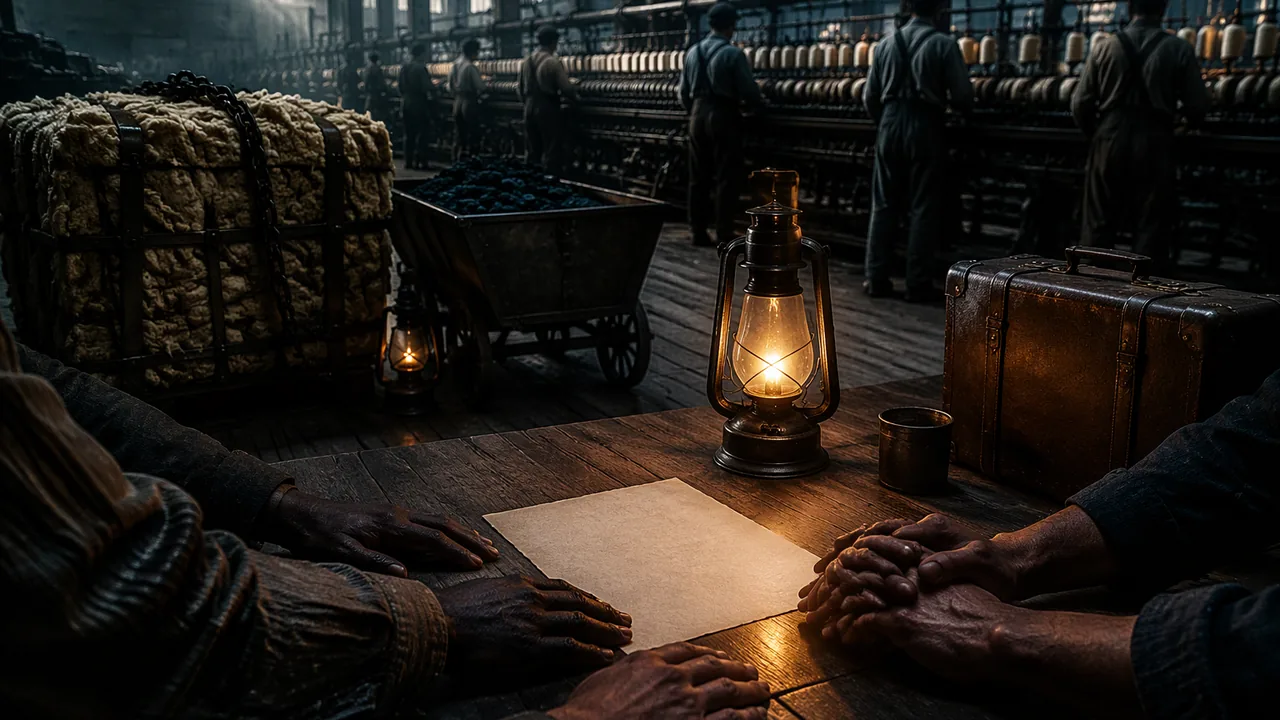
The factory and the mine. Before industrialization, most textile work was done at home, where families set their own pace. The factory brought the clock and the bell: shifts of twelve or more hours, fines for lateness, and machines that set the speed. The division of labor Adam Smith praised meant that a worker might repeat one motion all day. Mills employed many women and children because they could be paid less. In coal mines, children worked underground opening and closing ventilation doors or hauling coal; a British parliamentary commission in 1842 described these conditions, and Parliament banned women and children under ten from underground work that year. The Factory Act of 1833 was the first effective limit on child labor in textile mills, because it created inspectors to enforce it.
Slavery and the cotton economy. Britain’s leading industry spun cotton, and most of that cotton was grown by enslaved people — first in the Caribbean, then overwhelmingly in the American South. So industrialization and slavery were connected, not separate stories. Yet the same decades saw abolition. Campaigners, including formerly enslaved writers such as Olaudah Equiano, whose autobiography appeared in 1789, and the enslaved themselves through resistance and revolts, pressed Britain to abolish its slave trade in 1807 and slavery in its colonies by an act of 1833. Parliament paid £20 million in compensation — to slave owners, not to the people they had enslaved. Slavery lasted in the United States until 1865 and in Brazil until 1888.
Migration. Industry pulled rural people into cities, and hunger and opportunity pushed millions across oceans. After the Irish famine of 1845-1852, in which about a million people died, more than a million Irish emigrated, many to industrial cities in Britain and the United States. Chinese workers came to the United States from 1849 onward, and thousands built the Central Pacific’s section of the transcontinental railroad over the Sierra Nevada, completed in 1869. They faced violence and discrimination, and in 1882 the United States passed the Chinese Exclusion Act. Within the British Empire, after slavery ended, hundreds of thousands of Indian indentured laborers were sent to plantations in the Caribbean, Mauritius, Fiji and elsewhere.
Organizing. Workers answered with collective action. Britain’s Combination Acts banned unions until 1824. In 1834 six farm laborers from Tolpuddle were sentenced to transportation to Australia for swearing an oath to form a union; public protest won their pardon. The Chartists (1838-1848) petitioned Parliament for the vote for all men and a secret ballot. Skilled unions grew from the 1850s, Britain’s Trades Union Congress formed in 1868, and in the United States the American Federation of Labor was founded in 1886. Unions won shorter hours and higher wages slowly, often after bitter strikes.
Seminar question. Who paid the greatest costs of industrialization, and did the people who paid them share in its gains?
Integrating sources (SL.9-10.2). Bring three kinds of evidence: a number (for example, Chadwick’s table), a document (the Factory Act), and a first-person account. For the third, choose one — all three earn full credit and all three are complete public-domain texts, free on Project Gutenberg. Option A — Olaudah Equiano, The Interesting Narrative of the Life of Olaudah Equiano, or Gustavus Vassa (1789), ebook 15399, on the trade that supplied the cotton economy. Option B — a factory child: John Brown, A Memoir of Robert Blincoe, an Orphan Boy (1832), ebook 59127, Blincoe’s account of being sent from a workhouse to a cotton mill — written down by someone else, which you must say when you use it. Option C — London workers in their own words: Henry Mayhew, London Labour and the London Poor, Volume 1 (first edition 1851), ebook 55998, which prints street sellers’ and laborers’ answers largely as they gave them. When you speak, say what kind of source it is and what it can and cannot show. To propel the discussion (SL.9-10.1.c), connect the question to the present: who does dangerous or poorly paid work in today’s global supply chains, and how do the farm-worker and factory-worker movements of today compare?
📖 Read for this lesson
The reading opens over the lesson; close it to come back to exactly where you were. The checks below draw on it.
Reading: Evidence on health and work
Edwin Chadwick, Report on the Sanitary Condition of the Labouring Population of Great Britain (1842), table of average age at death (figures summarized); Factory Act 1833 (3 & 4 Will. IV c. 103), main provisions summarized · Public domain
Chadwick’s ‘average age at death’ is pulled down sharply by the deaths of infants and young children, so it is not the same as how long adults lived. It still shows the gap between classes and places.
Chadwick (1842), average age at death, by class and place:
| Manchester | Rutland (rural county) | |
|---|---|---|
| Gentry and professionals | 38 | 52 |
| Tradesmen and farmers | 20 | 41 |
| Laborers and artisans | 17 | 38 |
Factory Act of 1833 (summary): In textile mills, children under nine could not be employed; children aged nine to thirteen could work no more than nine hours a day; young people aged thirteen to eighteen, no more than twelve; and government inspectors were appointed to enforce the law.
Formative check
Work through these before moving on. They are not graded — they tell you whether the standard below has landed yet.
What made the Factory Act of 1833 more effective than earlier laws?
When Britain abolished slavery in its colonies, compensation was paid to the formerly enslaved people.
In Chadwick’s table, laborers in Manchester had an average age at death of 17. What best explains so low a figure?
Prepare three sourced pieces of evidence (a number, a document and a first-person account) and a two-sentence answer to the seminar question. During the seminar, make two contributions: one that integrates two kinds of source, and one that connects the question to the present. Recorded contributions earn equal credit.
How confident are you that you can trace how work and labor changed with industrialization and discuss who bore its costs using several kinds of evidence?
Practice
Work these on paper or in your notebook, then open Check your answer. Aim for all of Fluency and Application; try at least one Challenge.
Printable version: this unit’s practice workbook (PDF)
Fluency
Build speed and accuracy with the core skill.
- Order: (a) Britain abolishes its slave trade; (b) Factory Act; (c) Chinese Exclusion Act; (d) Tolpuddle laborers sentenced; (e) Britain’s Trades Union Congress forms.
Check your answer
Answer: (a) 1807 → (b) 1833 → (d) 1834 → (e) 1868 → (c) 1882.Abolition of the trade and early factory reform came first; organized labor grew stronger over the century; Chinese exclusion shows migrants’ labor was welcomed but their presence restricted. - Define indentured labor and give one example from the lesson.
Check your answer
Answer: Work under a contract binding a laborer to an employer for a fixed term, often in exchange for passage. Example: Indian laborers sent to plantations in the Caribbean, Mauritius and Fiji after slavery ended in the British Empire.A strong answer distinguishes it from slavery (a contract for a fixed term) while noting its harsh conditions.
Application
Use the skill in context. Show your reasoning.
- Chadwick’s 1842 table gives an average age at death of 17 for laborers in Manchester and 38 for laborers in rural Rutland. What does the comparison show, and why is 17 not a typical adult lifespan?
Check your answer
Answer: It shows how much more dangerous working-class city life was than rural life. The average is pulled down sharply by the many deaths of infants and young children.A strong answer compares places, explains how child deaths lower an average, and does not claim adults typically died at 17. - Perspectives: when Britain abolished slavery in its colonies, Parliament paid £20 million in compensation. Who received it, and how might a formerly enslaved person and a planter each describe the settlement?
Check your answer
Answer: Slave owners received it. A planter might call it fair compensation for lost ‘property’; a formerly enslaved person might call it a reward to those who had held them in bondage, while they received nothing.A strong answer states the fact accurately and represents each perspective in its holder’s terms. - Cause or sequence? “The Factory Act was passed in 1833, so children’s work conditions improved.” What mechanism made this law more effective than earlier ones, and what was its limit?
Check your answer
Answer: It appointed government inspectors to enforce it. Its limit: it covered only textile mills, so children in other work were not protected.A strong answer names the mechanism and a limit rather than assuming a law’s passage equals change.
Review
Keep earlier skills sharp.
- Review (Unit 2): the Haitian Revolution ended slavery in Saint-Domingue. How did it connect to the wider abolition movement described in Lesson 3.3?
Check your answer
Answer: It showed that enslaved people could free themselves by revolt, one of the pressures — along with campaigners and resistance elsewhere — that pushed Britain toward abolition.A strong answer treats enslaved people as agents of abolition, not only its beneficiaries.
A Number, a Document and a Testimony: Chadwick, the Sadler Committee, Equiano
Report to Her Majesty’s Principal Secretary of State for the Home Department from the Poor Law Commissioners, on an Inquiry into the Sanitary Condition of the Labouring Population of Great Britain (London, 1842), section IV, comparative chances of life; evidence taken before the Select Committee on the Bill to Regulate the Labour of Children in Mills and Factories (the Sadler Committee), 1832, and Michael Sadler’s address on the bill, as reprinted in Edward P. Cheyney, Readings in English History Drawn from the Original Sources (Boston: Ginn and Company, 1908), extracts 423-424; Olaudah Equiano, The Interesting Narrative of the Life of Olaudah Equiano, or Gustavus Vassa, the African, Written by Himself (London, 1789), chapter 2 · Public domain
Why this reading. The seminar asks you to bring three kinds of evidence — a number, a document and a first-person account — and to say of each what it can and cannot show. The lesson gives you a six-line summary of Chadwick’s table with no source note, a paraphrase of the Factory Act, and three first-person accounts that are titles and ebook numbers rather than text. Here are all three kinds, complete enough to be used: Chadwick’s figures as his report actually prints them and with the explanation of why the numbers are so low, two children questioned under oath about mill work, and a man describing what it was to be taken across the Atlantic. What to look for: a number, a document and a testimony about the same period do not simply add up. Find where they disagree — that is where the seminar question lives.
Spelling. Edwin Chadwick’s Report on the Sanitary Condition of the Labouring Population of Great Britain (1842) is a British document, and its title, table headings and text keep British spelling. Quote them as printed.
1. The number: Chadwick’s tables of average age at death, 1842
Chadwick’s method was to ask local registrars and doctors for the ages at death of everyone who died in a place over a stated period, sorted by the occupation of the head of the household. The famous comparison is Manchester against Rutlandshire, chosen because Rutland had already been surveyed as a typical agricultural county. This is the table as the report prints it, with the question that was put to the investigator:
“You have seen the following returns of the average ages of death amongst the different classes of people in Manchester and Rutlandshire:
Average Age of Death — In Manchester / In Rutlandshire (years)
Professional persons and gentry, and their families: 38 / 52
Tradesmen and their families (in Rutlandshire, farmers and graziers are included with shopkeepers): 20 / 41
Mechanics, labourers, and their families: 17 / 38Bearing in mind the fact that wages are nearly double in Manchester to the average of wages in Rutlandshire, though rents are higher in Manchester: are the different chances of life amongst each class of the population to the extent they are indicated by the returns, conformable to what you would have anticipated from your personal examinations of the houses and observation of the condition of the inhabitants? — They are decidedly conformable to my anticipation in the general results.”
The report gives the same kind of table for other places. Reading several together is what turns one striking figure into evidence:
| Place and date | Gentry and professional | Tradesmen | Labourers, mechanics and servants |
|---|---|---|---|
| Truro, 1837–40 | 40 | 33 | 28 |
| Derby | 49 | (not given in the extract) | 21 |
| Manchester | 38 | 20 | 17 |
| Liverpool, 1840 | 35 | 22 | 15 |
| Whitechapel union, 1838 | 45 | 27 | 22 |
| Strand union | 43 | (not given in the extract) | 24 |
| Rutlandshire (rural) | 52 | 41 | 38 |
And here is the sentence that explains the figures, which the lesson’s prediction block asks you to work out and which Chadwick supplies directly. Of the deaths among the labouring classes of Liverpool in 1840:
it appears that no less than 62 per cent. of the total number were deaths under five years of age. Even amongst those entered as shopkeepers and tradesmen, no less than 50 per cent. died before they attained that period.
So “average age at death 15” does not mean adults died at fifteen. It means that in Liverpool nearly two thirds of working-class deaths were of children under five, and those deaths drag the mean down. What this number can show: that class and place made an enormous difference to the chance of surviving childhood. What it cannot show: the life expectancy of an adult, the cause of any individual death, or whether things were getting better or worse — it is one snapshot. And Chadwick was arguing for a sanitary bill, so he chose the comparisons that made his case. Both of those go in your source note.
2. The document: the Sadler Committee, 1832, and the Factory Act it produced
In 1832 a parliamentary committee chaired by Michael Sadler took evidence on child labor in mills. Witnesses were questioned in the committee’s own form — short questions, short answers — and the transcript was printed. These extracts are from Edward P. Cheyney, Readings in English History Drawn from the Original Sources (1908), which reprints the parliamentary papers. The questioner’s words are in the questions; everything after the question mark is the witness.
What were the hours of work? We used to start at five and work till nine at night. What time had you for your dinner? Half an hour. What time for breakfast and drinking? A quarter of an hour at each end of the day. What wages had you? Two shillings and sixpence…
At what time did you begin work at that mill in the morning? We used to start at half past five and work till eight at night. What time was allowed for breakfast and dinner and drinking? Forty minutes a day was all that was allowed. How were you kept up to your work during the latter part of the day? The overlooker used to come with a strap and give us a rap or two, or if they caught us asleep they would give us a pinch of snuff till we sneezed; they would give us a slap with a strap if we did not mind our work. Was the strap an instrument capable of hurting you badly? It was a heavy strap with a small handle to it. Where did they strike you with it? Generally in the small of the back and over the head. Did they strike the young children as well as the older ones? Yes. And the females as well as the males? Yes.
State, in the first place, the effect upon your health and limbs of those long hours of labor? It produced a weakness in my knees; I was made crooked with standing the long hours. Just show the gentlemen your limbs. (The witness exhibited to the committee his limbs, which appeared exceedingly crooked.) Are you quite sure you were, as a child, perfectly straight and well formed? Yes. How old were you before your limbs began to fail you? About eight years and a half old… Had you time to go to a day school or a night school during this labor? No. Can you write? No, not at all. Had you to work by gaslight? Yes. What effect do you think that has upon the eyes? It nearly made me blind; I was forced to go into the infirmary; I was seven weeks there…
At what age did you commence? Seven years of age… What were your hours of labor at that mill? From five in the morning till eight at night. What intervals had you for refreshment? Thirty minutes at noon. Had you no time for breakfast or refreshment in the afternoon? No, not one minute; we had to eat our meals as we could, standing or otherwise. You had fourteen and a half hours of actual labor at seven years of age? Yes. What wages had you at that time? Two shillings and sixpence a week.
And Sadler, introducing his bill in the Commons, answering the objection he knew was coming:
The bill which I now implore the House to sanction with its authority has for its object the liberation of children and other young persons employed in the mills and factories of the United Kingdom from that overexertion and long confinement which common sense, as well as experience, has shown to be utterly inconsistent with the improvement of their minds, the preservation of their morals, and the maintenance of their health…
But, I apprehend, the strongest objections that will be offered on this occasion will be grounded upon the pretense that the very principle of the bill is an improper interference between the employer and the employed, and an attempt to regulate by law the market of labor. Were that market supplied by free agents, properly so denominated, I should fully participate in these objections. Theoretically, indeed, such is the case; but practically, I fear, the fact is far otherwise… and the boasted freedom of our laborers in many pursuits will, on a just view of their condition, be found little more than a name.
What these can show: the hours, the wages, the discipline and the injuries, in the words of the people they happened to — and the exact shape of the political argument, which was about whether a child in a mill is a free agent making a contract. What they cannot show: how typical any one mill was. Sadler chose witnesses to win a vote, mill owners later gave evidence of their own to the Factory Commission of 1833, and the two bodies of testimony do not agree. Saying that, and then saying why you still find the children credible, is a stronger contribution than quoting them as if no one disputed it.
What the law then did. The Factory Act of 1833 applied to textile mills: it forbade the employment of children under nine, limited children of nine to thirteen to nine hours a day and young people of thirteen to eighteen to twelve, required some schooling for the youngest, and — the part that mattered — created a small body of government inspectors with the power to enter mills. Sadler’s own bill, which asked for a ten-hour day for everyone under eighteen, did not pass; the law that did was weaker than what the testimony above was collected to obtain. That gap between evidence and legislation is itself an answer to the seminar question.
3. The first-person account: Olaudah Equiano on the ship
From The Interesting Narrative of the Life of Olaudah Equiano, or Gustavus Vassa, the African, Written by Himself (London, 1789). Equiano was taken from what is now south-eastern Nigeria as a child, carried to Barbados and Virginia, later bought his freedom, and became a leading campaigner against the British slave trade. His book went through nine editions in his lifetime. The cotton and sugar that fed British industry crossed the Atlantic on ships like the one he describes.
When I looked round the ship too and saw a large furnace or copper boiling, and a multitude of black people of every description chained together, every one of their countenances expressing dejection and sorrow, I no longer doubted of my fate; and, quite overpowered with horror and anguish, I fell motionless on the deck and fainted…
I was soon put down under the decks, and there I received such a salutation in my nostrils as I had never experienced in my life: so that, with the loathsomeness of the stench, and crying together, I became so sick and low that I was not able to eat, nor had I the least desire to taste any thing. I now wished for the last friend, death, to relieve me; but soon, to my grief, two of the white men offered me eatables; and, on my refusing to eat, one of them held me fast by the hands, and laid me across I think the windlass, and tied my feet, while the other flogged me severely…
I inquired of these what was to be done with us; they gave me to understand we were to be carried to these white people’s country to work for them. I then was a little revived, and thought, if it were no worse than working, my situation was not so desperate…
…now that the whole ship’s cargo were confined together, it became absolutely pestilential. The closeness of the place, and the heat of the climate, added to the number in the ship, which was so crowded that each had scarcely room to turn himself, almost suffocated us. This produced copious perspirations, so that the air soon became unfit for respiration, from a variety of loathsome smells, and brought on a sickness among the slaves, of which many died, thus falling victims to the improvident avarice, as I may call it, of their purchasers. This wretched situation was again aggravated by the galling of the chains, now become insupportable; and the filth of the necessary tubs, into which the children often fell, and were almost suffocated. The shrieks of the women, and the groans of the dying, rendered the whole a scene of horror almost inconceivable.
Read the phrase “improvident avarice”. Equiano is not only describing suffering; he is making an argument in the language of the readers he wants to persuade — that the trade was bad economics as well as evil, because greed killed the people it was carrying to be sold. He wrote as a campaigner, for a British audience, seeking subscribers. That is the source note, and it does not weaken the testimony; it tells you what the testimony was for.
Bringing the three together in the seminar
| Kind of evidence | What it establishes | What it cannot reach |
|---|---|---|
| Chadwick’s tables | The scale, across whole populations: class and place decided who survived childhood | Any individual’s experience; causes of particular deaths; whether conditions were improving |
| The Sadler testimony and the Act | Hours, wages, punishments, and exactly what the law did and did not do about them | How typical a mill was; what employers would have said; whether the witnesses were selected |
| Equiano | What the trade that supplied the raw material was, from inside it | Numbers; the 1780s are not the 1840s; he is writing to persuade |
The disagreement to build a contribution on. Chadwick says wages in Manchester were nearly double those in Rutland, and that people in Manchester died far younger. The Sadler witnesses were paid two shillings and sixpence a week as children and were crippled by the work. Equiano’s captors were pursuing profit and killing their own cargo. Three sources, three periods, one pattern: higher money income did not mean a better life, and in each case the gain and the cost fell on different people. That is an answer to “who paid?” that uses all three kinds of evidence at once — which is what the lesson is asking for.
And on the question of whether the people who paid shared in the gains. When Britain abolished slavery in its colonies by the Act of 1833, Parliament voted twenty million pounds in compensation, and it went to the slave owners for the loss of their property. The formerly enslaved received nothing, and were required to serve a further period of unpaid “apprenticeship” to their former owners. If you use that in the seminar, say that you are describing the statute rather than quoting it.
Sources: Chadwick, Report on the Sanitary Condition of the Labouring Population of Great Britain (1842) (archive.org); E. P. Cheyney, Readings in English History Drawn from the Original Sources (1908) (archive.org); Olaudah Equiano, The Interesting Narrative (1789), Project Gutenberg ebook 15399 (gutenberg.org)