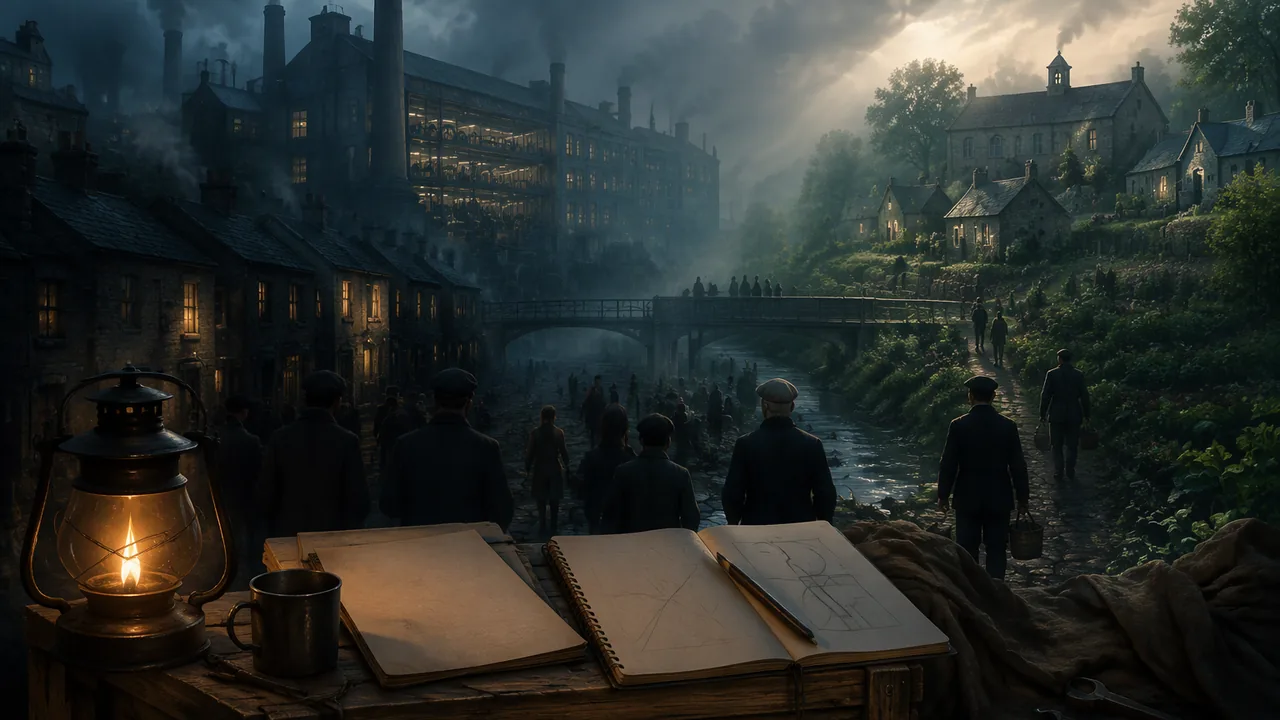
analyze the emergence of capitalism and compare the responses to it — utopianism, social democracy, socialism and communism — and the Romantic and realist critiques in art and literature, in a written comparison with claim and counterclaim.
Instruction
By the 1830s a new economic system dominated Britain and was spreading: capitalism, in which private owners invest capital in enterprises to earn profit, workers sell their labor for wages, and prices are set largely in markets. It produced wealth on a scale never seen — and poverty, crowding and insecurity on a scale that alarmed many observers. The responses can be arranged from least to most radical.
Reform within capitalism. Liberals who followed Smith argued that free markets would raise everyone’s living standards over time, and many supported factory, sanitary and education laws to fix the worst abuses.
Utopian socialism. Robert Owen, a Welsh-born mill owner, ran his cotton mills at New Lanark in Scotland with shorter hours, schools for workers’ children and decent housing, and showed they could still make a profit. In 1825 he founded a cooperative community at New Harmony, Indiana, which failed within a few years. In France, Charles Fourier and Henri de Saint-Simon imagined planned, cooperative societies. Critics called them “utopian” because they expected change to come through good examples rather than political struggle.
Communism. Karl Marx and Friedrich Engels (whose family was part-owner of a cotton mill in Manchester) published the Communist Manifesto in 1848. They argued that history is driven by conflict between classes; that capitalism divides society into the bourgeoisie, who own the means of production, and the proletariat, who own only their labor; and that competition would drive wages down until workers overthrew capitalism in a revolution, abolished private ownership of the means of production, and eventually created a classless society. The Manifesto is also a tribute to capitalism’s productive power — Marx thought it a necessary stage.
Social democracy. Others, especially in Germany, argued that workers could win socialism gradually through elections, unions and laws rather than revolution. The German Social Democratic Party grew into the largest party in the Reichstag by 1912. Its rise pushed the conservative chancellor Otto von Bismarck to introduce the world’s first national health, accident and old-age insurance programs in the 1880s — partly to draw workers away from socialism. Britain’s Fabian Society (1884) and later Labour Party took a similar gradual path.
The artists’ response. Romanticism (roughly 1790-1850) rejected the order, balance and reason of Classicism and the Enlightenment in favor of emotion, imagination, the individual and nature. Blake saw “dark Satanic Mills” and “mind-forg’d manacles” in industrial London; Wordsworth mourned a world of “getting and spending” cut off from nature; painters such as J. M. W. Turner and Caspar David Friedrich made nature vast and overwhelming. From the 1840s, realist writers turned to social criticism: Dickens exposed workhouses and factory towns, and Émile Zola’s Germinal (1885) portrayed a miners’ strike in France.
Weighing claims (RH.9-10.8). Test each response the way you tested Plato: what did it predict, and did the evidence support it? Marx predicted that workers in the most industrial countries would grow poorer and lead the revolution. In Britain and Germany, real wages rose in the later 1800s and workers largely chose unions and parties; the major communist revolution came in largely agricultural Russia. A defender of Marx might answer that reforms came only because workers organized and frightened elites. Your paragraph set must develop claim and counterclaim this fairly (WHST.9-10.1.b).
📖 Read for this lesson
The reading opens over the lesson; close it to come back to exactly where you were. The checks below draw on it.
Reading: Critics of the industrial age
Marx and Engels, Manifesto of the Communist Party (1848; English translation by Samuel Moore, 1888), sections I and IV; William Blake, ‘London’, Songs of Experience (1794), and preface to Milton (c. 1804-1810); William Wordsworth, ‘The world is too much with us’ (1807); Charles Dickens, Hard Times (1854), Book I ch. 5 · Public domain
Marx and Engels praise capitalism’s power in the same pages where they predict its fall. Find both.
Manifesto: The history of all hitherto existing society is the history of class struggles.
The bourgeoisie, during its rule of scarce one hundred years, has created more massive and more colossal productive forces than have all preceding generations together.
The proletarians have nothing to lose but their chains. They have a world to win.
Blake, ‘London’: In every cry of every Man,
In every Infants cry of fear,
In every voice: in every ban,
The mind-forg’d manacles I hear
Blake, Milton preface: And was Jerusalem builded here,
Among these dark Satanic Mills?
Wordsworth: The world is too much with us; late and soon,
Getting and spending, we lay waste our powers;
Little we see in Nature that is ours;
Dickens, Hard Times: It was a town of machinery and tall chimneys, out of which interminable serpents of smoke trailed themselves for ever and ever, and never got uncoiled.
Formative check
Work through these before moving on. They are not graded — they tell you whether the standard below has landed yet.
What most clearly distinguishes social democrats from Marx’s revolutionary communism?
Romantic poets such as Blake and Wordsworth celebrated industrial cities as the height of human reason.
Robert Owen’s model mills were at New ; Bismarck introduced national health and old-age in the 1880s; Dickens’s Hard Times describes the factory town of .
Write a comparative argument paragraph set (450-550 words): which response to industrial capitalism — utopian socialism, social democracy, communism or liberal reform — best understood the problems of the industrial age? Compare two responses, quote at least one reading, test one prediction against what happened, and develop the strongest counterclaim fairly before answering it.
How confident are you that you can compare the economic and artistic responses to industrial capitalism and weigh their claims against evidence?
Practice
Work these on paper or in your notebook, then open Check your answer. Aim for all of Fluency and Application; try at least one Challenge.
Printable version: this unit’s practice workbook (PDF)
Fluency
Build speed and accuracy with the core skill.
- Order: (a) Communist Manifesto; (b) Owen’s New Harmony; (c) Bismarck’s social insurance laws; (d) Dickens’s Hard Times; (e) Blake’s ‘London’.
Check your answer
Answer: (e) 1794 → (b) 1825 → (a) 1848 → (d) 1854 → (c) 1880s.Romantic critique came first; socialist and communist programs followed; social insurance came as a response. - Complete: in Marx’s terms, the ____ own the means of production and the ____ own only their labor.
Check your answer
Answer: bourgeoisie; proletariat.The Manifesto argues that history is driven by conflict between these classes.
Application
Use the skill in context. Show your reasoning.
- Source and read closely: the Manifesto says “The bourgeoisie, during its rule of scarce one hundred years, has created more massive and more colossal productive forces than have all preceding generations together.” Why is this surprising in a communist text, and what does it tell you about Marx’s argument?
Check your answer
Answer: It praises capitalism’s productive power. Marx saw capitalism as a necessary stage that created the wealth a later communist society would inherit, before, as he predicted, it would be overthrown.A strong answer notes the praise, explains its place in the argument, and avoids reading the Manifesto as only an attack. - Compare Blake’s “mind-forg’d manacles” with Smith’s “invisible hand.” What view of industrial and commercial society does each image express?
Check your answer
Answer: Smith’s image suggests that self-interested market activity promotes the common good without anyone intending it; Blake’s suggests that the society of his London bound people’s minds and lives.A strong answer reads each image in its context (an economist in 1776, a poet in 1794) and notes that the poem is evidence of perception, not of averages.
Review
Keep earlier skills sharp.
- Review (Lesson 1.2): test Marx’s prediction as you tested Plato’s argument. Premise: competition drives wages down. Prediction: workers in the most industrial countries will make the revolution. What happened?
Check your answer
Answer: Real wages rose in later-nineteenth-century Britain and Germany, workers largely chose unions and parties, and the major communist revolution came in largely agricultural Russia. A defender would say reforms came because workers organized.A strong answer tests the premise against evidence and states the strongest reply. - Review (Unit 2): Bismarck led a Germany that had been unified in which year, and which earlier revolutions of 1848 had tried and failed to unite it through a parliament?
Check your answer
Answer: 1871; the Frankfurt Parliament of 1848 tried to write a constitution for a united Germany but failed.A strong answer notes that Germany was finally unified by a monarchy, not by the liberal revolutionaries of 1848.
Marx at Argument Length, Bernstein’s Answer, Blake and Coketown Entire
Marx and Engels, Manifesto of the Communist Party (1848), sections I and IV, trans. Samuel Moore, authorized English edition of 1888; Eduard Bernstein, Evolutionary Socialism: A Criticism and Affirmation, trans. Edith C. Harvey (London: Independent Labour Party, 1909); William Blake, ‘London’, Songs of Experience (1794), from Poems of William Blake, ed. W. B. Yeats (London, 1905); Charles Dickens, Hard Times (1854), Book I ch. 5; the account of Robert Owen is written by the course authors · Public domain
Why this reading. Your paragraph set has to compare two responses to industrial capitalism, quote at least one reading, test one prediction against what happened, and develop the counterclaim fairly. Of the four responses the lesson lists, two are represented in its reading and two are not: there is not one word of Owen and not one word of any social democrat, so a comparison involving either of them would have to be written out of the mini-lecture’s summary. And the prediction test needs the Manifesto’s actual predictions, which the four quoted lines do not contain. Here is Marx and Engels at argument length, the social-democratic answer in the words of the man who made it, Blake’s poem entire and Dickens’s Coketown entire, plus an honest note about Owen. What to look for: the Manifesto is far more admiring of capitalism than its reputation suggests. Find the passage that praises it, because a paragraph that quotes only the hostile lines is quoting half a document.
1. Marx and Engels, Manifesto of the Communist Party (1848)
Translated by Samuel Moore, with Engels’s supervision, for the authorized English edition of 1888. The four passages below are the argument, in order.
(a) The thesis, the first sentence of Section I:
The history of all hitherto existing societies is the history of class struggles. Freeman and slave, patrician and plebeian, lord and serf, guild-master and journeyman, in a word, oppressor and oppressed, stood in constant opposition to one another, carried on an uninterrupted, now hidden, now open fight, a fight that each time ended, either in a revolutionary re-constitution of society at large, or in the common ruin of the contending classes.
(b) What capitalism destroyed — and the sentence that gives the game away about how they felt about it:
The bourgeoisie, historically, has played a most revolutionary part. The bourgeoisie, wherever it has got the upper hand, has put an end to all feudal, patriarchal, idyllic relations. It has pitilessly torn asunder the motley feudal ties that bound man to his “natural superiors,” and has left remaining no other nexus between man and man than naked self-interest, than callous “cash payment.” It has drowned the most heavenly ecstasies of religious fervour, of chivalrous enthusiasm, of philistine sentimentalism, in the icy water of egotistical calculation. It has resolved personal worth into exchange value… It has converted the physician, the lawyer, the priest, the poet, the man of science, into its paid wage labourers.
(c) The praise, which is not ironic:
The bourgeoisie, during its rule of scarce one hundred years, has created more massive and more colossal productive forces than have all preceding generations together. Subjection of Nature’s forces to man, machinery, application of chemistry to industry and agriculture, steam-navigation, railways, electric telegraphs, clearing of whole continents for cultivation, canalisation of rivers, whole populations conjured out of the ground — what earlier century had even a presentiment that such productive forces slumbered in the lap of social labour?
Constant revolutionising of production, uninterrupted disturbance of all social conditions, everlasting uncertainty and agitation distinguish the bourgeois epoch from all earlier ones. All fixed, fast-frozen relations, with their train of ancient and venerable prejudices and opinions, are swept away, all new-formed ones become antiquated before they can ossify. All that is solid melts into air, all that is holy is profaned, and man is at last compelled to face with sober senses, his real conditions of life, and his relations with his kind.
The need of a constantly expanding market for its products chases the bourgeoisie over the whole surface of the globe. It must nestle everywhere, settle everywhere, establish connexions everywhere… To the great chagrin of Reactionists, it has drawn from under the feet of industry the national ground on which it stood.
(d) The close:
The Communists disdain to conceal their views and aims. They openly declare that their ends can be attained only by the forcible overthrow of all existing social conditions. Let the ruling classes tremble at a Communistic revolution. The proletarians have nothing to lose but their chains. They have a world to win. WORKING MEN OF ALL COUNTRIES, UNITE!
The predictions you can test. Read passage (c) again and notice that two of its claims have been spectacularly confirmed: that this system would revolutionize production faster than anything before it, and that it would become global and dissolve national economies. Whatever you think of Marx, an essay that does not concede those is not testing anything. The claims that did not hold are different ones: that the workers of the most industrialized countries would grow poorer and make the revolution, and that the middle classes would be squeezed out of existence. In Britain and Germany real wages rose over the second half of the century, the middle class grew rather than shrank, and workers organized in unions and parties instead. The great communist revolution came in Russia, the least industrialized of the major powers.
2. The social-democratic answer, in the words of the man who made it
Eduard Bernstein was a leading German socialist, Engels’s literary executor, and the man who set off the argument that split European socialism. In Evolutionary Socialism (translated by Edith C. Harvey, London, 1909) he answers his critics:
My proposition, “To me that which is generally called the ultimate aim of socialism is nothing, but the movement is everything,” has often been conceived as a denial of every definite aim of the socialist movement… There, indeed, a passage reads that it is certainly indispensable for revolutionary socialism to take as its ultimate aim the nationalisation of all the means of production, but not for practical political socialism which places near aims in front of distant ones…
I expressed the conviction that with the continuance of free development, the English working classes would certainly increase their demands, but would desire nothing that could not be shown each time to be necessary and attainable beyond all doubt.
This is the counterclaim to communism from the inside, which is what makes it worth a paragraph. Bernstein is not a liberal defending capitalism. He is a socialist saying that the predicted collapse is not happening, that workers are winning real gains through unions, elections and laws, and that a movement should therefore be judged by what it obtains rather than by an end state it names. The reply from the other side — made at the time by Rosa Luxemburg — is that reforms which do not change who owns the means of production leave the system intact and can be taken back, and that what looks like steady progress is a truce. Both halves of that argument are available to you, and it is a better comparison than utopian-socialism-versus-communism because both sides had evidence.
3. Owen — described, not quoted
We could not reach a scan of a public-domain edition of Robert Owen’s writings that we could check, so this paragraph is ours. Owen managed, and later part-owned, the cotton mills at New Lanark in Scotland from 1800. He cut working hours, stopped employing the youngest children and opened a school for them, built decent housing and a store selling goods at cost, and published the mills’ accounts to show that they still returned a profit — which was the whole of his argument, since he was trying to persuade other owners by demonstration rather than to compel them by law. He believed that character is formed by circumstances, so that changing the circumstances would change the people. In 1825 he bought a town in Indiana and founded a cooperative community at New Harmony; it broke up within about three years. Marx and Engels called him and the French writers Saint-Simon and Fourier “utopian” because they expected a good example to convert the powerful, rather than expecting the powerful to be removed. If you use Owen in your comparison, describe him as we have and cite A New View of Society (1813–16) by title and date.
4. The artists’ response, complete
William Blake, “London”, from Songs of Experience (1794). Sixteen lines, printed here from the edition of Blake’s poems edited by W. B. Yeats (London, 1905), which modernizes his spelling and punctuation: Blake’s own engraved plates read “thro’ each charter’d street” and “mind-forg’d manacles”. If you quote the archaic forms, you are quoting the plates; if you quote what is below, say you are using a modernized edition.
I wandered through each chartered street,
Near where the chartered Thames does flow,
A mark in every face I meet,
Marks of weakness, marks of woe.In every cry of every man,
In every infant’s cry of fear,
In every voice, in every ban,
The mind-forged manacles I hear:How the chimney-sweeper’s cry
Every blackening church appalls,
And the hapless soldier’s sigh
Runs in blood down palace-walls.But most, through midnight streets I hear
How the youthful harlot’s curse
Blasts the new-born infant’s tear,
And blights with plagues the marriage-hearse.
“Chartered” is the word to stop on. A charter was a legal grant of monopoly or privilege — to a city, a company, a trade. Blake applies it to the street and then to the river, which cannot be owned, and the joke is bitter: in this city even the water has been turned into somebody’s property. The poem was written in 1794, a generation before the mills of Manchester; it is evidence about a commercial city, not a factory town, which is a distinction worth making if you use it.
Charles Dickens, Hard Times (1854), Book I chapter 5. The lesson quotes one sentence. Here is the paragraph, and the sentence the lesson leaves out is the one that matters most:
It was a town of red brick, or of brick that would have been red if the smoke and ashes had allowed it; but as matters stood, it was a town of unnatural red and black like the painted face of a savage. It was a town of machinery and tall chimneys, out of which interminable serpents of smoke trailed themselves for ever and ever, and never got uncoiled. It had a black canal in it, and a river that ran purple with ill-smelling dye, and vast piles of building full of windows where there was a rattling and a trembling all day long, and where the piston of the steam-engine worked monotonously up and down, like the head of an elephant in a state of melancholy madness. It contained several large streets all very like one another, and many small streets still more like one another, inhabited by people equally like one another, who all went in and out at the same hours, with the same sound upon the same pavements, to do the same work, and to whom every day was the same as yesterday and to-morrow, and every year the counterpart of the last and the next.
These attributes of Coketown were in the main inseparable from the work by which it was sustained; against them were to be set off, comforts of life which found their way all over the world, and elegancies of life which made, we will not ask how much of the fine lady, who could scarcely bear to hear the place mentioned.
The second paragraph is Dickens doing the cost-benefit analysis you will be asked for in Lesson 3.5, in a single sentence and with a sting: the smoke is inseparable from the work, and set against it are the comforts that “found their way all over the world” — including to the fine lady who cannot bear to hear the town named. A novelist is not evidence of wages. He is very good evidence of an argument people were having.
Weighing the responses — what each predicted, and what happened
| Response | Its prediction | What happened |
|---|---|---|
| Liberal reform | Free markets would raise living standards, with laws fixing the worst abuses | Real wages did rise in Britain and Germany after mid-century, and factory, sanitary and education laws did come — but only after decades of agitation, and Chadwick’s figures show what the interval cost |
| Utopian socialism | A profitable model community would convert other owners by example | New Lanark worked and was widely visited; almost no one copied it, and New Harmony failed within a few years |
| Communism | Competition would drive wages down; workers in the most industrial countries would make the revolution | Wages rose; the revolution came in agricultural Russia. A defender answers that wages rose because workers organized and elites were frightened — which is a real reply, and testable against the dates of the reforms |
| Social democracy | Workers would win by elections, unions and laws, step by step | The German SPD became the largest party in the Reichstag by 1912; Bismarck introduced state insurance in the 1880s partly to draw workers away from it. The critics’ answer is that the gains left ownership untouched |
One thing to avoid. “Marx was wrong because there was no revolution in Britain” is not an argument; it is a scoreboard. The argument is about the mechanism: did wages rise because capitalism naturally raises them, or because organized workers and frightened governments made it raise them? Those two explanations predict different things about when wages rose — before or after the unions and the reform acts — and that is a question evidence can settle. Set up your counterclaim that way and it will be a real one.
Sources: Marx and Engels, The Communist Manifesto, trans. Samuel Moore, Project Gutenberg ebook 61 (gutenberg.org); Eduard Bernstein, Evolutionary Socialism, trans. Edith C. Harvey (1909) (archive.org); Poems of William Blake, ed. W. B. Yeats, Project Gutenberg ebook 574 (gutenberg.org); Charles Dickens, Hard Times, Project Gutenberg ebook 786 (gutenberg.org)