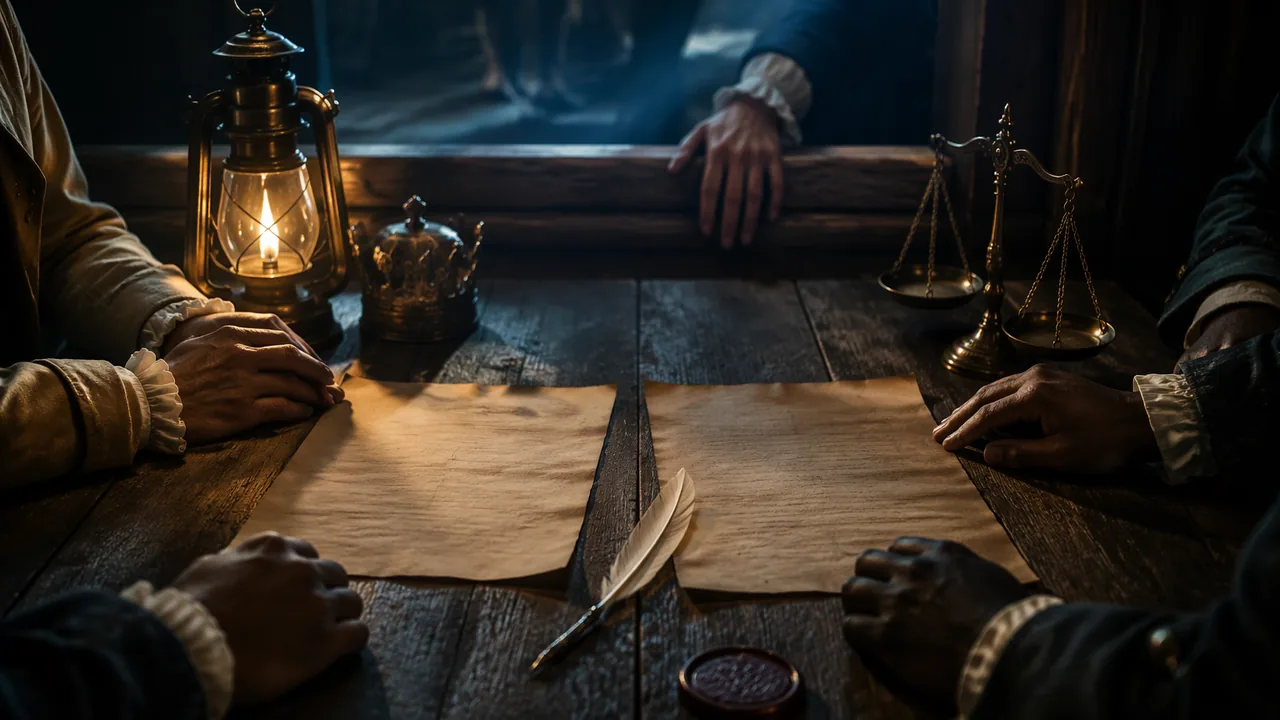
argue, from a set of documents, whether the revolutions of 1688 and 1776 put the ideas of Locke and Montesquieu into practice and for whom, and defend the argument orally.
Instruction
The question. Did the revolutions of 1688 and 1776 put the ideas of Locke and Montesquieu into practice — and for whom?
This is a document-based question (DBQ). You are not asked to retell events. You are asked to make an argument and prove it with documents, the way a historian does.
Your document set. Locke (§§6 and 199); Hobbes; Magna Carta clause 39; the English Bill of Rights; Montesquieu; the Declaration of Independence; the First and Eighth Amendments; Abigail Adams’s letter. You must cite at least five, and at least one must be a voice outside the new settlement. Choose one. All three earn full credit, all three are free and public, and all three ask the same question of the revolutions’ language: did it include me? Option A — Abigail Adams to John Adams, 31 March 1776, the “Remember the Ladies” letter, in the Adams Papers Digital Edition at the Massachusetts Historical Society (masshist.org/digitaladams). Option B — the petition of “a Great Number of Blackes” to the Massachusetts Council and House of Representatives, [13] January 1777, attributed to Prince Hall and signed by eight Black men, in MHS Collections Online (masshist.org/database/557). Option C — Phillis Wheatley, “To the Right Honourable William, Earl of Dartmouth”, in Poems on Various Subjects, Religious and Moral (1773), Project Gutenberg ebook 409, where an enslaved poet sets her own capture — “I, young in life, by seeming cruel fate / Was snatch’d from Afric’s fancy’d happy seat” — against the colonists’ language of liberty.
Reading a document as evidence. For each document ask four questions: Who wrote it? When and why? For what audience? What does it show, and what can it not show? For example, the English Bill of Rights shows that Parliament limited the Crown’s power to tax — strong evidence that Locke’s idea of consent was put into practice. But it cannot show that ordinary people consented, because only a small share of men could vote for Parliament. That limit is itself evidence for the “for whom?” part of the question.
Building the argument. A strong thesis answers both halves of the question. For example: Both revolutions put Locke’s principle of consent and Montesquieu’s separation of powers into law, but only for a narrow, propertied, male and — in America — free white public; the principles were broad, their application narrow, and that gap became the ground on which later groups fought for inclusion. You may argue a different position. Whatever you argue, organize body paragraphs by idea, not by document: one paragraph on consent, one on separated powers, one on who was included.
Counterclaims (WHST.9-10.1.b). Develop the strongest opposing claim fairly, with evidence. If you argue that the revolutions fulfilled Locke’s ideas, the counterclaim is the exclusion of most people from consent. If you argue that they betrayed those ideas, the counterclaim is that universal language, once written down, created the tools for later expansion, as Abigail Adams was already trying to use it. Answer the counterclaim; do not ignore it.
Judging evidence (HR.4). Your conclusion should say not only what you think, but how confident the evidence lets you be, and what evidence you would want that the set does not include.
The oral defense. Three minutes, live or recorded: state your thesis in one sentence, explain your strongest piece of evidence, then answer these two questions: which document in your set does the least work for your thesis, and what evidence would you need to make that part of the argument hold?
📖 Read for this lesson
The reading opens over the lesson; close it to come back to exactly where you were. The checks below draw on it.
Reading: Two additional documents for the set
Montesquieu, The Spirit of the Laws (trans. Thomas Nugent, 1752), Book XI ch. 6; Abigail Adams to John Adams, 31 March 1776 (Adams Family Papers, Massachusetts Historical Society) · Public domain
Your full document set also includes the Lesson 1.3 and 1.4 readings. Abigail Adams’s spelling is her own.
Montesquieu: When the legislative and executive powers are united in the same person, or in the same body of magistrates, there can be no liberty… Again, there is no liberty, if the judiciary power be not separated from the legislative and executive.
Abigail Adams: …in the new Code of Laws which I suppose it will be necessary for you to make I desire you would Remember the Ladies, and be more generous and favourable to them than your ancestors.
Formative check
Work through these before moving on. They are not graded — they tell you whether the standard below has landed yet.
Which body-paragraph plan best fits a DBQ essay?
A document’s limits — what it cannot show — can be used as evidence in an argument.
How confident are you that you can build and defend a document-based argument that answers both halves of the question?
Unit 1 checkpoint
Do this before you start the task. It covers the whole unit and tells you what to review first.
Where does law come from in Cicero’s natural-law view?
Athenian citizenship included women and enslaved people.
For Aristotle, tyranny is rule by one person…
Aristotle wrote that the law is unaffected by desire.
Which principle is in the English Bill of Rights?
Locke differs from Hobbes because Locke thinks government…
Magna Carta dates from ; the Glorious Revolution from .
The American Revolution was the first time colonies broke from a European empire and justified it with universal natural rights.
Which constitution was drafted under American occupation?
Which is a causal claim, not just sequence?
Abigail Adams’s ‘Remember the Ladies’ letter is evidence of how someone outside the new settlement read the revolution’s language.
Submit: Ideas into Revolution DBQ essay (800-1,000 words) + 3-minute oral defense
Task: Using at least five documents from the set, argue whether the revolutions of 1688 and 1776 put the ideas of Locke and Montesquieu into practice, and for whom.
Submission workflow
- Stage 1 — Evidence plan. Thesis; a table sourcing each of five or more documents (author, date, purpose, what it shows, what it cannot show); and the strongest counterclaim.
- Stage 2 — Self-checked draft. Check that paragraphs are organized by idea, every claim is tied to a cited document, and the counterclaim is stated fairly. Save a revision note listing what you changed and why; a parent, guardian or study partner may read the draft too.
- Stage 3 — Revised final. 800-1,000 words with document citations in parentheses, e.g. (Doc. 4, Bill of Rights).
- Stage 4 — Oral defense. Three minutes, live or recorded (equal credit), answering a question you write yourself: what is the weakest piece of evidence in your essay, and how would you defend it?
How it is scored
| Criterion | What proficient looks like |
|---|---|
| Claim (WHST.9-10.1) | Precise thesis that answers both ‘did they’ and ‘for whom’. |
| Use of documents (WH.10.2.1) | At least five documents cited accurately and sourced; ideas of Locke and Montesquieu explained correctly. |
| Counterclaim (WHST.9-10.1.b) | Strongest opposing claim developed with evidence and answered. |
| Historical context (WH.10.2) | Accurate comparison of the English and American revolutions, including who was included and excluded. |
| Conclusion and evidence judgment (WHST.9-10.1.e, 9-12.WH.1.CC.C / 9-12.WH.1.CC.D) | Conclusion follows from the argument and states the limits of the evidence. |
| Revision (WHST.9-10.5) | Final shows substantive changes in response to your self-check. |
| Oral defense (SL.9-10.4) | Clear, logical, evidence-based answer that listeners can follow. |
The Rest of the DBQ Set: Montesquieu, the Adamses, and Wheatley
Montesquieu, The Spirit of Laws, Book XI ch. 6, trans. Thomas Nugent (London, 1758 printing); Abigail Adams to John Adams, 31 March 1776, and John Adams to Abigail Adams, 14 April 1776, in Familiar Letters of John Adams and His Wife Abigail Adams During the Revolution, ed. Charles Francis Adams (New York: Hurd and Houghton, 1876); Phillis Wheatley, ‘To the Right Honourable William, Earl of Dartmouth’, in Poems on Various Subjects, Religious and Moral (London, 1773) · Public domain
Why this reading. The task names a document set and tells you to cite at least five of them, one of which must be a voice outside the new settlement. Two of those documents — Montesquieu and the outside voice — exist in the lesson only as a title and a link. This reading is the missing half of the set: Montesquieu’s argument at the length you need to use it, and two outside voices complete, so that the “for whom?” half of your question can be argued from a text instead of from a summary. Documents 1 to 5 of the set are in the readings for Lessons 1.1, 1.3 and 1.4. What to look for: for each document, the four sourcing questions — who, when and why, for what audience, and what it can and cannot show. The last one is where most of your marks are.
Document 6. Montesquieu, The Spirit of Laws, Book XI chapter 6 (1748)
Translated by Thomas Nugent; quoted here from the London edition of 1758. The long s of the eighteenth-century printer is transcribed as a modern s, which is a printing convention and not a change to the words. Montesquieu is describing England, partly inaccurately, in order to recommend a design.
In every government there are three sorts of power: the legislative; the executive in respect to things dependent on the law of nations; and the executive, in regard to things that depend on the civil law. By virtue of the first, the prince or magistrate enacts temporary or perpetual laws, and amends or abrogates those that have been already enacted. By the second, he makes peace or war, sends or receives embassies, establishes the public security, and provides against invasions. By the third, he punishes criminals, or determines the disputes that arise between individuals. The latter we shall call the judiciary power, and the other simply the executive power of the state.
The political liberty of the subject is a tranquillity of mind, arising from the opinion each person has of his safety. In order to have this liberty, it is requisite the government be so constituted as one man need not be afraid of another.
When the legislative and executive powers are united in the same person, or in the same body of magistrates, there can be no liberty; because apprehensions may arise, lest the same monarch or senate should enact tyrannical laws, to execute them in a tyrannical manner.
Again, there is no liberty, if the power of judging be not separated from the legislative and executive powers. Were it joined with the legislative, the life and liberty of the subject would be exposed to arbitrary controul; for the judge would be then the legislator. Were it joined to the executive power, the judge might behave with all the violence of an oppressor.
There would be an end of every thing, were the same man, or the same body whether of the nobles or of the people, to exercise those three powers, that of enacting laws, that of executing the public resolutions, and that of judging the crimes or differences of individuals.
A note for your sourcing table. Nugent’s translation was reprinted many times and the printings differ in small ways: some read “if the judiciary power be not separated” where the 1758 printing reads “if the power of judging be not separated”. If your quotation differs by a word from another reader’s, that is why. Name your printing.
What this document can and cannot show. It can show where the design of separated powers came from, and that it was in print twenty-eight years before 1776. It cannot show that any government actually worked this way — Montesquieu’s England did not; the ministers who ran the executive sat in the legislature. A strong essay uses that gap: the American founders built the theory more literally than the country the theory was supposedly describing.
Document 7. Abigail Adams to John Adams, 31 March 1776 — and his reply
From Familiar Letters of John Adams and His Wife Abigail Adams During the Revolution, edited by their grandson Charles Francis Adams (New York: Hurd and Houghton, 1876). The manuscripts are at the Massachusetts Historical Society; this printed edition regularizes Abigail’s capitalization, so where the manuscript has “Remember the Ladies” the book prints “remember the ladies”. Quote whichever you are reading and say which it is.
She begins with slavery in Virginia, several paragraphs before the famous passage. That sentence is rarely quoted and it belongs in a DBQ:
I have sometimes been ready to think that the passion for liberty cannot be equally strong in the breasts of those who have been accustomed to deprive their fellow-creatures of theirs. Of this I am certain, that it is not founded upon that generous and Christian principle of doing to others as we would that others should do unto us.
And then:
I long to hear that you have declared an independency. And, by the way, in the new code of laws which I suppose it will be necessary for you to make, I desire you would remember the ladies and be more generous and favorable to them than your ancestors. Do not put such unlimited power into the hands of the husbands. Remember, all men would be tyrants if they could. If particular care and attention is not paid to the ladies, we are determined to foment a rebellion, and will not hold ourselves bound by any laws in which we have no voice or representation.
That your sex are naturally tyrannical is a truth so thoroughly established as to admit of no dispute; but such of you as wish to be happy willingly give up the harsh title of master for the more tender and endearing one of friend. Why, then, not put it out of the power of the vicious and the lawless to use us with cruelty and indignity with impunity?… regard us then as beings placed by Providence under your protection, and in imitation of the Supreme Being make use of that power only for our happiness.
Read what she is arguing, not just that she argued. She uses the revolutionaries’ own premise — no laws binding those who have no voice or representation — and turns it on them. Then, in the second paragraph, she asks for protection rather than the vote. Both are in the letter. A careful essay says so.
John Adams’s reply, 14 April 1776. The lesson does not mention that there is one. It is the best evidence in the whole set of what the settlement’s leaders thought the universal language meant:
As to your extraordinary code of laws, I cannot but laugh. We have been told that our struggle has loosened the bonds of government everywhere; that children and apprentices were disobedient; that schools and colleges were grown turbulent; that Indians slighted their guardians, and negroes grew insolent to their masters. But your letter was the first intimation that another tribe, more numerous and powerful than all the rest, were grown discontented. This is rather too coarse a compliment, but you are so saucy, I won’t blot it out. Depend upon it, we know better than to repeal our masculine systems.
He answers with a joke, and the joke contains a list: apprentices, students, Native nations, enslaved people, women. He is naming, in one sentence and without meaning to, every group the revolution’s language was already being claimed by. That makes this reply usable as evidence for either side of your question, which is what makes it a good document.
Document 8. Phillis Wheatley, “To the Right Honourable William, Earl of Dartmouth” (1773)
From Poems on Various Subjects, Religious and Moral (London, 1773), printed while Wheatley was enslaved in Boston. Spelling, punctuation and the poet’s elisions are as printed. She is addressing the new Secretary of State for North America, congratulating him, and celebrating colonial liberty — and then, in the middle, she changes the subject:
HAIL, happy day, when, smiling like the morn,
Fair Freedom rose New-England to adorn:
The northern clime beneath her genial ray,
Dartmouth, congratulates thy blissful sway…No more, America, in mournful strain
Of wrongs, and grievance unredress’d complain,
No longer shalt thou dread the iron chain,
Which wanton Tyranny with lawless hand
Had made, and with it meant t’ enslave the land.Should you, my lord, while you peruse my song,
Wonder from whence my love of Freedom sprung,
Whence flow these wishes for the common good,
By feeling hearts alone best understood,
I, young in life, by seeming cruel fate
Was snatch’d from Afric’s fancy’d happy seat:
What pangs excruciating must molest,
What sorrows labour in my parent’s breast?
Steel’d was that soul and by no misery mov’d
That from a father seiz’d his babe belov’d:
Such, such my case. And can I then but pray
Others may never feel tyrannic sway?
How to use it. Notice the structure. Colonists complain of “the iron chain” and of tyranny as a metaphor; Wheatley sets beside it a literal seizure, of a child, from a father. She does not accuse anyone. She explains where her love of freedom comes from, and lets the comparison do the work — in a poem addressed to a British minister, published in London, by a woman who was still legally property in Boston. Every one of those facts belongs in your sourcing note, and the last one is what the document can show that no other document in the set can.
A third outside voice, and an honest note about it
In January 1777 eight Black men of Boston, led by Prince Hall, petitioned the Massachusetts Council and House of Representatives for freedom, arguing that they had a natural right to liberty which had been taken from them, and that they were astonished that a people petitioning against their own enslavement to Britain would deny the same to others. We have not printed the text here because we could not check it against a scan of the manuscript, and this course does not print quotations it has not verified. The original is in the Massachusetts Historical Society’s collections. If you use it, describe its argument in your own words and cite where it is held — which, done properly, is itself a piece of historical practice worth marks.
Grouping the documents — three plans that work
| Plan | Grouping | The argument it supports |
|---|---|---|
| By principle | Consent (Locke §95 and §240, Bill of Rights cl. 4, Declaration) · Separated powers (Montesquieu XI.6, Bill of Rights cl. 1 and 9) · Who consented (Magna Carta cl. 14, Bill of Rights cl. 7 and 11, Constitution Art. I.2) | The principles were enacted; the franchise was not widened. Both halves of the question answered, in that order. |
| By who is speaking | Men designing the settlement (Locke, Montesquieu, Declaration) · Men defending it (John Adams’s reply) · People outside it (Abigail Adams, Wheatley, Dessalines 1804) | The meaning of the universal language depends on who is using it — and the outsiders read it more literally than the authors did. |
| By what changed | Before (Magna Carta, Hobbes) · The settlements (Bill of Rights 1689, Declaration 1776, Bill of Rights 1791) · After (France 1789, Haiti 1804, Abigail Adams’s threat to “foment a rebellion”) | Writing the principles down was itself the decisive act, because it created a text others could hold the authors to. |
For the oral defense. You will be asked which document does the least work for your thesis. Have an answer ready. Hobbes is the usual honest answer — he is in the set to show what the alternative looked like, not to support either side — and saying so, and saying what you would want instead (a record of who could actually vote in 1689 and in 1789), is a better answer than pretending every document helps.
Sources: Montesquieu, The Spirit of Laws, trans. T. Nugent (London, 1758) (archive.org); Familiar Letters of John Adams and His Wife Abigail Adams (1876), Project Gutenberg ebook 34123 (gutenberg.org); Phillis Wheatley, Poems on Various Subjects (1773), Project Gutenberg ebook 409 (gutenberg.org); Petition of a Great Number of Blackes, January 1777, Massachusetts Historical Society (masshist.org)