explain how Plato and Aristotle each answered the question of who should rule, trace the ideas of the rule of law and the illegitimacy of tyranny in their texts, and identify the premises behind each argument.
Instruction
Athens executed the philosopher Socrates in 399 BCE after a trial by a jury of his fellow citizens. His student Plato never forgave democracy. Plato’s student Aristotle, whose school collected accounts of 158 Greek constitutions, came to more cautious conclusions. Between them, they framed a question every revolution in this course will face: who should rule, and what makes a ruler illegitimate?
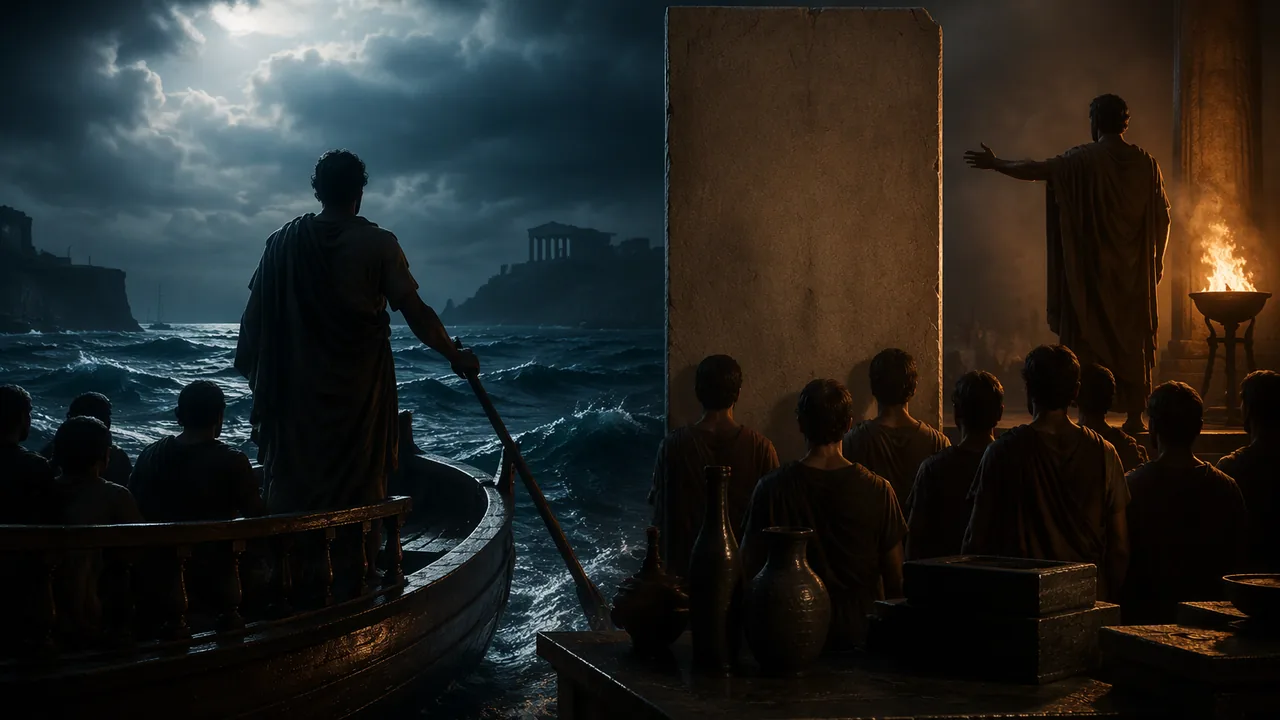
Plato’s answer: the wise. In the Republic (about 375 BCE), Plato argues that ruling is a skill, like medicine or navigating a ship. You would not let passengers vote on how to steer through a storm; you would want a trained navigator. So, he concludes, cities should be ruled by “philosopher-kings” — people trained for decades to know what is truly good. Plato also describes how constitutions decay. Democracy, he says, loves freedom so much that it rejects all restraint; in the disorder, a popular leader promises to protect the people, gathers a bodyguard and becomes a tyrant. Hence his warning that the excess of liberty “seems only to pass into excess of slavery.”
Aristotle’s answer: the law, and the common good. Aristotle sorted governments by two questions. How many rule — one, few or many? And in whose interest? Rule by one for the common good is kingship; for the ruler’s own good it is tyranny. Rule by a few for all is aristocracy; for themselves, oligarchy. Rule by many for all he called polity; for the poor majority’s own interest, democracy (he used the word negatively). His test of legitimacy is therefore not how rulers got power but whether they govern for the common good. And because even good people are swayed by passion, he concludes that law — “reason unaffected by desire” — should rule rather than any person.
Worked example: mapping an argument (HR.1). Distinguishing a valid argument from a fallacious one starts with finding the premises. Take Plato’s ship analogy.
- Premise 1: Steering a ship requires expert knowledge.
- Premise 2: Ruling a city is like steering a ship.
- Conclusion: Therefore ruling should be left to experts, not to votes.
The logic is valid: if both premises are true, the conclusion follows. So test the premises. Premise 2 is the weak one. A ship’s destination is agreed in advance; a city’s goals are exactly what citizens disagree about. A navigator knows how to reach a port, but who decides which port? That is an argument by analogy, and an analogy is only as strong as the likeness between the two things.
Why this matters later. Aristotle’s two ideas — that tyranny is rule for the ruler’s own benefit, and that law should rule rather than men — became tools for later thinkers. Medieval scholars such as Thomas Aquinas, English lawyers resisting the Stuart kings, and John Adams, who wrote that Massachusetts should have “a government of laws and not of men,” all used them. Plato’s worry that democracy can collapse into tyranny also returns: the American founders cited it when they designed checks on majorities, and you will meet it again when you study how twentieth-century dictators came to power through elections.
Vocabulary in context (RH.9-10.4). Notice that Aristotle’s “democracy” is not ours. Read the word in the author’s sense, then explain the difference when you use it.
📖 Read for this lesson
The reading opens over the lesson; close it to come back to exactly where you were. The checks below draw on it.
Reading: Who should rule?
Plato, The Republic, Books V and VIII; Aristotle, Politics, Book III chs. 6 and 16 (trans. Benjamin Jowett) · Public domain
Underline each author’s answer to ‘who should rule?’ Circle any word that describes a bad ruler.
Plato, Republic V: Until philosophers are kings, or the kings and princes of this world have the spirit and power of philosophy, and political greatness and wisdom meet in one… cities will never have rest from their evils…
Plato, Republic VIII: The excess of liberty, whether in States or individuals, seems only to pass into excess of slavery.
Aristotle, Politics III.6: The conclusion is evident: that governments which have a regard to the common interest are constituted in accordance with strict principles of justice, and are therefore true forms; but those which regard only the interest of the rulers are all defective and perverted forms, for they are despotic, whereas a state is a community of freemen.
Aristotle, Politics III.16: Therefore he who bids the law rule may be deemed to bid God and Reason alone rule, but he who bids man rule adds an element of the beast; for desire is a wild beast, and passion perverts the minds of rulers, even when they are the best of men. The law is reason unaffected by desire.
Formative check
Work through these before moving on. They are not graded — they tell you whether the standard below has landed yet.
For Aristotle, what separates kingship from tyranny?
Plato’s ship argument is logically valid. Which premise is most open to challenge?
When Aristotle uses the word ‘democracy’, he means the same kind of government Americans mean by it today.
Map one Plato passage and one Aristotle passage as premise-premise-conclusion. For each, judge (a) whether the conclusion follows from the premises and (b) which premise is weakest and why. Finish with two sentences comparing their answers to ‘who should rule?’
How confident are you that you can explain Plato’s and Aristotle’s views on who should rule and why tyranny is illegitimate, and test the premises of their arguments?
Practice
Work these on paper or in your notebook, then open Check your answer. Aim for all of Fluency and Application; try at least one Challenge.
Printable version: this unit’s practice workbook (PDF)
Fluency
Build speed and accuracy with the core skill.
- Order: (a) Aristotle’s Politics; (b) the death of Socrates; (c) Plato’s Republic.
Check your answer
Answer: (b) 399 BCE → (c) about 375 BCE → (a) later 4th century BCE.Plato wrote after Socrates, his teacher, was executed; Aristotle was Plato’s student. - Complete Aristotle’s six-part scheme: rule by one for the common good is ____; for the ruler’s own good, ____; by a few for all, ____; for themselves, ____; by many for all, ____; for the poor majority’s own interest, ____.
Check your answer
Answer: kingship; tyranny; aristocracy; oligarchy; polity; democracy.The two tests are how many rule and in whose interest. ‘Democracy’ is a perverted form in Aristotle’s usage.
Application
Use the skill in context. Show your reasoning.
- Map as premises and conclusion: Aristotle, “he who bids man rule adds an element of the beast; for desire is a wild beast… The law is reason unaffected by desire.”
Check your answer
Answer: Premise 1: rulers, even the best, are swayed by desire and passion. Premise 2: law is reason without desire. Conclusion: law should rule rather than any person.A strong answer finds both premises, states the conclusion, and tests one premise (for example: laws are written by people, so are they truly free of desire?). - Plato wrote after Athens executed Socrates by a citizen jury. How might that event shape how we read his argument against democracy?
Check your answer
Answer: Model answer: Plato had personal reason to distrust rule by ordinary citizens, so his argument may reflect grievance as well as reasoning. That does not make it wrong, but we should test its premises rather than accept its authority.A strong answer uses the author’s context to raise a question about point of view, without dismissing the argument on that basis alone (that would be a fallacy). - True or false, and why: “Because Plato’s ship argument is valid, its conclusion must be true.”
Check your answer
Answer: False. A valid argument’s conclusion follows if the premises are true. Plato’s analogy premise (a city is like a ship) is doubtful, so the conclusion is not established.Validity is about form; truth needs true premises.
Review
Keep earlier skills sharp.
- Review (Lesson 1.1): name one idea shared by natural law and biblical law that supports the rule of law.
Check your answer
Answer: Both put a law above the ruler — from reason and nature, or from God.This shared idea is what later thinkers used against unjust kings.
The Three Arguments the Lab Asks You to Map, at Full Length
Plato, The Republic, Books VI (488a-489c) and VIII (562-566), trans. Benjamin Jowett; Aristotle, Politics III.11 and III.16, trans. Benjamin Jowett (Oxford: Clarendon Press, 1885) · Public domain
Why this reading. The lab asks you to map one Plato passage and one Aristotle passage as premise–premise–conclusion, then judge which premise is weakest. The mini-lecture describes Plato’s ship argument and then tells you what is wrong with it; it never gives you the passage. You cannot map an argument you have not read, and you cannot judge a premise you have only been told about. Here are the three arguments the lab turns on, complete: Plato’s ship, Plato on how democracy becomes tyranny, and Aristotle’s reply — which is a real counter-argument, not a summary of one. What to look for: each of these is a valid argument. Your work is on the premises, not the logic.
1. Plato, the ship of state — Republic Book VI (488a–489c)
Translation by Benjamin Jowett (Oxford, third edition). Socrates is explaining why philosophers are held in contempt in their own cities. Read it once for the story, then again counting the premises.
Imagine then a fleet or a ship in which there is a captain who is taller and stronger than any of the crew, but he is a little deaf and has a similar infirmity in sight, and his knowledge of navigation is not much better. The sailors are quarrelling with one another about the steering — every one is of opinion that he has a right to steer, though he has never learned the art of navigation and cannot tell who taught him or when he learned, and will further assert that it cannot be taught, and they are ready to cut in pieces any one who says the contrary. They throng about the captain, begging and praying him to commit the helm to them; and if at any time they do not prevail, but others are preferred to them, they kill the others or throw them overboard, and having first chained up the noble captain’s senses with drink or some narcotic drug, they mutiny and take possession of the ship and make free with the stores; thus, eating and drinking, they proceed on their voyage in such manner as might be expected of them. Him who is their partisan and cleverly aids them in their plot for getting the ship out of the captain’s hands into their own whether by force or persuasion, they compliment with the name of sailor, pilot, able seaman, and abuse the other sort of man, whom they call a good-for-nothing; but that the true pilot must pay attention to the year and seasons and sky and stars and winds, and whatever else belongs to his art, if he intends to be really qualified for the command of a ship, and that he must and will be the steerer, whether other people like or not — the possibility of this union of authority with the steerer’s art has never seriously entered into their thoughts or been made part of their calling. Now in vessels which are in a state of mutiny and by sailors who are mutineers, how will the true pilot be regarded? Will he not be called by them a prater, a star-gazer, a good-for-nothing?
Of course, said Adeimantus.
Then you will hardly need, I said, to hear the interpretation of the figure, which describes the true philosopher in his relation to the State… The pilot should not humbly beg the sailors to be commanded by him — that is not the order of nature; neither are ‘the wise to go to the doors of the rich’ — the ingenious author of this saying told a lie — but the truth is, that, when a man is ill, whether he be rich or poor, to the physician he must go, and he who wants to be governed, to him who is able to govern. The ruler who is good for anything ought not to beg his subjects to be ruled by him.
Three things worth noticing before you map it. First, the captain in the parable — deaf, short-sighted, no great navigator — is the people, the demos, who formally hold power and cannot use it well. Second, Plato smuggles in a second analogy at the end, the physician, and it does different work from the ship: nobody disputes what health is, and cities dispute constantly about what the good life is. Third, look at who is doing the killing and drugging in the parable. Plato is not arguing that ordinary people are merely uninformed; he is arguing they are dangerous. Is that a premise or a piece of rhetoric? Decide, and defend your answer.
2. Plato, how a protector becomes a tyrant — Republic Book VIII (562–566)
This is the second Plato passage available to you for the map, and it is the one the mini-lecture points at without quoting. He is describing a democracy that has come to treat every restraint as an insult:
And above all, I said, and as the result of all, see how sensitive the citizens become; they chafe impatiently at the least touch of authority, and at length, as you know, they cease to care even for the laws, written or unwritten; they will have no one over them.
Yes, he said, I know it too well.
Such, my friend, I said, is the fair and glorious beginning out of which springs tyranny… The ruin of oligarchy is the ruin of democracy; the same disease magnified and intensified by liberty overmasters democracy — the truth being that the excessive increase of anything often causes a reaction in the opposite direction; and this is the case not only in the seasons and in vegetable and animal life, but above all in forms of government… The excess of liberty, whether in States or individuals, seems only to pass into excess of slavery.
And then the mechanism, which is the part you can actually test against history:
The people have always some champion whom they set over them and nurse into greatness… This and no other is the root from which a tyrant springs; when he first appears above ground he is a protector.
Yes, that is quite clear.
How then does a protector begin to change into a tyrant?… the protector of the people… having a mob entirely at his disposal, he is not restrained from shedding the blood of kinsmen; by the favourite method of false accusation he brings them into court and murders them… some he kills and others he banishes, at the same time hinting at the abolition of debts and partition of lands: and after this, what will be his destiny? Must he not either perish at the hands of his enemies, or from being a man become a wolf — that is, a tyrant?
Plato is writing about Greek cities in the fourth century BCE. Whether the pattern holds elsewhere is an empirical question, and you will have several chances to test it this year: Robespierre in Unit 2, Napoleon in Unit 2, and in World History B the leaders who reached power through elections in the 1920s and 1930s. Note what a test requires. One case that fits does not establish a general claim, and one case that does not fit — a democracy that grew disorderly and did not produce a tyrant — is evidence against it.
3. Aristotle’s reply — Politics Book III chapters 11 and 16
Translation by Benjamin Jowett (Oxford, 1885). Aristotle studied under Plato for twenty years and disagreed with him here. He attacks exactly the premise the mini-lecture calls weakest, and he attacks it with an argument rather than a doubt:
For the many, of whom each individual is but an ordinary person, when they meet together may very likely be better than the few good, if regarded not individually but collectively, just as a feast to which many contribute is better than a dinner provided out of a single purse. For each individual among the many has a share of virtue and prudence, and when they meet together they become in a manner one man, who has many feet, and hands, and senses; that is a figure of their mind and disposition. Hence the many are better judges than a single man of music and poetry; for some understand one part, and some another, and among them, they understand the whole.
That is a claim about how knowledge is distributed, and it can be argued about. Aristotle then admits the obvious objection himself:
But is this principle really applicable to bodies of men? To some, not to all; for there are assemblies of men who are no better than brutes. But there are men of another sort, whom union makes wise.
In chapter 16 he turns to the rule of law, and again states the strongest objection before answering it:
…the law trains officers for this express purpose, and appoints them to determine matters which are left undecided by it to the best of their judgment. Further it permits them to make any amendment of the existing laws which experience suggests. But still they are only the ministers of the law. He who bids the law rule, may be deemed to bid God and Reason alone rule, but he who bids man rule adds an element of the beast; for desire is a wild beast, and passion perverts the minds of rulers, even when they are the best of men. The law is reason unaffected by desire.
We are told that a patient should call in a physician; he will not get better if he is doctored out of a book. But the parallel of the arts is clearly not in point; for the physician does nothing contrary to reason from motives of friendship; he only cures a patient and takes a fee; whereas magistrates do many things from spite and partiality. And, indeed, if a man suspected the physician of being in league with his enemies to destroy him for a bribe, he would rather have recourse to the book.
That last sentence is the answer to Plato’s smuggled second analogy. A doctor has no motive to treat you badly; a ruler has every motive to rule in his own interest. So expertise is not the whole of the problem of governing — interest is. If you map this argument, your premises are roughly: (1) rulers are moved by desire and passion; (2) law is not; (3) the arts are not a good parallel, because a craftsman’s interest does not conflict with his client’s in the way a ruler’s does. Conclusion: law should rule, and people only as its ministers.
How to map an argument, worked on Plato’s ship
| Step | Plato, Republic VI |
|---|---|
| Premise 1 | Steering a ship well requires an art that must be learned (“attention to the year and seasons and sky and stars and winds”). |
| Premise 2 | Governing a city is relevantly like steering a ship. |
| Premise 3 (unstated) | The people cannot recognize expertise when they see it: they call the true pilot a star-gazer. |
| Conclusion | Authority should go to the person who has the art, whether or not the crew consents. |
| Is it valid? | Yes. If all three premises are true, the conclusion follows. |
| Weakest premise | Premise 2. A ship’s destination is fixed before it sails; a city’s purposes are what its members disagree about. The pilot knows how to reach a port. Nothing in his art tells him which port. |
| What would test it | Aristotle’s claim in III.11: on questions where judgment is spread across many people, are groups in fact better judges than experts? That is answerable with evidence, ancient and modern. |
An unstated premise is still a premise. Premise 3 above appears nowhere in Plato’s sentences as a sentence; it is carried by the picture of drunken, murderous sailors. Finding the premise an author never states, and asking whether it is true, is most of the skill this lab is teaching. Do it to Locke in Lesson 1.3 and to Robespierre in Unit 2 and you will find that both of them also rest on something they never say.
Sources: Plato, The Republic, trans. B. Jowett, Project Gutenberg ebook 1497 (gutenberg.org); Aristotle, The Politics of Aristotle, trans. B. Jowett (1885), vol. 1 (archive.org)