give informal arguments for the circumference and area of a circle and the volumes of cylinders, pyramids and cones, and use volume formulas, including the sphere, to solve problems.
Instruction
You have used these formulas for years. This lab is about why they are true.
Circumference. All circles are similar (you will prove this in Unit 3), so the ratio circumference ÷ diameter is the same for every circle. That constant is called π ≈ 3.14159. So C = πd = 2πr is really the definition of π plus similarity.
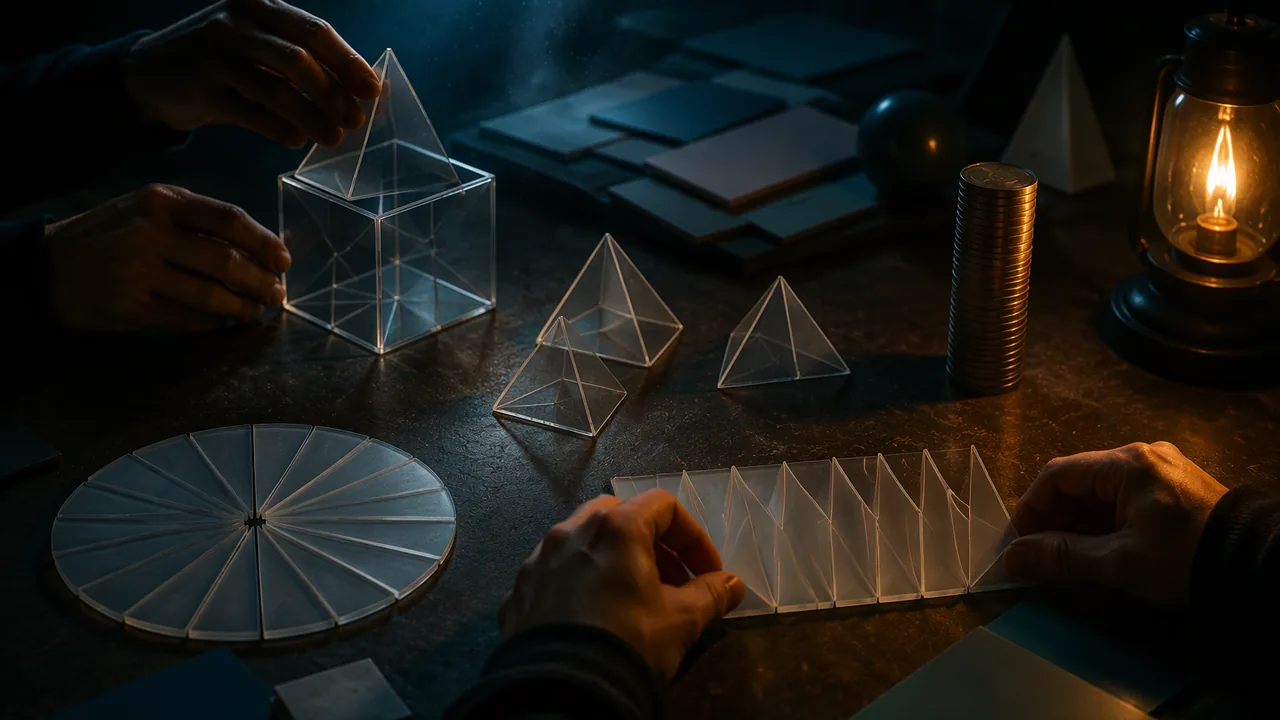
Area of a circle: an informal limit. Cut a circle into many equal sectors, like pizza slices, and lay them side by side, alternating point-up and point-down. The shape looks like a bumpy parallelogram. Its height is about r, and its base is half the circumference, πr. As the number of slices grows, the bumps flatten and the shape approaches a rectangle with area πr × r = πr2. No finite number of slices gives an exact rectangle; the formula is the value the areas approach.
Prisms and cylinders: Cavalieri’s principle. Picture a stack of coins. Push it so it leans; its volume does not change, because every coin is still there. Cavalieri’s principle: if two solids have the same height and every plane parallel to the base cuts them in cross-sections of equal area, the solids have equal volume. A prism or cylinder with base area B and height h has every cross-section equal to B, so it has the same volume as a rectangular box with base B and height h: V = Bh. For a cylinder, V = πr2h, whether it is upright or oblique.
Pyramids: dissection. A cube of side s can be cut into three congruent square pyramids that share one corner of the cube as their apex. Each pyramid’s base is one of the three faces not touching that corner, and its height is s. So each pyramid has volume s3/3 = ⅓ × (base area) × height. Cavalieri’s principle extends V = ⅓Bh to every pyramid: cross-sections of pyramids with equal base areas and heights are dilations of the bases by the same factor at each level, so they have equal areas.
Cones. Compare a cone to a pyramid with the same base area and height. At each level, both cross-sections are the base shrunk by the same scale factor, so their areas stay equal. By Cavalieri, V = ⅓Bh = ⅓πr2h. A cone holds exactly one-third of the cylinder that fits around it; you can check this by filling them with rice.
Spheres. V = &frac43πr3. Archimedes’ argument, for the curious: at height y above the center, a hemisphere of radius r has cross-section area π(r2 − y2). A cylinder of radius r and height r with a cone removed from it has cross-section πr2 − πy2, the same. So the hemisphere’s volume is πr3 − ⅓πr3 = ⅔πr3.
Worked numbers. With r = 3 and h = 10: cylinder 90π ≈ 282.74; cone 30π ≈ 94.25; sphere of radius 3, 36π ≈ 113.10. A square pyramid with base side 6 and height 10 has volume ⅓ × 36 × 10 = 120. Leave answers in terms of π until the end, then round.
📖 Read for this lesson
The reading opens over the lesson; close it to come back to exactly where you were. The checks below draw on it.
Formative check
Work through these before moving on. They are not graded — they tell you whether the standard below has landed yet.
An upright cylinder and an oblique cylinder have the same radius and the same height. How do their volumes compare?
A cylinder with r = 3 and h = 10 has volume π; the cone with the same base and height has volume π.
The sector-rearrangement argument proves the area of a circle with a finite number of slices.
Explain, as if to a younger student, why a cone holds one-third as much as the cylinder around it. Use either the cube dissection plus Cavalieri, or describe an experiment and what it shows and does not show.
How confident are you that you can argue informally for the circle and volume formulas and use them to solve problems?
Practice
Work these on paper or in your notebook, then open Check your answer. Aim for all of Fluency and Application; try at least one Challenge.
Printable version: this unit’s practice workbook (PDF)
Fluency
Build speed and accuracy with the core skill.
- Find the volume of a sphere with radius 4 cm. Give an exact answer and, if it involves π, a decimal to the nearest tenth.
Check your answer
Answer: 256π/3 cm3 ≈ 268.1 cm3 - Find the volume of a cone with radius 4 cm and height 9 cm. Give an exact answer and, if it involves π, a decimal to the nearest tenth.
Check your answer
Answer: 48π cm3 ≈ 150.8 cm3 - Find the volume of a sphere with radius 7 cm. Give an exact answer and, if it involves π, a decimal to the nearest tenth.
Check your answer
Answer: 1372π/3 cm3 ≈ 1,436.8 cm3 - Find the volume of a cylinder with radius 9 cm and height 8 cm. Give an exact answer and, if it involves π, a decimal to the nearest tenth.
Check your answer
Answer: 648π cm3 ≈ 2,035.8 cm3 - Find the volume of a cone with radius 5 cm and height 17 cm. Give an exact answer and, if it involves π, a decimal to the nearest tenth.
Check your answer
Answer: 425π/3 cm3 ≈ 445.1 cm3 - Find the volume of a cylinder with radius 12 cm and height 20 cm. Give an exact answer and, if it involves π, a decimal to the nearest tenth.
Check your answer
Answer: 2880π cm3 ≈ 9,047.8 cm3 - Find the volume of a rectangular prism 9 cm by 9 cm by 15 cm. Give an exact answer and, if it involves π, a decimal to the nearest tenth.
Check your answer
Answer: 1215 cm3 - Find the volume of a rectangular prism 6 cm by 15 cm by 13 cm. Give an exact answer and, if it involves π, a decimal to the nearest tenth.
Check your answer
Answer: 1170 cm3 - A cube with edge 6 is cut into three congruent square pyramids that share a corner as their apex. Find the volume of one pyramid and check it with V = ⅓Bh.
Check your answer
Answer: 72216 ÷ 3 = 72; ⅓(36)(6) = 72. - An upright cylinder and an oblique cylinder both have radius 4 and height 9. Compare their volumes and name the principle.
Check your answer
Answer: Equal: 144π ≈ 452.39; Cavalieri’s principle.
Application
Use the skill in context. Show your reasoning.
- A grain silo is a cylinder of radius 3 m and height 10 m topped by a hemisphere of the same radius. Find its volume.
Check your answer
Answer: 108π ≈ 339.29 m3Cylinder 90π + hemisphere ⅔π(27) = 18π. - An ice-cream cone is modeled as a cone of radius 2.5 cm and height 11 cm with a hemisphere of ice cream on top. Find the total volume to the nearest tenth.
Check your answer
Answer: about 104.7 cm3Cone ⅓π(2.5)2(11) ≈ 71.99; hemisphere ⅔π(2.5)3 ≈ 32.72. - A basketball has a diameter of about 24 cm. Find its volume to the nearest cubic centimeter.
Check your answer
Answer: 2304π ≈ 7,238 cm3&frac43π(12)3. - A cone and a cylinder have the same radius and height. How many full cones of water fill the cylinder, and which argument explains it?
Check your answer
Answer: 3; a cone has the same cross-section areas as a pyramid of equal base area and height (Cavalieri), and a pyramid is one-third of the prism.
Challenge
Stretch problems. Expect to think before you write.
- For a hemisphere of radius 5, and for a cylinder of radius 5 and height 5 with a cone removed (apex at the base center, base at the top), compare the cross-section areas at height 3 above the base. What does Cavalieri’s principle then give for the hemisphere’s volume?
Check your answer
Answer: Both are 16π; the hemisphere’s volume is 125π − 125π/3 = 250π/3 ≈ 261.80.Hemisphere: π(25 − 9) = 16π. Cylinder minus cone: π(25) − π(3)2 = 16π. The same holds at every height, so the volumes are equal.
Review
Keep earlier skills sharp.
- In a right triangle, an acute angle is 18° and the hypotenuse is 34. Find the side opposite the angle. Round to the nearest tenth.
Check your answer
Answer: 10.5sin 18° = opp/34 - A 30°-60°-90° triangle has hypotenuse 8. Find both legs.
Check your answer
Answer: shorter leg 4; longer leg 4√3The shorter leg is half the hypotenuse. - Triangle ABC is similar to triangle DEF. AB = 14 and the corresponding side DE = 7. If BC = 12, find EF, and the ratio of the triangles’ areas.
Check your answer
Answer: EF = 6; area ratio (DEF : ABC) = 1/4The scale factor is 7/14 = 1/2; areas scale by its square.
The Volume Lab: A Cube in Three Pyramids, a Rice Experiment, and Eight Solids to Compute
Constructed teaching material written for this course: exact coordinates for the three-pyramid dissection of a cube, a cone-and-cylinder pouring record labeled illustrative, and a volume problem set with answers · SLS original (constructed teaching data)
Why this reading. The lesson says a cube “can be cut into three congruent square pyramids” and that you “can check” the cone formula by filling with rice, but it gives neither the cut nor the experiment. Both are here: the dissection as exact coordinates you can build in GeoGebra 3D, and a pouring record you can argue about. The lesson’s last question asks what an experiment shows and does not show; the record is what you answer that with.
The three pyramids, exactly
Take the cube with corners at every combination of 0 and s in each coordinate, and choose the corner V = (s, s, s) as the apex of all three pyramids. The three faces of the cube that do not touch V are the faces z = 0, x = 0 and y = 0. Each is the base of one pyramid:
| Pyramid | Base (a face of the cube) | Apex | Height |
|---|---|---|---|
| 1 | (0,0,0), (s,0,0), (s,s,0), (0,s,0) | (s,s,s) | s, the distance from V to the plane z = 0 |
| 2 | (0,0,0), (0,s,0), (0,s,s), (0,0,s) | (s,s,s) | s, to the plane x = 0 |
| 3 | (0,0,0), (s,0,0), (s,0,s), (0,0,s) | (s,s,s) | s, to the plane y = 0 |
The three pyramids share only faces, and together they fill the cube, so each has volume s3/3 = ⅓ × s2 × s = ⅓ × (base area) × height. To see it in GeoGebra 3D with s = 4, type Pyramid((0,0,0),(4,0,0),(4,4,0),(0,4,0),(4,4,4)) and the two others, then Volume(a) for each; you should read 21.33 three times, and 64 for the cube. Rotate the view until you can see that the three apexes coincide. Notice that these pyramids are oblique: the apex is not above the center of the base. Cavalieri’s principle is what lets the formula carry over to the upright ones.
The pouring record (illustrative)
A cone and a cylinder were cut from card with the same base radius, 3.0 cm, and the same height, 10.0 cm. The cone was filled level with rice and poured into the cylinder three times, and the height of rice in the cylinder was measured with a ruler after each pour. These readings were written for this lesson to show what such an experiment looks like; they are not measurements of a real pair of containers.
| Pour | Height of rice in the cylinder (cm) | Predicted if Vcone = ⅓ Vcylinder |
|---|---|---|
| 1 | 3.4 | 3.33 |
| 2 | 6.7 | 6.67 |
| 3 | 10.1 | 10.00 |
Three questions to settle in writing. Does the record support one-third? How large is the disagreement in the last row, as a percent of 10.0 cm, and name two physical reasons it could be that large (think about the card cone’s tip and about how rice settles). And the hard one: could any pouring record, however careful, prove the formula? Say what the dissection above proves that the rice cannot, and what the rice shows that the dissection does not.
Eight solids to compute
Leave π in your answer until the last step. Answers are given so you can check your work, not so you can skip it.
| # | Solid | Volume |
|---|---|---|
| 1 | Cylinder, r = 4, h = 9 | 144π ≈ 452.39 |
| 2 | Cone, r = 4, h = 9 | 48π ≈ 150.80 |
| 3 | Sphere, r = 6 | 288π ≈ 904.78 |
| 4 | Grain silo: cylinder of radius 3 m and height 10 m topped by a hemisphere of radius 3 m | 90π + 18π = 108π ≈ 339.29 m3 |
| 5 | Square pyramid, base side 9, height 7 | 189 |
| 6 | Oblique cylinder, r = 2.5, height 6 (leaning 20°) | 37.5π ≈ 117.81; the lean changes nothing (Cavalieri) |
| 7 | A felled log: circumference 94 cm, length 3.20 m, modeled as a cylinder | r = 94/(2π) ≈ 14.96 cm, V ≈ 224,990 cm3 ≈ 0.225 m3 |
| 8 | Find r: a cylinder holds 500 cm3 with h = 10 cm | r = √(50/π) ≈ 3.99 cm |
For problem 7, say which cross-section you measured and why the circumference is the practical thing to measure on a real log. For problem 8, notice that you solved the formula backward; the package design in Lesson 1.5 will do this constantly.