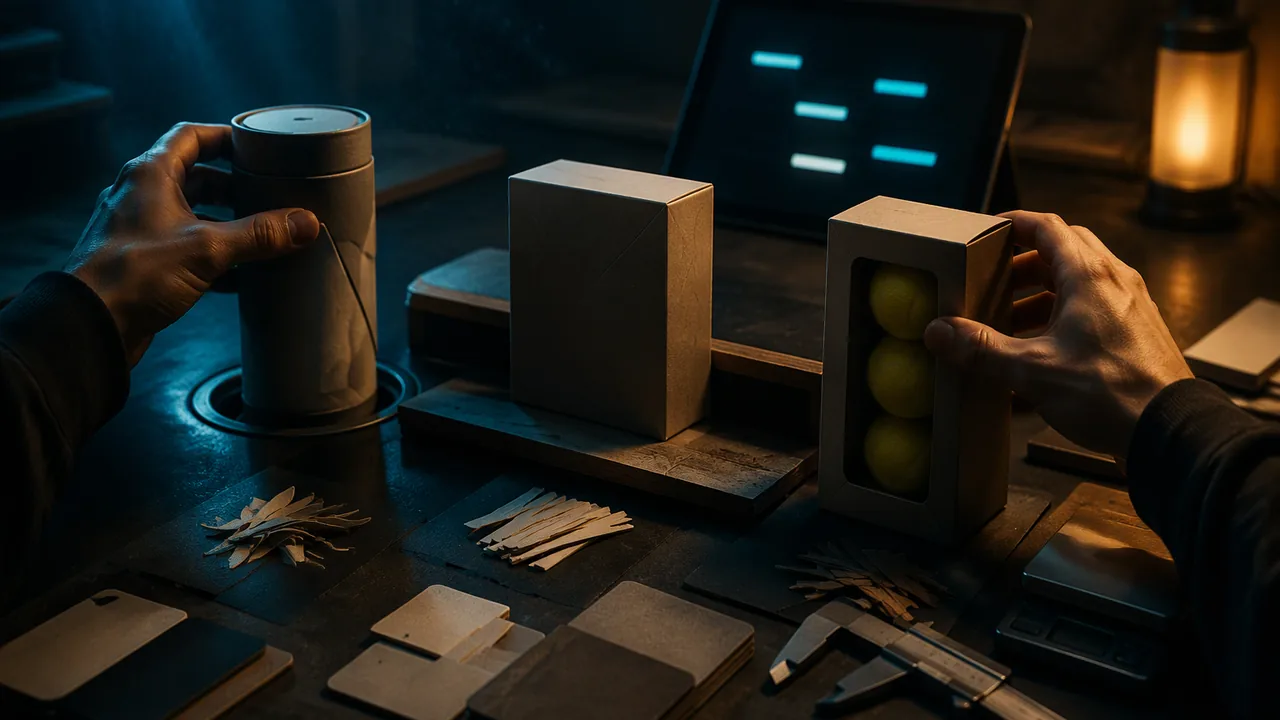
design a container that meets a volume requirement with the least material under realistic constraints, compute its mass from density, build a scale model, and defend the design.
Instruction
Packaging is a real design problem with real costs. Material costs money, adds weight and becomes waste. This challenge asks you to do what a packaging engineer does.
The brief. Choose one of three products; all three earn full credit and all three are about equally demanding: a 355 mL drink; a 500 cm3 bag-in-box snack; or three tennis balls, each about 6.7 cm in diameter. Your container must hold the product, meet at least two practical constraints you state (for example, fits a 7.5 cm cup holder, stacks on a shelf, can be held in one hand), and use as little material as possible.
Model at least three candidates. Use at least two different solid types: a cylinder, a rectangular prism, a square prism, a cone or a composite. For each, express the dimensions so the volume is exactly right, compute the surface area, and build a table (spreadsheet or Desmos) across a range of dimensions to find the least surface area for that shape. Then apply your constraints: the mathematical optimum may not be allowed.
Worked start. For the 355 mL drink, the unconstrained best cylinder has r ≈ 3.84 cm and S ≈ 277.5 cm2 (Lesson 1.4). A cup holder that is 7.5 cm across forces r ≤ 3.75 cm, so the best allowed cylinder is at r = 3.75, still close to the minimum. A square prism holding 355 cm3 with base side s has height 355/s2; test values of s and compare its least area with the cylinder’s.
Mass and cost. Choose one of three materials; the densities you need are printed here, so nothing has to be looked up: aluminum, 2.70 g/cm3, with a wall 0.10 mm thick; PET plastic, about 1.38 g/cm3, with a wall 0.40 mm thick; or solid bleached paperboard, about 0.75 g/cm3, with a wall 0.45 mm thick. Multiply your surface area by the wall thickness to estimate the volume of material, then multiply by the density for its mass; keep your units straight, since 0.10 mm is 0.010 cm. Then compare your design with a package you can measure at home; if you have nothing suitable, compare it instead with the unconstrained best cylinder from Lesson 1.4 (r ≈ 3.84 cm, h ≈ 7.68 cm, S ≈ 277.5 cm2) and say how much material your constraints cost you.
Scale model. Build a model at a stated scale, in card, in clay or in GeoGebra 3D. Use k, k2 and k3 to state the model’s dimensions, surface area and volume, and check one of them by measuring.
Defend the choice. Your report argues for one design. It must state all constraints and assumptions, show the comparison table, and answer the strongest objection (for example, “a sphere uses the least material of all”: so why not a spherical can?).
Pitch. Three minutes, live or recorded, to a “client”: your design, the evidence, the trade-off you accepted. A written pitch is an equal-credit alternative.
📖 Read for this lesson
The reading opens over the lesson; close it to come back to exactly where you were. The checks below draw on it.
Formative check
Work through these before moving on. They are not graded — they tell you whether the standard below has landed yet.
Height of a 355 cm³ cylinder with radius r
Tap to revealh = 355 / (πr²)
Surface area of a closed cylinder
Tap to revealS = 2πr² + 2πrh
Least-area closed cylinder for a fixed volume
Tap to revealHeight equals diameter.
Mass of material
Tap to revealsurface area × wall thickness × density
The least-material cylinder for 355 mL has r ≈ 3.84 cm, but a cup holder allows r ≤ 3.75 cm. What should the designer do?
Stage 1: state your product, its volume, two constraints with reasons, and the three candidate designs you will model.
How confident are you that you can design, optimize and defend a container using volume, surface area, density and scale?
Unit 1 checkpoint
Do this before you start the task. It covers the whole unit and tells you what to review first.
A plane cuts a cylinder parallel to its base. The cross-section is:
Rotating a right triangle about one leg produces a:
A cube can have a regular hexagonal cross-section.
A cylinder with radius 5 and height 4 has volume π.
A cone with radius 3 and height 7 has volume π.
A sphere with radius 6 has volume π.
An oblique prism has a larger volume than an upright prism with the same base and height.
Why is the cone formula one-third of Bh?
Two similar solids have scale factor 4. The volume ratio is:
A 1:20 model has a surface area of 30 cm². The real surface area is cm².
A 400 cm³ block has mass 1,080 g. Its density is:
For a closed cylinder holding a fixed volume, the least surface area occurs when the height equals the diameter.
Submit: Package Design Report, scale model and three-minute pitch
Task: Design a container for a chosen product that meets a volume requirement and at least two practical constraints with the least material. Compare at least three candidates across two solid types, compute mass from density, build a scale model, and argue for your design.
Submission workflow
- Stage 1 — Plan. Product, volume requirement, constraints, candidate shapes and the formulas you will use.
- Stage 2 — Peer-reviewed draft. Comparison tables and computations; a partner re-checks one candidate’s volume and surface area and challenges one constraint. Submit a revision note.
- Stage 3 — Revised final. Report with chosen design, mass estimate, scale model and answer to the strongest objection.
- Stage 4 — Pitch. Three-minute live or recorded pitch, or an equal-credit written pitch.
How it is scored
| Criterion | What proficient looks like |
|---|---|
| Volume and surface area (G.GMD.A.2) | Correct formulas and computations for every candidate, with volume exactly met. |
| Optimization (G.MG.A.3) | Systematic search for least material within each shape; constraints applied correctly. |
| Density and mass (G.MG.A.2) | Material volume and mass estimated with units and stated thickness. |
| Scale model (G.SRT.A.1) | Model built at a stated scale; k, k² and k³ used correctly and checked. |
| Modeling (G.MG.A.1, MP.4) | Assumptions and constraints stated; comparison with a real package, or with the Lesson 1.4 benchmark cylinder. |
| Argument and pitch (MP.1) | Clear recommendation; strongest objection answered. |
The Package Design Brief: Three Products, Their Constraints, and the Benchmark Numbers Every Candidate Is Judged Against
Constructed design brief written for this course: product specifications, a constraint sheet, the cylinder and square-prism search tables for 355 cm³, the tennis-ball packing computation, the sphere objection with numbers, and material masses · SLS original (constructed teaching data)
Why this reading. A design brief is a document, and a performance task has to hand it to you rather than describe it. This is the brief: the three products with their volumes, a constraint sheet to choose from, and the benchmark computations your candidates will be measured against, worked in full so that your peer reviewer and you agree on what “least material” means before you start. Every number here is reproducible from the formulas in Lessons 1.2 and 1.4.
The three products
| Product | What the container must hold | Notes |
|---|---|---|
| 1. Drink | 355 mL = 355 cm3 of liquid | Model the container as holding exactly 355 cm3; real cans add a little headspace, which you may add as a stated constraint. |
| 2. Bag-in-box snack | 500 cm3 | The box must be a prism (it stands on a shelf); the bag inside is not part of your design. |
| 3. Three tennis balls | three spheres, each about 6.7 cm in diameter | The balls may not be compressed; the container must hold them in a line or an arrangement you specify. |
The constraint sheet (choose at least two)
These are typical dimensions written for this brief, not measurements of any product line. State each constraint you adopt as an inequality on your dimensions.
| Constraint | As an inequality |
|---|---|
| Fits a 7.5 cm cup holder | diameter ≤ 7.5 cm, so r ≤ 3.75 cm |
| Fits a 25 cm shelf | height ≤ 25 cm |
| Held in one hand | 6 cm ≤ width ≤ 8 cm |
| Ships 24 to a case with a 40 cm × 27 cm footprint | a 6-by-4 array of footprints fits: width ≤ 6.6 cm and depth ≤ 6.7 cm |
| Stacks | flat top and bottom (rules out a sphere and a cone standing on its point) |
| Headspace | internal volume ≥ 1.03 × product volume |
Benchmark 1. The 355 cm3 cylinder, searched
h = 355/(πr2), S = 2πr2 + 2πrh.
| r (cm) | h (cm) | S (cm2) |
|---|---|---|
| 3.25 | 10.70 | 284.8 |
| 3.50 | 9.22 | 279.8 |
| 3.75 (cup-holder limit) | 8.04 | 277.7 |
| 3.84 (unconstrained best) | 7.66 | 277.5 |
| 4.00 | 7.06 | 278.0 |
| 4.25 | 6.26 | 280.5 |
The exact optimum is r = (355/2π)1/3 = 3.837 cm, h = 2r = 7.674 cm, S = 6πr2 = 277.5 cm2. The cup holder costs 277.7 − 277.5 = 0.2 cm2, less than a tenth of a percent. Constraints are not always expensive; part of your report is saying which ones were.
Benchmark 2. The 355 cm3 square prism, searched
Base side s, height h = 355/s2, S = 2s2 + 4sh = 2s2 + 1420/s.
| s (cm) | h (cm) | S (cm2) |
|---|---|---|
| 5 | 14.20 | 334.0 |
| 6 | 9.86 | 308.7 |
| 7 | 7.24 | 300.9 |
| 7.08 (a cube) | 7.08 | 300.8 |
| 8 | 5.55 | 305.5 |
| 9 | 4.38 | 319.8 |
The best square prism is the cube, s = 3551/3 = 7.08 cm, S = 6s2 = 300.8 cm2, which uses 300.8/277.5 − 1 = 8.4% more material than the best cylinder. Before you conclude that cylinders win, note what the cube can do that the cylinder cannot: it packs into a case with no gaps. If your constraint sheet includes the shipping case, compute how much of the case’s footprint 24 cylinders of radius 3.3 cm leave empty.
Benchmark 3. The tennis-ball tube
Three balls of diameter 6.7 cm in a line need a cylinder of radius 3.35 cm and height 3 × 6.7 = 20.1 cm: V = π(3.35)2(20.1) ≈ 708.7 cm3, S = 2π(3.35)2 + 2π(3.35)(20.1) ≈ 493.6 cm2. The balls themselves have volume 3 × &frac43π(3.35)3 ≈ 472.4 cm3, so they fill 472.4/708.7 = exactly two-thirds of the tube; check that this ratio is 2/3 for any ball radius, using r for the radius and 6r for the tube’s height. A square box 6.7 × 6.7 × 20.1 holds V ≈ 902.3 cm3 with S = 2(6.7)2 + 4(6.7)(20.1) ≈ 628.5 cm2: 27% more material and 27% more empty space. Design a third arrangement (a triangle of three balls? a 2-plus-1 stack?) and compute it.
Benchmark 4. The 500 cm3 box
Among rectangular prisms of volume 500, the cube with side 5001/3 = 7.94 cm has the least surface, S = 6 × 7.942 ≈ 378.0 cm2. A 10 × 10 × 5 box needs 400 cm2; a 12.5 × 8 × 5 box needs 405 cm2. A shelf-facing box wants a large front face and a shallow depth; that is a constraint with a cost, and you should quote it.
The sphere objection, with its numbers
A sphere holding 355 cm3 has r = (3 × 355/4π)1/3 = 4.39 cm and S = 4πr2 ≈ 242.5 cm2, which is 12.6% less than the best cylinder. Your report must answer this objection, and the answer is on the constraint sheet.
Material masses for the benchmark cylinder
Mass = surface area × wall thickness × density, with S = 277.5 cm2:
| Material | Wall | Material volume (cm3) | Mass (g) |
|---|---|---|---|
| Aluminum, 2.70 g/cm3 | 0.10 mm = 0.010 cm | 2.775 | 7.49 |
| PET, 1.38 g/cm3 | 0.40 mm = 0.040 cm | 11.10 | 15.32 |
| Paperboard, 0.75 g/cm3 | 0.45 mm = 0.045 cm | 12.49 | 9.37 |
Repeat the computation for your own design, and report the mass difference between your design and the benchmark as the material cost of your constraints.
Scale model
State a scale k and give the model’s dimensions (×k), surface area (×k2) and volume (×k3). A 1:2 model of the benchmark cylinder has r = 1.92 cm, h = 3.84 cm, S = 277.5/4 ≈ 69.4 cm2 and V = 355/8 ≈ 44.4 cm3; measure one of these on your model and report the percent difference.