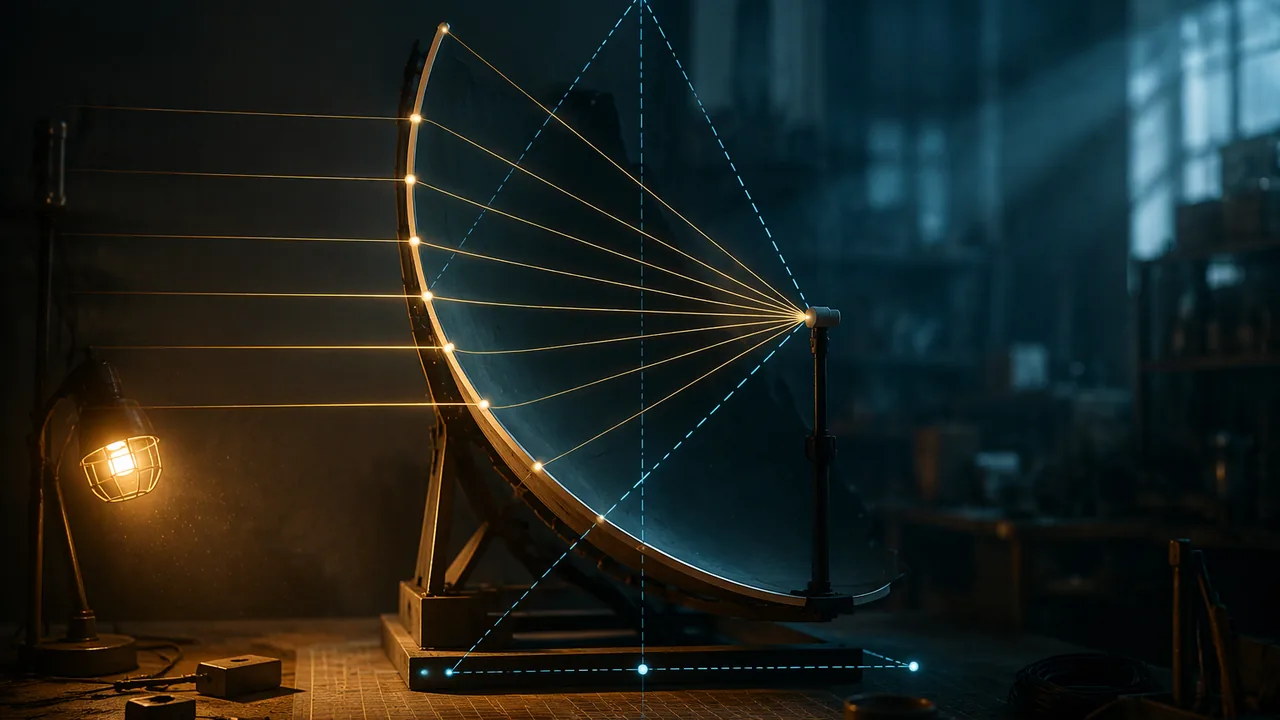
derive the equation of a parabola from its focus and directrix and use it to design a parabolic reflector.
Instruction
Definition. A parabola is the set of all points that are the same distance from a fixed point, the focus, and a fixed line, the directrix. It is defined by distance, just like a circle, so the distance formula turns it into an equation.
Derivation (vertex at the origin). Let the focus be (0, p) and the directrix be y = −p. A point (x, y) is on the parabola when its distance to the focus equals its distance to the directrix:
√(x2 + (y − p)2) = |y + p|.
Square both sides: x2 + y2 − 2py + p2 = y2 + 2py + p2. Cancel y2 and p2: x2 − 2py = 2py, so
x2 = 4py, or y = x2/(4p).
The vertex (0, 0) is halfway between the focus and the directrix. The larger p is, the wider the parabola. For focus (0, 2) and directrix y = −2, p = 2 and y = x2/8.
A shifted parabola. Focus (2, 3), directrix y = −1. The vertex is halfway: (2, 1), so p = 2. Set up the distances: (x − 2)2 + (y − 3)2 = (y + 1)2. Expand the y terms: y2 − 6y + 9 on the left and y2 + 2y + 1 on the right. So (x − 2)2 = 8y − 8 = 8(y − 1). Check the point (6, 3): (6 − 2)2 = 16 and 8(3 − 1) = 16. Its distance to the focus is 4 and to the directrix is 3 − (−1) = 4. Equal, as required.
Why engineers care: the reflective property. Every ray arriving parallel to the axis of a parabola reflects off the curve straight through the focus. Satellite dishes, radio telescopes and solar cookers use this to gather weak signals or sunlight at one point; car headlights and flashlights run it in reverse, sending light from a bulb at the focus out in a parallel beam. (Proving the reflective property needs tangent lines, which you will study in calculus; here you use it.)
Design: where does the receiver go? A satellite dish is 60 cm across and 10 cm deep. Model its cross-section as x2 = 4py with the vertex at the bottom. The rim is at x = 30, y = 10, so 900 = 40p and p = 22.5 cm. The receiver must sit 22.5 cm above the center of the dish. A deeper dish of the same width has a smaller p, with the focus closer to the dish.
Modeling questions (G.MG.A.1, G.MG.A.3). A real dish is a paraboloid, the solid of revolution of a parabola; its cross-sections through the axis are all the same parabola, so the 2D model is enough to locate the focus. Many dishes are “offset”: they use a piece of a larger paraboloid, so the receiver sits off to the side and does not block the signal.
Workshop. Design a parabolic solar cooker from a stated width and depth, locate its focus, and describe how you would build it from card and foil. Plot your parabola, its focus and directrix in GeoGebra or Desmos, and check three points by measuring both distances.
📖 Read for this lesson
The reading opens over the lesson; close it to come back to exactly where you were. The checks below draw on it.
Formative check
Work through these before moving on. They are not graded — they tell you whether the standard below has landed yet.
What is the equation of the parabola with focus (0, 2) and directrix y = −2?
A dish 60 cm wide and 10 cm deep has its focus cm above the vertex.
Simulation & tools
Build a parabola from its definition
Open a blank GeoGebra Graphing Calculator.
- Type
F=(2,3)andd: y=-1for the focus and directrix. - Type
P=(6,3). Then typeDistance(P,F)andDistance(P,d). Record both. - Type
(x-2)^2=8(y-1)to draw the parabola you derived. TypeQ=Point(c), using the name GeoGebra gives the parabola in place of c, to put a movable point on it. - Type
Distance(Q,F)andDistance(Q,d). Drag Q along the curve and record the two distances at four positions. - Change F to (2, 5) and predict the new equation before you type it.
Answer: What do your recorded distances show, and why does that confirm the derivation? How did moving the focus change the width of the parabola, and why?
Without a device: on graph paper, plot the focus and directrix, then plot points whose distances to both are 2, 3, 4 and 5 using a compass and a ruler, and sketch the curve through them.
Open GeoGebra ↗ · GeoGebra · free for non-commercial use
Derive the equation of the parabola with focus (2, 3) and directrix y = −1, showing each algebra step. Then design a solar cooker 50 cm wide and 12 cm deep: find p and say where the pot should go.
How confident are you that you can derive a parabola’s equation from its focus and directrix and use it in a design?
Practice
Work these on paper or in your notebook, then open Check your answer. Aim for all of Fluency and Application; try at least one Challenge.
Printable version: this unit’s practice workbook (PDF)
Fluency
Build speed and accuracy with the core skill.
- Write the equation of the parabola with focus (0, 3) and directrix y = −3.
Check your answer
Answer: x2 = 12yp = 3, so x2 = 4py. - Write the equation of the parabola with focus (0, −1) and directrix y = 1.
Check your answer
Answer: x2 = −4yp = −1; it opens downward. - Find the focus and directrix of x2 = 20y.
Check your answer
Answer: Focus (0, 5); directrix y = −5 - Find the vertex, focus and directrix of (x − 1)2 = 8(y + 2).
Check your answer
Answer: Vertex (1, −2); focus (1, 0); directrix y = −44p = 8 so p = 2. - Write the equation of the parabola with focus (3, 5) and directrix y = 1.
Check your answer
Answer: (x − 3)2 = 8(y − 3)Vertex (3, 3), halfway; p = 2. - Check that (7, 5) lies on (x − 3)2 = 8(y − 3), and that it is equidistant from the focus (3, 5) and the directrix y = 1.
Check your answer
Answer: 16 = 16; both distances are 4. - Which parabola is wider: x2 = 4y or x2 = 16y? Where is each focus?
Check your answer
Answer: x2 = 16y is wider; foci (0, 1) and (0, 4).
Application
Use the skill in context. Show your reasoning.
- A satellite dish is 80 cm across and 12 cm deep. How far above the vertex should the receiver be placed?
Check your answer
Answer: about 33.33 cm402 = 4p(12), so p = 1600/48. - A flashlight reflector has its bulb 1.5 cm from the vertex, at the focus. The reflector is 8 cm across. How deep is it?
Check your answer
Answer: about 2.67 cmx2 = 4(1.5)y = 6y; at x = 4, y = 16/6. - (Illustrative.) A solar cooker is 50 cm across and 12 cm deep. Where should the pot sit?
Check your answer
Answer: about 13.02 cm above the vertex, on the axis252 = 4p(12).
Challenge
Stretch problems. Expect to think before you write.
- Derive the equation of the parabola with focus (h, k + p) and directrix y = k − p.
Check your answer
Answer: (x − h)2 = 4p(y − k)Set (x − h)2 + (y − k − p)2 = (y − k + p)2. Expanding, the right side minus the square term on the left is 4p(y − k).
Review
Keep earlier skills sharp.
- Find the volume of a rectangular prism 10 cm by 10 cm by 14 cm. Give an exact answer and, if it involves π, a decimal to the nearest tenth.
Check your answer
Answer: 1400 cm3 - Find the center and radius of x2 + y2 − 10x + 2y + 1 = 0.
Check your answer
Answer: Center (5, −1); radius 5(x − 5)2 + (y + 1)2 = 25.
Reflector Design Cards: Four Dishes to Locate the Focus Of, and the Points to Plot Without a Device
Constructed design cards written for this course: four parabolic reflectors given as width and depth, a depth-versus-focus table, the plotting table for the no-device route, and a solar-cooker power estimate using an approximate irradiance · SLS original (constructed teaching data)
Why this reading. The workshop says “design a parabolic solar cooker from a stated width and depth,” and the no-device route says to plot points “whose distances to both are 2, 3, 4 and 5.” Neither the dishes nor the points are in the lesson. Both are here. The dish dimensions are typical values written for these cards, not measurements of any product. Card A is worked; Cards B to D and the cooker are yours.
The method, once
Put the vertex at the origin with the dish opening upward, so the cross-section is x2 = 4py. A dish of width w and depth d has its rim at x = w/2, y = d. Substituting, (w/2)2 = 4pd, so
p = w2 / (16d),
and the focus is p above the vertex. The lesson’s dish, w = 60 and d = 10, gives p = 3600/160 = 22.5 cm, as the lesson says.
The cards
| Card | Reflector | Width w | Depth d | p and the focus |
|---|---|---|---|---|
| A | Small satellite dish | 45 cm | 5 cm | p = 452/(16 × 5) = 2025/80 = 25.3 cm above the vertex, well above the rim (5 cm). The receiver sits on an arm 25.3 cm out from the center. |
| B | Solar cooker | 1.2 m | 25 cm | |
| C | Headlight (given the other way around: the bulb is at the focus, 2 cm from the vertex, and the reflector is 12 cm wide) | 12 cm | find d | |
| D | The lesson’s cooker | 50 cm | 12 cm |
For Card C, p = 2, so the equation is x2 = 8y and the depth is the y-value at x = 6. For Card D you should get the same p as in the lesson’s open question, so the two answers must agree.
Depth against focus, at fixed width
Keep w = 60 cm and vary the depth:
| Depth d (cm) | 5 | 10 | 15 | 20 |
|---|---|---|---|---|
| p (cm) | 45 | 22.5 | 15 | 11.25 |
| Focus is | above the rim | above the rim | at the rim | inside the dish |
A deeper dish brings the focus down toward the rim, which is why a deep dish can hold its receiver on short struts and a shallow one needs a long arm. For a cooker you want the pot near the rim where it is easy to reach and shaded from wind: which depth would you choose, and what does that choice cost in how accurately the dish must be shaped? (Say what happens to p if the depth is off by 1 cm at d = 15 and at d = 5.)
How much power does a cooker gather? (approximate)
On a clear day at noon, sunlight delivers roughly 1 kW per square meter to a surface facing the sun; treat this as an approximate figure, not a measurement for any particular place. Card B’s opening is a circle of radius 0.6 m, area π(0.6)2 ≈ 1.13 m2, so it intercepts about 1.1 kW, all of it aimed at one pot. Compute the same for Card D. Then explain why a dish that is a paraboloid can do this and a bowl that is a hemisphere cannot; the reflective property in the lesson is the reason.
The no-device route: points to plot
Focus F(2, 3), directrix y = −1, so p = 2, the vertex is (2, 1), and the parabola is (x − 2)2 = 8(y − 1). A point at distance d from the directrix has y = d − 1; put that into the equation to find x. These are the points the lesson asks you to construct with a compass at distances 2, 3, 4 and 5; construct them first, then compare with the table.
| Distance to both | y | (x − 2)2 | Points |
|---|---|---|---|
| 2 | 1 | 0 | (2, 1), the vertex |
| 3 | 2 | 8 | (2 ± 2√2, 2) ≈ (4.83, 2) and (−0.83, 2) |
| 4 | 3 | 16 | (6, 3) and (−2, 3) |
| 5 | 4 | 24 | (2 ± 2√6, 4) ≈ (6.90, 4) and (−2.90, 4) |
Verify one row with the distance formula: (6, 3) is √(16 + 0) = 4 from F and 3 − (−1) = 4 from the directrix. Notice that the points at distance 4 are exactly 2p = 4 from the axis on each side: the chord through the focus parallel to the directrix always has length 4p, which gives you a quick check on any parabola you draw.
Building it
A card-and-foil cooker is a set of identical curved ribs. Each rib is a copy of the cross-section from the vertex to the rim, so cut one rib to the table of points for your chosen dish, then trace it. State how many ribs you would use and how you would locate the pot at p; the arm that holds it is the one measurement the whole design depends on.