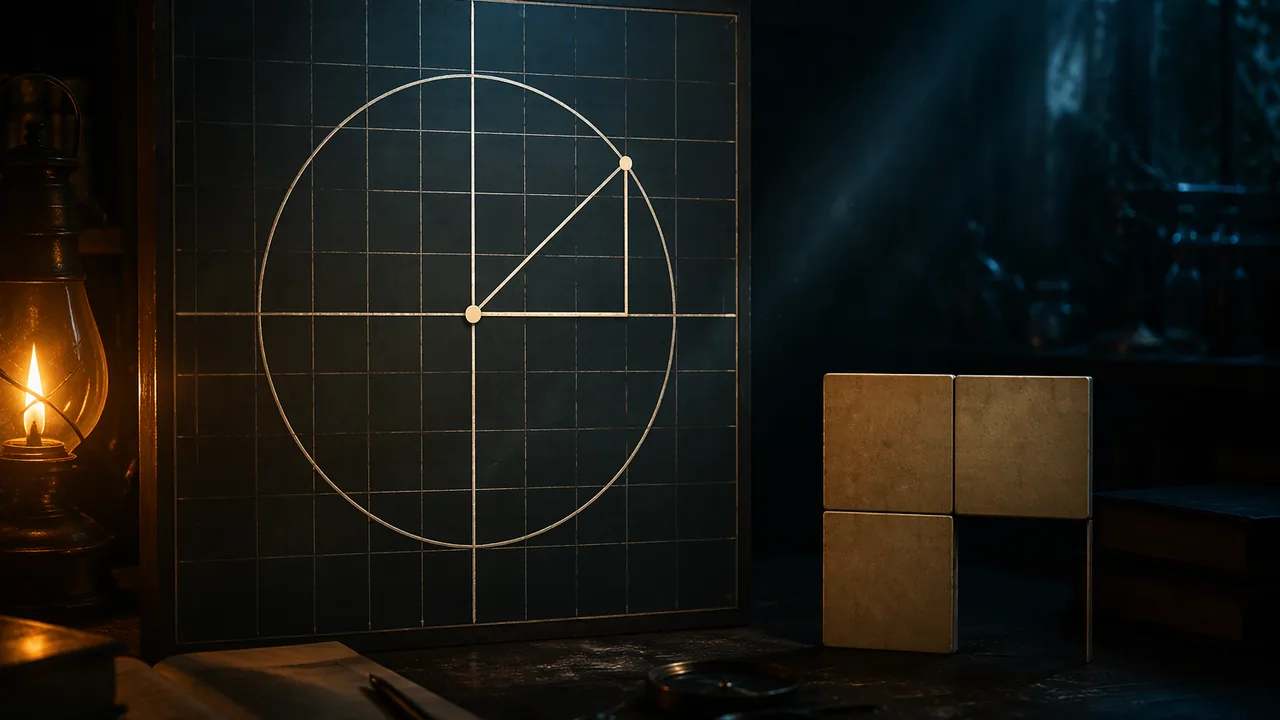
derive the equation of a circle with a given center and radius from the Pythagorean Theorem, and complete the square to find the center and radius of a circle from its equation.
Instruction
A circle is the set of all points at distance r from a center. On the coordinate plane, that definition becomes an equation.
Derivation. Let the center be (h, k) and let (x, y) be any point on the circle. Draw the right triangle with the radius as hypotenuse, a horizontal leg of length |x − h| and a vertical leg of length |y − k|. By the Pythagorean Theorem, the point is on the circle exactly when
(x − h)2 + (y − k)2 = r2.
The absolute values disappear because squares are never negative. This is the standard form. It is the distance formula with the distance fixed at r.
Examples. The circle with center (3, −2) and radius 5 is (x − 3)2 + (y + 2)2 = 25. Notice the sign: y − (−2) = y + 2. Is (6, 2) on it? (6 − 3)2 + (2 + 2)2 = 9 + 16 = 25. Yes. Is (1, 1)? 4 + 9 = 13 < 25, so (1, 1) is inside the circle, closer to the center than 5.
From general form back to center and radius. Expanding the standard form gives something like x2 + y2 − 6x + 4y − 12 = 0, which hides the center and radius. To recover them, complete the square in x and in y.
- Group: (x2 − 6x) + (y2 + 4y) = 12.
- Half of −6 is −3, and (−3)2 = 9. Half of 4 is 2, and 22 = 4. Add 9 and 4 to both sides: (x2 − 6x + 9) + (y2 + 4y + 4) = 12 + 9 + 4.
- Factor: (x − 3)2 + (y + 2)2 = 25.
Center (3, −2), radius 5: the same circle as before.
Second example. x2 + y2 + 8x − 10y + 5 = 0. Group and move the constant: (x2 + 8x) + (y2 − 10y) = −5. Add 16 and 25: (x + 4)2 + (y − 5)2 = 36. Center (−4, 5), radius 6.
Why completing the square works geometrically. x2 + 8x is the area of an x-by-x square plus two x-by-4 strips. Adding a 4-by-4 corner piece, 16, completes a square of side x + 4. That is where the name comes from.
A warning. If completing the square gives a negative number on the right, such as (x − 1)2 + (y + 3)2 = −4, there is no circle: a sum of squares cannot be negative. If it gives 0, the “circle” is a single point.
Looking for structure (MP.7). An equation is a circle when x2 and y2 have the same coefficient and there is no xy term. If the coefficients are both 2, divide the whole equation by 2 first.
📖 Read for this lesson
The reading opens over the lesson; close it to come back to exactly where you were. The checks below draw on it.
Formative check
Work through these before moving on. They are not graded — they tell you whether the standard below has landed yet.
What are the center and radius of x² + y² + 8x − 10y + 5 = 0?
To complete the square for x² − 6x, add . The circle with center (3, −2) and radius 5 has equation (x − 3)² + (y + 2)² = .
The point (1, 1) lies outside the circle (x − 3)² + (y + 2)² = 25.
Derive the equation of the circle with center (h, k) and radius r in your own words, naming the theorem you use. Then explain why x² + y² − 2x + 6y + 14 = 0 is not a circle at all.
How confident are you that you can derive the circle equation and find a circle’s center and radius by completing the square?
Practice
Work these on paper or in your notebook, then open Check your answer. Aim for all of Fluency and Application; try at least one Challenge.
Printable version: this unit’s practice workbook (PDF)
Fluency
Build speed and accuracy with the core skill.
- Find the center and radius of the circle x2 − 8x + y2 + 4y − 61 = 0.
Check your answer
Answer: center (4, −2); radius 9Group and complete the square in x and in y. - Find the center and radius of the circle x2 + 4x + y2 − 8y + 16 = 0.
Check your answer
Answer: center (−2, 4); radius 2Group and complete the square in x and in y. - Find the center and radius of the circle x2 − 8x + y2 + 2y − 19 = 0.
Check your answer
Answer: center (4, −1); radius 6Group and complete the square in x and in y. - Find the center and radius of the circle x2 + 2x + y2 − 12y − 27 = 0.
Check your answer
Answer: center (−1, 6); radius 8Group and complete the square in x and in y. - Find the center and radius of the circle x2 − 12x + y2 + 8y + 36 = 0.
Check your answer
Answer: center (6, −4); radius 4Group and complete the square in x and in y. - Find the center and radius of the circle x2 + 6x + y2 + 8y − 24 = 0.
Check your answer
Answer: center (−3, −4); radius 7Group and complete the square in x and in y. - Write the equation of the circle with center (−2, 5) and radius 3.
Check your answer
Answer: (x + 2)2 + (y − 5)2 = 9 - Write the equation of the circle with center (1, −3) that passes through (4, 1).
Check your answer
Answer: (x − 1)2 + (y + 3)2 = 25r2 = 32 + 42 = 25. - Is (5, 2) inside, on or outside the circle (x − 2)2 + (y + 2)2 = 25?
Check your answer
Answer: On it9 + 16 = 25.
Application
Use the skill in context. Show your reasoning.
- (Illustrative.) A cell tower at (3, −2) on a grid in kilometers covers everything within 8 km. Write the coverage boundary and decide whether a ranger station at (9, 5) is covered.
Check your answer
Answer: (x − 3)2 + (y + 2)2 = 64; not covered (85 > 64)Distance2 from the tower is 62 + 72 = 85. - A circular garden has the diameter from (−1, 2) to (5, 10). Find its center, radius and equation.
Check your answer
Answer: Center (2, 6); radius 5; (x − 2)2 + (y − 6)2 = 25The center is the midpoint; the radius is half of √(36 + 64) = 10. - Explain why x2 + y2 + 4x − 6y + 20 = 0 is not a circle.
Check your answer
Answer: Completing the square gives (x + 2)2 + (y − 3)2 = −7, and a sum of squares cannot be negative.
Challenge
Stretch problems. Expect to think before you write.
- Find the equation of the circle through (0, 0), (8, 0) and (0, 6).
Check your answer
Answer: (x − 4)2 + (y − 3)2 = 25The triangle has a right angle at the origin, so the hypotenuse from (8, 0) to (0, 6) is a diameter (Thales). Its midpoint is (4, 3) and it has length 10.
Review
Keep earlier skills sharp.
- Find the volume of a rectangular prism 14 cm by 8 cm by 14 cm. Give an exact answer and, if it involves π, a decimal to the nearest tenth.
Check your answer
Answer: 1568 cm3 - A 1:25 model has volume 80 cm3. Find the real volume in m3.
Check your answer
Answer: 1.25 m380 × 253 = 1,250,000 cm3. - A right triangle has legs 9 and 40. Find the hypotenuse.
Check your answer
Answer: 41
The Circle Set: Eight Equations to Convert, Two to Expand, and a Siren to Check Against
Constructed teaching material written for this course: eight general-form equations of which two are not circles, two standard-form circles to expand, a point-classification table, and a coverage-circle context · SLS original (constructed teaching data)
Why this reading. The lesson’s output is “a set of circles converted between forms,” and the lesson supplies two worked conversions and one equation to explain away. This is the set. Two of the eight equations are traps of the kind the lesson warns about, one needs to be divided through first, and one has fractions in it on purpose. Rows 1 and 5 are worked; do the rest, and for every circle give the center, the exact radius and a decimal.
General form to center and radius
| # | Equation | Completed squares | Center, radius |
|---|---|---|---|
| 1 | x2 + y2 − 4x + 6y − 12 = 0 | (x − 2)2 + (y + 3)2 = 12 + 4 + 9 = 25 | (2, −3), r = 5 |
| 2 | x2 + y2 + 10x − 2y + 1 = 0 | ||
| 3 | x2 + y2 − 8y = 0 | ||
| 4 | 2x2 + 2y2 − 12x + 4y − 10 = 0 | ||
| 5 | x2 + y2 + 6x − 4y + 13 = 0 | (x + 3)2 + (y − 2)2 = −13 + 9 + 4 = 0 | a single point, (−3, 2); no circle |
| 6 | x2 + y2 − 2x + 6y + 14 = 0 | ||
| 7 | x2 + y2 + 3x − 5y − ½ = 0 | ||
| 8 | x2 + y2 − 12x + 16y = 0 |
Checks you can make without the answers: row 3 and row 8 have no constant term, so each passes through the origin; confirm it once you have the center and radius. Row 4 should be divided by 2 before anything else. Row 6 is the equation from the lesson’s discussion question: finish the squares and say in one sentence why the result rules out any point at all. Row 7’s radius is a whole number despite the fractions.
Standard form to general form
| # | Center and radius | Standard form | General form |
|---|---|---|---|
| 9 | (−2, 7), r = 3 | (x + 2)2 + (y − 7)2 = 9 | x2 + y2 + 4x − 14y + 44 = 0 |
| 10 | (5, 0), r = √7 |
Row 9’s constant is 4 + 49 − 9 = 44: the squares of the center’s coordinates minus r2. After row 10, complete the square on your own general form and confirm you get back to (5, 0) and √7; a conversion you cannot reverse is a conversion you should not trust.
Inside, on or outside
For circle 1, center (2, −3) and radius 5, classify each point by comparing (x − 2)2 + (y + 3)2 with 25. The first is worked.
| Point | (x − 2)2 + (y + 3)2 | Position |
|---|---|---|
| (6, 0) | 16 + 9 = 25 | on the circle |
| (−1, 1) | ||
| (5, 2) | ||
| (0, 0) | ||
| (2, −8) |
A coverage circle
A town’s emergency siren can be heard 3 km away in every direction. On a map with 1 unit = 1 km, the siren is at (4, −2). Write the circle’s standard form, expand it to general form, and decide which of these homes can hear it: H1(6, 0), H2(7, −2), H3(1, 1), H4(4, 1.5). One of the four sits exactly on the edge; say which, and say what “exactly on the edge” would mean about a real siren, whose sound does not stop at a line. Then find where a second siren of the same range should go so that H3 is covered and the two circles just touch; write its equation and check the touching with the distance between the centers.
The derivation, in your words
The lesson derives (x − h)2 + (y − k)2 = r2 from a right triangle. When you write your own version, name the theorem, say why the legs have lengths |x − h| and |y − k|, and say why the absolute-value bars can be dropped. Then test your derivation on circle 8 above: pick any point you found on it and show that the triangle’s legs really do give r2.