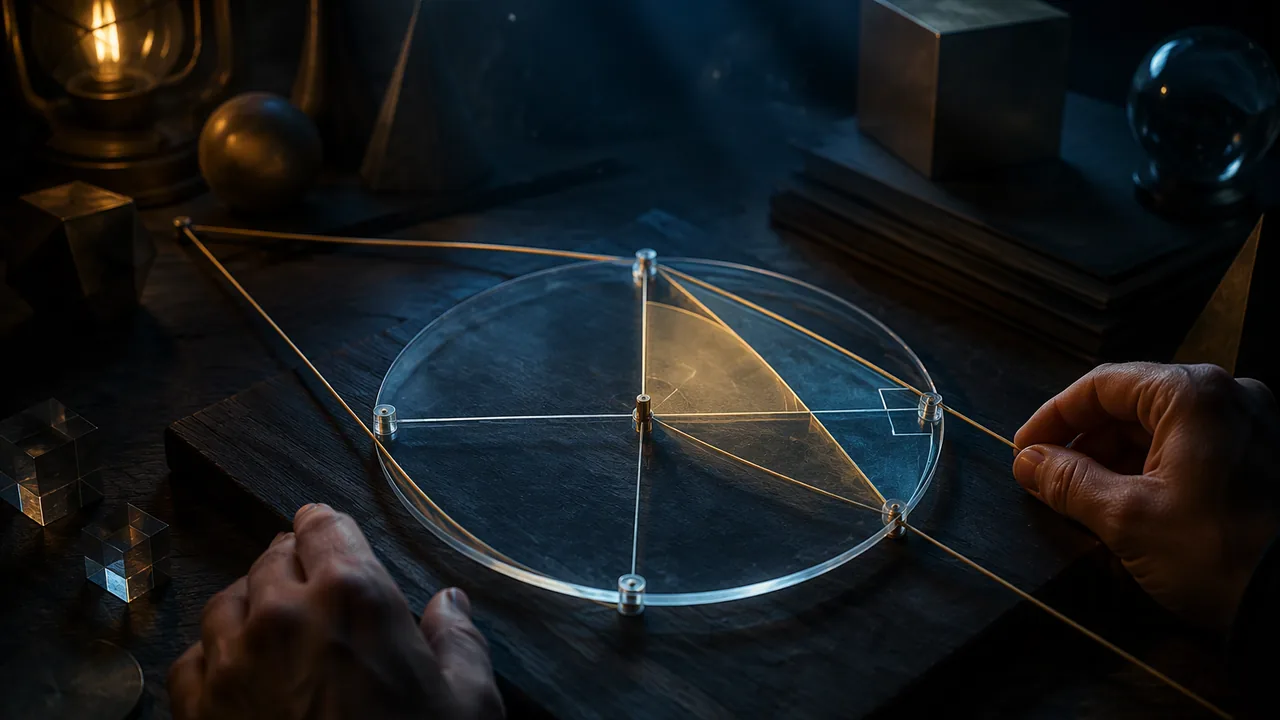
prove that an inscribed angle is half the central angle on the same arc, that an angle inscribed in a semicircle is a right angle, and find the measures of inscribed, central and circumscribed angles.
Instruction
A central angle has its vertex at the center; its measure is the measure of the arc it cuts off. An inscribed angle has its vertex on the circle and its sides are chords. A circumscribed angle is formed by two tangents from an outside point.
The inscribed angle theorem. An inscribed angle is half the central angle that intercepts the same arc.
Proof, case 1: the center lies on a side of the inscribed angle. Let C be on the circle with diameter CD through the center O, and let the inscribed angle be ∠ACD. Triangle AOC is isosceles, because OA = OC = r, so its base angles are equal: ∠OAC = ∠OCA = x. The central angle ∠AOD is an exterior angle of triangle AOC, so it equals the sum of the two remote interior angles: x + x = 2x. The inscribed angle is x, half of 2x. ∎
Case 2: the center is inside the angle. Draw the diameter from C. It splits the inscribed angle into two angles, each of the case-1 type; add the two results. Case 3: the center is outside the angle. Draw the diameter from C and subtract instead of add. Writing cases 2 and 3 is part of today’s lab.
Consequences.
- Inscribed angles that intercept the same arc are congruent: each is half the same central angle.
- An angle inscribed in a semicircle is a right angle (Thales’ theorem): the central angle is a straight angle, 180°, so the inscribed angle is 90°. This explains Unit 2’s result that the midpoint of the hypotenuse is the center of a circle through all three vertices.
- Circumscribed angles. Tangents from P touch the circle at A and B. Quadrilateral PAOB has right angles at A and B (tangent ⊥ radius), so ∠P + ∠AOB = 360° − 180° = 180°. The circumscribed angle is supplementary to the central angle.
Worked example. Arc AB measures 100°. The central angle is 100°; any inscribed angle on arc AB is 50°; the circumscribed angle formed by tangents at A and B is 180° − 100° = 80°.
Second example. Points A, B, C and D lie on a circle, and arc AD (not containing B or C) measures 84°. Then ∠ABD and ∠ACD both intercept arc AD, so each is 42°, even though B and C are in different places. If AC is a diameter, ∠ABC and ∠ADC are both 90°.
Practice routine. For every angle, first identify its type (central, inscribed or circumscribed) and the arc it intercepts. Then apply the matching relationship. Most errors come from using the wrong arc; trace it with a finger or a highlighter.
📖 Read for this lesson
The reading opens over the lesson; close it to come back to exactly where you were. The checks below draw on it.
Formative check
Work through these before moving on. They are not graded — they tell you whether the standard below has landed yet.
Arc AB measures 100°. Tangents at A and B meet at P. What is angle APB?
An inscribed angle that intercepts a 140° arc measures °. An angle inscribed in a semicircle measures °.
Simulation & tools
Inscribed angle investigation
Open a blank GeoGebra Geometry app.
- Draw a circle with center O. Place points A, B and C on the circle with the Point on Object tool.
- Draw segments OA, OB, CA and CB. Measure the central angle AOB and the inscribed angle ACB with the Angle tool (click the points in order so you get the angle on the correct side).
- Drag C around the circle, keeping it off arc AB. Record both angles at five positions.
- Drag A and B to make arc AB a semicircle (use a diameter). Record angle ACB.
- Draw tangents at A and B with the Tangents tool, mark their intersection P, and measure angle APB.
Answer: State the relationships your table shows between the inscribed, central and circumscribed angles. Which one is Thales’ theorem? Then say which of your observations we have proved and which you still need to prove.
Without a device: draw a large circle with a compass, mark A and B, and measure angle ACB with a protractor for four positions of C.
Open GeoGebra ↗ · GeoGebra · free for non-commercial use
Write the proof of case 2 of the inscribed angle theorem (center inside the angle), using case 1 twice. Include a labeled diagram.
How confident are you that you can prove the inscribed angle theorem and find inscribed, central and circumscribed angle measures?
Practice
Work these on paper or in your notebook, then open Check your answer. Aim for all of Fluency and Application; try at least one Challenge.
Printable version: this unit’s practice workbook (PDF)
Fluency
Build speed and accuracy with the core skill.
- An inscribed angle intercepts an arc of 130°. Find the angle.
Check your answer
Answer: 65° - An inscribed angle measures 38°. Find the central angle on the same arc.
Check your answer
Answer: 76° - Tangents at A and B meet at P, and arc AB (the minor arc) measures 110°. Find ∠APB.
Check your answer
Answer: 70°180° − 110°. - A circumscribed angle measures 50°. Find the minor arc between the points of tangency.
Check your answer
Answer: 130° - Triangle ABC is inscribed in a circle with AB a diameter. ∠A = 32°. Find ∠C and ∠B.
Check your answer
Answer: ∠C = 90°; ∠B = 58°Thales’ theorem. - Two inscribed angles intercept the same arc. One is (2x + 10)° and the other (4x − 20)°. Find the angle.
Check your answer
Answer: 40° (x = 15) - Points A, B, C divide a circle into arcs of 100°, 120° and 140°. Find the angles of triangle ABC.
Check your answer
Answer: 50°, 60°, 70°Each angle is half the arc opposite it.
Application
Use the skill in context. Show your reasoning.
- A carpenter places the corner of a set square on a circular tabletop edge and marks where the two sides cross the edge. What has she found, and why? How can she find the center?
Check your answer
Answer: The two marks are the ends of a diameter (Thales). Repeating from another point gives a second diameter; the center is where they cross. - (Illustrative.) A soccer goal occupies an arc of 40° of a circle drawn through both posts. Every point on the rest of that circle sees the goal at the same angle. What is it?
Check your answer
Answer: 20°All inscribed angles on the same arc equal half the arc. - A regular pentagon is inscribed in a circle. Find the angle between two adjacent sides by using inscribed angles.
Check your answer
Answer: 108°Each side cuts off 72°. The interior angle intercepts the three arcs not adjacent to it: ½(3 × 72°) = 108°.
Challenge
Stretch problems. Expect to think before you write.
- Prove the inscribed angle theorem in the case where the center lies outside the inscribed angle ACB.
Check your answer
Answer: Draw diameter CD and subtract two case-1 results.Model proof. With diameter CD, ∠ACB = ∠DCB − ∠DCA (or the reverse). By case 1, ∠DCB = ½∠DOB and ∠DCA = ½∠DOA. So ∠ACB = ½(∠DOB − ∠DOA) = ½∠AOB.
Review
Keep earlier skills sharp.
- Find the center and radius of the circle x2 − 4x + y2 − 4y − 73 = 0.
Check your answer
Answer: center (2, 2); radius 9Group and complete the square in x and in y. - Find the volume of a square pyramid with base edge 7 cm and height 8 cm. Give an exact answer and, if it involves π, a decimal to the nearest tenth.
Check your answer
Answer: 392/3 cm3 - Write the line through (2, 5) perpendicular to y = 4x − 1.
Check your answer
Answer: y = −¼x + 5.5
The Inscribed Angle Record: A Protractor Investigation Already Run, Seven Angle Problems, and the Diagram for Case 3
Constructed teaching material written for this course: an investigation record labeled illustrative, seven inscribed, central and circumscribed angle problems with arc measures, and a labeled setup for the third case of the inscribed angle theorem · SLS original (constructed teaching data)
Why this reading. The lab asks you to record angles at five positions, state the relationships your table shows, and then “say which of your observations we have proved and which you still need to prove.” If you have GeoGebra, run the investigation and compare with this record. If you do not, this record is your table. It was written for this lesson to look like a careful protractor investigation, with the small disagreements a protractor produces; it is not a measurement of any particular drawing.
The record (illustrative)
A circle of radius 8 cm was drawn with a compass. A and B were placed so that the central angle AOB measured 140° (the minor arc AB is 140°). C was moved along the major arc and angle ACB read with a protractor at five positions, then A and B were moved to the ends of a diameter and three more readings taken.
| Position of C | Central angle AOB | Inscribed angle ACB (read) | Predicted by the theorem |
|---|---|---|---|
| 1 | 140° | 70° | 70° |
| 2 | 140° | 69° | 70° |
| 3 | 140° | 71° | 70° |
| 4 | 140° | 70° | 70° |
| 5 (C on the minor arc) | 140° (the intercepted arc is now the major arc, 220°) | 110° | 110° |
| 6, AB a diameter | 180° | 90° | 90° |
| 7, AB a diameter | 180° | 89° | 90° |
| 8, AB a diameter | 180° | 91° | 90° |
Tangents at A and B (with arc AB back at 140°) met at P, and angle APB read 40°. Predicted: 180° − 140° = 40°.
Position 5 is the one students skip. When C crosses onto the minor arc, angle ACB intercepts the other arc, and 70° + 110° = 180° is the inscribed-quadrilateral fact of Lesson 3.3 arriving early. Write the three relationships the record shows, name the one that is Thales’ theorem, and then be honest: which of them has the lesson proved (case 1 of the inscribed angle theorem), which follow from that proof once cases 2 and 3 are written, and which one (the circumscribed angle) the lesson proved by a different route?
Seven problems
Identify the angle’s type and the arc it intercepts before computing. Row 1 is worked.
| # | Given | Find | Answer |
|---|---|---|---|
| 1 | arc AD (not containing B) is 84°; B is on the circle | angle ABD | inscribed, intercepts arc AD: ½ × 84° = 42° |
| 2 | inscribed angle ACB = 35° | arc AB and central angle AOB | |
| 3 | tangents from P touch at A and B; angle APB = 50° | central angle AOB, the minor arc AB, and an inscribed angle on that arc | |
| 4 | A, B, C, D in order on a circle; arcs AB = 80°, BC = 100°, CD = 70°, DA = 110° | all four angles of ABCD | |
| 5 | AC is a diameter; angle BAC = 32° | angles ABC and BCA, and arc BC | |
| 6 | a triangle inscribed in a circle has a right angle and legs 6 and 8 | the circle’s radius | |
| 7 | inscribed angles ACB and ADB intercept the same arc AB; angle ACB = 47° | angle ADB, and the reason |
Problem 4 checks itself: opposite angles must add to 180°, and all four arcs must add to 360°. Problem 6 runs Thales backward: if the angle is right, the hypotenuse is a diameter.
The setup for case 3
The lesson asks you to write case 2 (center inside the angle). Case 3 is the one that catches people, so here is its diagram in words, for you to draw and label. Circle with center O. Place C at the top of the circle and draw the diameter CD straight down through O. Now place A and B both on the right side of CD, with A nearer to C than B is. Angle ACB does not contain O. Draw CA and CB.
Angle DCB is a case-1 angle (one side is the diameter), so angle DCB = ½ angle DOB. Angle DCA is also a case-1 angle, so angle DCA = ½ angle DOA. The angle you want is the difference: angle ACB = angle DCB − angle DCA = ½(angle DOB − angle DOA) = ½ angle AOB. Case 2 is the same argument with A and B on opposite sides of CD and a plus sign in place of the minus. When you write case 2, draw both diagrams side by side and point to the one word that changes.