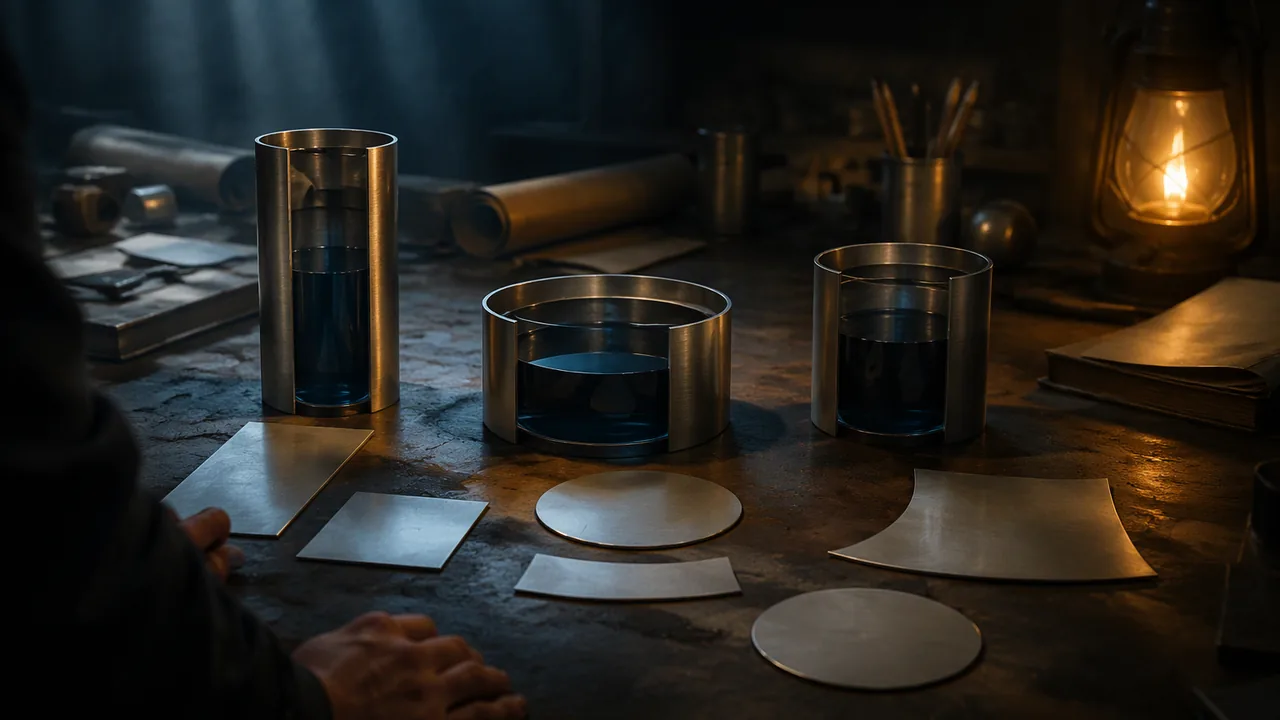
compute and interpret densities based on area and volume, and use volume and surface-area models to compare designs that meet a requirement.
Instruction
Density is an amount per unit of space. It can be based on area or on volume.
Area density: population. The 2020 Census counted about 6.15 million people in Missouri, which has about 68,750 square miles of land. Its population density is about 6,154,913 ÷ 68,746 ≈ 90 people per square mile. That average hides enormous variation: dense city blocks and nearly empty Ozark forest. A density is a model, and it describes the whole region only on average. The same idea gives trees per acre in a forest survey, or cell towers per square mile in a coverage plan.
Volume density: mass. Aluminum has a density of about 2.70 grams per cubic centimeter. A solid aluminum cylinder with radius 2 cm and height 10 cm has volume π × 22 × 10 = 40π ≈ 125.66 cm3, so its mass is about 125.66 × 2.70 ≈ 339.3 g. Density lets you find the mass of material in a design before you build it, and so its cost, weight and shipping emissions.
Energy and other densities. Dividing any quantity by area or volume gives a density: BTUs of heating per cubic foot of room, kilograms of fertilizer per hectare, bits per square millimeter of a chip. Always carry the units: density = quantity ÷ (area or volume).
Design: the least material for a given volume. A drink can must hold 355 mL, which is 355 cm3. For a cylinder with radius r, the height must be h = 355 / (πr2), and the surface area (top, bottom and side) is S = 2πr2 + 2πrh. Build the table in a spreadsheet or Desmos:
| r (cm) | h (cm) | S (cm2) |
|---|---|---|
| 2.5 | 18.08 | 323.3 |
| 3.0 | 12.56 | 293.2 |
| 3.5 | 9.22 | 279.8 |
| 4.0 | 7.06 | 278.0 |
| 4.5 | 5.58 | 285.0 |
| 5.0 | 4.52 | 299.1 |
The minimum is near r ≈ 3.84 cm, h ≈ 7.67 cm, with S ≈ 277.5 cm2. At that point the height equals the diameter: the most material-efficient closed cylinder is as tall as it is wide.
So why are real cans taller? Because the model left things out. Real cans are narrower to fit a hand and a cup holder; the top is thicker metal than the sides, so a smaller top saves more than the model suggests; and a slimmer can stacks and ships well. This is the modeling cycle: build a model, compute, compare with reality, and revise the model’s assumptions.
Workshop. Pick a product and compute its best closed-cylinder dimensions for a fixed volume, then compare with a real package you measure. List every constraint the real design seems to satisfy that your model ignored.
📖 Read for this lesson
The reading opens over the lesson; close it to come back to exactly where you were. The checks below draw on it.
Formative check
Work through these before moving on. They are not graded — they tell you whether the standard below has landed yet.
A solid aluminum cylinder (density 2.70 g/cm³) has radius 2 cm and height 10 cm. What is its mass, to the nearest gram?
Missouri’s population density of about 90 people per square mile means most Missourians live in areas with about that many people per square mile.
For a closed cylinder holding a fixed volume, the least surface area occurs when the height equals the .
Measure a real cylindrical package (a can, a jar, a tube). Compute its volume and surface area, then compute the dimensions of the closed cylinder with the same volume and least surface area. List three reasons the manufacturer might not use those dimensions.
How confident are you that you can compute densities and compare designs by volume, surface area and mass?
Practice
Work these on paper or in your notebook, then open Check your answer. Aim for all of Fluency and Application; try at least one Challenge.
Printable version: this unit’s practice workbook (PDF)
Fluency
Build speed and accuracy with the core skill.
- Find the volume of a rectangular prism 5 cm by 7 cm by 20 cm. Give an exact answer and, if it involves π, a decimal to the nearest tenth.
Check your answer
Answer: 700 cm3 - Find the volume of a cone with radius 6 cm and height 13 cm. Give an exact answer and, if it involves π, a decimal to the nearest tenth.
Check your answer
Answer: 156π cm3 ≈ 490.1 cm3 - Find the volume of a cylinder with radius 3 cm and height 7 cm. Give an exact answer and, if it involves π, a decimal to the nearest tenth.
Check your answer
Answer: 63π cm3 ≈ 197.9 cm3 - An iron ball (density 7.87 g/cm3) has radius 3 cm. Find its mass to the nearest gram.
Check your answer
Answer: 890 gVolume 36π cm3; multiply by 7.87. - (Illustrative.) A town of 48,000 people covers 12.5 square miles. Find its population density.
Check your answer
Answer: 3,840 people per square mile - A 250 cm3 block has mass 675 g. Find its density and say which material in the lesson it matches.
Check your answer
Answer: 2.70 g/cm3; aluminum
Application
Use the skill in context. Show your reasoning.
- (Illustrative forest survey.) A circular plot of radius 10 m contains 23 trees. Estimate the tree density per hectare (10,000 m2).
Check your answer
Answer: about 732 trees per hectarePlot area 100π ≈ 314.16 m2; 23/314.16 × 10,000. - A closed box with a square base must hold 1,000 cm3. Compute the surface area for base edges 8, 10 and 12 cm and say which is least.
Check your answer
Answer: s = 8: 628.0 cm2; s = 10: 600.0 cm2; s = 12: 621.3 cm2; least at 10 cm (a cube)Height = 1000/s2; surface area = 2s2 + 4s × height. - A solid aluminum cylinder (2.70 g/cm3) of radius 2 cm must weigh 500 g. How tall must it be?
Check your answer
Answer: about 14.74 cmVolume needed 500/2.70 ≈ 185.19 cm3; divide by π(2)2.
Challenge
Stretch problems. Expect to think before you write.
- An open-top box with a square base must hold 1,000 cm3. Build a table in a spreadsheet or Desmos and find the base edge that uses the least material, to the nearest tenth. How does it compare with the closed box?
Check your answer
Answer: base edge ≈ 12.6 cm, surface area ≈ 476.2 cm2; the open box is wider and shorter than the closed cubeSurface area = s2 + 4000/s. The minimum is where the height is half the base edge.
Review
Keep earlier skills sharp.
- In a right triangle, an acute angle is 31° and the adjacent leg is 34. Find the opposite leg. Round to the nearest tenth.
Check your answer
Answer: 20.4tan 31° = opp/34 - A 30°-60°-90° triangle has shorter leg 7. Find the longer leg and the hypotenuse.
Check your answer
Answer: longer leg 7√3; hypotenuse 14Sides are in the ratio 1 : √3 : 2. - Triangle ABC is similar to triangle DEF. AB = 10 and the corresponding side DE = 15. If BC = 22, find EF, and the ratio of the triangles’ areas.
Check your answer
Answer: EF = 33; area ratio (DEF : ABC) = 9/4The scale factor is 15/10 = 3/2; areas scale by its square.
The Density File: Missouri and Five Missouri Areas, a Materials Table, and Three Packages Already Measured
U.S. Census Bureau: 2020 Census resident population of Missouri (Apportionment Table 2, April 2021); county April 1, 2020 estimates base (CO-EST2024-POP-29); land areas from the TIGERweb State_County service and the 2020 Gazetteer county file; all retrieved Nov. 5, 2026. Material densities are approximate reference values; the three package measurements are SLS original teaching data · Public domain (U.S. Census Bureau figures), with SLS original worked examples and constructed package measurements
Why this reading. The lesson’s last task says “measure a real cylindrical package” and compute from it. If you have a can or a jar, measure it; if you do not, three packages are already measured below, so the work does not depend on what is in your kitchen. The lesson’s population density for Missouri is also checked here against the Census Bureau’s own figures, and five Missouri areas are added so you can see how much a statewide average hides. The material densities are the approximate reference values the course uses; they are not attributed to any agency, and real materials vary.
Table 1. Population density, Missouri and five Missouri areas
Population is the Census Bureau’s count or estimates base for April 1, 2020; land area is from the Bureau’s TIGERweb service and 2020 Gazetteer file, converted from square meters at 2,589,988.11 m2 per square mile. Density = population ÷ land area. Two rows are worked. (St. Louis city is an independent city, counted separately from St. Louis County.)
| Area | Population, April 1, 2020 | Land area (mi2) | People per mi2 |
|---|---|---|---|
| Missouri (2020 Census count) | 6,154,913 | 68,746.5 | 6,154,913 ÷ 68,746.5 = 89.5 |
| St. Louis County | 1,004,501 | 507.9 | 1,004,501 ÷ 507.9 = 1,978 |
| St. Louis city | 301,371 | 61.7 | |
| Jackson County (Kansas City) | 717,214 | 604.5 | |
| Shannon County | 7,033 | 1,003.8 | |
| Worth County | 1,973 | 266.6 |
Fill the last four. Then answer: how many times denser than the state average is St. Louis city, and what fraction of the state average is Shannon County? Which of these six figures is closest to 90, the lesson’s statewide value? That is the point of the lesson’s true-false item: the average describes almost nowhere. (The county populations are the Bureau’s April 1, 2020 estimates base, which integrates the 2020 Census count; the state row is the Census count itself, which is why the Bureau’s state total of county bases, 6,154,854, differs slightly from 6,154,913.)
Table 2. Material densities used in this course
Approximate reference values in grams per cubic centimeter. Use them with the wall thicknesses in Lesson 1.5.
| Material | Density (g/cm3) | Material | Density (g/cm3) |
|---|---|---|---|
| Aluminum | 2.70 | PET plastic | 1.38 |
| Steel (tinplate) | 7.85 | HDPE plastic | 0.95 |
| Glass (soda-lime) | 2.50 | Solid bleached paperboard | 0.75 |
| Water | 1.00 | Pine (dry) | 0.50 |
Check the lesson’s example with the table: an aluminum cylinder of radius 2 cm and height 10 cm has volume 40π ≈ 125.66 cm3 and mass 125.66 × 2.70 ≈ 339.3 g. Now a package: a can’s metal is a thin shell, so its material volume is surface area × wall thickness, not πr2h.
Table 3. Three packages, already measured (illustrative)
Outside dimensions, measured with a ruler to the nearest millimeter, of three packages of the kinds the lesson names. These are teaching measurements written for this course, not a survey of real products. Each is modeled as a closed cylinder.
| Package | Diameter (cm) | Height (cm) | Volume (cm3) | Surface area (cm2) | Least-area cylinder of the same volume |
|---|---|---|---|---|---|
| A, a drink can | 6.6 | 12.2 | π × 3.32 × 12.2 ≈ 417.4 | 2π(3.3)2 + 2π(3.3)(12.2) ≈ 321.4 | r = (417.4/2π)1/3 ≈ 4.05, h = 8.10, S = 6πr2 ≈ 309.2 |
| B, a glass jar | 8.4 | 11.0 | |||
| C, a snack tube | 7.5 | 24.5 |
Where the least-area formula comes from. For a fixed volume V, the closed cylinder with the least surface area has h = 2r (Lesson 1.4), so V = πr2(2r) = 2πr3, r = (V/2π)1/3, and S = 2πr2 + 2πr(2r) = 6πr2. Package A uses 321.4 − 309.2 = 12.2 cm2 more than the minimum, about 4%. Compute the same for B and C. Package C should come out far from its optimum; before you look for reasons, notice that its contents are stacked and its diameter is set by what is inside, which is a constraint the area model does not know about.
Mass of a can. If Package A were aluminum with the 0.10 mm wall of Lesson 1.5 (0.010 cm), its metal would have volume 321.4 × 0.010 = 3.214 cm3 and mass 3.214 × 2.70 ≈ 8.7 g. Real cans have thicker ends than sides, so a real can weighs more; that is one of the reasons the lesson asks you to list.
For your design comparison table
Whichever package you use, real or Table 3, your table should show for each candidate: volume (which must match), surface area, material volume from your stated wall thickness, mass from Table 2, and the difference from the least-area cylinder. Then list three constraints the manufacturer seems to have honored that the least-area model ignores. Table 3’s diameters are a place to start: what is each one sized to fit?
Sources: U.S. Census Bureau, Table 2. Resident Population for the 50 States, the District of Columbia, and Puerto Rico: 2020 Census (www2.census.gov); U.S. Census Bureau, Annual Estimates of the Resident Population for Counties in Missouri: April 1, 2020 to July 1, 2024 (CO-EST2024-POP-29) (www2.census.gov); U.S. Census Bureau, TIGERweb State_County map service (AREALAND field) (tigerweb.geo.census.gov); U.S. Census Bureau, 2020 Gazetteer Files, counties (ALAND) (www2.census.gov)