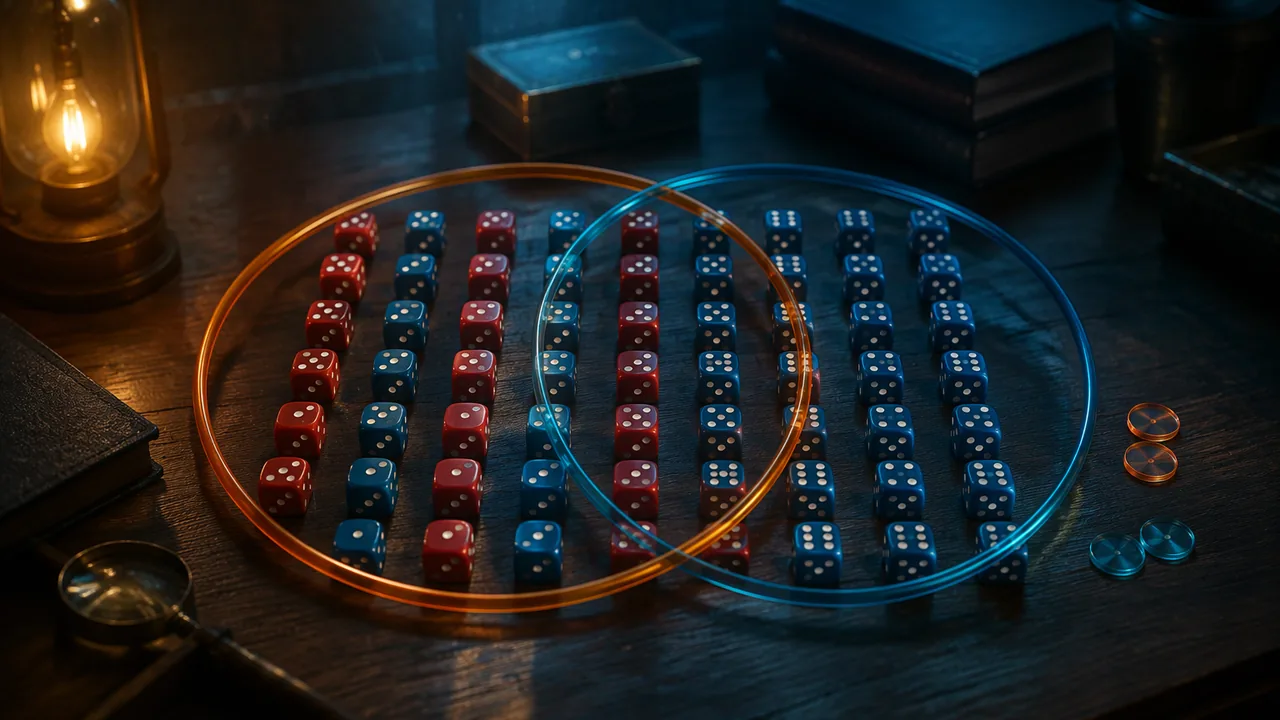
describe events as subsets of a sample space using and, or and not, and apply the Addition Rule to find the probability of A or B.
Instruction
Sample space and events. The sample space of a chance process is the set of all its possible outcomes. An event is a subset of the sample space. When every outcome is equally likely, the probability of an event is
P(event) = (number of outcomes in the event) ÷ (number of outcomes in the sample space).
Roll two fair six-sided dice, one red and one blue. Each outcome is an ordered pair, such as (2, 5), meaning red 2 and blue 5. There are 6 × 6 = 36 equally likely outcomes. Treating the dice as different matters: (2, 5) and (5, 2) are different outcomes.
Events from the sample space.
- A = “the sum is 7” = {(1,6), (2,5), (3,4), (4,3), (5,2), (6,1)}: 6 outcomes, P(A) = 6/36 = 1/6.
- B = “doubles”: 6 outcomes, P(B) = 1/6.
- C = “at least one die shows 6”: 11 outcomes (6 with red 6, 6 with blue 6, minus the one counted twice, (6,6)). P(C) = 11/36.
Combining events. The words map to set operations:
- A and C (intersection): outcomes in both. Sum 7 with a 6: {(1,6), (6,1)}, so P(A and C) = 2/36.
- A or C (union): outcomes in at least one.
- not C (complement): outcomes not in C. P(not C) = 1 − 11/36 = 25/36. Check: neither die shows 6 means each die has 5 choices, 5 × 5 = 25.
The Addition Rule. Counting the outcomes of A or C by adding the counts of A and C counts the overlap twice. Subtract it once:
P(A or C) = P(A) + P(C) − P(A and C) = 6/36 + 11/36 − 2/36 = 15/36 = 5/12.
If two events cannot happen together, they are mutually exclusive, P(A and B) = 0 and the rule reduces to adding. A sum of 7 and doubles are mutually exclusive (doubles always have an even sum), so P(A or B) = 6/36 + 6/36 = 12/36 = 1/3.
Cards. A standard 52-card deck has 13 hearts and 12 face cards (jack, queen, king in each of four suits); 3 cards are both. P(heart or face card) = 13/52 + 12/52 − 3/52 = 22/52 = 11/26 ≈ 0.423.
Interpreting. A probability is a statement about the long run: “P(A or C) = 5/12” means that over many rolls, about 5 in every 12 will have a sum of 7, a 6, or both. It does not say what the next roll will be.
Tools for seeing. Draw the 6-by-6 grid of dice outcomes and shade events; draw Venn diagrams for events that overlap. Precision (MP.6) means naming the sample space before counting, and saying whether outcomes are equally likely.
📖 Read for this lesson
The reading opens over the lesson; close it to come back to exactly where you were. The checks below draw on it.
Formative check
Work through these before moving on. They are not graded — they tell you whether the standard below has landed yet.
Two dice are rolled. How many of the 36 outcomes show at least one 6?
What is P(heart or face card) for one card drawn from a standard deck?
Rolling two dice, P(neither die shows 6) = /36, and P(sum is 7 or at least one 6) = /36.
Describe the sample space for flipping a coin three times. List the outcomes in the events A = ‘at least two heads’ and B = ‘the first flip is tails’. Find P(A and B), P(A or B) and P(not A), and check P(A or B) with the Addition Rule.
How confident are you that you can describe events with and, or and not, and apply the Addition Rule?
Practice
Work these on paper or in your notebook, then open Check your answer. Aim for all of Fluency and Application; try at least one Challenge.
Printable version: this unit’s practice workbook (PDF)
Fluency
Build speed and accuracy with the core skill.
- Two fair dice are rolled. Find P(doubles).
Check your answer
Answer: 1/6Count outcomes in the 36-outcome sample space. - Two fair dice are rolled. Find P(sum ≥ 9).
Check your answer
Answer: 5/18Count outcomes in the 36-outcome sample space. - Two fair dice are rolled. Find P(at least one die shows 2).
Check your answer
Answer: 11/36Count outcomes in the 36-outcome sample space. - Two fair dice are rolled. Find P(sum = 6).
Check your answer
Answer: 5/36Count outcomes in the 36-outcome sample space. - Two fair dice are rolled. Find P(at least one die shows 4).
Check your answer
Answer: 11/36Count outcomes in the 36-outcome sample space. - Two fair dice are rolled. Find P(sum ≥ 10).
Check your answer
Answer: 1/6Count outcomes in the 36-outcome sample space. - One card is drawn from a standard 52-card deck. Find P(king or red card).
Check your answer
Answer: 28/52 = 7/134/52 + 26/52 − 2/52. - Find P(not a heart) for one card.
Check your answer
Answer: 39/52 = 3/4 - A coin is flipped three times. List the outcomes in “exactly two heads” and find its probability.
Check your answer
Answer: HHT, HTH, THH; 3/8 - Are “sum is 7” and “doubles” mutually exclusive for two dice? Find P(sum 7 or doubles).
Check your answer
Answer: Yes; 12/36 = 1/3
Application
Use the skill in context. Show your reasoning.
- (Illustrative.) Of 30 students, 18 play soccer, 12 are in band, and 5 do both. Find P(soccer or band) for a randomly chosen student, and P(neither).
Check your answer
Answer: 25/30 = 5/6; 5/30 = 1/618 + 12 − 5 = 25. - Two dice are rolled. Find P(sum is 8 or doubles).
Check your answer
Answer: 10/36 = 5/185/36 + 6/36 − 1/36; (4, 4) is in both. - Describe the event “at least one die shows 6 and the sum is even” as a list, and find its probability.
Check your answer
Answer: (2,6), (4,6), (6,6), (6,2), (6,4): 5/36
Challenge
Stretch problems. Expect to think before you write.
- Show that P(A or B or C) = P(A) + P(B) + P(C) − P(A and B) − P(A and C) − P(B and C) + P(A and B and C) gives the right answer for one die with A = even, B = greater than 3, C = prime.
Check your answer
Answer: 5/63/6 + 3/6 + 3/6 − 2/6 − 1/6 − 1/6 + 0 = 5/6. Directly, the union is {2, 3, 4, 5, 6}.
Review
Keep earlier skills sharp.
- A circle has radius 3. For a central angle of 240°, find the arc length and the sector area in terms of π.
Check your answer
Answer: arc length = 4π; sector area = 6πThe sector is 240/360 of the circle; in radians the angle is 4π/3, and s = rθ. - Find the distance between (−6, 7) and (9, −6), and the midpoint of the segment.
Check your answer
Answer: distance √394; midpoint (3/2, 1/2) - Convert 150° to radians.
Check your answer
Answer: 5π/6
The Sample Spaces, Printed: Two Dice, a Deck, Three Coins, and Twelve Addition Rule Problems
Constructed teaching material written for this course: the 36-outcome dice grid, the 52-card deck as a suit-by-rank table, the eight outcomes of three coin flips, a club-membership Venn count, and twelve Addition Rule problems with four worked · SLS original (constructed teaching data)
Why this reading. The lesson says “draw the 6-by-6 grid of dice outcomes and shade events” and its output is “sample-space diagrams and Addition Rule computations with interpretations.” Here are the sample spaces drawn out, so you can shade and count on them, and twelve problems whose only difficulty is counting the overlap correctly. Four are worked; the answers to the rest are given so you can check the count, not the reasoning.
Two dice: the 36 outcomes, as sums
Rows are the red die, columns the blue die; each cell is the sum. Every cell is one equally likely outcome.
| red blue | 1 | 2 | 3 | 4 | 5 | 6 |
|---|---|---|---|---|---|---|
| 1 | 2 | 3 | 4 | 5 | 6 | 7 |
| 2 | 3 | 4 | 5 | 6 | 7 | 8 |
| 3 | 4 | 5 | 6 | 7 | 8 | 9 |
| 4 | 5 | 6 | 7 | 8 | 9 | 10 |
| 5 | 6 | 7 | 8 | 9 | 10 | 11 |
| 6 | 7 | 8 | 9 | 10 | 11 | 12 |
Counts by sum: 2 and 12 once each; 3 and 11 twice; 4 and 10 three times; 5 and 9 four times; 6 and 8 five times; 7 six times. Total 36. The event “at least one 6” is the last row plus the last column: 6 + 6 − 1 = 11 cells.
A standard deck: 4 suits by 13 ranks
| Suit | A | 2 | 3 | 4 | 5 | 6 | 7 | 8 | 9 | 10 | J | Q | K |
|---|---|---|---|---|---|---|---|---|---|---|---|---|---|
| ♥ hearts (red) | 13 cards | ||||||||||||
| ♦ diamonds (red) | 13 cards | ||||||||||||
| ♣ clubs (black) | 13 cards | ||||||||||||
| ♠ spades (black) | 13 cards | ||||||||||||
52 cards; 26 red; 12 face cards (J, Q, K in each suit); 4 aces; 36 number cards (2 through 10 in each suit). The overlap of “heart” and “face card” is the three cells J♥, Q♥, K♥.
Three coin flips
Eight equally likely outcomes: HHH, HHT, HTH, HTT, THH, THT, TTH, TTT.
A club roster (illustrative)
Of 30 students in a homeroom, 18 are in band, 14 are in drama, and 7 are in both. Draw the Venn diagram: 11 in band only, 7 in both, 7 in drama only, and 30 − 25 = 5 in neither.
Twelve problems
For each, name the sample space, write the two events, count the overlap, and write P(A or B) = P(A) + P(B) − P(A and B). End with one sentence interpreting the number as a long-run frequency.
| # | Problem | Answer |
|---|---|---|
| 1 | Two dice: sum is 5 or at least one die shows 3 | 4/36 + 11/36 − 2/36 = 13/36; the overlap is (2,3) and (3,2) |
| 2 | Two dice: sum is even or doubles | 18/36 + 6/36 − 6/36 = 18/36 = 1/2; doubles are always even, so “or doubles” adds nothing |
| 3 | Two dice: sum is at least 10 or red shows 1 | 6/36 + 6/36 − 0 = 12/36; mutually exclusive, since red 1 gives a sum of at most 7 |
| 4 | Two dice: red is greater than blue, or the sum is 7 | 15/36 + 6/36 − 3/36 = 18/36 |
| 5 | Two dice: at least one 6, or the sum is 7 | 15/36 (the lesson’s example) |
| 6 | One card: red or an ace | 26/52 + 4/52 − 2/52 = 28/52 = 7/13 |
| 7 | One card: face card or spade | 22/52 = 11/26 |
| 8 | One card: number card or club | 36/52 + 13/52 − 9/52 = 40/52 = 10/13 |
| 9 | Three coins: exactly two heads, or the first flip is heads | 3/8 + 4/8 − 2/8 = 5/8; the overlap is HHT and HTH |
| 10 | Three coins: all the same, or at least one tail | 2/8 + 7/8 − 1/8 = 8/8 = 1; explain why the answer had to be 1 |
| 11 | Homeroom: a randomly chosen student is in band or drama | 18/30 + 14/30 − 7/30 = 25/30 = 5/6 |
| 12 | Homeroom: in band or not in drama | 18/30 + 16/30 − 11/30 = 23/30; “not in drama” is the complement, 30 − 14 = 16, and its overlap with band is band-only, 11 |
Problem 4 is worked in full because the overlap is the one people miss. “Red greater than blue” is the 15 cells below the diagonal of the grid. “Sum is 7” is the six cells (1,6), (2,5), (3,4), (4,3), (5,2), (6,1). The ones with red greater than blue are (4,3), (5,2) and (6,1): three cells. So P = 15/36 + 6/36 − 3/36 = 18/36 = 1/2. Interpretation: over many rolls, about half will have red ahead of blue or a sum of 7 or both.
The three-coin question, checked
The lesson asks for A = “at least two heads” and B = “the first flip is tails.” From the list: A = {HHH, HHT, HTH, THH}, B = {THH, THT, TTH, TTT}, A and B = {THH}. So P(A and B) = 1/8, P(A or B) = 4/8 + 4/8 − 1/8 = 7/8, P(not A) = 4/8. Count A or B directly from the list to confirm 7; the only outcome in neither is HTT.