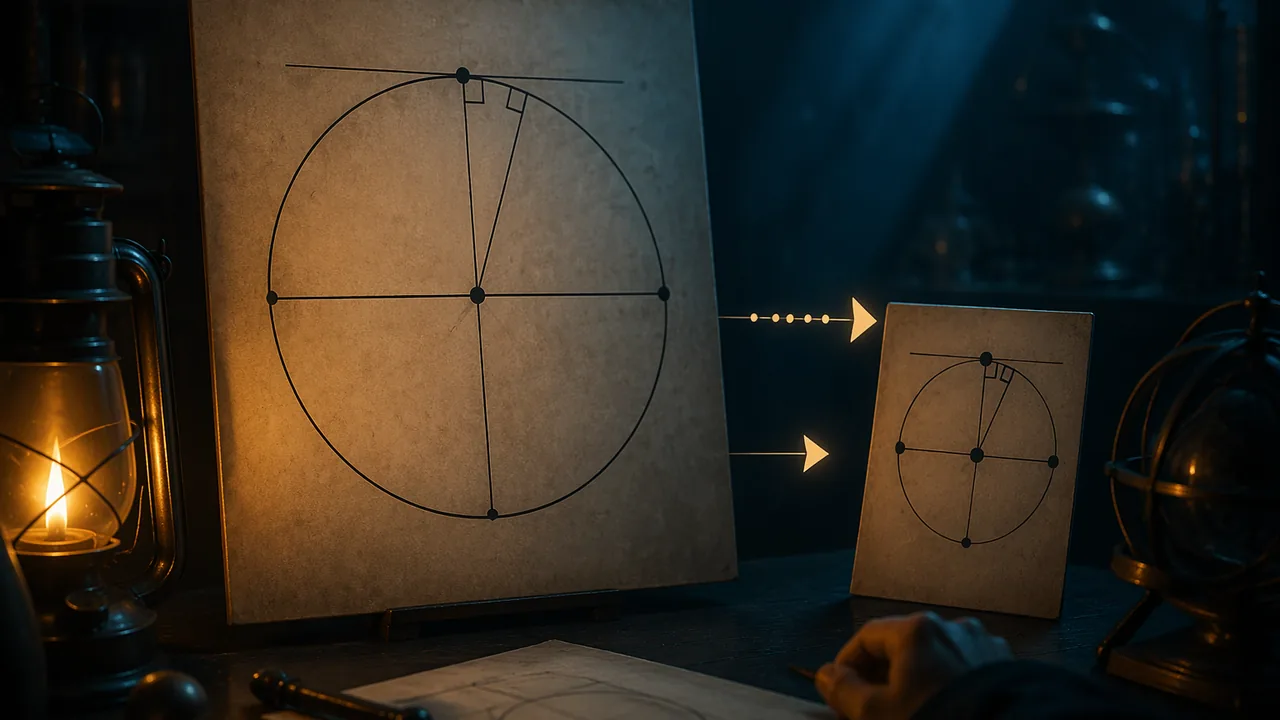
prove that all circles are similar, and prove relationships among radii, chords and tangents, including that a tangent is perpendicular to the radius at the point of tangency.
Instruction
Theorem: all circles are similar. Take circle 1 with center A and radius r and circle 2 with center B and radius s. Translate circle 1 along the directed segment from A to B; translations preserve distance, so the image is the circle with center B and radius r. Now dilate from B with scale factor s/r. Every point at distance r from B moves to distance r × s/r = s from B, and every point at distance s from B is the image of a point at distance r. So the image is exactly circle 2. A translation followed by a dilation is a similarity transformation, so the circles are similar. ∎
A consequence: π. Similar figures have proportional lengths, so for every circle, circumference ÷ diameter is the same number. We call it π. That is why one constant works for every circle, from a coin to a planet’s orbit.
Vocabulary. A chord joins two points of a circle; a diameter is a chord through the center. A tangent line meets the circle in exactly one point, the point of tangency. A secant line meets it in two points.
Theorem: the perpendicular bisector of a chord passes through the center. The center O is at distance r from both endpoints of chord PQ, so O is equidistant from P and Q. By the perpendicular bisector theorem (Geometry A), O lies on the perpendicular bisector of PQ. This gives a way to find the center of any circle: draw two chords and intersect their perpendicular bisectors.
Theorem: a tangent is perpendicular to the radius at the point of tangency. Let line l touch the circle only at P. Suppose OP were not perpendicular to l. Drop the perpendicular from O to l, meeting it at F ≠ P. In right triangle OFP, the hypotenuse is OP, so OF < OP = r. Now reflect P across line OF to get P′ on l. Reflection preserves distance, so OP′ = OP = r, and P′ ≠ P is also on the circle. Then l meets the circle twice, contradicting that it is a tangent. So OP ⊥ l. ∎ This is a proof by contradiction: assume the opposite and show it leads to something impossible.
Theorem: tangent segments from an outside point are congruent. From a point P outside the circle, draw tangents touching at T1 and T2. Triangles OT1P and OT2P have right angles at T1 and T2, share hypotenuse OP, and have OT1 = OT2 = r. By the Pythagorean Theorem, PT1 = √(OP2 − r2) = PT2.
Example. A circle has radius 5, and P is 13 units from the center. Each tangent segment from P has length √(169 − 25) = √144 = 12.
Example. A chord of length 16 is 6 units from the center. The perpendicular from the center bisects the chord, making a right triangle with legs 8 and 6, so the radius is √(64 + 36) = 10.
📖 Read for this lesson
The reading opens over the lesson; close it to come back to exactly where you were. The checks below draw on it.
Formative check
Work through these before moving on. They are not graded — they tell you whether the standard below has landed yet.
Which sequence of transformations shows that a circle with center A and radius 3 is similar to one with center B and radius 7?
A circle has radius 5 and P is 13 units from its center. Each tangent segment from P has length .
The radius drawn to the point of tangency is perpendicular to the tangent line.
Explain why the fact that all circles are similar means that circumference divided by diameter is the same for every circle. Then describe how to find the center of a circular plate using only a ruler, a pencil and a set square, and justify it.
How confident are you that you can prove that all circles are similar and prove the chord and tangent theorems?
Practice
Work these on paper or in your notebook, then open Check your answer. Aim for all of Fluency and Application; try at least one Challenge.
Printable version: this unit’s practice workbook (PDF)
Fluency
Build speed and accuracy with the core skill.
- A right triangle has hypotenuse 17 and one leg 3. Find the other leg exactly.
Check your answer
Answer: 2√70b2 = 172 − 32 = 280. - A right triangle has hypotenuse 7 and one leg 3. Find the other leg exactly.
Check your answer
Answer: 2√10b2 = 72 − 32 = 40. - A right triangle has hypotenuse 9 and one leg 5. Find the other leg exactly.
Check your answer
Answer: 2√14b2 = 92 − 52 = 56. - A circle has radius 8 and P is 17 from the center. Find the length of each tangent segment from P.
Check your answer
Answer: 15√(172 − 82) = √225. - A chord is 5 units from the center of a circle of radius 13. How long is the chord?
Check your answer
Answer: 24Half-chord √(169 − 25) = 12. - A chord of length 16 lies in a circle of radius 10. How far is it from the center?
Check your answer
Answer: 6√(100 − 64). - From an outside point P, tangent segments PA = 3x + 4 and PB = 10 − x. Find PA.
Check your answer
Answer: 8.5 (x = 1.5)Tangent segments from one point are congruent. - Describe a similarity transformation that carries the circle with center (2, −1) and radius 3 onto the circle with center (−4, 5) and radius 12.
Check your answer
Answer: Translate by 〈−6, 6〉, then dilate from (−4, 5) by scale factor 4. - A tangent line touches a circle at T. What angle does it make with radius OT?
Check your answer
Answer: 90°
Application
Use the skill in context. Show your reasoning.
- Only a piece of a broken circular plate survives. Describe how to find the center using chords, and justify it.
Check your answer
Answer: Draw two non-parallel chords and construct their perpendicular bisectors; they meet at the center.The center is equidistant from the endpoints of every chord, so it lies on every chord’s perpendicular bisector. - Taking the Earth as a sphere of radius 6,371 km, how far away is the horizon for a person whose eyes are 2 m above a calm sea? (The line of sight to the horizon is tangent to the Earth.)
Check your answer
Answer: about 5.0 kmThe tangent segment is √((R + 2)2 − R2) with R = 6,371,000 m, about 5,048 m. - A belt runs around a pulley of radius 5 cm. The two straight parts of the belt meet (if extended) at a point 13 cm from the pulley’s center. How long is each straight part from that point to the pulley?
Check your answer
Answer: 12 cmEach straight part is a tangent segment: √(169 − 25).
Challenge
Stretch problems. Expect to think before you write.
- Prove that the perpendicular from the center of a circle to a chord bisects the chord.
Check your answer
Answer: The two right triangles are congruent, so the halves are equal.Model proof. Let OM ⊥ AB at M. OA = OB (radii). By the Pythagorean Theorem, AM = √(OA2 − OM2) = √(OB2 − OM2) = BM.
Review
Keep earlier skills sharp.
- Find the center and radius of the circle x2 − 4x + y2 + 10y − 20 = 0.
Check your answer
Answer: center (2, −5); radius 7Group and complete the square in x and in y. - Find the volume of a square pyramid with base edge 9 cm and height 8 cm. Give an exact answer and, if it involves π, a decimal to the nearest tenth.
Check your answer
Answer: 216 cm3 - Find the point 2/3 of the way from (−3, 2) to (6, −4).
Check your answer
Answer: (3, −2)
The Chord and Tangent Set: Nine Problems, a Broken Plate, and the Center Found From Three Points
Constructed teaching material written for this course: nine chord and tangent problems with exact measurements, a sagitta problem, and a three-point center-finding problem on coordinates, with two rows worked · SLS original (constructed teaching data)
Why this reading. The lesson’s output is “three short proofs and a set of chord and tangent problems,” and its last question asks how to find the center of a circular plate. The lesson gives two worked examples and the theorems. This is the problem set, and the plate is in it, with coordinates so the answer can be checked rather than eyeballed. Every problem is solved by one of the lesson’s three theorems plus the Pythagorean Theorem; name the theorem each time.
Chords and radii
Theorem used: the perpendicular from the center to a chord bisects it (because the center lies on the chord’s perpendicular bisector), so half the chord, the distance from the center, and the radius make a right triangle.
| # | Given | Find | Answer |
|---|---|---|---|
| 1 | chord 24, distance from center 5 | radius | √(122 + 52) = 13 |
| 2 | radius 10, chord at distance 6 | chord length | |
| 3 | radius 7, chord 10 | distance from the center | |
| 4 | radius 6; two parallel chords of lengths 8 and 10 | distance between the chords, if they are on the same side of the center; and if on opposite sides | |
| 5 | a chord of length 12 cm cuts off an arc whose highest point is 2 cm above the chord’s midpoint (a broken plate’s rim) | the plate’s radius |
Problem 5 is the shape of every archaeologist’s and machinist’s problem: you have a fragment and want the whole. Let the radius be r. The center is r − 2 from the chord’s midpoint (draw it), so r2 = 62 + (r − 2)2. The r2 terms cancel and a linear equation is left. Solve it, then check that the arc’s height (called the sagitta) really is 2 for your r.
Tangents
Theorems used: a tangent is perpendicular to the radius at the point of tangency, so the radius, the tangent segment and the segment to the outside point form a right triangle; and the two tangent segments from an outside point are equal.
| # | Given | Find | Answer |
|---|---|---|---|
| 6 | radius 8, P is 17 from the center | each tangent segment from P | √(172 − 82) = √225 = 15 |
| 7 | tangent segment 24, radius 7 | distance from P to the center | |
| 8 | P is 10 from a center of radius 6; the tangents touch at T1 and T2 | PT1, and the perimeter of quadrilateral OT1PT2 | |
| 9 | a belt runs around two pulleys of radius 3 whose centers are 20 apart, with no crossing | the length of each straight part of the belt |
Problem 9 needs a drawing before a theorem: the straight part of the belt is tangent to both circles, and because the radii are equal it is parallel to the line of centers. Say why that makes the straight part exactly 20 long, and what would change if the pulleys had different radii.
The plate: center from three points
Three points on the rim of a circular plate were measured on a coordinate grid: (8, 2), (6, 6) and (−1, −1). Find the center and radius by intersecting the perpendicular bisectors of two chords. Worked:
- Chord from (8, 2) to (6, 6): midpoint (7, 4); slope (6 − 2)/(6 − 8) = −2; the perpendicular bisector has slope ½ and equation y − 4 = ½(x − 7), that is, y = ½x + ½.
- Chord from (−1, −1) to (8, 2): midpoint (3.5, 0.5); slope 3/9 = 1/3; the perpendicular bisector has slope −3 and equation y − 0.5 = −3(x − 3.5), that is, y = −3x + 11.
- Intersect: ½x + ½ = −3x + 11 gives 3.5x = 10.5, x = 3, y = 2. Center (3, 2).
- Radius: distance to (8, 2) is 5. Check with (6, 6): √(9 + 16) = 5. Check with (−1, −1): √(16 + 9) = 5.
Now the plate question as the lesson asks it, with a ruler, a pencil and a set square and no coordinates: mark three points on the rim, draw two chords, use the set square to draw each chord’s perpendicular through its midpoint, and the center is where they cross. Write the justification as a two-sentence proof from the chord theorem, and say why a third chord is a useful check rather than a necessary step. Then do it a second way: the set square’s right angle placed on the rim marks a diameter (you will prove why in Lesson 3.2); two diameters cross at the center. Which method depends on a theorem you have already proved?
Why the theorems are needed
Each answer above is a number, and each number rests on a right angle you did not measure but proved. Problem 6 is wrong if the tangent is not perpendicular to the radius; problem 1 is wrong if the perpendicular from the center does not bisect the chord. When you write up your three proofs, attach each to the problem it makes possible.