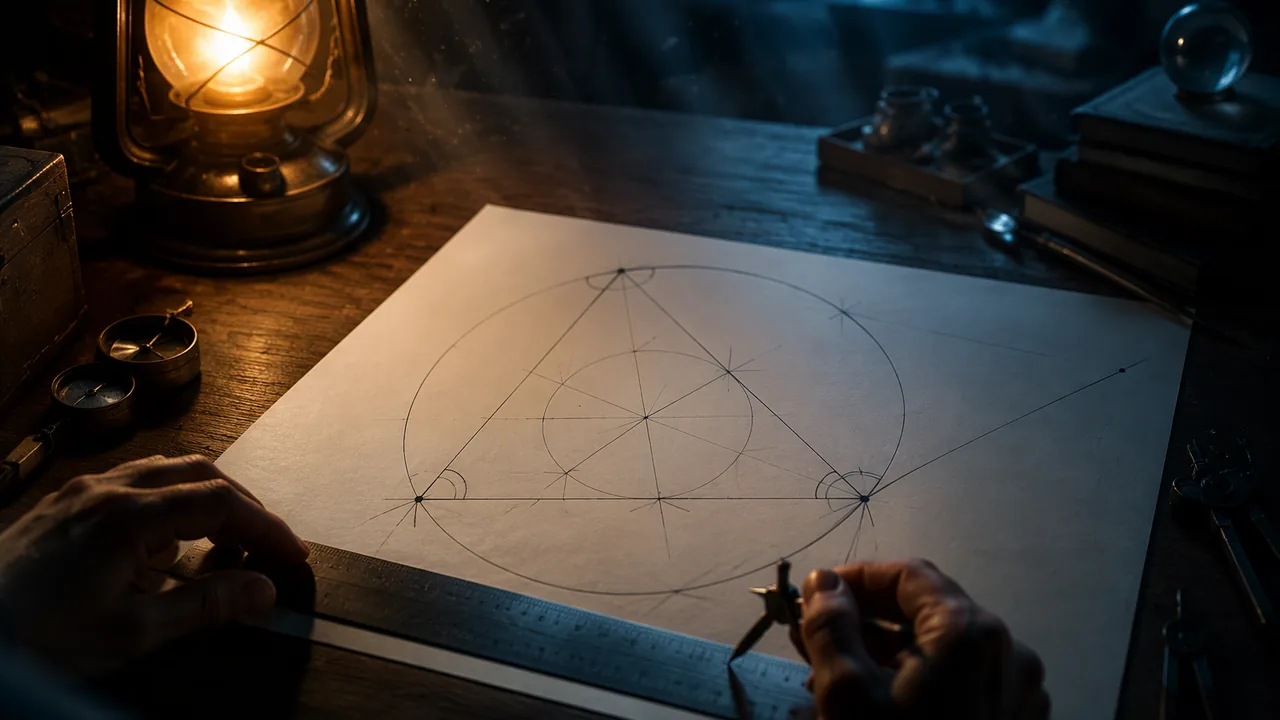
construct the inscribed and circumscribed circles of a triangle, prove that opposite angles of an inscribed quadrilateral are supplementary, and construct a tangent from an outside point.
Instruction
The circumscribed circle. Every triangle has exactly one circle through its three vertices. Construction: construct the perpendicular bisectors of two sides; where they meet is the center, the circumcenter. Why it works: a point on the perpendicular bisector of AB is equidistant from A and B; a point on the perpendicular bisector of BC is equidistant from B and C. Their intersection O is equidistant from all three, so the circle centered at O through A passes through B and C. And because OA = OC, O is also on the third bisector: the three perpendicular bisectors are concurrent. For a right triangle the circumcenter is the midpoint of the hypotenuse (Thales); for an obtuse triangle it lies outside the triangle.
The inscribed circle. Every triangle has exactly one circle tangent to all three sides. Construction: bisect two angles; their intersection is the incenter I. Drop a perpendicular from I to one side to find the radius. Why it works: every point on the bisector of an angle is equidistant from the angle’s two sides. (Proof: drop perpendiculars from the point to the sides; the two right triangles share a hypotenuse and have equal angles at the vertex, so they are congruent by AAS and the perpendiculars are equal.) So I is equidistant from all three sides, and the circle centered at I with that distance as radius touches each side at the foot of a perpendicular, which makes each side tangent to it.
Inscribed quadrilaterals. Theorem: if a quadrilateral is inscribed in a circle, its opposite angles are supplementary. Proof: in inscribed quadrilateral ABCD, ∠A intercepts arc BCD and ∠C intercepts arc DAB. Those two arcs make up the whole circle, 360°. By the inscribed angle theorem, ∠A + ∠C = ½(arc BCD) + ½(arc DAB) = ½(360°) = 180°. The same argument works for ∠B and ∠D. ∎ So if ∠A = 75° in an inscribed quadrilateral, ∠C = 105°. The converse is also true (a quadrilateral with supplementary opposite angles can be inscribed), which is why a rectangle can always be inscribed in a circle but a non-rectangular parallelogram cannot.
Tangent from an outside point. Given a circle with center O and a point P outside it. Construction: construct the midpoint M of OP. Draw the circle centered at M through O (and P). It crosses the given circle at T1 and T2. Lines PT1 and PT2 are the tangents. Why it works: OP is a diameter of the circle centered at M, and T1 is on that circle, so ∠OT1P is inscribed in a semicircle and is 90° (Thales). A line perpendicular to a radius at its endpoint on the circle is tangent: every other point Q of that line is farther than r from O, because OQ is the hypotenuse of right triangle OT1Q.
Regular polygons again. Geometry A’s inscribed hexagon and square are circumscribed-circle constructions in disguise: the center of the circle is the circumcenter of the polygon.
Discourse protocol. Each group constructs one object, then another group must justify it without seeing the first group’s notes. Justifications are compared and critiqued as a class.
📖 Read for this lesson
The reading opens over the lesson; close it to come back to exactly where you were. The checks below draw on it.
Formative check
Work through these before moving on. They are not graded — they tell you whether the standard below has landed yet.
Which lines meet at the center of a triangle’s inscribed circle?
In an inscribed quadrilateral ABCD, angle A = 75°. Angle C = °.
In the tangent construction, angle OTP is a right angle because OP is a diameter of the auxiliary circle through T.
Prove that opposite angles of an inscribed quadrilateral are supplementary. Then explain why a parallelogram that is not a rectangle cannot be inscribed in a circle.
How confident are you that you can construct inscribed and circumscribed circles and tangents, and prove the inscribed-quadrilateral theorem?
Practice
Work these on paper or in your notebook, then open Check your answer. Aim for all of Fluency and Application; try at least one Challenge.
Printable version: this unit’s practice workbook (PDF)
Fluency
Build speed and accuracy with the core skill.
- Quadrilateral ABCD is inscribed in a circle, with ∠A = 82° and ∠B = 97°. Find ∠C and ∠D.
Check your answer
Answer: ∠C = 98°; ∠D = 83°Opposite angles are supplementary. - Which lines meet at the circumcenter of a triangle, and what is it equidistant from?
Check your answer
Answer: The perpendicular bisectors of the sides; the three vertices. - Which lines meet at the incenter, and what is it equidistant from?
Check your answer
Answer: The angle bisectors; the three sides. - A right triangle has legs 10 and 24. Find the radius of its circumscribed circle.
Check your answer
Answer: 13The hypotenuse, 26, is a diameter. - Where does the circumcenter of an obtuse triangle lie?
Check your answer
Answer: Outside the triangle. - Put in order the steps to construct a tangent from an outside point P to a circle with center O: (a) draw lines PT1 and PT2; (b) construct the midpoint M of OP; (c) draw the circle centered at M through O, meeting the given circle at T1 and T2.
Check your answer
Answer: (b), (c), (a)
Application
Use the skill in context. Show your reasoning.
- (Illustrative.) Three trees stand at (0, 0), (8, 0) and (0, 6) on a park grid in meters. A sprinkler must be equidistant from all three. Where should it go, and what radius reaches them?
Check your answer
Answer: At (4, 3), with radius 5 mThe triangle has a right angle at the origin, so the circumcenter is the midpoint of the hypotenuse. - A triangular plaza has sides 6 m, 8 m and 10 m. The largest circular fountain that fits is its inscribed circle. Its radius is (a + b − c)/2 for a right triangle with legs a, b and hypotenuse c. Find the radius and the fountain’s area.
Check your answer
Answer: 2 m; 4π ≈ 12.57 m2(6 + 8 − 10)/2 = 2. - Can a rhombus that is not a square be inscribed in a circle? Explain.
Check your answer
Answer: No. Its opposite angles are equal but not 90°, so they are not supplementary.
Challenge
Stretch problems. Expect to think before you write.
- Complete the proof. Prove that opposite angles of inscribed quadrilateral ABCD are supplementary.
Check your answer
Answer: ∠A + ∠C = 180°Model proof. ∠A intercepts arc BCD, so ∠A = ½ arc BCD. ∠C intercepts arc DAB, so ∠C = ½ arc DAB. The two arcs make the whole circle, 360°, so ∠A + ∠C = ½(360°) = 180°. The same argument applies to ∠B and ∠D. - Identify the flaw. “PT is tangent because OT ⊥ PT, and OT ⊥ PT because PT is tangent.”
Check your answer
Answer: Circular reasoning: each claim is used to justify the other.Repair: OP is a diameter of the auxiliary circle, so ∠OTP = 90° by Thales; a line perpendicular to a radius at its endpoint on the circle is tangent.
Review
Keep earlier skills sharp.
- Find the center and radius of the circle x2 − 6x + y2 − 10y − 30 = 0.
Check your answer
Answer: center (3, 5); radius 8Group and complete the square in x and in y. - Find the volume of a sphere with radius 5 cm. Give an exact answer and, if it involves π, a decimal to the nearest tenth.
Check your answer
Answer: 500π/3 cm3 ≈ 523.6 cm3 - A triangle has vertices (0, 0), (6, 0) and (2, 5). Find its area.
Check your answer
Answer: 15
The Construction File: Three Triangles With Their Centers Computed, a Tangent Construction on Coordinates, and a Cyclic Claim to Argue
Constructed teaching material written for this course: three triangles on exact coordinates with circumcenter, circumradius, incenter and inradius, the tangent construction from an outside point worked on coordinates, and two claims about inscribed quadrilaterals to test · SLS original (constructed teaching data)
Why this reading. The lab’s output is “three justified constructions,” and the discourse protocol is that one group constructs and another justifies without seeing the first group’s notes. A construction can only be checked if everyone starts from the same figure. Here are the figures, on coordinates, with the answers each construction should land on. Construct first with GeoGebra or compass, then compare; if your incenter is not where the table says, one of the two bisectors is off.
Three triangles
| Triangle | Vertices | Circumcenter and circumradius | Incenter and inradius |
|---|---|---|---|
| T1 (right, 6-8-10) | (0, 0), (8, 0), (0, 6) | (4, 3), R = 5 | (2, 2), r = 2 |
| T2 (right, 5-12-13) | (0, 0), (12, 0), (0, 5) | (6, 2.5), R = 6.5 | (2, 2), r = 2 |
| T3 (acute) | A(0, 0), B(6, 0), C(2, 4) | (3, 1), R = √10 ≈ 3.162 | (2.41, 1.49), r ≈ 1.488 |
T1, circumcenter. The perpendicular bisector of the side from (0, 0) to (8, 0) is x = 4; of the side from (0, 0) to (0, 6) is y = 3. They meet at (4, 3), which is the midpoint of the hypotenuse, as Thales’ theorem promises for a right triangle. R = distance to (0, 0) = 5, and the third vertex (8, 0) is also at distance √(16 + 9) = 5.
T1, incenter. The right angle at the origin has bisector y = x. For a right triangle the inradius has a shortcut worth proving: r = (leg + leg − hypotenuse)/2 = (6 + 8 − 10)/2 = 2, so the incenter is (2, 2). Check that (2, 2) is at distance 2 from all three sides: from the x-axis, 2; from the y-axis, 2; from the hypotenuse 3x + 4y = 24, |3(2) + 4(2) − 24|/5 = 10/5 = 2.
T3, circumcenter. The perpendicular bisector of AB is x = 3. The side AC has midpoint (1, 2) and slope 2, so its perpendicular bisector is y − 2 = −½(x − 1). At x = 3 this gives y = 1. Circumcenter (3, 1); R2 = 9 + 1 = 10. Check B: (6 − 3)2 + 1 = 10. Check C: 1 + 9 = 10.
T3, incenter. Area = ½ × 6 × 4 = 12. Sides: AB = 6, BC = √32 ≈ 5.657, CA = √20 ≈ 4.472, so the half-perimeter is s ≈ 8.064 and r = Area/s ≈ 1.488. Justify that formula: the incenter splits the triangle into three triangles of height r on the three sides, so Area = ½ r (AB + BC + CA) = rs. The incenter itself is where the bisectors from A and B cross; construct it and read its coordinates, then check its distance to AB equals its y-coordinate.
Do T2 yourself, both centers, with the same checks. Then decide, for each of the three triangles, whether the circumcenter is inside, on or outside the triangle, and state the rule.
The tangent construction, on coordinates
Circle with center O(0, 0) and radius 5; outside point P(13, 0). The construction says: find the midpoint M of OP, draw the circle centered at M through O and P, and the two circles cross at the points of tangency.
- M = (6.5, 0); the auxiliary circle is (x − 6.5)2 + y2 = 6.52 = 42.25.
- The given circle is x2 + y2 = 25. Subtracting the two equations: −13x + 42.25 = 17.25, so x = 25/13 ≈ 1.923.
- Then y2 = 25 − (25/13)2 = 25 × 144/169, so y = ±60/13 ≈ ±4.615. The points of tangency are T1,2 = (25/13, ±60/13).
- Check the tangent length: PT1 = √((13 − 25/13)2 + (60/13)2) = √((144/13)2 + (60/13)2) = √(20736 + 3600)/13 = √24336/13 = 156/13 = 12, which is exactly Lesson 3.1’s example: radius 5, P at 13, tangent 12.
- Check the right angle: the slope of OT1 is (60/13)/(25/13) = 12/5 and the slope of PT1 is (60/13)/(25/13 − 13) = (60/13)/(−144/13) = −5/12. Product −1.
Now write the justification without the coordinates: why must angle OT1P be a right angle (which circle is T1 on, and what is OP to that circle), and why does a right angle at T1 make PT1 tangent?
Two claims to argue
Claim A. “Every parallelogram can be inscribed in a circle, because you can always draw a circle through three of its vertices and the fourth is symmetric to one of them.” Test it on the rhombus from Lesson 2.3, (0, 0), (4, 1), (5, 5), (1, 4): find the circle through the first three vertices (perpendicular bisectors, as in the tangent construction) and check whether the fourth vertex is on it. Then say which theorem of the lesson settles the claim in general and what the parallelogram’s angles would have to be.
Claim B. “The rectangle (0, 0), (6, 0), (6, 4), (0, 4) is cyclic.” Find its circumcenter and radius, verify all four vertices, and connect the result to Thales’ theorem: which segments are diameters?
For your proof that opposite angles of an inscribed quadrilateral are supplementary, use the cyclic quadrilateral with arcs AB = 80°, BC = 100°, CD = 70°, DA = 110° from Lesson 3.2’s problem set as the worked instance, and then write the general argument with arcs called x and 360° − x.