explain how ‘The Custom-House’ and the first scaffold scene set up the structure of The Scarlet Letter, and start a structure map that I will complete each time the novel returns to the scaffold.
Instruction
The Scarlet Letter was published in Boston in 1850 and is set in the same town in the 1640s. The distance matters: Hawthorne is a nineteenth-century writer looking back at the Puritan founders, and the novel is as much about how Americans remember their origins as about the origins themselves. This lesson maps the novel’s structure, because in this book where people stand — on the scaffold, in the crowd, in the forest — tells you who they are.
The frame: “The Custom-House.” Before the story begins, Hawthorne gives a long, comic, bitter essay about his years working in the Salem Custom House, where he claims to have found a faded scarlet A and a manuscript telling Hester Prynne’s story. The discovery is a fiction; the job was real, and he lost it in 1849 when the presidency changed parties. In the same essay he writes about his ancestors — one of them a judge in the Salem witch trials — and takes their shame on himself. Read it as a key: the novel is a descendant’s reckoning with the people who made him.
The scaffold as the novel’s skeleton. The novel has 24 chapters, and Hawthorne builds it around a single place: the scaffold in the Boston market-place. You meet it first in Chapters 2-3:
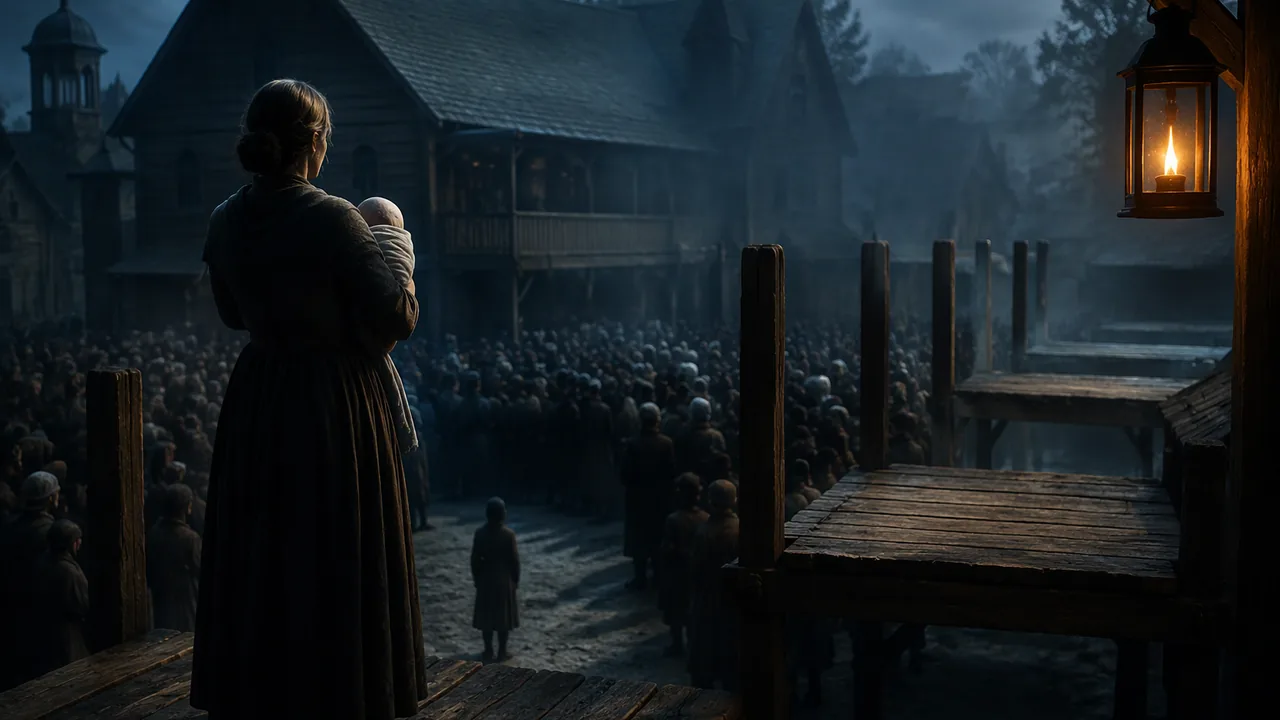
- Chapters 2-3: Hester stands on the scaffold for three hours, through midday, holding her infant Pearl before the whole town. From a balcony above her, the young minister Arthur Dimmesdale urges her to name the child’s father. She refuses. In the crowd, a stranger — her long-absent husband — recognizes her, and she recognizes him.
Hawthorne brings his characters back to this same platform twice more: once near the exact center of the book, and once near its end. This lesson does not tell you what happens there. Instead, you will start a structure map now and add a row each time the novel returns to the scaffold (in Lessons 2.4 and 2.8). As you read, ask who stands on the scaffold, who stands above it, who watches from the crowd — and who is missing. The pattern those positions make is the subject of 11-12.RL.2.A: how the structure of specific parts contributes to overall meaning and aesthetic impact.
Characters defined by position (11-12.RL.2.D). In these opening chapters Hester is the one everyone sees; the minister speaks from the balcony above her, with his hand upon his heart; and the stranger watches from the edge of the crowd, where he asks a townsman who she is. Each character is introduced by where he or she stands and who he or she looks at. Track who looks at whom in every scene you read.
Reading Hawthorne’s sentences (11-12.RL.1.B / 11-12.RI.1.B). His opening sentence makes you wait more than twenty words for its verb, was assembled. Find the subject (a throng) and the verb first, then add the descriptions back. Use context for unfamiliar words: sad-colored means dark or drab, as the rest of the scene of gray hats and iron spikes suggests.
The prison and the cemetery. The second sentence above is Hawthorne’s first argument: however idealistic a new society is, it soon needs a place for its dead and its criminals. Hold that idea against Winthrop’s “city upon a hill” from Unit 1.
📖 Before this lesson, read: The Scarlet Letter, The Custom-House and Chapters 1-3
The reading opens over the lesson; close it to come back to exactly where you were.
Reading: The frame, the opening and the first scaffold scene: passages for your structure map
Nathaniel Hawthorne, The Scarlet Letter (Boston: Ticknor, Reed and Fields, 1850), Project Gutenberg #33, retrieved 2026-09-26….. Identifiers: Project Gutenberg ebook 33 (The Scarlet Letter) · SLS original; quoted passages are public domain (Nathaniel Hawthorne, 1850)
Quotation marks and apostrophes are given as plain characters. Hawthorne’s British spelling is kept.
The novel is long, and your structure map starts with the first scaffold scene, the opening of the book and the passage in “The Custom-House” where Hawthorne speaks of his ancestors. Each is given below in Hawthorne’s text, with his British spellings (see the boxed passages), in the order you meet them in the book. Each paragraph in a box is a separate passage, given in order; text between passages is left out. The chapter is named at the end of each box. Everything outside the boxes is SLS original.
The frame: “The Custom-House”
He was a soldier, legislator, judge; he was a ruler in the Church; he had all the Puritanic traits, both good and evil. He was likewise a bitter persecutor; as witness the Quakers, who have remembered him in their histories, and relate an incident of his hard severity towards a woman of their sect, which will last longer, it is to be feared, than any record of his better deeds, although these were many. His son, too, inherited the persecuting spirit, and made himself so conspicuous in the martyrdom of the witches, that their blood may fairly be said to have left a stain upon him.
I know not whether these ancestors of mine bethought themselves to repent, and ask pardon of Heaven for their cruelties; or whether they are now groaning under the heavy consequences of them in another state of being. At all events, I, the present writer, as their representative, hereby take shame upon myself for their sakes, and pray that any curse incurred by them—as I have heard, and as the dreary and unprosperous condition of the race, for many a long year back, would argue to exist—may be now and henceforth removed.
— Nathaniel Hawthorne, The Scarlet Letter (Boston: Ticknor, Reed and Fields, 1850), “The Custom-House”
Chapter I, The Prison Door
A throng of bearded men, in sad-coloured garments and grey steeple-crowned hats, intermixed with women, some wearing hoods, and others bareheaded, was assembled in front of a wooden edifice, the door of which was heavily timbered with oak, and studded with iron spikes.
The founders of a new colony, whatever Utopia of human virtue and happiness they might originally project, have invariably recognised it among their earliest practical necessities to allot a portion of the virgin soil as a cemetery, and another portion as the site of a prison.
But on one side of the portal, and rooted almost at the threshold, was a wild rose-bush, covered, in this month of June, with its delicate gems,
— The Scarlet Letter, Chapter I
First scaffold scene: Chapters II and III
On the breast of her gown, in fine red cloth, surrounded with an elaborate embroidery and fantastic flourishes of gold thread, appeared the letter A. It was so artistically done, and with so much fertility and gorgeous luxuriance of fancy, that it had all the effect of a last and fitting decoration to the apparel which she wore, and which was of a splendour in accordance with the taste of the age, but greatly beyond what was allowed by the sumptuary regulations of the colony.
Hester Prynne passed through this portion of her ordeal, and came to a sort of scaffold, at the western extremity of the market-place. It stood nearly beneath the eaves of Boston’s earliest church, and appeared to be a fixture there.
Take heed how thou deniest to him—who, perchance, hath not the courage to grasp it for himself—the bitter, but wholesome, cup that is now presented to thy lips!” The young pastor’s voice was tremulously sweet, rich, deep, and broken. The feeling that it so evidently manifested, rather than the direct purport of the words, caused it to vibrate within all hearts, and brought the listeners into one accord of sympathy.
Hester shook her head. “Woman, transgress not beyond the limits of Heaven’s mercy!” cried the Reverend Mr. Wilson, more harshly than before. “That little babe hath been gifted with a voice, to second and confirm the counsel which thou hast heard. Speak out the name! That, and thy repentance, may avail to take the scarlet letter off thy breast.” “Never,” replied Hester Prynne, looking, not at Mr. Wilson, but into the deep and troubled eyes of the younger clergyman. “It is too deeply branded. Ye cannot take it off. And would that I might endure his agony as well as mine!” “Speak, woman!” said another voice, coldly and sternly, proceeding from the crowd about the scaffold, “Speak; and give your child a father!” “I will not speak!” answered Hester, turning pale as death, but responding to this voice, which she too surely recognised. “And my child must seek a heavenly father; she shall never know an earthly one!
— The Scarlet Letter, Chapter II (first two passages); Chapter III (last two)
Worked structure map (SLS original)
Your map records, for each scaffold scene: the time and place, who stands on the scaffold, who stands above or beside it, who watches, one quotation, and what the scene sets up or changes. You will fill one row now and add a row each time the novel returns to the scaffold. Row 1 is started for you from the passages above.
| Scene | Time and place | On the scaffold | Above or beside it | Who watches | Quotation | What it sets up |
|---|---|---|---|---|---|---|
| 1. Chapters II–III | Daylight, through midday, the market-place | Hester, holding the infant | The Governor, Mr. Wilson and the young minister, on the balcony of the meeting-house | The whole town, and a stranger at the edge of the crowd | (you choose) | (you write) |
| 2. (when the novel returns to the scaffold; Lesson 2.4) | ||||||
| 3. (when the novel returns again; Lesson 2.8) |
How the key works. The last column is not a summary of plot. It states what the scene does to the meaning of what follows. Here is a model entry for Chapter 1, which is not a scaffold scene: The rose-bush beside the prison door sets up a second way of judging. The narrator offers it as a token that “the deep heart of Nature could pity and be kind” to the condemned, so the novel opens with two judges, the colony’s iron-studded door and nature’s rose. Write your entry for row 1 the same way: name what the first scaffold scene sets up that the rest of the book will have to answer.
A caution for your evidence. In Chapter III the minister does not stand on the scaffold. He speaks from the balcony of the meeting-house, above the platform, beside the Governor and Mr. Wilson. Record that difference in height carefully: in this novel, where a character stands is evidence.
Before you leave this lesson. Rows 2 and 3 stay empty for now. Write one sentence predicting who will stand on the scaffold when the novel returns to it, and at what time of day. You will test your prediction when you get there.
Formative check
Work through these before moving on. They are not graded — they tell you whether the standard below has landed yet.
Hawthorne will bring his characters back to this scaffold twice more. Before you read on, who do you expect to stand on it next time?
What does ‘The Custom-House’ add to the novel?
In Chapter 3, Dimmesdale stands on the scaffold beside Hester while he urges her to name the child’s father.
Start your structure map. For the first scaffold scene (Chapters 2-3), record the time of day, who stands on the scaffold, who stands above it, who watches, and one quotation. Then write a paragraph arguing what this scene sets up for the rest of the novel, using one detail from ‘The Custom-House’ or Chapter 1, and end with a one-sentence prediction of who will stand on the scaffold when the novel returns to it.
How confident are you that you can explain how the frame and the first scaffold scene set up the structure of The Scarlet Letter?
Printable: Unit 2 Student Workbook
Every organizer for this unit in one booklet — the reading schedule, the vocabulary pages, all five lesson organizers, the peer review sheet and the scoring rubric. Print it before the unit starts and bring the page to each lesson.
Read the complete work: The Scarlet Letter
This unit only close-reads part of the text in any one lesson. The complete, unabridged public-domain text of The Scarlet Letter is also here as a single printable PDF, for anyone who wants to read ahead or read it straight through.
The Scarlet Letter, The Custom-House and Chapters 1-3
The Scarlet Letter, The Custom-House (Introductory) Bridge summary — not the primary text
This is a short recap written for this course, not Nathaniel Hawthorne’s own words, so you can follow the story between close-reading lessons.
{summary}The Scarlet Letter, Chapter 1: The Prison Door Bridge summary — not the primary text
This is a short recap written for this course, not Nathaniel Hawthorne’s own words, so you can follow the story between close-reading lessons.
{summary}The Scarlet Letter, Chapter 2: The Market-place
Source: Nathaniel Hawthorne, The Scarlet Letter (Boston: Ticknor, Reed and Fields, 1850), Project Gutenberg eBook #33 (gutenberg.org) · Public domain
The grass-plot before the jail, in Prison Lane, on a certain summer morning, not less than two centuries ago, was occupied by a pretty large number of the inhabitants of Boston, all with their eyes intently fastened on the iron-clamped oaken door. Amongst any other population, or at a later period in the history of New England, the grim rigidity that petrified the bearded physiognomies of these good people would have augured some awful business in hand. It could have betokened nothing short of the anticipated execution of some noted culprit, on whom the sentence of a legal tribunal had but confirmed the verdict of public sentiment. But, in that early severity of the Puritan character, an inference of this kind could not so indubitably be drawn. It might be that a sluggish bond-servant, or an undutiful child, whom his parents had given over to the civil authority, was to be corrected at the whipping-post. It might be that an Antinomian, a Quaker, or other heterodox religionist, was to be scourged out of the town, or an idle or vagrant Indian, whom the white man’s firewater had made riotous about the streets, was to be driven with stripes into the shadow of the forest. It might be, too, that a witch, like old Mistress Hibbins, the bitter-tempered widow of the magistrate, was to die upon the gallows. In either case, there was very much the same solemnity of demeanour on the part of the spectators, as befitted a people among whom religion and law were almost identical, and in whose character both were so thoroughly interfused, that the mildest and severest acts of public discipline were alike made venerable and awful. Meagre, indeed, and cold, was the sympathy that a transgressor might look for, from such bystanders, at the scaffold. On the other hand, a penalty which, in our days, would infer a degree of mocking infamy and ridicule, might then be invested with almost as stern a dignity as the punishment of death itself.
It was a circumstance to be noted on the summer morning when our story begins its course, that the women, of whom there were several in the crowd, appeared to take a peculiar interest in whatever penal infliction might be expected to ensue. The age had not so much refinement, that any sense of impropriety restrained the wearers of petticoat and farthingale from stepping forth into the public ways, and wedging their not unsubstantial persons, if occasion were, into the throng nearest to the scaffold at an execution. Morally, as well as materially, there was a coarser fibre in those wives and maidens of old English birth and breeding than in their fair descendants, separated from them by a series of six or seven generations; for, throughout that chain of ancestry, every successive mother had transmitted to her child a fainter bloom, a more delicate and briefer beauty, and a slighter physical frame, if not character of less force and solidity than her own. The women who were now standing about the prison-door stood within less than half a century of the period when the man-like Elizabeth had been the not altogether unsuitable representative of the sex. They were her countrywomen: and the beef and ale of their native land, with a moral diet not a whit more refined, entered largely into their composition. The bright morning sun, therefore, shone on broad shoulders and well-developed busts, and on round and ruddy cheeks, that had ripened in the far-off island, and had hardly yet grown paler or thinner in the atmosphere of New England. There was, moreover, a boldness and rotundity of speech among these matrons, as most of them seemed to be, that would startle us at the present day, whether in respect to its purport or its volume of tone.
“Goodwives,” said a hard-featured dame of fifty, “I’ll tell ye a piece of my mind. It would be greatly for the public behoof if we women, being of mature age and church-members in good repute, should have the handling of such malefactresses as this Hester Prynne. What think ye, gossips? If the hussy stood up for judgment before us five, that are now here in a knot together, would she come off with such a sentence as the worshipful magistrates have awarded? Marry, I trow not.”
“People say,” said another, “that the Reverend Master Dimmesdale, her godly pastor, takes it very grievously to heart that such a scandal should have come upon his congregation.”
“The magistrates are God-fearing gentlemen, but merciful overmuch—that is a truth,” added a third autumnal matron. “At the very least, they should have put the brand of a hot iron on Hester Prynne’s forehead. Madame Hester would have winced at that, I warrant me. But she—the naughty baggage—little will she care what they put upon the bodice of her gown! Why, look you, she may cover it with a brooch, or such like heathenish adornment, and so walk the streets as brave as ever!”
“Ah, but,” interposed, more softly, a young wife, holding a child by the hand, “let her cover the mark as she will, the pang of it will be always in her heart.”
“What do we talk of marks and brands, whether on the bodice of her gown or the flesh of her forehead?” cried another female, the ugliest as well as the most pitiless of these self-constituted judges. “This woman has brought shame upon us all, and ought to die; is there not law for it? Truly there is, both in the Scripture and the statute-book. Then let the magistrates, who have made it of no effect, thank themselves if their own wives and daughters go astray.”
“Mercy on us, goodwife!” exclaimed a man in the crowd, “is there no virtue in woman, save what springs from a wholesome fear of the gallows? That is the hardest word yet! Hush now, gossips for the lock is turning in the prison-door, and here comes Mistress Prynne herself.”
The door of the jail being flung open from within there appeared, in the first place, like a black shadow emerging into sunshine, the grim and grisly presence of the town-beadle, with a sword by his side, and his staff of office in his hand. This personage prefigured and represented in his aspect the whole dismal severity of the Puritanic code of law, which it was his business to administer in its final and closest application to the offender. Stretching forth the official staff in his left hand, he laid his right upon the shoulder of a young woman, whom he thus drew forward, until, on the threshold of the prison-door, she repelled him, by an action marked with natural dignity and force of character, and stepped into the open air as if by her own free will. She bore in her arms a child, a baby of some three months old, who winked and turned aside its little face from the too vivid light of day; because its existence, heretofore, had brought it acquaintance only with the grey twilight of a dungeon, or other darksome apartment of the prison.
When the young woman—the mother of this child—stood fully revealed before the crowd, it seemed to be her first impulse to clasp the infant closely to her bosom; not so much by an impulse of motherly affection, as that she might thereby conceal a certain token, which was wrought or fastened into her dress. In a moment, however, wisely judging that one token of her shame would but poorly serve to hide another, she took the baby on her arm, and with a burning blush, and yet a haughty smile, and a glance that would not be abashed, looked around at her townspeople and neighbours. On the breast of her gown, in fine red cloth, surrounded with an elaborate embroidery and fantastic flourishes of gold thread, appeared the letter A. It was so artistically done, and with so much fertility and gorgeous luxuriance of fancy, that it had all the effect of a last and fitting decoration to the apparel which she wore, and which was of a splendour in accordance with the taste of the age, but greatly beyond what was allowed by the sumptuary regulations of the colony.
The young woman was tall, with a figure of perfect elegance on a large scale. She had dark and abundant hair, so glossy that it threw off the sunshine with a gleam; and a face which, besides being beautiful from regularity of feature and richness of complexion, had the impressiveness belonging to a marked brow and deep black eyes. She was ladylike, too, after the manner of the feminine gentility of those days; characterised by a certain state and dignity, rather than by the delicate, evanescent, and indescribable grace which is now recognised as its indication. And never had Hester Prynne appeared more ladylike, in the antique interpretation of the term, than as she issued from the prison. Those who had before known her, and had expected to behold her dimmed and obscured by a disastrous cloud, were astonished, and even startled, to perceive how her beauty shone out, and made a halo of the misfortune and ignominy in which she was enveloped. It may be true that, to a sensitive observer, there was some thing exquisitely painful in it. Her attire, which indeed, she had wrought for the occasion in prison, and had modelled much after her own fancy, seemed to express the attitude of her spirit, the desperate recklessness of her mood, by its wild and picturesque peculiarity. But the point which drew all eyes, and, as it were, transfigured the wearer—so that both men and women who had been familiarly acquainted with Hester Prynne were now impressed as if they beheld her for the first time—was that SCARLET LETTER, so fantastically embroidered and illuminated upon her bosom. It had the effect of a spell, taking her out of the ordinary relations with humanity, and enclosing her in a sphere by herself.
“She hath good skill at her needle, that’s certain,” remarked one of her female spectators; “but did ever a woman, before this brazen hussy, contrive such a way of showing it? Why, gossips, what is it but to laugh in the faces of our godly magistrates, and make a pride out of what they, worthy gentlemen, meant for a punishment?”
“It were well,” muttered the most iron-visaged of the old dames, “if we stripped Madame Hester’s rich gown off her dainty shoulders; and as for the red letter which she hath stitched so curiously, I’ll bestow a rag of mine own rheumatic flannel to make a fitter one!”
“Oh, peace, neighbours—peace!” whispered their youngest companion; “do not let her hear you! Not a stitch in that embroidered letter but she has felt it in her heart.”
The grim beadle now made a gesture with his staff. “Make way, good people—make way, in the King’s name!” cried he. “Open a passage; and I promise ye, Mistress Prynne shall be set where man, woman, and child may have a fair sight of her brave apparel from this time till an hour past meridian. A blessing on the righteous colony of the Massachusetts, where iniquity is dragged out into the sunshine! Come along, Madame Hester, and show your scarlet letter in the market-place!”
A lane was forthwith opened through the crowd of spectators. Preceded by the beadle, and attended by an irregular procession of stern-browed men and unkindly visaged women, Hester Prynne set forth towards the place appointed for her punishment. A crowd of eager and curious schoolboys, understanding little of the matter in hand, except that it gave them a half-holiday, ran before her progress, turning their heads continually to stare into her face and at the winking baby in her arms, and at the ignominious letter on her breast. It was no great distance, in those days, from the prison door to the market-place. Measured by the prisoner’s experience, however, it might be reckoned a journey of some length; for haughty as her demeanour was, she perchance underwent an agony from every footstep of those that thronged to see her, as if her heart had been flung into the street for them all to spurn and trample upon. In our nature, however, there is a provision, alike marvellous and merciful, that the sufferer should never know the intensity of what he endures by its present torture, but chiefly by the pang that rankles after it. With almost a serene deportment, therefore, Hester Prynne passed through this portion of her ordeal, and came to a sort of scaffold, at the western extremity of the market-place. It stood nearly beneath the eaves of Boston’s earliest church, and appeared to be a fixture there.
In fact, this scaffold constituted a portion of a penal machine, which now, for two or three generations past, has been merely historical and traditionary among us, but was held, in the old time, to be as effectual an agent, in the promotion of good citizenship, as ever was the guillotine among the terrorists of France. It was, in short, the platform of the pillory; and above it rose the framework of that instrument of discipline, so fashioned as to confine the human head in its tight grasp, and thus hold it up to the public gaze. The very ideal of ignominy was embodied and made manifest in this contrivance of wood and iron. There can be no outrage, methinks, against our common nature—whatever be the delinquencies of the individual—no outrage more flagrant than to forbid the culprit to hide his face for shame; as it was the essence of this punishment to do. In Hester Prynne’s instance, however, as not unfrequently in other cases, her sentence bore that she should stand a certain time upon the platform, but without undergoing that gripe about the neck and confinement of the head, the proneness to which was the most devilish characteristic of this ugly engine. Knowing well her part, she ascended a flight of wooden steps, and was thus displayed to the surrounding multitude, at about the height of a man’s shoulders above the street.
Had there been a Papist among the crowd of Puritans, he might have seen in this beautiful woman, so picturesque in her attire and mien, and with the infant at her bosom, an object to remind him of the image of Divine Maternity, which so many illustrious painters have vied with one another to represent; something which should remind him, indeed, but only by contrast, of that sacred image of sinless motherhood, whose infant was to redeem the world. Here, there was the taint of deepest sin in the most sacred quality of human life, working such effect, that the world was only the darker for this woman’s beauty, and the more lost for the infant that she had borne.
The scene was not without a mixture of awe, such as must always invest the spectacle of guilt and shame in a fellow-creature, before society shall have grown corrupt enough to smile, instead of shuddering at it. The witnesses of Hester Prynne’s disgrace had not yet passed beyond their simplicity. They were stern enough to look upon her death, had that been the sentence, without a murmur at its severity, but had none of the heartlessness of another social state, which would find only a theme for jest in an exhibition like the present. Even had there been a disposition to turn the matter into ridicule, it must have been repressed and overpowered by the solemn presence of men no less dignified than the governor, and several of his counsellors, a judge, a general, and the ministers of the town, all of whom sat or stood in a balcony of the meeting-house, looking down upon the platform. When such personages could constitute a part of the spectacle, without risking the majesty, or reverence of rank and office, it was safely to be inferred that the infliction of a legal sentence would have an earnest and effectual meaning. Accordingly, the crowd was sombre and grave. The unhappy culprit sustained herself as best a woman might, under the heavy weight of a thousand unrelenting eyes, all fastened upon her, and concentrated at her bosom. It was almost intolerable to be borne. Of an impulsive and passionate nature, she had fortified herself to encounter the stings and venomous stabs of public contumely, wreaking itself in every variety of insult; but there was a quality so much more terrible in the solemn mood of the popular mind, that she longed rather to behold all those rigid countenances contorted with scornful merriment, and herself the object. Had a roar of laughter burst from the multitude—each man, each woman, each little shrill-voiced child, contributing their individual parts—Hester Prynne might have repaid them all with a bitter and disdainful smile. But, under the leaden infliction which it was her doom to endure, she felt, at moments, as if she must needs shriek out with the full power of her lungs, and cast herself from the scaffold down upon the ground, or else go mad at once.
Yet there were intervals when the whole scene, in which she was the most conspicuous object, seemed to vanish from her eyes, or, at least, glimmered indistinctly before them, like a mass of imperfectly shaped and spectral images. Her mind, and especially her memory, was preternaturally active, and kept bringing up other scenes than this roughly hewn street of a little town, on the edge of the western wilderness: other faces than were lowering upon her from beneath the brims of those steeple-crowned hats. Reminiscences, the most trifling and immaterial, passages of infancy and school-days, sports, childish quarrels, and the little domestic traits of her maiden years, came swarming back upon her, intermingled with recollections of whatever was gravest in her subsequent life; one picture precisely as vivid as another; as if all were of similar importance, or all alike a play. Possibly, it was an instinctive device of her spirit to relieve itself by the exhibition of these phantasmagoric forms, from the cruel weight and hardness of the reality.
Be that as it might, the scaffold of the pillory was a point of view that revealed to Hester Prynne the entire track along which she had been treading, since her happy infancy. Standing on that miserable eminence, she saw again her native village, in Old England, and her paternal home: a decayed house of grey stone, with a poverty-stricken aspect, but retaining a half obliterated shield of arms over the portal, in token of antique gentility. She saw her father’s face, with its bold brow, and reverend white beard that flowed over the old-fashioned Elizabethan ruff; her mother’s, too, with the look of heedful and anxious love which it always wore in her remembrance, and which, even since her death, had so often laid the impediment of a gentle remonstrance in her daughter’s pathway. She saw her own face, glowing with girlish beauty, and illuminating all the interior of the dusky mirror in which she had been wont to gaze at it. There she beheld another countenance, of a man well stricken in years, a pale, thin, scholar-like visage, with eyes dim and bleared by the lamp-light that had served them to pore over many ponderous books. Yet those same bleared optics had a strange, penetrating power, when it was their owner’s purpose to read the human soul. This figure of the study and the cloister, as Hester Prynne’s womanly fancy failed not to recall, was slightly deformed, with the left shoulder a trifle higher than the right. Next rose before her in memory’s picture-gallery, the intricate and narrow thoroughfares, the tall, grey houses, the huge cathedrals, and the public edifices, ancient in date and quaint in architecture, of a continental city; where new life had awaited her, still in connexion with the misshapen scholar: a new life, but feeding itself on time-worn materials, like a tuft of green moss on a crumbling wall. Lastly, in lieu of these shifting scenes, came back the rude market-place of the Puritan settlement, with all the townspeople assembled, and levelling their stern regards at Hester Prynne—yes, at herself—who stood on the scaffold of the pillory, an infant on her arm, and the letter A, in scarlet, fantastically embroidered with gold thread, upon her bosom.
Could it be true? She clutched the child so fiercely to her breast that it sent forth a cry; she turned her eyes downward at the scarlet letter, and even touched it with her finger, to assure herself that the infant and the shame were real. Yes these were her realities—all else had vanished!
The Scarlet Letter, Chapter 3: The Recognition Bridge summary — not the primary text
This is a short recap written for this course, not Nathaniel Hawthorne’s own words, so you can follow the story between close-reading lessons.
{summary}