distinguish what Melville’s narrator says from what his story reveals, compare ‘Bartleby’ with the Transcendentalists’ claims, and help run a civil seminar with clear goals and roles.
Instruction
Herman Melville had been famous for sea adventures; by 1853 his ambitious Moby-Dick (1851) had sold poorly, and he turned to magazine fiction. “Bartleby, the Scrivener” appeared anonymously in Putnam’s Monthly Magazine in two parts at the end of 1853. It is short enough to read in one evening, and it has been argued about ever since.
The story. A Wall Street lawyer hires a pale, quiet copyist — a scrivener — named Bartleby. At first Bartleby copies enormously. Then, asked to check a copy, he answers, “I would prefer not to.” Soon he prefers not to do anything, including leave. The lawyer tries reason, kindness, bribery and finally moves his own office away. Bartleby is taken to the city prison, the Tombs, where he stops eating and dies. In a short epilogue, the narrator reports a rumor that Bartleby once worked in the Dead Letter Office in Washington.
What is said and what is meant (11-12.RL.2.B / 11-12.RL.3.C). This standard asks you to analyze a case where grasping a point of view requires distinguishing what is directly stated from what is really meant. The narrator tells us he is “an eminently safe man” whose life has been guided by the conviction that the easiest way of life is the best. He presents himself as patient and generous. But read his actions: he values Bartleby at first as a copying machine; his charity is mixed with self-congratulation; when Bartleby becomes inconvenient, he moves his own offices rather than face him, and it is the building’s new tenants, not he, who finally have Bartleby removed. Is he a kind man in an impossible situation, or a comfortable man whose kindness stops where his comfort does? Melville never says. The irony lives in the gap between the narrator’s account of himself and what his account reveals.
Bartleby and the Transcendentalists (11-12.RL.3.B). Emerson and Thoreau urged Americans to refuse conformity and live by their own lights. Bartleby refuses — and his refusal leads not to a cabin by a pond but to a prison and death. Read one way, the story is a critique of Transcendental confidence: in the world of Wall Street, walls and money, a man who simply prefers not to has nowhere to go. Read another, Bartleby is the purest non-conformist of all, and the story indicts the society that cannot make room for him. Some readers see the story as Melville’s comment on his own position as a writer who would prefer not to produce what the market wanted. Two texts from the same period, treating the same theme, reach opposite conclusions: that is 11-12.RL.3.B in practice.
The epilogue. “Ah Bartleby! Ah humanity!” The narrator’s final cry is his most sincere moment, or his most sentimental. Your seminar should decide which, with evidence.
Running the seminar (11-12.SL.1.A). This time, the class sets the rules. Before the seminar, agree on a goal (a question the group will try to answer), a time limit per contribution, and roles: facilitator, two text leads, a devil’s advocate and a recorder who summarizes decisions. Civil, democratic discussion means every voice is heard and disagreement targets ideas, not people. Your role card tells you what you are responsible for.
Reading: Bartleby and the Transcendentalists: key passages, a stated-versus-meant chart, three positions, role cards and a model claim
Herman Melville, “Bartleby, the Scrivener,” Putnam’s Monthly Magazine (1853), Project Gutenberg #11231; Ralph Waldo Emerson, “Self-Reliance,” Essays: First Series (1841), Project Gutenberg #2944; Henry David Thoreau, Walden (1854), Project Gutenberg #205; all retrieved 2026-09-26….. Identifiers: Project Gutenberg 11231; Project Gutenberg 2944; Project Gutenberg 205 · SLS original; quoted passages are public domain (Melville, 1853; Emerson, 1841; Thoreau, 1854)
The lesson says the building’s new tenants had Bartleby removed; in the story it is the landlord, speaking for the tenants, who sends for the police. Passages are printed in the order they occur; text between them is not reproduced.
The seminar argues from the story itself, so the passages it needs are printed here, in the printings’ spelling and punctuation, in the order they occur in the story, followed by two texts from the same period that the seminar sets beside it. Each paragraph in a box is a separate passage; text between passages is left out, and the sections the passages come from are named in the labels. The story should still be read whole. After the texts come a stated-versus-meant chart with worked rows, three positions the seminar can defend, the seminar protocol and role cards, question stems and a model contribution. Everything outside the boxes is SLS original.
Herman Melville, “Bartleby, the Scrivener: A Story of Wall-Street” (1853)
The narrator describes himself.
Imprimis: I am a man who, from his youth upwards, has been filled with a profound conviction that the easiest way of life is the best. Hence, though I belong to a profession proverbially energetic and nervous, even to turbulence, at times, yet nothing of that sort have I ever suffered to invade my peace. I am one of those unambitious lawyers who never addresses a jury, or in any way draws down public applause; but in the cool tranquility of a snug retreat, do a snug business among rich men’s bonds and mortgages and title-deeds. All who know me, consider me an eminently safe man. The late John Jacob Astor, a personage little given to poetic enthusiasm, had no hesitation in pronouncing my first grand point to be prudence; my next, method.
The scrivener at work.
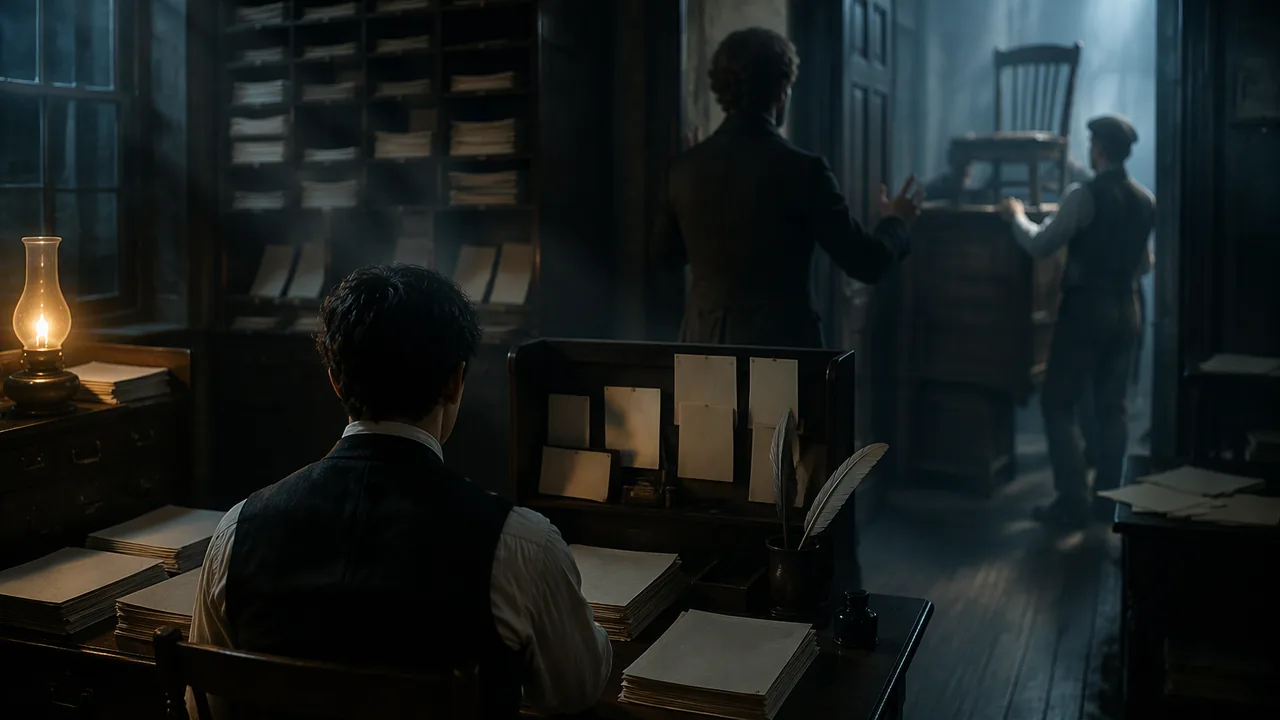
At first Bartleby did an extraordinary quantity of writing. As if long famishing for something to copy, he seemed to gorge himself on my documents. There was no pause for digestion. He ran a day and night line, copying by sun-light and by candle-light. I should have been quite delighted with his application, had he been cheerfully industrious. But he wrote on silently, palely, mechanically.
The first refusal.
Imagine my surprise, nay, my consternation, when without moving from his privacy, Bartleby in a singularly mild, firm voice, replied, “I would prefer not to.”
The narrator moves his offices.
Acting accordingly, next day I thus addressed him: “I find these chambers too far from the City Hall; the air is unwholesome. In a word, I propose to remove my offices next week, and shall no longer require your services. I tell you this now, in order that you may seek another place.”
As soon as tranquility returned I distinctly perceived that I had now done all that I possibly could, both in respect to the demands of the landlord and his tenants, and with regard to my own desire and sense of duty, to benefit Bartleby, and shield him from rude persecution. I now strove to be entirely care-free and quiescent; and my conscience justified me in the attempt;
The landlord.
“You must take him away, sir, at once,” cried a portly person among them, advancing upon me, and whom I knew to be the landlord of No.—Wall-street. “These gentlemen, my tenants, cannot stand it any longer; Mr. B—” pointing to the lawyer, “has turned him out of his room, and he now persists in haunting the building generally, sitting upon the banisters of the stairs by day, and sleeping in the entry by night. Every body is concerned; clients are leaving the offices; some fears are entertained of a mob; something you must do, and that without delay.”
In the Tombs.
“I know you,” he said, without looking round,—”and I want nothing to say to you.” “It was not I that brought you here, Bartleby,” said I, keenly pained at his implied suspicion. “And to you, this should not be so vile a place. Nothing reproachful attaches to you by being here. And see, it is not so sad a place as one might think. Look, there is the sky, and here is the grass.” “I know where I am,” he replied, but would say nothing more, and so I left him.
The epilogue.
The report was this: that Bartleby had been a subordinate clerk in the Dead Letter Office at Washington, from which he had been suddenly removed by a change in the administration. When I think over this rumor, I cannot adequately express the emotions which seize me. Dead letters! does it not sound like dead men? Conceive a man by nature and misfortune prone to a pallid hopelessness, can any business seem more fitted to heighten it than that of continually handling these dead letters, and assorting them for the flames? For by the cart-load they are annually burned. Sometimes from out the folded paper the pale clerk takes a ring:—the finger it was meant for, perhaps, moulders in the grave; a bank-note sent in swiftest charity:—he whom it would relieve, nor eats nor hungers any more; pardon for those who died despairing; hope for those who died unhoping; good tidings for those who died stifled by unrelieved calamities. On errands of life, these letters speed to death. Ah Bartleby! Ah humanity!
— Herman Melville, “Bartleby, the Scrivener,” Putnam’s Monthly Magazine (November-December 1853), Project Gutenberg #11231, retrieved 2026-09-26
Two texts on the same theme
Ralph Waldo Emerson, “Self-Reliance,” Essays: First Series (1841)
The virtue in most request is conformity. Self-reliance is its aversion. It loves not realities and creators, but names and customs. Whoso would be a man, must be a nonconformist. He who would gather immortal palms must not be hindered by the name of goodness, but must explore if it be goodness. Nothing is at last sacred but the integrity of your own mind.
— Ralph Waldo Emerson, “Self-Reliance,” in Essays — First Series (1841), Project Gutenberg #2944, retrieved 2026-09-26
Henry David Thoreau, Walden (1854)
I went to the woods because I wished to live deliberately, to front only the essential facts of life, and see if I could not learn what it had to teach, and not, when I came to die, discover that I had not lived.
— Henry David Thoreau, Walden (1854), “Where I Lived, and What I Lived For,” Project Gutenberg #205, retrieved 2026-09-26
Stated versus meant: a worked chart (SLS original)
| What the narrator says | What his actions or words reveal |
|---|---|
| He is “an eminently safe man,” and the easiest way of life is the best. | His self-praise is a list of prudence and method. When Bartleby refuses, those virtues have nothing to say; the first refusal leaves him “in perfect silence, rallying my stunned faculties” (the passage between the refusal and his reply, not printed above; find it in the story). |
| He was “quite delighted” with Bartleby’s application, “had he been cheerfully industrious.” | What pleases him is output. He describes the man as one who wrote “silently, palely, mechanically,” and values it. |
| He describes his own patience as charity: he strove to drown his anger “by benevolently construing his conduct” (a passage not printed above; find it in the source). | His reason for helping includes self-interest, which he admits: “Mere self-interest… should… prompt all beings to charity.” Charity and comfort are mixed. |
| He tells Bartleby, “I find these chambers too far from the City Hall; the air is unwholesome.” | The reason given is about the offices, not the man. He moves rather than face the refusal. |
| At the Tombs he says, “Nothing reproachful attaches to you by being here.” | Bartleby answers, “I know where I am.” The narrator’s comfort is not what Bartleby wants. |
Note that the story credits the removal to a chain: the landlord, who complains of his tenants, and the police, to whom the landlord sent. The narrator has moved away, but he is the one who had told the reader that he had done “all that I possibly could.” Evaluate that claim.
Three positions the seminar can defend (SLS original)
- The story criticizes Transcendental confidence. Emerson (1841) asks that a man be a nonconformist and hold to “the integrity of your own mind.” Bartleby does hold to his own mind, and the story sends him to the Tombs. A critic taking this side would say the story tests the claim in a world of offices and money and finds no place for it.
- The story criticizes the society, not the refuser. Thoreau (1854) refuses to “live what was not life” (the phrase is in the passage above from Walden). A critic taking this side would say Bartleby is the purest non-conformist, and the narrator and the landlord are the world that cannot make room for him.
- The story is about the narrator. Neither Emerson nor Thoreau is on trial; the narrator is. The evidence is the gap between what he says about himself and what he does. His last cry, “Ah Bartleby! Ah humanity!”, is either the one honest moment or the most sentimental.
Seminar protocol and role cards (SLS original)
- Goal (agreed before you begin). Example: decide whether the narrator’s final cry is sincere or self-serving, using at least three passages.
- Time. No contribution longer than 90 seconds; no one speaks twice until everyone has spoken once.
- Roles. Facilitator: keeps the goal in view, invites quiet voices. Text leads (two): point the group to page-level evidence. Devil’s advocate: argues the position nobody has taken. Recorder: summarizes each decision the group makes.
- Norms. Disagree with ideas, not people; begin a reply by restating the point you answer; every claim needs a passage.
Question stems. “The narrator says… but he does…” • “The passage that shows this is…” • “If we read the final cry as sincere, what do we do with…?” • “Emerson would say…, Thoreau would say…, and the story shows…” • “Which reading does the last paragraph make harder to hold?”
Model 60-second claim (SLS original)
SLS original model, not a quotation from any student.
I think the narrator’s final cry is more sentimental than sincere. In the epilogue he passes along a rumor about the Dead Letter Office and then says that “Dead letters! does it not sound like dead men?” This is a moving passage, but the rumor is the one thing he says he “could never ascertain,” and he builds a whole meaning on it. His earlier actions matter more: he told Bartleby the “air is unwholesome” and moved his offices instead of facing him. My question for the devil’s advocate: if the cry is sincere, why does it come only after Bartleby is dead?
Formative check
Work through these before moving on. They are not graded — they tell you whether the standard below has landed yet.
Which detail most suggests the narrator’s self-portrait should be read with irony?
‘Bartleby’ and ‘Where I Lived, and What I Lived For’ treat the theme of refusal and reach the same conclusion.
Which is a clear seminar goal?
Stated-versus-meant chart: list five things the narrator says about himself or Bartleby, and beside each what his actions or words reveal. Then prepare your role card contribution: a 60-second claim on whether the narrator’s final cry is sincere, with two passages, and one question for the devil’s advocate.
How confident are you that you can distinguish what a narrator says from what the story reveals?