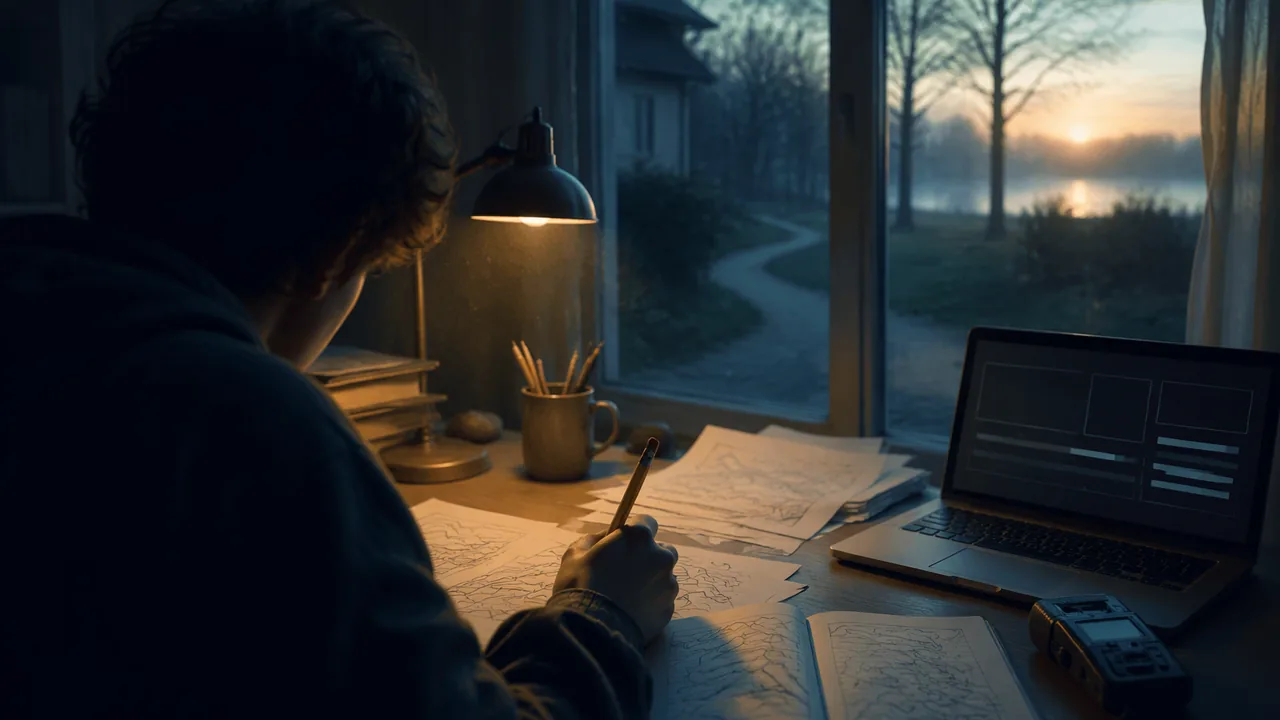
write a 1,300-1,600 word reflective essay that answers a writer of the American Renaissance, publish it, and deliver a recorded reflective narrative.
Instruction
The semester began with Paine’s argument that America should govern itself. It ends with the question the Transcendentalists asked next: how should a free person live? Your answer, in this essay, is a narrative.
The essay. Write about a place, practice or decision that has shaped how you want to live — or, if you prefer, a place or community practice you have observed closely. Move between narrated scenes and reflection on what they mean. Answer at least one unit writer: Thoreau, Emerson, Fuller, Whitman or Melville.
The conclusion (11-12.W.2.A). The ending must follow from and reflect on what has been experienced and observed. It should not announce a moral (“This taught me to appreciate the little things”). It should show the narrator’s understanding at the end, which the reader has watched develop. Thoreau ends Walden with an image of morning: “There is more day to dawn.” He does not explain it; the book has earned it.
Writing for task, purpose and audience (11-12.W.2.A). Your audience is a thoughtful adult reader who does not know you. Your purpose is to make them see something and think about it. The style should be personal but controlled: first person, precise, no slang unless it is quoted speech that reveals character.
Publishing (11-12.W.3.A.e). Your final essay is published to the class portfolio page, where classmates can read and comment. Before you publish, respond to at least one comment on your draft in writing, saying what you changed.
The recorded narrative (11-12.SL.2.A / 11-12.SL.2.B / 11-12.SL.2.C). Record three minutes: a reflective narrative drawn from your essay, planned for listeners. Do not read the essay aloud. Choose one scene, tell it with sensory language, and end by reflecting on its significance. Speak to a listener; use pauses where a reader would see a paragraph break. A live telling to a small group is an equal-credit alternative, and a student who prefers not to share personal material may narrate the observed-place version.
Checklist. Does the opening set out a situation and why it matters? Is there at least one full scene with a non-visual detail? Does reflection arise from scenes? Do you answer a unit writer rather than just quote one? Does the ending follow from what you narrated?
Reading: A reflective essay in the American tradition: prompt, key passages by location, a four-level rubric, and a model plan and exemplar
Henry David Thoreau, Walden (1854), Project Gutenberg 205; Ralph Waldo Emerson, “The American Scholar,” Essays by Ralph Waldo Emerson, Project Gutenberg 16643; Margaret Fuller, Woman in the Nineteenth Century (1845), Project Gutenberg 8642; Walt Whitman, Leaves of Grass, Project Gutenberg 1322; Herman Melville, “Bartleby, the Scrivener” (1853), Project Gutenberg 11231; all retrieved 2026-09-26….. Identifiers: Project Gutenberg 205; Project Gutenberg 16643; Project Gutenberg 8642; Project Gutenberg 1322; Project Gutenberg 11231 · SLS original; quoted passages are public domain (Thoreau, 1854; Emerson, 1837; Fuller, 1845; Whitman; Melville, 1853)
Passages are printed in the printings’ spelling; text between passages is left out. The Whitman text is the later authorized text supplied by Project Gutenberg.
This page gives you what the essay needs in one place: the full prompt, key passages by writer and location, a four-level rubric, and a model plan and short exemplar. The passages are in the printed texts, in their spelling and punctuation. Each paragraph in a box is a separate passage, in order; text between passages is left out. Everything outside the boxes is SLS original, including the exemplar, which is not a quotation from any student or author.
The full prompt
Write a 1,300-1,600 word reflective essay about a place, practice or decision that has shaped how you want to live, or a place or community practice you have observed closely. Move between narrated scenes and reflection on what they mean. Answer at least one writer from the unit (Thoreau, Emerson, Fuller, Whitman or Melville): agree in part, disagree, or complicate, and do it out of your own experience, not a summary of theirs. End so that the ending follows from and reflects on what you narrated, without announcing a moral. Keep a five-entry writing log (150-250 words each, one sitting each) and publish the essay to the class portfolio page, replying in writing to at least one comment. Then record a three-minute reflective narrative built from one scene of your essay, planned for listeners.
Key passages, by writer and location
Henry David Thoreau, Walden (1854)
I went to the woods because I wished to live deliberately, to front only the essential facts of life, and see if I could not learn what it had to teach, and not, when I came to die, discover that I had not lived.
Sometimes, in a summer morning, having taken my accustomed bath, I sat in my sunny doorway from sunrise till noon, rapt in a revery, amidst the pines and hickories and sumachs, in undisturbed solitude and stillness, while the birds sing around or flitted noiseless through the house, until by the sun falling in at my west window, or the noise of some traveller’s wagon on the distant highway, I was reminded of the lapse of time. I grew in those seasons like corn in the night, and they were far better than any work of the hands would have been. They were not time subtracted from my life, but so much over and above my usual allowance. I realized what the Orientals mean by contemplation and the forsaking of works. For the most part, I minded not how the hours went. The day advanced as if to light some work of mine; it was morning, and lo, now it is evening, and nothing memorable is accomplished. Instead of singing like the birds, I silently smiled at my incessant good fortune.
The light which puts out our eyes is darkness to us. Only that day dawns to which we are awake. There is more day to dawn. The sun is but a morning star.
— Henry David Thoreau, Walden (1854): “Where I Lived, and What I Lived For” (first passage), “Sounds” (second), and the conclusion (third), Project Gutenberg #205, retrieved 2026-09-26
Ralph Waldo Emerson, “The American Scholar” (1837)
Books are the best of things, well used; abused, among the worst. What is the right use? What is the one end which all means go to effect? They are for nothing but to inspire.
— Ralph Waldo Emerson, “The American Scholar,” in Essays by Ralph Waldo Emerson, Project Gutenberg #16643, retrieved 2026-09-26
Margaret Fuller, Woman in the Nineteenth Century (1845)
But if you ask me what offices they may fill, I reply—any. I do not care what case you put; let them be sea-captains, if you will.
— Margaret Fuller, Woman in the Nineteenth Century (1845), Project Gutenberg #8642, retrieved 2026-09-26
Walt Whitman, “Song of Myself” (Leaves of Grass)
Do I contradict myself?
Very well then I contradict myself,
(I am large, I contain multitudes.)
— Walt Whitman, “Song of Myself,” section 51, Leaves of Grass, Project Gutenberg #1322, retrieved 2026-09-26
Herman Melville, “Bartleby, the Scrivener” (1853)
Imagine my surprise, nay, my consternation, when without moving from his privacy, Bartleby in a singularly mild, firm voice, replied, “I would prefer not to.”
Ah Bartleby! Ah humanity!
— Herman Melville, “Bartleby, the Scrivener,” Putnam’s Monthly Magazine (November-December 1853), Project Gutenberg #11231, retrieved 2026-09-26
Rubric at four levels (SLS original)
| Criterion | 4 Exceeds | 3 Meets | 2 Approaches | 1 Beginning |
|---|---|---|---|---|
| Orientation and significance (11-12.W.2.A, .3.a) | Opening sets out a specific situation and makes the reader want to know why it matters. | Opening sets out a situation and signals why it matters. | Situation is present but its significance is not. | No clear opening. |
| Technique and detail (11-12.W.2.A, .3.d) | Scene and summary alternate by design; telling details, including a non-visual sense, carry meaning. | At least one full scene; some telling detail. | Mostly summary; details are general. | No scene. |
| Sequence and conclusion (11-12.W.3.A.d, .3.e) | Events build to an outcome; the ending shows the changed understanding without a moral. | Sequence is clear; the ending follows and reflects. | Ending repeats or announces a moral. | Events do not build. |
| Answering a writer (11-12.RL.3.B) | Answers a unit writer from experience; the answer changes the essay’s direction. | Answers a unit writer from experience. | Quotes a writer but does not answer. | No writer is used. |
| Publication and log (11-12.W.3.A.e, .10) | Published, reply shows a specific revision, five log entries with visible growth. | Published with a reply; five entries complete. | Fewer than five entries, or no reply. | Not published. |
| Reflective narrative (11-12.SL.2.A / 11-12.SL.2.B / 11-12.SL.2.C) | One scene told for listeners, with sensory language and a reflection that lands. | One scene told for listeners with reflection. | Reads the essay aloud. | Not delivered. |
Model plan (SLS original)
- Opening. A situation and a question: “For two years I have walked past the same shuttered bakery…”
- Scene one. The Tuesday I stopped: the cold glass, the sign in cents, the bus behind me.
- Summary. Two weeks of asking the neighbors, compressed to one paragraph.
- Scene two, with a reflection. A neighbor’s account of the baker; the reflection that a place is something people did.
- Answering a writer. Thoreau says most people are not awake to their days; the essay agrees for the walk to school and complicates it, since the waking came from a small closed shop and not from a pond.
- Ending. An image, not a moral: the sign, seen once more, with its prices in cents.
Model exemplar: an ending that shows (SLS original)
SLS original exemplar, not a quotation from any student or author.
On Friday I went by again. The sign was still there, its prices in cents, and a strip of tape had come off one corner and curled in the wind. A woman was putting flyers under the wipers of the parked cars. I stood at the glass a while longer than I needed to. Then the bus came, and I got on, and I looked out at the door until I could not see it.
Why this ending works. It follows from the essay’s scenes, returns to the opening’s detail, and shows that the narrator now looks where he used to pass. It states no moral.
Presentation plan for the three-minute narrative (SLS original)
30 seconds to set the situation; 90 seconds for one scene, told with sound, touch or smell; 45 seconds of reflection that could only follow that scene; 15 seconds of silence and a last image. Mark the pauses where a reader would see a paragraph break, and do not read your essay aloud.
Formative check
Work through these before moving on. They are not graded — they tell you whether the standard below has landed yet.
Transcendentalism
Tap to revealTruth through intuition and nature.
catalog
Tap to revealA long list given equal weight in a poem.
unreliable narrator
Tap to revealA narrator to be read against his own account.
pacing
Tap to revealSpeed of narrative, set by scene and summary.
reflection
Tap to revealThe narrator’s present-day thinking about events.
Which ending best follows from and reflects on the narrative?
How confident are you that you can write and tell a reflective narrative that answers another writer?
Submit: Reflective Essay (1,300-1,600 words) + writing log + 3-minute reflective narrative
Task: Write a reflective narrative essay about a place, practice or decision that has shaped how you want to live (or one you have observed closely), answering a writer of the American Renaissance.
Submission workflow
- Stage 1 — Plan and log. Opening, scene list with pacing, reflection points, writer to answer, first log entries (from Lesson 4.4).
- Stage 2 — Peer-reviewed draft. A partner marks each reflection and checks that it arises from a scene; submit a revision note.
- Stage 3 — Final essay published to the class portfolio page, 1,300-1,600 words, with the complete five-entry writing log and a written reply to one comment.
- Stage 4 — Reflective narrative. Three minutes, recorded or live, told for listeners.
How it is scored
| Criterion | What proficient looks like |
|---|---|
| Orientation and significance (11-12.W.2.A) | Opening sets out a situation and why it matters. |
| Technique and detail (11-12.W.2.A) | Scene and summary paced deliberately; telling and sensory detail. |
| Sequence and conclusion (11-12.W.3.A.d, 11-12.W.2.A) | Events build to an outcome; the ending follows and reflects without a stated moral. |
| Answering a writer (11-12.RL.3.B) | A unit writer is answered from experience, not summarized. |
| Publication and log (11-12.W.3.A.e, 11-12.W.2.A) | Published with a reply to feedback; five log entries complete. |
| Reflective narrative (11-12.SL.2.A / 11-12.SL.2.B / 11-12.SL.2.C) | Planned for listeners; sensory language; significance reflected on. |