choose the right kind and fidelity of prototype for a design question, and compare my concept with existing games in its genre.
Instruction
A prototype is a question you can play. The skill is not building prototypes; it is choosing the cheapest prototype that will answer the question you actually have.
Fidelity. A low-fidelity prototype is rough, fast and disposable: index cards, a whiteboard sketch or gray boxes on screen. A high-fidelity prototype looks and behaves close to the final game. Low fidelity answers questions about rules, flow and fun. High fidelity answers questions about feel, readability and emotional impact. Using a high-fidelity prototype to test a rule wastes days; using a low-fidelity prototype to test how a jump feels tells you nothing.
Three kinds.
- Paper prototypes test rules, economies, turn structure and information: what players know and when. A digital card game or a strategy game’s resource system can be tested on paper in an afternoon.
- Digital prototypes test anything involving timing, physics, camera or real-time input: how a jump feels, whether an enemy is fair to dodge, whether players can read the screen at speed. A greybox prototype uses plain shapes instead of art so that nobody mistakes it for finished and every change is cheap.
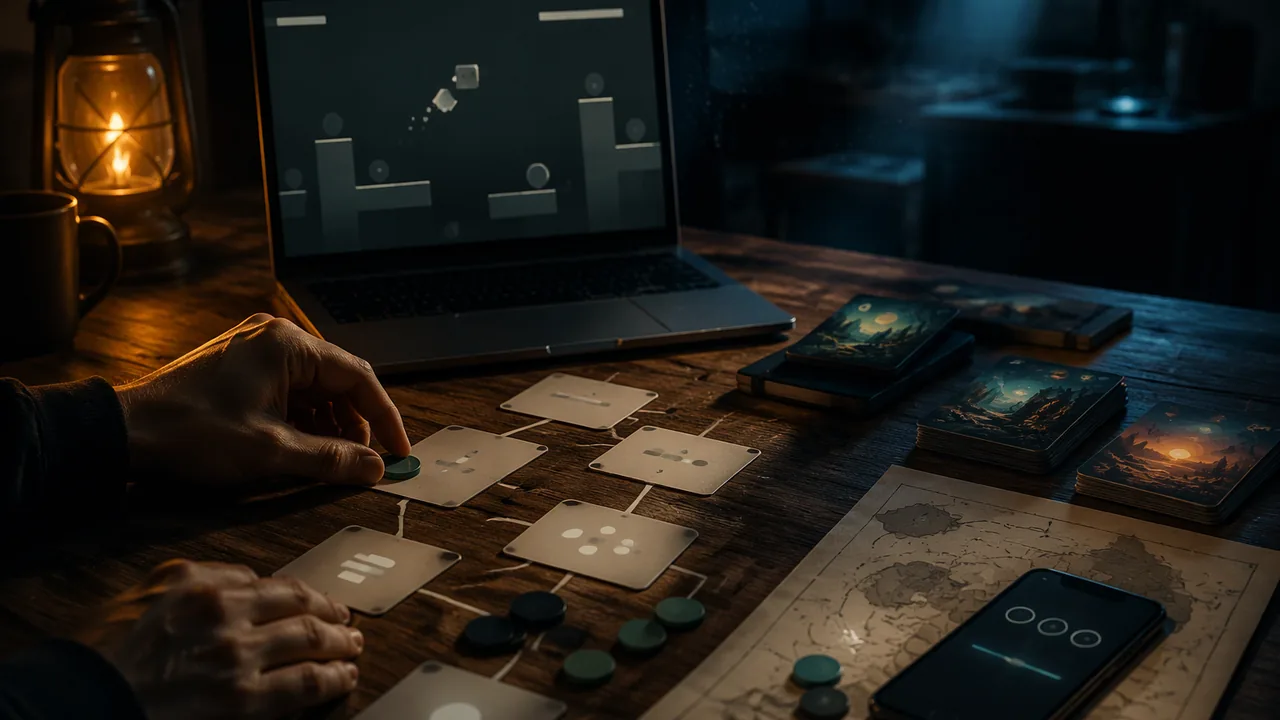
- Hybrid prototypes mix the two: a board game with a phone timer, or a digital map with paper character sheets. They are useful when part of the design is real-time and part is rules.
Throwaway or evolutionary? A throwaway prototype is built to learn and then discarded; its code can be messy. An evolutionary prototype grows into the final game, so it must be built more carefully. Decide in advance and write the decision at the top of your build log; on a studio team, designers announce it to everyone working on the build. Many teams build throwaway prototypes quickly, then rebuild cleanly once they know what works.
Writing a design question. A good question is specific and testable: “Do players understand, without instructions, that blue platforms disappear?” or “Is a 60-second timer tense or stressful for new players?” A poor question is vague: “Is it fun?” For each question, name what you will observe that would answer it.
Know your genre. Genres are families of games that share conventions: platformers, puzzle games, roguelikes, role-playing games, real-time strategy, simulation and management games, and multiplayer forms such as cooperative games, battle arenas and battle royales. Conventions are useful, because players arrive knowing that coins are good and spikes are bad, but they also set expectations you must meet or deliberately break. Comparing your concept with existing games in the genre tells you what players will expect, what has been done well, and where your idea is genuinely different. Play at least two examples with a notebook, and write down one thing to borrow and one thing to avoid from each.
Iteration as the bridge. The concept in your head is untested. The prototype is the bridge between imagination and execution: every round of build, test and revise moves the game from what you hoped would happen to what actually happens when people play. Expect the first version to be wrong, and plan time for the second and third.
📖 Read for this lesson
The reading opens over the lesson; close it to come back to exactly where you were. The checks below draw on it.
Formative check
Work through these before moving on. They are not graded — they tell you whether the standard below has landed yet.
A team wants to know whether their card game’s economy lets one strategy dominate. What is the cheapest useful prototype?
Which is the best design question for a prototype?
Name your game’s genre and two existing games in it. For each, write one thing to borrow and one thing to avoid. Then write three design questions for your prototype, each with the prototype type that fits it best and what you will observe.
How confident are you that you can choose the right prototype for a design question and compare my concept with its genre?
Practice
Work these on paper or in your notebook, then open Check your answer. Aim for all of Fluency and Application; try at least one Challenge.
Printable version: this unit’s practice workbook (PDF)
Fluency
Build speed and accuracy with the core skill.
- Low or high fidelity? (a) index cards testing a turn order; (b) a build with near-final art testing whether a jump feels heavy and satisfying; (c) gray boxes on screen testing whether a route is readable; (d) a polished scene testing emotional impact.
Check your answer
Answer: (a) low; (b) high; (c) low; (d) high.Low fidelity answers questions about rules, flow and fun; high fidelity answers questions about feel, readability and emotional impact. - Name the three kinds of prototype and what each tests best.
Check your answer
Answer: Paper: rules, economies, turn structure and information. Digital: timing, physics, camera and real-time input. Hybrid: designs that are part real-time and part rules (a board game with a phone timer, a digital map with paper character sheets).A greybox is a digital prototype built from plain shapes. - What is the difference between a throwaway and an evolutionary prototype, and when should you decide which one you are building?
Check your answer
Answer: A throwaway prototype is built to learn and then discarded, so its code can be messy; an evolutionary prototype grows into the final game, so it must be built carefully. Decide in advance and write it at the top of your build log.Many teams build throwaway prototypes quickly, then rebuild cleanly once they know what works.
Application
Use the skill in context. Show your reasoning.
- Rewrite “Is the level fun?” as a specific, testable design question, and name what you will observe.
Check your answer
Answer: Model: “Do new players find the hidden side path in the first level without hints?” Observe: how many testers enter the side path and how long it takes them.A good question is specific and names something observable. - Match each design question to the cheapest prototype that answers it: (a) “Does the shop’s price list let one strategy dominate?” (b) “Can players dodge the bat’s swoop at speed?” (c) “Is a real-time map with paper character sheets workable for two players?”
Check your answer
Answer: (a) paper; (b) digital (greybox); (c) hybrid.Using a high-fidelity prototype to test a rule wastes days; using paper to test dodging at speed tells you nothing. - Your concept is a platformer. Name two conventions players will arrive expecting, and explain why a designer must know them even if they plan to break one.
Check your answer
Answer: Model: coins (collectibles) are good and spikes are bad; you move right toward the goal. Conventions set expectations you must meet or deliberately break, so breaking one by accident confuses players, while breaking one on purpose can surprise them.Comparing with existing games in the genre tells you what players expect and where your idea is different. - Explain in two sentences why the lesson calls the prototype a bridge, and what you should plan for as a result.
Check your answer
Answer: The prototype connects the untested concept in your head to what actually happens when people play, moving the game through rounds of build, test and revise. Expect the first version to be wrong and plan time for the second and third.Iteration is the bridge between imagination and execution.
Review
Keep earlier skills sharp.
- Review (Semester A): what is a vertical slice, and why is it not the right prototype for testing a new rule?
Check your answer
Answer: A short section built close to final quality to prove the full game can be made. It is slow and expensive to change, so a rule is tested faster on paper or in a greybox.Fidelity should match the question.
Choosing a Prototype: A Worked Plan, a Cost Table and a Genre Chart
SLS original technique sheet with an invented game; hours are illustrative · SLS original
Why this reading. The lesson asks for three design questions, a prototype type for each and a genre comparison chart. This reading walks one invented game through all of it, with a cost table, so you can copy the method onto your own game. Everything here is SLS original and invented; the two comparison games are made up so that no fact about a real game needs checking.
The game: Tide Pool Dash (invented)
A 2D platformer. The player runs across rocks at low tide, collects pearls and avoids urchins. Coral platforms vanish one second after they are stepped on. A 60-second tide timer floods the level. Between levels the player spends pearls on one of three upgrade paths: Speed, Jump or Shield.
What each kind of prototype costs and answers (illustrative build hours)
| Prototype | Hours to build | Can answer | Cannot answer |
|---|---|---|---|
| Paper (cards, tokens, graph paper) | 3 | Does the pearl economy let one upgrade path dominate? Is the turn order clear? | How a jump feels; whether a timer is tense |
| Digital greybox (Godot, gray boxes) | 10 | Do players notice the vanishing coral? Is an urchin fair to dodge? | Whether the art is appealing |
| Hybrid (printed map, token, phone timer) | 5 | Is a 60-second limit tense on a small map? Can players plan a route? | Real-time reflexes |
| High fidelity (final art and sound) | 40 | Emotional impact, readability at speed | Anything cheaper prototypes could have told you |
The worked prototype plan
| Design question | Prototype | What we will observe |
|---|---|---|
| Q1. Without instructions, do players notice that coral vanishes one second after they step on it? | Digital greybox | Count of testers (of 4) who step off within 2 seconds of the first vanish; number of falls on the first coral |
| Q2. Does any of Speed, Jump or Shield win far more often than the others? | Paper: 3 upgrade cards, 20 pearl tokens, a d6 for hazards | Which path each tester picks first; win or loss over 3 paper runs per path (9 runs) |
| Q3. Is the 60-second tide tense without being stressful? | Hybrid: printed level, token, phone timer | Pauses, quotations, and a 1 to 5 tension rating, where 3 means tense but fair |
Cost check: the three prototypes total 10 + 3 + 5 = 18 hours. Building one high-fidelity version to answer all three would cost about 40 hours and could not start until art existed. The plan is throwaway: the paper cards and the greybox code will be discarded, and the team said so in writing.
The worked genre chart (two invented comparison games)
| Convention | Reef Runner (invented) | Kelp Kingdom (invented) | Tide Pool Dash |
|---|---|---|---|
| Coins or pickups are good | Yes, pearls | Yes, shells | Follows |
| Timer pressure | None | Soft: hunger bar | Breaks it: a hard 60-second tide |
| Checkpoints | Every screen | None | Follows: one mid-level |
| Borrow | Readable one-screen layouts | Pickup arcs that show landings | |
| Avoid | Hidden spikes below the screen edge | Long walks after a death |
Reading the chart: the team keeps most conventions, deliberately breaks one (the hard timer), and knows that breaking it means testers may find it stressful, which is exactly Q3. Now make your own: one row per convention, two real games you have played, one thing to borrow and one to avoid from each.