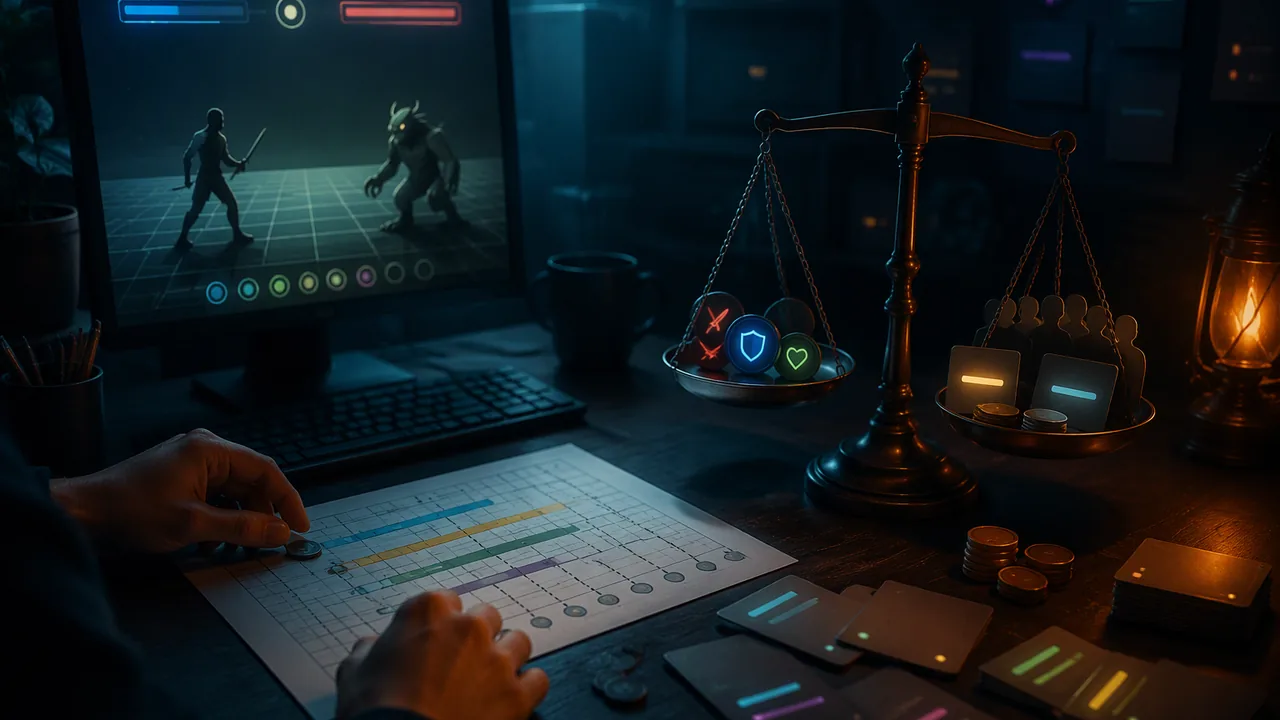
balance one system in my game against numeric targets using test and simulation evidence, and write a launch plan with a business model, ratings, platform research and marketing materials.
Instruction
This project joins the two halves of the unit, because they meet in real studios: how a game is balanced and how it earns money shape each other. A free-to-play game that sells power has to be balanced differently from a premium game that sells nothing after purchase.
Part 1: the balance chart. Choose one system: health and damage, a drop table, an economy or a difficulty curve. State the target experience as numbers: “a standard enemy should take 3-4 seconds to defeat with the starting weapon; the first upgrade should cut that by about a quarter” or “players should get a health drop at least once every 8 enemies”. Build a chart (a spreadsheet is ideal) listing every value in the system and the resulting outcomes, such as hits to defeat, time to defeat and expected drops, with breakpoints marked. Then test in play and with your simulation, gather feedback from at least three home testers (family members or other adults you know, in person, using the Unit 1 consent script; a tester under 18 needs a parent’s OK), adding a structured self-playtest after a day away if fewer testers are available, and revise. Record each change and its effect. The reflection should show how small adjustments changed the experience, with evidence.
Part 2: the launch plan. Write for a small publisher deciding whether to help release your game.
- Audience and positioning: who it is for and two comparable games.
- Business model: premium, free with cosmetic purchases, free and donation-supported, or another model, justified for your audience. If you choose any randomized purchase, you must show the expected-value calculation and explain how you meet disclosure rules; many students choose not to, and that is a legitimate business decision.
- Funding and budget: how the next three months of development would be paid for, with a simple budget. Label any rates you assume as illustrative.
- Licensing: the licenses of your engine and every asset, and what they allow you to do commercially.
- Ratings: your expected ESRB rating and two other regions’ ratings, with reasons.
- Platform research: one distribution platform in depth, with advantages and disadvantages drawn from its official terms (dated) and at least one developer’s published experience.
- Marketing materials: a poster, a 60-second pitch script and one social media post. The post must follow advertising-disclosure rules and must not make claims your game cannot support.
Entrepreneurship. Many game developers start small businesses, from solo studios to contract art and audio work. A launch plan is a business plan in miniature: it shows you understand your market, your costs and your risks.
The reflection (600-800 words) covers your balance decisions with evidence, why your business model fits your audience and values, and how marketing choices could influence your game’s success, including one way marketing could mislead players and how you avoided it.
The pitch. Record your 60-second pitch as if to a publisher panel, with the poster on screen, then record your answers to two questions a publisher would likely ask (the brief lists some; a family member may read them to you). Keep the recording on your own device.
📖 Read for this lesson
The reading opens over the lesson; close it to come back to exactly where you were. The checks below draw on it.
Formative check
Work through these before moving on. They are not graded — they tell you whether the standard below has landed yet.
Your budget assumes a contract artist at $30 an hour, a rate you chose for planning. How should it appear in the launch plan?
Two developers each work 30 hours a week for 12 weeks at an illustrative $30 an hour. Labor costs $. If the schedule slips by 4 weeks, the total rises to $.
Write your system’s numeric target experience, list the values you will tune, and state the business model you are choosing with two reasons tied to your audience.
How confident are you that you can balance a system against numeric targets and write a launch plan?
Unit 3 checkpoint
Do this before you start the task. It covers the whole unit and tells you what to review first.
Enemies have 100 health. Which upgrade changes the number of hits needed?
A weapon deals 15 damage every 0.5 s, so its DPS is . Against 100 health it needs hits.
Repair costs and shop purchases are faucets in a game economy.
Why does the health component emit signals instead of updating a health bar directly?
With a 25% drop chance, the average is one drop every enemies. With pity_limit 6, the longest possible dry streak is misses.
A pity rule raises the average drop rate a great deal while leaving the worst case unchanged.
A $2 box has a 5% chance of the wanted item. On average it takes boxes, costing $.
Which is a fair design principle from the lesson?
A release in the United States, Europe and Japan involves which rating bodies?
A Godot web export runs correctly when you double-click index.html.
A store wants 920 × 430 and you have a 1920 × 1080 screenshot. What should you do?
Submit: Balance chart + launch plan (with poster, 60-second pitch and social post) + reflection (600-800 words) + pitch
Task: Balance one system in your game against numeric targets using play and simulation evidence, and write a launch plan covering audience, business model, budget, licenses, ratings, platform research and marketing materials.
Submission workflow
- Stage 1 — Plan. Chosen system and numeric targets, first balance chart, business-model choice and platform to research.
- Stage 2 — Home-tested, self-checked draft. At least three home testers (or self-playtests after a day away) try the balanced system and you record their feedback; then you check every claim in your launch plan for a source and recompute your budget arithmetic with the self-check sheet in the brief.
- Stage 3 — Revised final. Revised balance chart with before-and-after values, complete launch plan with all materials, and the 600-800 word reflection.
- Stage 4 — Recorded pitch. A sixty-second recorded pitch to an imagined publisher panel with the poster, followed by recorded answers to two likely questions.
How it is scored
| Criterion | What proficient looks like |
|---|---|
| Balance (AME.D3.3) | Numeric targets stated; chart accurate with breakpoints; revisions tied to test and simulation evidence. |
| Business model and budget (AME.D7.3, MM.WRS.3) | Model justified for the audience; budget arithmetic correct; illustrative figures labeled. |
| Licensing and ratings (AME.D7.2, AME.D7.9) | Licenses and ratings accurate and explained. |
| Platform research (WHST.9-10.8) | Advantages and disadvantages drawn from dated official terms and developer experience. |
| Marketing materials (AME.D7.4) | Poster, pitch and post are clear, honest and follow disclosure rules. |
| Reflection and pitch (WHST.9-10.1, SL.9-10.4) | Reflection uses evidence and addresses marketing ethics; pitch is persuasive and answers questions. |
Balance Chart and Launch Plan: Model Chart, Worked Budget, License Facts and Self-Check Sheet
SLS original brief; the chart and budget are invented; Godot license page and Kenney support page retrieved 2026-09-26 · SLS original, with license facts paraphrased from Godot and Kenney pages
Why this reading. The project asks for a balance chart with numeric targets and before-and-after values, and a launch plan with a budget, licenses, ratings and marketing pieces. This brief supplies a model chart with its arithmetic, a model launch plan skeleton with the budget worked, the license facts you need, the self-check sheet and likely publisher questions for your recorded pitch. Every number is invented or computed here; replace them with your own.
Model balance chart (SLS original)
Target: a standard enemy takes 3 to 4 seconds to defeat with the starting weapon; the first upgrade cuts that by about a quarter; a health drop appears at least once every 8 enemies.
| Value | Before | After (first upgrade) | Effect |
|---|---|---|---|
| Enemy health | 100 | 100 | |
| Damage per hit | 12 | 15 | +3 |
| Hits to defeat | 9 | 7 | 100 / 12 = 8.33 up to 9; 100 / 15 = 6.67 up to 7 |
| Time to defeat (0.5 s per hit) | 4.0 s | 3.0 s | (9 minus 1) x 0.5 = 4.0; (7 minus 1) x 0.5 = 3.0; 1 minus 3.0 / 4.0 = 25% |
| Health drop chance / pity limit | 25% / 8 | 25% / 8 | Longest dry streak 7; about 278 drops per 1,000 enemies |
The starting time of 4.0 s sits on the edge of the target, so a home tester who finds it slow is giving evidence, not an opinion. Change one value at a time and record it.
Model launch plan skeleton (SLS original, illustrative)
| Section | Example |
|---|---|
| Audience and positioning | Ages 10 and up, casual platformer fans; comparable games: two you have played, named |
| Business model | Premium at $4, no random items, so no expected-value calculation is needed |
| Budget | 2 developers x 30 hours x 12 weeks x $30 (an assumed rate) = $21,600; if the schedule slips 4 weeks, 2 x 30 x 16 x 30 = $28,800, which is $7,200 more |
| Licensing | Godot Engine is MIT licensed: keep its copyright notice and license text in the credits. Kenney assets are CC0: free for commercial use, credit not required but kind (both retrieved 2026-09-26) |
| Ratings | ESRB E; PEGI 3 or 7; one more region with reasons |
| Platform research | One platform, its fee and rules with the date you read them, and one developer’s published experience |
| Marketing | Poster, 60-second pitch script, one social post with no claims the game cannot support |
Self-check sheet (Stage 2)
| Check | Note |
|---|---|
| Each target is a number and each value is listed | |
| Before and after values reproduce (recompute hits and time) | |
| Budget arithmetic recomputed; assumed rates labeled illustrative | |
| Licenses named with what they allow | |
| Post makes no unsupported claim |
Likely publisher questions for your recorded pitch
- Who exactly is this for, and what will they compare it with?
- How will it make money, and what does a player pay in total?
- What did testing show, and what did you change because of it?
- What would three more months of development cost, and where would that money come from?
Answer two of them on your recording, with a number or a test result in each answer. A family member may read them to you.
Sources: Godot Engine, License (godotengine.org); Kenney, Support (asset license) (kenney.nl)