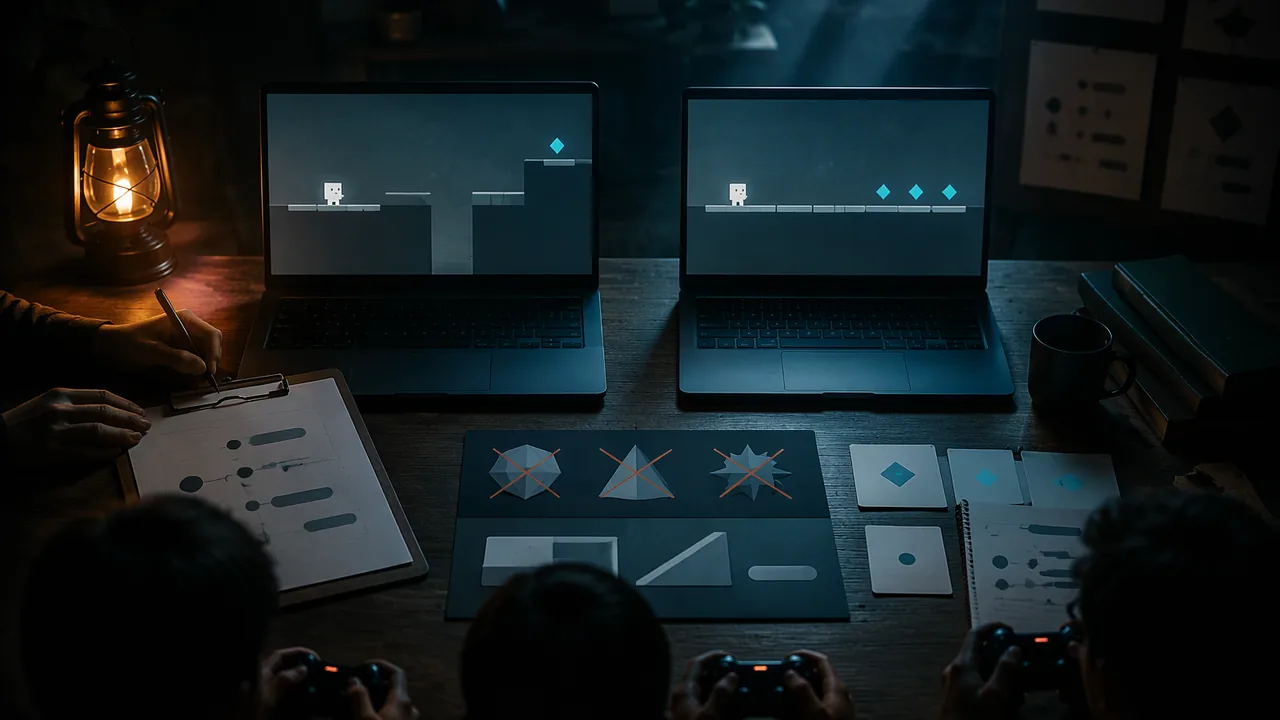
test my first digital prototype in two ethical playtest rounds, revise it from the evidence, and report the results and changes in a structured playtest report.
Instruction
This project is the first full turn of the design loop on your own digital game: build, test, learn, change, test again. The report is written for a producer deciding whether your prototype deserves more time. It should convince them with evidence, not enthusiasm.
Before round 1. Take the paper prototype from Semester A, or a quick new one, and play it once more to confirm the core loop. Build the digital greybox (Lesson 1.2) around that loop. Write your three design questions and, for each, what you will observe. Prepare your consent script and observation sheet (Lesson 1.3), and get a parent’s OK in advance for any tester under 18.
Round 1: three or more testers. Test in person at home with family members or other adults you know. If you are one short, a structured self-playtest after a day away may fill one slot, labeled S and reported separately. Run each test the same way. Record behavior and quotations separately, collect a three-question questionnaire at the end (for example, rate difficulty from 1 to 5; what was most confusing?; what did you want to do that you couldn’t?), and file bug reports for anything broken.
Between rounds: analyze, then change. Tally what you saw. If three of four testers died at the same gap, that is a pattern; if one tester disliked the color, that is a data point. Choose at least three changes, each tied to evidence and each with a prediction. Keep changes small enough that round 2 can show whether they worked.
Round 2: new testers where possible. Testers from round 1 have learned your game, so they cannot tell you whether a new player now understands it. Use at least some fresh testers, such as a relative who has not played yet, repeat the same questions, and compare. Report repeat testers separately, and if you run out of fresh testers, say so.
Simple numbers help. If round 1 testers took a mean of 3.5 attempts to clear the first gap and round 2 testers took 1.5, that is a clear, reportable improvement. With so few testers, treat numbers as indications, not proof, and say so.
The genre comparison. Compare your prototype with two published games in the same genre: which conventions you follow, which you break, and why. This section shows a reviewer you know the field.
Report structure (800-1,000 words). 1. Summary: the game, the design questions and the headline findings. 2. Method: testers (anonymized), sessions and what was recorded. 3. Findings from round 1, organized by design question. 4. Changes, each with its evidence and prediction. 5. Round 2 results compared with round 1. 6. Genre comparison. 7. Reflection: how iteration changed the design, and the next three things you would test. Attach the observation sheets, the bug reports and both builds.
The demonstration. A three-minute screen recording with your voice-over: show version 1 and version 2 side by side at the moment that changed most, and explain the evidence behind the change.
📖 Read for this lesson
The reading opens over the lesson; close it to come back to exactly where you were. The checks below draw on it.
Formative check
Work through these before moving on. They are not graded — they tell you whether the standard below has landed yet.
Round 1 testers needed a mean of 4 attempts at a jump; after you widened the platform, round 2 testers needed a mean of 1.5. What is the most accurate way to report this?
Write the findings paragraph for one design question: the question, what you observed in round 1 (with numbers where you have them), the change you made and your prediction.
How confident are you that you can run two playtest rounds, revise from evidence and write a structured playtest report?
Unit 1 checkpoint
Do this before you start the task. It covers the whole unit and tells you what to review first.
A team wants to know whether a 45-second timer feels tense for new players. Which question type is this, and what prototype fits?
An evolutionary prototype can be built with messy code because it will be thrown away.
Which is the best design question?
A level has six pickups and the player has collected four. Touching the goal shows “ left to collect”.
Why does the hazard use call_deferred() to reload the scene?
Before you observe a 12-year-old relative play, their parent or guardian must say yes.
Which note is an observation?
A tester asks, “What do I do now?” The best response is…
The game crashes whenever the player opens the map. Severity?
After build 0.4.0 gets a bug fix it becomes ; after a new feature is added to that it becomes .
A USB flash drive can be unplugged as soon as the copy finishes; ejecting it first is optional.
Submit: Prototype v1 and v2 + observation sheets + bug reports + playtest report (800-1,000 words) + demonstration
Task: Build a first digital prototype of your game’s core loop, test it ethically in two rounds, make at least three evidence-based changes, compare it with two games in its genre, and report the results.
Submission workflow
- Stage 1 — Plan. Design questions with observables, the greybox build, consent script, observation sheet and questionnaire.
- Stage 2 — Self-reviewed draft. After round 1, check your tallies and proposed changes against the self-check sheet in the reading, cut any change without evidence, and reproduce each bug report from its written steps a day later.
- Stage 3 — Revised final. Version 2 build, round 2 results, and the 800-1,000 word report with genre comparison and attachments.
- Stage 4 — Demonstration. Three-minute recorded side-by-side demonstration of the change with the most evidence behind it.
How it is scored
| Criterion | What proficient looks like |
|---|---|
| Prototype (AME.D10.3) | Playable from start to win; core loop testable; greybox appropriate to the questions. |
| Testing practice (AME.D5.1, MM.WRS.2) | Consent, privacy and neutral facilitation followed; observations separated from opinions. |
| Iteration from evidence (AME.D6.2) | Three or more changes, each tied to evidence and a tested prediction; results compared across rounds. |
| Quality assurance (AME.D5.6) | Bug reports reproducible, with severity. |
| Report (WHST.9-10.2) | Organized, precise and honest about limits; genre comparison informed. |
| Demonstration (SL.9-10.4) | Clear before-and-after with evidence. |
Playtest Report Brief, Worked Tally and Self-Check Sheet
SLS original brief; the tally and paragraph are invented and illustrative · SLS original
Why this reading. The project asks you to tally two playtest rounds with family members or other adults you know, tie each change to evidence and write an 800 to 1,000 word report. Because your own data does not exist yet, this reading gives the full brief with a word budget, an invented tally with its arithmetic (including a repeat tester, which home testing makes common), a model findings paragraph and a self-check sheet for your Stage 2 draft. Copy the structure, never the numbers.
Report word budget (total 920 words, inside the 800 to 1,000 limit)
| Section | Words |
|---|---|
| 1 Summary | 100 |
| 2 Method | 100 |
| 3 Findings, round 1 | 250 |
| 4 Changes with evidence and prediction | 150 |
| 5 Round 2 compared with round 1 | 100 |
| 6 Genre comparison | 120 |
| 7 Reflection and next three tests | 100 |
Invented tally for one design question (SLS original)
Question: can new players clear the first gap? Measure: attempts before clearing. Testers are household members and relatives, anonymized.
| Round | Tester | Attempts |
|---|---|---|
| 1 | A | 5 |
| 1 | B | 4 |
| 1 | C | 3 |
| 2 | D (fresh) | 2 |
| 2 | E (fresh) | 1 |
| 2 | A (repeat) | 1 |
Round 1 mean = (5 + 4 + 3) / 3 = 4.0. Round 2 fresh-tester mean = (2 + 1) / 2 = 1.5. The drop is 2.5 attempts, or 62.5%. Tester A’s 1 attempt in round 2 is reported separately: A had already learned the gap, so it says nothing about whether a new player now understands it. All three round 1 testers needed several attempts at the same gap, so that is a pattern; one tester disliking the color is a data point.
Model findings paragraph
Design question 1 asked whether new players could clear the first gap. In round 1, three testers needed a mean of 4.0 attempts (5, 4 and 3), and two said they could not see the landing. I widened the landing platform by one tile and added a coin arc over the gap, predicting a fresh-tester mean under 2.5. In round 2, two fresh testers needed a mean of 1.5 (2 and 1); Tester A, replaying, needed 1, which I report separately because A already knew the gap. With five different testers this indicates, but does not prove, that the change helped.
Self-check sheet (complete it yourself at Stage 2, a day after round 1)
| Check | Yes / no / note |
|---|---|
| Each change has a piece of round 1 evidence | |
| Each change has a prediction that round 2 can test | |
| Round 2 includes at least some fresh testers; repeat testers and self-tests (S) are reported separately | |
| Every tester under 18 has a parent OK recorded; no faces or voices recorded | |
| Numbers are reported with the sample-size limit | |
| Each bug report could be reproduced from its written steps a day later |