design, test and revise a level that teaches, paces and guides the player and that meets an accessibility checklist, and explain every revision with evidence.
Instruction
This project asks you to design a level with intent, then find out what players actually do in it. The distance between the two is where the learning is.
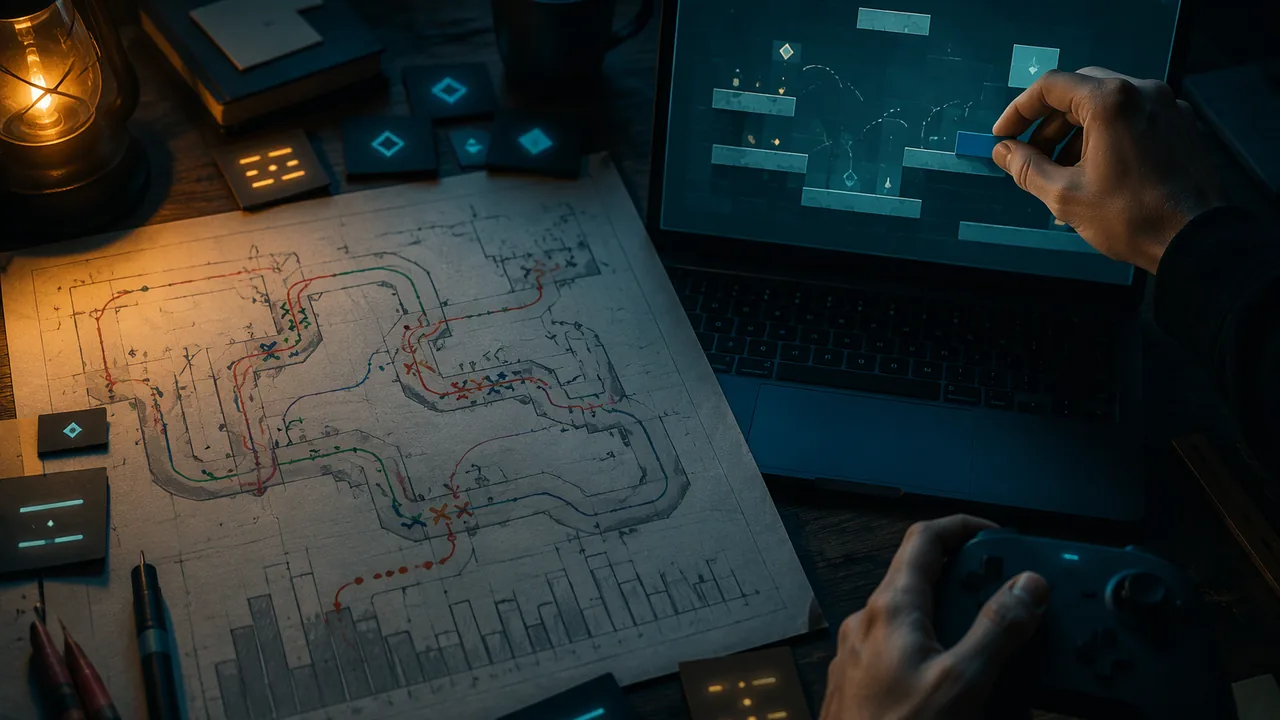
Design intent. Start on paper. Choose one mechanic your level teaches and plan the sequence: introduce it safely, test it, twist it and finish with a challenge that combines what the player learned. Draw an intensity graph and mark rests and rewards. Mark each gap and ledge with its size against your metrics. Write a one-paragraph intent statement: what the player should learn, feel and do.
Build. Build the level in Godot from your map, with checkpoints placed deliberately and the accessibility options from Lesson 2.4 in the game.
Test for behavior. Run at least four playtests using your ethical protocol, in person at home with family members or other adults you know, with a parent’s OK first for any tester under 18. If fewer than four people are available, fill the gap with structured self-playtests after a day away, marked S on the map and weighed lower. This time, record spatial data: on a printed copy of your map, mark where each tester died (X), hesitated (dot) and looked or explored (arrow). After four testers, the map shows patterns: a cluster of Xs at one gap, nobody exploring the side path, everyone hesitating at a fork. Ask each tester afterward: what did the level teach you? If their answer does not match your intent, the level taught something else.
Audit. Complete the accessibility checklist from Lesson 2.3 on your level yourself, after a day away, with the simulated constraints. A family member playing one-handed or with the sound muted can add evidence.
Revise. Make at least three revisions, including at least one for flow (pacing, difficulty or guidance) and at least one for accessibility. Tie each to evidence: “Four of five testers died at gap B, which is 5 tiles, near the metric limit, and has no warning. Revised to 4 tiles, and added a coin arc showing the landing.” Retest with at least two testers (fresh family members if possible, or a self-test after a day away, labeled S) and compare the maps.
The report (700-900 words). 1. Intent: mechanic, sequence and intended feeling, with the intensity graph. 2. Method: testers, what was recorded. 3. Findings: what the maps and answers showed. 4. Revisions, each with evidence and result. 5. Accessibility: audit results and changes. 6. Reflection: how design choices affected player motivation, such as where testers pushed on and where they gave up, and why.
Walkthrough presentation. A four-minute recording: show the before-and-after death maps, play through the revised section on screen, and explain the reasoning. Then act as your own design review: ask and answer, on the recording, the three review questions in the reading (for example, what evidence would have made you keep the original?). A family member may ask the questions instead.
📖 Read for this lesson
The reading opens over the lesson; close it to come back to exactly where you were. The checks below draw on it.
Formative check
Work through these before moving on. They are not graded — they tell you whether the standard below has landed yet.
Your death map shows eight Xs at one gap and none anywhere else. What should you check first?
Write your level’s intent statement: the mechanic it teaches, the introduce-test-twist-challenge sequence in one sentence each, and the feeling you want at the final challenge.
How confident are you that you can design, test and revise a level for flow and accessibility with evidence?
Unit 2 checkpoint
Do this before you start the task. It covers the whole unit and tells you what to review first.
What is the first step in teaching a mechanic through a level?
Good difficulty curves rise steadily with no drops, keeping intensity at its maximum.
A locked door seen before its key tells the player what to look for. This technique is…
With 32-pixel tiles, a 5-tile gap is px wide and a level 80 tiles wide needs a camera right limit of px.
Why does the checkpoint live in the GameState autoload?
In Godot 4.3 and later, TileMapLayer replaces the deprecated TileMap node.
Enemies and friends differ only by color. The best fix is…
WCAG’s threshold allows no more than flashes in any one-second period.
The 21st Century Communications and Video Accessibility Act requires in-game voice and text chat to be accessible to people with disabilities.
At Engine.time_scale 0.5, a 5-second window lasts real seconds.
Which subtitle setting best follows the lesson’s typography rules?
Submit: Level map and intensity graph + Godot level (before and after) + accessibility audit + level design report (700-900 words) + walkthrough
Task: Design a level that teaches one mechanic, build it to your metrics, test it with at least four players using death maps, audit its accessibility, make at least three evidence-based revisions and present the before and after.
Submission workflow
- Stage 1 — Plan. Paper map with metrics, intensity graph, intent statement and test plan.
- Stage 2 — Self-reviewed draft. The built level is tested by four players (family members or other adults you know, or labeled self-tests); you complete the accessibility audit and check your death-map analysis against the self-check sheet in the reading.
- Stage 3 — Revised final. Revised level, retest maps and the 700-900 word report with all attachments.
- Stage 4 — Walkthrough. Four-minute recorded walkthrough with before-and-after maps, answering the three design-review questions with evidence.
How it is scored
| Criterion | What proficient looks like |
|---|---|
| Level design (AME.D4.9) | The level teaches one mechanic through a clear introduce-test-twist-challenge sequence, with deliberate pacing and guidance. |
| Metrics and build (AME.D4.6) | Built to documented metrics; checkpoints and camera placed with purpose. |
| Testing and evidence (AME.D5.1) | Four or more ethical playtests with spatial data; findings accurately interpreted. |
| Accessibility (AME.D5.4) | Audit complete; at least one accessibility revision plus the implemented options. |
| Report (WHST.9-10.2) | Revisions tied to evidence and results; reflection on motivation specific. |
| Walkthrough (SL.9-10.4) | Clear before-and-after reasoning; questions answered with evidence. |
Level Project Brief: Intent Statement, an Invented Death Map, a Worked Revision and a Self-Check Sheet
SLS original brief; the map, tallies and revision are invented and illustrative · SLS original
Why this reading. The project asks for an intent statement, a death map from four testers, at least three evidence-based revisions and a 700 to 900 word report. This brief adds a model intent statement, an invented death-map tally with its arithmetic, a worked revision, a report word budget, a self-check sheet and the three design-review questions for your recorded walkthrough. All numbers are invented; use your own.
Model intent statement (SLS original)
Mechanic: the spring pad. Introduce: a safe pad on flat sand. Test: a pad over a netted pit. Twist: a pad over an urchin. Challenge: a two-pad chain. At the final challenge the player should feel tense but confident.
Invented death map: four testers, one level (household members and relatives; a self-test would be a column marked S)
| Spot | Tester A | Tester B | Tester C | Tester D | Total deaths |
|---|---|---|---|---|---|
| Gap B (5 tiles, no landing arc) | 3 | 2 | 2 | 1 | 8 |
| Urchin ledge | 0 | 1 | 0 | 1 | 2 |
| Pad chain | 1 | 0 | 0 | 0 | 1 |
| Side path explored | no | no | no | yes | 1 of 4 |
Total deaths = 8 + 2 + 1 = 11; Gap B holds 8 / 11 = 73% of them, and all four testers died there, so it is a pattern. Nobody but Tester D used the side path (1 of 4).
Worked revision (evidence, change, prediction, result)
Evidence: 8 of 11 deaths at Gap B, which is 5 tiles = 160 px, 85% of the 189 px limit, with no landing shown. Change: shorten to 4 tiles = 128 px (68% of the limit) and add a pearl arc over the landing. Prediction: no more than 1 death per tester. Retest with testers E and F (two relatives who had not played): 1 death and 0 deaths, a mean of 0.5 against 2.0 before (8 / 4). Accessibility revision: add a spike outline to hazards, fixing the color-only failure found in the audit.
Report word budget (total 800, inside 700 to 900)
| Section | Words |
|---|---|
| Intent and intensity graph | 100 |
| Method | 80 |
| Findings from maps and answers | 180 |
| Revisions with evidence and result | 220 |
| Accessibility | 110 |
| Reflection on motivation | 110 |
Self-check sheet (complete it yourself at Stage 2)
| Check | Note |
|---|---|
| Sequence is introduce, test, twist, challenge | |
| Every gap is marked with its size against the metric | |
| At least four testers, with X, dot and arrow marks; self-tests marked S and weighed lower | |
| Parent OK recorded for every tester under 18 | |
| At least three revisions, one for flow and one for accessibility | |
| Retest maps shown beside the originals |
Design-review questions to answer on your recorded walkthrough
- Which revision had the weakest evidence, and what would you test next to confirm it?
- What evidence would have made you keep the original design?
- Where did testers do something you did not intend, and is that a problem or a discovery?