How can the meaning of a constitutional guarantee like ‘equal protection’ change so profoundly over time without the words themselves changing?
analyze how the Court’s interpretation of equal protection and of basic freedoms changed from Plessy to Brown to Bakke, and write an analysis comparing a majority and a dissent.
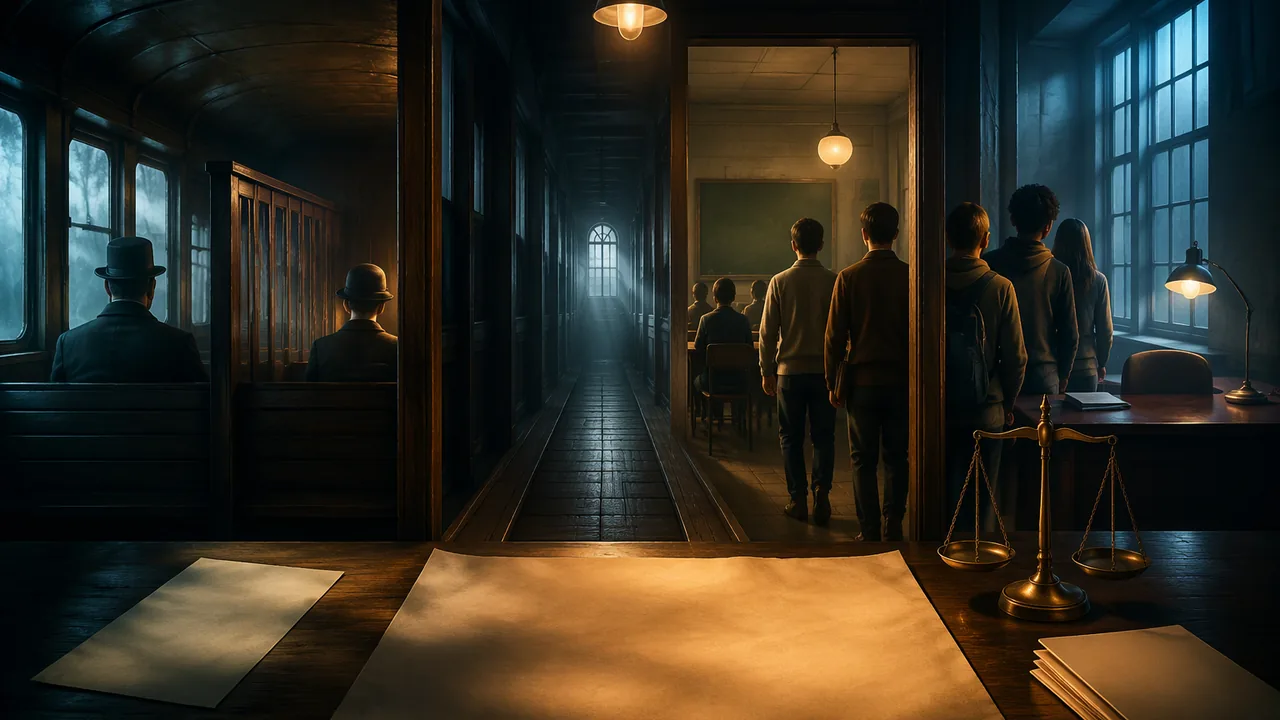
The Fourteenth Amendment (1868) guarantees every person “the equal protection of the laws.” The words have not changed since. What they have been held to mean has changed profoundly — and tracing that change is the clearest lesson in how constitutional interpretation works.
The Supreme Court’s interpretation of constitutional principles, like the equal protection clause, can profoundly change over time, demonstrating the dynamic nature of constitutional law.
📖 Read for this lesson
The reading opens over the lesson; close it to come back to exactly where you were. The checks below draw on it.
If the words of the Constitution don’t change, what factors do you think should influence how judges interpret its meaning over time?
Which later decision adopted the reasoning of Justice Harlan’s Plessy dissent for public schools?
Plessy v. Ferguson (1896)
Justice John Marshall Harlan, the lone dissenter in Plessy v. Ferguson, is often called “the Great Dissenter”; his line “Our Constitution is color-blind” was later quoted by civil rights advocates.
Louisiana required railways to provide “equal but separate” cars for Black and white passengers. Homer Plessy, who was seven-eighths white and one-eighth Black, sat in a white car to test the law and was arrested. The Court upheld the law, reasoning that segregation did not imply inferiority and that any “badge of inferiority” existed only because Black citizens chose to read it that way. Separate but equal became the constitutional basis of Jim Crow for nearly sixty years. Justice John Marshall Harlan dissented alone: “Our Constitution is color-blind.”
The Plessy doctrine permitting racial segregation if facilities were nominally equal.
In Bakke, the Court upheld the medical school’s fixed quota of sixteen places.
Brown v. Board of Education (1954)
The NAACP’s lawyers, led by Thurgood Marshall, challenged school segregation in several states. A unanimous Court, under Chief Justice Earl Warren, held that “separate educational facilities are inherently unequal,” citing evidence of segregation’s effects on children. Brown overruled Plessy for public education. Its implementation was slow and fiercely resisted, and the Court’s 1955 order to desegregate “with all deliberate speed” was used to delay for years.
Once the Supreme Court makes a decision, like ‘separate but equal,’ that ruling is the final word and cannot be changed.
Supreme Court decisions establish precedents, but later Courts can reject them if their reading of the Constitution changes, as when Brown held that “separate but equal” has no place in public education, turning away from Plessy.
Write your 500-600 word majority-dissent analysis for one case, quoting both opinions and explaining which reasoning later Courts adopted. Mark your own evaluation clearly in the final paragraph.
Two Missouri cases
Missouri sits on both sides of Brown. In Missouri ex rel. Gaines v. Canada (1938), Lloyd Gaines, a graduate of Lincoln University, was refused admission to the law school of the State University of Missouri; the state offered to pay his tuition at a law school in an adjacent state. The Court held that this was not equality, because “The admissibility of laws separating the races in the enjoyment of privileges afforded by the State rests wholly upon the equality of the privileges which the laws give to the separated groups within the State.” Gaines did not overrule Plessy; it enforced Plessy‘s own condition. In Shelley v. Kraemer (1948), from a block of Labadie Avenue in St. Louis, the Court held that “the action of the state courts cannot stand” when those courts enforced a racially restrictive property agreement.
Regents of the University of California v. Bakke (1978)
The medical school run by the Regents of the University of California reserved sixteen of one hundred places for minority applicants. Allan Bakke, a white applicant rejected twice, sued. A divided Court held that fixed racial quotas violated the law, but Justice Powell’s controlling opinion allowed race to be considered as one factor among many to pursue a diverse student body. In 2023 the Supreme Court held that race-conscious admissions programs at Harvard and the University of North Carolina violated the Equal Protection Clause.
Other landmark shifts the standards name: Miranda v. Arizona (1966) required police to warn suspects of their rights; Adarand Constructors v. Peña (1995) applied strict scrutiny to federal racial classifications; United States v. Virginia (1996) required the Virginia Military Institute to admit women. Interpretations of free speech, religion, press and assembly have shifted in similar ways — Tinker v. Des Moines (1969) protected students’ armbands against the Vietnam War: students do not “shed their constitutional rights … at the schoolhouse gate.”
The Fourteenth Amendment’s guarantee that states treat people equally under the law.
The most demanding standard of judicial review, applied to racial classifications.
Reading an opinion in context
HI.3 asks you to interpret past events within their own context rather than solely by present-day norms. That does not mean excusing Plessy; it means understanding the reasoning a majority found persuasive in 1896, so you can see precisely what later Courts rejected and why.
The workshop
Choose one case with a significant dissent. In 500-600 words, explain the question, the majority’s reasoning, the dissent’s reasoning, and which reasoning later Courts adopted — quoting both opinions. WHST.11-12.2 asks for clear, accurate explanation; your own evaluation belongs in the final paragraph, clearly marked as yours.
Key terms
An opinion by a justice who disagrees with the majority’s decision.
A prior decision that guides later cases (stare decisis).
Reading: Equal protection in three opinions
Plessy v. Ferguson, 163 U.S. 537 (1896), Harlan J., dissenting; Brown v. Board of Education, 347 U.S. 483 (1954); Regents of the University of California v. Bakke, 438 U.S. 265 (1978) · Public domain
Harlan’s dissent lost in 1896. Find the sentence Brown later vindicated.
Harlan, dissenting in Plessy: Our Constitution is color-blind, and neither knows nor tolerates classes among citizens… The arbitrary separation of citizens, on the basis of race, while they are on a public highway, is a badge of servitude wholly inconsistent with the civil freedom and the equality before the law established by the Constitution.
Brown: We conclude that, in the field of public education, the doctrine of “separate but equal” has no place. Separate educational facilities are inherently unequal.
Practice
Work these on paper or in your notebook, then open Check your answer. Aim for all of Fluency and Application; try at least one Challenge.
Printable version: this unit’s practice workbook (PDF)
Fluency
Build speed and accuracy with the core skill.
- Put in order and give the year: Brown v. Board of Education; Plessy v. Ferguson; Regents of the University of California v. Bakke; Miranda v. Arizona; Tinker v. Des Moines.
Check your answer
Answer: Plessy (1896); Brown (1954); Miranda (1966); Tinker (1969); Bakke (1978). - Define separate but equal, dissenting opinion and precedent.
Check your answer
Answer: Separate but equal: the Plessy doctrine that segregation was permitted if facilities were nominally equal. Dissenting opinion: an opinion by a justice who disagrees with the majority’s decision. Precedent: a prior decision that guides later cases (stare decisis). - What did each case hold? (a) Miranda v. Arizona; (b) United States v. Virginia; (c) Tinker v. Des Moines.
Check your answer
Answer: (a) Police must warn suspects of their rights. (b) The Virginia Military Institute had to admit women. (c) Students’ armbands protesting the Vietnam War were protected speech; students do not “shed their constitutional rights … at the schoolhouse gate.”
Application
Use the skill in context. Show your reasoning.
- Harlan, dissenting in Plessy, called segregation on a public highway “a badge of servitude.” The Plessy majority said any badge of inferiority existed only because Black citizens chose to read it that way. Explain the disagreement, and identify the sentence in Brown that later vindicated Harlan.
Check your answer
Answer: The majority treated segregation as a neutral separation whose meaning lay in the eye of the person segregated; Harlan argued its meaning was built into the law itself, as a mark of subordinate status inconsistent with equality before the law. Brown: “Separate educational facilities are inherently unequal.”A strong answer states what each opinion assumes about the meaning of segregation, and why “inherently” answers the majority’s claim. - HI.3 asks you to read Plessy in its own context without excusing it. Write two sentences that do both.
Check your answer
Answer: Model answer: In 1896 a majority of the Court read the equal protection clause as requiring only nominal equality, reasoning that reflected and reinforced the Jim Crow laws being written across the South. Understanding that reasoning shows exactly what Brown rejected, and Harlan’s dissent shows the reasoning was contested even at the time, so it cannot be explained away as simply the thinking of its era.A strong answer explains the majority’s reasoning accurately and uses the dissent as evidence that other readings were available in 1896. - Trace the law on race-conscious admissions at public universities from 1978 to 2023, using only facts from the lesson.
Check your answer
Answer: Bakke (1978): fixed racial quotas were unlawful, but Justice Powell’s controlling opinion allowed race as one factor among many to pursue a diverse student body. In 2023 the Supreme Court held that race-conscious admissions programs at Harvard and the University of North Carolina violated the Equal Protection Clause.WHST.11-12.2 rewards an accurate, neutral explanation. Evaluation of the policy, if any, belongs in a separate, clearly marked sentence. - In Missouri ex rel. Gaines v. Canada (1938), Missouri offered to pay Lloyd Gaines’s tuition at a law school in an adjacent state instead of admitting him to its state university’s law school. Use the Court’s sentence in the lesson to explain why that did not satisfy the Constitution, and why Gaines did not overrule Plessy.
Check your answer
Answer: The Court said laws separating the races are admissible only if they give the separated groups equal privileges within the State; Missouri provided a law school to white students inside the state and none to Black students, so paying for study elsewhere was not equality. The Court applied Plessy’s own test (separate must be equal) and found Missouri failed it; it did not question separation itself, which Brown did sixteen years later.A strong answer separates the narrow holding (this state failed the equality condition) from the broader question Brown answered (whether separation can ever be equal).
Review
Keep earlier skills sharp.
- Review from Unit 1: Brown applied the Fourteenth Amendment to a state’s schools. Why was the Fourteenth Amendment, not the Bill of Rights alone, the basis for limiting a state?
Check your answer
Answer: The Bill of Rights originally limited only the national government. The Fourteenth Amendment (1868) is written as a limit on states (“the equal protection of the laws”), and it is also the route by which most Bill of Rights protections have been applied to the states. - Review from Lesson 2.3: name the Chief Justice who wrote Marbury and the Chief Justice who led the unanimous Court in Brown.
Check your answer
Answer: John Marshall; Earl Warren.
Missouri sits on both sides of this story: in Missouri ex rel. Gaines v. Canada (1938) the Court held that paying a Black student’s tuition in another state was not equality, and in Shelley v. Kraemer (1948), a dispute over a block of Labadie Avenue in St. Louis, it held that state courts could not enforce racially restrictive property agreements.
Considering the evolution of interpretation from Plessy to Bakke, what are the potential benefits and drawbacks of allowing the meaning of constitutional provisions to change over time?
How confident are you that you can explain how interpretations of equal protection changed and compare a majority with a dissent?
The Shift
- Constitutional interpretation is dynamic and can change profoundly.
- Supreme Court precedents, even long-standing ones, can be overturned.
- Dissenting opinions play a crucial role in shaping future legal arguments.
Equal Protection in Six Cases: Plessy and Harlan, Gaines, Brown, Korematsu and Murphy, Shelley, Bakke
Plessy v. Ferguson, 163 U.S. 537 (1896); Korematsu v. United States, 323 U.S. 214 (1944); Brown v. Board of Education, 347 U.S. 483 (1954); Regents of the Univ. of California v. Bakke, 438 U.S. 265 (1978) — official U.S. Reports via the Library of Congress; Missouri ex rel. Gaines v. Canada, 305 U.S. 337 (1938) and Shelley v. Kraemer, 334 U.S. 1 (1948) — Legal Information Institute; Students for Fair Admissions v. Harvard, No. 20-1199 (2023) — supremecourt.gov · Public domain
Why this reading. The words of the Equal Protection Clause have not changed since 1868: “nor deny to any person within its jurisdiction the equal protection of the laws.” What they have been held to mean has changed completely. Your workshop asks you to compare a majority with a dissent and to explain which reasoning later Courts adopted. Below are the cases the lesson names, each in longer extract than a textbook gives: the Plessy majority with Harlan’s dissent; Brown; Korematsu with Murphy’s dissent and Jackson’s warning; and Justice Powell’s controlling opinion in Bakke. Two Missouri cases, Missouri ex rel. Gaines v. Canada (1938) and Shelley v. Kraemer (1948), come at the end because they connect Plessy to Brown and show the Fourteenth Amendment reaching property. Texts are taken from the official U.S. Reports and, for the two Missouri cases, from the Legal Information Institute. What to look for: in every pair, find the sentence where the two opinions stop disagreeing about law and start disagreeing about a fact in the world.
1. Plessy v. Ferguson (1896): the majority
Louisiana required railways to provide “equal but separate” accommodations. Homer Plessy, who was seven-eighths white, boarded a white car to test the statute and was arrested. The Court upheld the law.
We consider the underlying fallacy of the plaintiff’s argument to consist in the assumption that the enforced separation of the two races stamps the colored race with a badge of inferiority. If this be so, it is not by reason of anything found in the act, but solely because the colored race chooses to put that construction upon it. The argument necessarily assumes that if, as has been more than once the case, and is not unlikely to be so again, the colored race should become the dominant power in the state legislature, and should enact a law in precisely similar terms, it would thereby relegate the white race to an inferior position. We imagine that the white race, at least, would not acquiesce in this assumption.
That is the whole doctrine in one paragraph: segregation is a neutral separation, and its insulting meaning exists only in the mind of the person segregated. The majority went on to say that social prejudices cannot be overcome by legislation and that equality before the law is all a government owes. “Separate but equal” governed American law for fifty-eight years.
Harlan, dissenting in Plessy — alone
The white race deems itself to be the dominant race in this country. And so it is, in prestige, in achievements, in education, in wealth and in power. So, I doubt not, it will continue to be for all time, if it remains true to its great heritage and holds fast to the principles of constitutional liberty. But in view of the Constitution, in the eye of the law, there is in this country no superior, dominant, ruling class of citizens. There is no caste here. Our Constitution is color-blind, and neither knows nor tolerates classes among citizens. In respect of civil rights, all citizens are equal before the law. The humblest is the peer of the most powerful. The law regards man as man, and takes no account of his surroundings or of his color when his civil rights as guaranteed by the supreme law of the land are involved. It is, therefore, to be regretted that this high tribunal, the final expositor of the fundamental law of the land, has reached the conclusion that it is competent for a State to regulate the enjoyment by citizens of their civil rights solely upon the basis of race.
In my opinion, the judgment this day rendered will, in time, prove to be quite as pernicious as the decision made by this tribunal in the Dred Scott case.
[…] The arbitrary separation of citizens, on the basis of race, while they are on a public highway, is a badge of servitude wholly inconsistent with the civil freedom and the equality before the law established by the Constitution. It cannot be justified upon any legal grounds.
Read Harlan’s first four sentences carefully. He is not claiming that white supremacy is untrue as a social fact; he asserts it and expects it to continue. His claim is that the law may not know it. That is a narrower and harder argument than the phrase “color-blind” on its own suggests, and both sides of today’s arguments about race-conscious policy quote him.
2. Brown v. Board of Education (1954)
A unanimous Court, Chief Justice Warren writing:
We come then to the question presented: Does segregation of children in public schools solely on the basis of race, even though the physical facilities and other “tangible” factors may be equal, deprive the children of the minority group of equal educational opportunities? We believe that it does.
[…] To separate them from others of similar age and qualifications solely because of their race generates a feeling of inferiority as to their status in the community that may affect their hearts and minds in a way unlikely ever to be undone. The effect of this separation on their educational opportunities was well stated by a finding in the Kansas case by a court which nevertheless felt compelled to rule against the Negro plaintiffs:
“Segregation of white and colored children in public schools has a detrimental effect upon the colored children. The impact is greater when it has the sanction of the law; for the policy of separating the races is usually interpreted as denoting the inferiority of the negro group. A sense of inferiority affects the motivation of a child to learn. Segregation with the sanction of law, therefore, has a tendency to [retard] the educational and mental development of negro children and to deprive them of some of the benefits they would receive in a racial[ly] integrated school system.”
Whatever may have been the extent of psychological knowledge at the time of Plessy v. Ferguson, this finding is amply supported by modern authority. Any language in Plessy v. Ferguson contrary to this finding is rejected.
We conclude that in the field of public education the doctrine of “separate but equal” has no place. Separate educational facilities are inherently unequal. Therefore, we hold that the plaintiffs and others similarly situated for whom the actions have been brought are, by reason of the segregation complained of, deprived of the equal protection of the laws guaranteed by the Fourteenth Amendment.
This is the sentence that vindicates Harlan, and notice how the Court reaches it. The Plessy majority had made a factual claim — that the badge of inferiority is only in the mind of the person segregated. Brown answers it with a factual finding, quoted from a trial court that had ruled the other way, and with the social-science evidence cited in its famous footnote 11. The legal text did not change; the Court’s account of what segregation does changed.
Brown‘s implementation was another matter. In 1955 the Court ordered desegregation “with all deliberate speed,” a formula used across the South to delay for years.
3. Korematsu v. United States (1944): a second majority–dissent pair
Fred Korematsu, an American citizen, was convicted of remaining in a military area on the West Coast from which all persons of Japanese ancestry had been excluded. The Court upheld the conviction — and, in doing so, announced the standard later used to strike such laws down.
It should be noted, to begin with, that all legal restrictions which curtail the civil rights of a single racial group are immediately suspect. That is not to say that all such restrictions are unconstitutional. It is to say that courts must subject them to the most rigid scrutiny. Pressing public necessity may sometimes justify the existence of such restrictions; racial antagonism never can.
Justice Murphy, dissenting:
This exclusion of “all persons of Japanese ancestry, both alien and non-alien,” from the Pacific Coast area on a plea of military necessity in the absence of martial law ought not to be approved. Such exclusion goes over “the very brink of constitutional power” and falls into the ugly abyss of racism.
[…] it is essential that there be definite limits to military discretion, especially where martial law has not been declared. Individuals must not be left impoverished of their constitutional rights on a plea of military necessity that has neither substance nor support. Thus, like other claims conflicting with the asserted constitutional rights of the individual, the military claim must subject itself to the judicial process of having its reasonableness determined and its conflicts with other interests reconciled.
I dissent, therefore, from this legalization of racism. Racial discrimination in any form and in any degree has no justifiable part whatever in our democratic way of life. It is unattractive in any setting but it is utterly revolting among a free people who have embraced the principles set forth in the Constitution of the United States.
Justice Jackson, dissenting — on what it costs a court to approve such an order:
A military order, however unconstitutional, is not apt to last longer than the military emergency. […] But once a judicial opinion rationalizes such an order to show that it conforms to the Constitution, or rather rationalizes the Constitution to show that the Constitution sanctions such an order, the Court for all time has validated the principle of racial discrimination in criminal procedure and of transplanting American citizens. The principle then lies about like a loaded weapon ready for the hand of any authority that can bring forward a plausible claim of an urgent need. Every repetition imbeds that principle more deeply in our law and thinking and expands it to new purposes.
Korematsu is the sharpest majority–dissent pair in the canon precisely because the majority states the right rule and then does not apply it. Congress formally apologized and provided redress in the Civil Liberties Act of 1988; Korematsu’s own conviction was vacated by a federal district court in 1984 on the ground that the government had withheld evidence from the Supreme Court.
4. Regents of the University of California v. Bakke (1978)
The medical school run by the Regents of the University of California set aside sixteen of one hundred places for minority applicants. Allan Bakke, rejected twice, sued. The Court split; Justice Powell’s opinion controlled the outcome, striking the set-aside while allowing race to be considered:
In such an admissions program, race or ethnic background may be deemed a “plus” in a particular applicant’s file, yet it does not insulate the individual from comparison with all other candidates for the available seats. The file of a particular black applicant may be examined for his potential contribution to diversity without the factor of race being decisive when compared, for example, with that of an applicant identified as an Italian-American if the latter is thought to exhibit qualities more likely to promote beneficial educational pluralism. […] In short, an admissions program operated in this way is flexible enough to consider all pertinent elements of diversity in light of the particular qualifications of each applicant, and to place them on the same footing for consideration, although not necessarily according them the same weight.
[…] The diversity that furthers a compelling state interest encompasses a far broader array of qualifications and characteristics of which racial or ethnic origin is but a single though important element. Petitioner’s special admissions program, focused solely on ethnic diversity, would hinder rather than further attainment of genuine diversity.
So the lesson’s true/false check is false: the fixed set-aside was struck down, and Powell’s opinion permitted race only as one factor among many. In 2023 the Supreme Court decided Students for Fair Admissions v. President and Fellows of Harvard College (decided June 29, 2023, together with a companion case about the University of North Carolina) and held that the race-conscious admissions programs at the two schools violated the Equal Protection Clause.
5. Missouri ex rel. Gaines v. Canada (1938)
Lloyd Gaines, a Missouri citizen and a graduate of Lincoln University, the state’s institution for Black students, was refused admission to the School of Law of the State University of Missouri because of his race. Lincoln University had no law school, and Missouri offered to pay his tuition at a law school in an adjacent state. The Supreme Court held that this did not satisfy the Fourteenth Amendment. The Court’s test is a clear statement of what “separate but equal” required, applied to a state that claimed to be meeting it:
The admissibility of laws separating the races in the enjoyment of privileges afforded by the State rests wholly upon the equality of the privileges which the laws give to the separated groups within the State.
Notice that the Court did not overrule Plessy; it enforced Plessy‘s own condition of equality, and found that Missouri had not met it. That is why Gaines is read as a step on the road to Brown, sixteen years later.
6. Shelley v. Kraemer (1948)
A 1911 agreement among property owners on Labadie Avenue in St. Louis barred occupancy by anyone not of the “Caucasian race.” The Shelley family, who are Black, bought a house on the block in 1945, and neighbors sued in the St. Louis Circuit Court to remove them. The trial court refused, ruling that the agreement had never become final because not every owner had signed it; the Supreme Court of Missouri reversed and enforced the agreement. The United States Supreme Court reversed that judgment on May 3, 1948:
We hold that in granting judicial enforcement of the restrictive agreements in these cases, the States have denied petitioners the equal protection of the laws and that, therefore, the action of the state courts cannot stand.
Ask which words of the Fourteenth Amendment restrained the Missouri courts, and why a private agreement could not be enforced by a state court even though the amendment says “No State.”
Writing the comparison
A good majority–dissent analysis does four things, in this order. State the question the case put — not the topic, the question. Quote each opinion on the point where they diverge, not on their rhetorical high points. Name the kind of disagreement: is it about the meaning of a clause, about a fact in the world, or about who should decide? Plessy and Harlan disagree about a fact; Korematsu‘s majority and Murphy disagree about who should decide and on what evidence. Then say which reasoning later Courts adopted, with the later case named. Keep your own evaluation clearly marked in the final paragraph, and when you read an opinion like Plessy in its own context, do both things at once: explain the reasoning as its authors meant it, and note that Harlan, writing the same week, shows that the reasoning was contested at the time and so cannot be excused as merely the thinking of its era.
Sources: Plessy v. Ferguson, 163 U.S. 537 (1896), official U.S. Reports (tile.loc.gov); Brown v. Board of Education, 347 U.S. 483 (1954), official U.S. Reports (tile.loc.gov); Korematsu v. United States, 323 U.S. 214 (1944), official U.S. Reports (tile.loc.gov); Regents of the University of California v. Bakke, 438 U.S. 265 (1978), official U.S. Reports (tile.loc.gov); Missouri ex rel. Gaines v. Canada, 305 U.S. 337 (1938) (Legal Information Institute) (law.cornell.edu); Shelley v. Kraemer, 334 U.S. 1 (1948) (Legal Information Institute) (law.cornell.edu); Students for Fair Admissions v. President and Fellows of Harvard College, No. 20-1199 (2023), slip opinion (Supreme Court of the United States) (supremecourt.gov)