When a government decision is made, how can we tell whom it affects, what it was meant to do and what it actually did, and what do the election returns tell us about who wanted it?
analyze how a Missouri law and the process around it affected individuals and groups, evaluate its intended and unintended effects, distinguish the powers and responsibilities of citizens and institutions, predict consequences when institutions or individuals fail to act, and analyze state and federal election results for regional and demographic patterns.
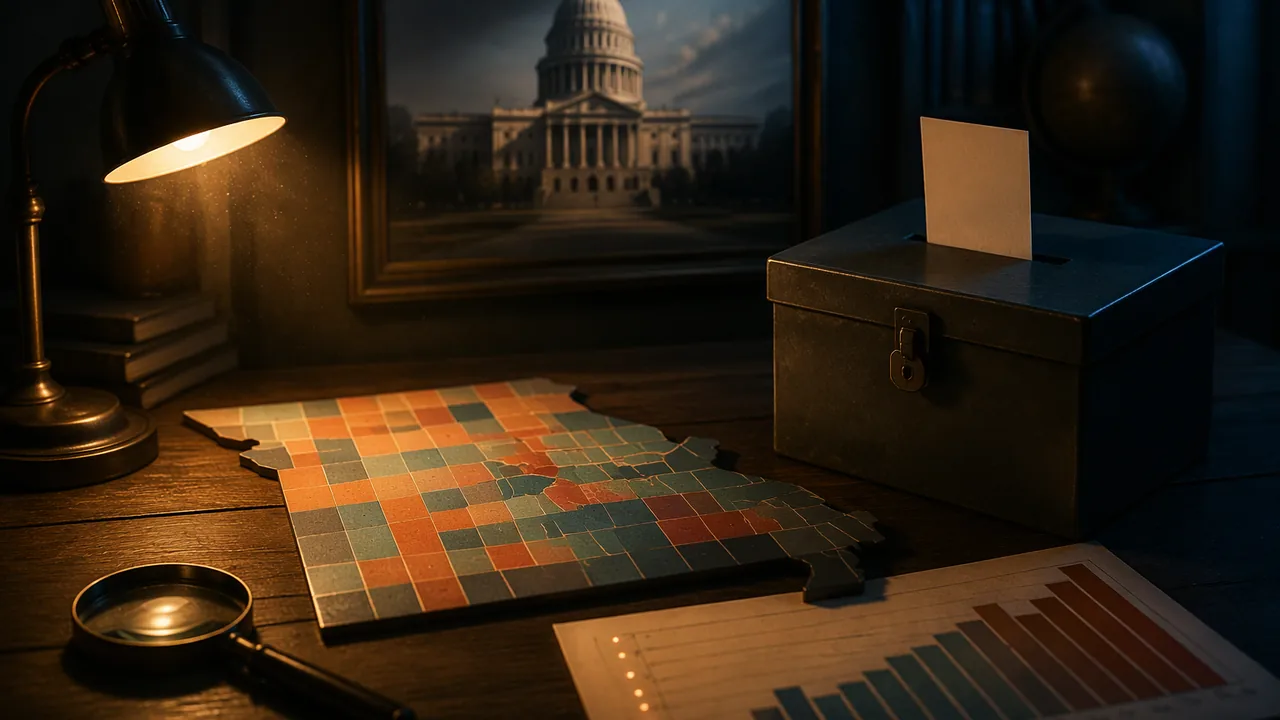
Earlier units showed how laws are made. This lesson asks what happens after: who is affected, what was intended, what was not, what happens when an institution does not deliver, and what election returns reveal about who wanted the decision. One Missouri case runs through the whole lesson, told from official records only. It is a study of process, not an argument for or against the policy.
Following one decision from ballot to court shows that every actor holds a distinct power, that decisions have effects no one wrote down, that failures by institutions push people toward other institutions, and that official election returns reveal regional patterns but not how individuals voted.
📖 Read for this lesson
The reading opens over the lesson; close it to come back to exactly where you were. The checks below draw on it.
Which actor in the case had the most power to decide the outcome, and which had the most responsibility?
Missouri standard: 9-12.GV.1.GS.A
Who was directly affected by Article IV, Section 36(c) as written?
The case: MO HealthNet expansion, 2020–2021
About 1.27 million votes were cast on Amendment 2 in the August 2020 primary, compared with about 3.03 million votes for president that November.
Medicaid is a federal–state health program; in Missouri it is called MO HealthNet. Before 2021, the Missouri Supreme Court later summarized, it covered only certain groups of low-income Missourians, such as people who are aged, blind or disabled, pregnant women, children and their custodial parents. Citizens then used a power the Missouri Constitution reserves to them in Article III, Section 49: “The people reserve power to propose and enact or reject laws and amendments to the constitution by the initiative, independent of the general assembly.” An initiative petition put Constitutional Amendment No. 2 on the August 4, 2020 ballot. The Secretary of State’s official results: 676,687 yes (53.3%) to 593,491 no (46.7%).
Missouri’s name for its Medicaid program, the federal-state health coverage program for eligible low-income people.
A petition signed by voters that places a proposed law or constitutional amendment on the ballot without the General Assembly (Mo. Const. Art. III, secs. 49-50).
Missouri standard: 9-12.GV.3.PC.B
Which of these was an unplanned consequence of the 2020 vote rather than an effect written in the amendment?
What the decision said it would do
The amendment, now Article IV, Section 36(c), says that beginning July 1, 2021, adults 19 to 64 with income “at or below one hundred thirty-three percent of the federal poverty level plus five percent” (138% in all) “shall be eligible for medical assistance under MO HealthNet.” It ordered the Department of Social Services to file the federal paperwork by March 1, 2021. The Supreme Court noted an estimate that the new group “could include more than 275,000 Missourians.” Those are the intended effects.
Once voters approve a measure, it takes effect exactly as written.
Approval begins a process: the agency must act, the legislature controls funding, and courts may have to decide what the measure requires before people feel its effects.
Missouri standard: 9-12.GV.1.GS.B
In this case, Missouri citizens used three different powers: the initiative petition, the vote, and a lawsuit in state court.
What happened next
The department filed its plan on time. Then the General Assembly, which controls appropriations, rejected separate funding lines for the expansion and passed MO HealthNet budget bills that did not mention Section 36(c); the department withdrew its plan. Three eligible Missourians sued. The Cole County circuit court ruled the amendment invalid under Article III, Section 51, which says an initiative “shall not be used for the appropriation of money other than of new revenues created and provided for thereby.” On July 22, 2021, the Missouri Supreme Court unanimously disagreed: the amendment “does not appropriate money and does not remove the General Assembly’s discretion,” and since the legislature had funded MO HealthNet, the department had to serve everyone the Constitution made eligible. Notice the consequences no ballot listed: a funding conflict between branches, a delay past the July 1 start, a lawsuit and a court ruling on the limits of the initiative power. Those are unintended or at least unplanned effects.
A law that sets aside public money for a purpose; in Missouri the General Assembly holds this power, and an initiative may not appropriate money without new revenue.
Missouri standard: 9-12.GV.4.PC.C
Based on this case, what is the most likely consequence when an institution does not meet the needs of a group of people?
Powers and responsibilities
Each actor had a distinct power. Citizens could petition, vote and sue. The General Assembly holds the power of the purse. The department carries out the law. Courts decide what the constitution means. When one institution does not meet people’s needs, the predictable consequences are pressure on another: citizens turn to the initiative, people who are not served turn to the courts, and conflicts between branches grow. Individuals have responsibilities too, and voting is the clearest. In the August primary, 1,270,178 votes were cast on Amendment 2; three months later 3,025,962 votes were cast for president. About 58 percent fewer Missourians decided the constitutional question than chose a president.
Missouri standard: 9-12.GV.4.G.A
Jasper County is 76.5% urban but voted 33.6% yes. What is the best conclusion?
Reading the election map
Amendment 2 carried only 8 of Missouri’s 115 counties and independent city (counting Kansas City with Jackson County): St. Louis City, St. Louis County, Jackson, Boone, Platte, Clay, Greene and St. Charles. It passed because those places hold many voters. Comparing official returns with the 2020 Census share of each county’s population living in urban areas shows a strong pattern: in the ten most urban jurisdictions, 67.8% voted yes; in the 58 least urban (under 25% urban), 30.5% did. But patterns are not destiny. Jasper County in southwest Missouri is 76.5% urban yet voted 33.6% yes, so region matters alongside density. A careful analyst names the pattern, the exceptions and what the data cannot show: county totals do not tell you how any individual or group within a county voted.
The certified vote counts published by the Missouri Secretary of State after canvassing.
Key terms
A result a law or decision was designed to produce, usually stated in its text.
A result no one wrote into the decision, such as a conflict, delay or new court ruling.
The number or share of eligible people who vote in an election.
The error of assuming that a pattern in group totals (such as county results) tells you how individuals voted.
Check your understanding
Not graded: these tell you whether the standard has landed yet.
Missouri standard: 9-12.GV.1.GS.A, 9-12.GV.3.PC.B, 9-12.GV.1.GS.B, 9-12.GV.4.PC.C, 9-12.GV.4.G.A
Write your one-page case analysis: (1) the actors and the power each used; (2) two intended and two unintended effects, each with a quoted source; (3) a prediction of what happens when an institution fails to act, and when citizens do not vote. Add a chart of at least eight jurisdictions from the reading’s table (yes share against urban share) and two sentences on what the chart shows and cannot show, including the August versus November turnout. Take no side on the policy. Record it as a 2-minute audio or video briefing (a family member may listen) and paste your script here.
Practice
Work these on paper or in your notebook, then open Check your answer. Aim for all of Fluency and Application; try at least one Challenge.
Printable version: this unit’s practice workbook (PDF)
Fluency
Build speed and accuracy with the core skill.
- What does Article IV, Section 36(c) of the Missouri Constitution make adults aged 19 to 64 eligible for, at what income level, and from what date?
Check your answer
Answer: Medical assistance under MO HealthNet, for income at or below 133% of the federal poverty level plus 5% (138% in all), beginning July 1, 2021. - Which section of the Missouri Constitution reserves the initiative to the people, and which limits it on spending?
Check your answer
Answer: Article III, Section 49 reserves the power to propose and enact laws and amendments by initiative; Article III, Section 51 says the initiative may not appropriate money other than new revenues it creates. - Official results, August 4, 2020: Amendment 2 received 676,687 yes and 593,491 no. Compute the total and the yes share.
Check your answer
Answer: Total 1,270,178; yes share 676,687 / 1,270,178 = 53.3%.
Application
Use the skill in context. Show your reasoning.
- List four actors in the MO HealthNet case and the power each used.
Check your answer
Answer: Citizens: initiative petition and vote (Art. III, Sec. 49). General Assembly: appropriation (it funded MO HealthNet without separate lines for the expansion). Department of Social Services: administration (it filed, then withdrew, the state plan amendment). Courts: interpretation (the Supreme Court ruled the amendment valid and the department had authority to serve the new group). Also acceptable: the three plaintiffs, who used the power to sue. - Give two intended and two unintended (unplanned) effects of the 2020 decision, and say how you can tell which is which.
Check your answer
Answer: Intended (written in Section 36(c)): eligibility for adults 19-64 at or below 138% of poverty; a July 1, 2021 start and a March 1, 2021 filing deadline. Unplanned: a funding conflict with the General Assembly and the withdrawal of the state plan; a lawsuit and a Supreme Court ruling on the limits of the initiative power; a delay past July 1. Test: intended effects are stated in the decision’s text; unplanned ones appear only in later records. - Predict: if a state agency does not carry out a measure the voters approved, what are two likely consequences? Then predict one consequence when many eligible voters do not take part.
Check your answer
Answer: Likely: the people affected sue to make the agency act, and conflict grows between branches (as in Doyle v. Tidball). When many voters do not take part, a smaller group decides questions for everyone: about 1.27 million votes decided Amendment 2 in August 2020, compared with about 3.03 million votes for president that November. - St. Louis City, St. Louis County and Jackson County (with Kansas City) cast 339,340 yes and 109,314 no on Amendment 2. Statewide it was 676,687 yes and 593,491 no. What were the totals and yes share in the rest of Missouri, and what does that show?
Check your answer
Answer: Rest of Missouri: 676,687 – 339,340 = 337,347 yes; 593,491 – 109,314 = 484,177 no; yes share 337,347 / 821,524 = 41.1%. The amendment lost outside the three largest urban jurisdictions and passed statewide because of their large margins: a regional pattern in the returns.Check: 337,347 + 484,177 = 821,524. The point is about places, not individuals; county totals cannot show how any one group voted. - Jasper County (76.5% urban) voted 33.6% yes; Boone County (77.2% urban) voted 66.6% yes. Write two sentences an honest analyst could publish about urban share and the vote.
Check your answer
Answer: Across Missouri, more urban jurisdictions voted yes at much higher rates (67.8% in the ten most urban, 30.5% in the 58 least urban). But Jasper and Boone are almost equally urban and voted very differently, so region and other characteristics also matter, and county totals cannot tell us how individuals voted.
Review
Keep earlier skills sharp.
- Unit 3 review: name the two kinds of direct democracy in Article III, Section 49 and say which one the 2020 MO HealthNet amendment used.
Check your answer
Answer: The initiative (proposing and enacting laws or amendments) and the referendum (approving or rejecting acts of the General Assembly). The 2020 amendment used the initiative. - Unit 4 review: why is a primary-election ballot measure likely to be decided by fewer voters than a measure on a November presidential ballot?
Check your answer
Answer: Turnout is usually lower in primaries than in presidential general elections; in Missouri in 2020, 1,270,178 votes were cast on Amendment 2 in August, about 42% of the 3,025,962 cast for president in November.
Every Missouri statewide ballot measure is reported by county on the Secretary of State’s website, so any Missourian can repeat this lesson’s analysis for a new election.
What would you want to know, beyond county totals, before claiming that a particular group of people voted one way?
How confident are you that you can analyze a Missouri decision’s effects and the actors’ powers, and read official election returns for regional patterns?
The Shift
- Laws affect specific groups, and their effects include intended and unintended ones.
- Citizens and institutions each hold distinct powers and responsibilities to solve problems.
- Election returns show regional and demographic patterns, which must be read with their limits.
A Missouri Decision From Ballot to Court, and the Election Map
Missouri Constitution, Article III, secs. 49 and 51, and Article IV, sec. 36(c), via the Missouri Revisor of Statutes; Doyle v. Tidball, No. SC99185 (Mo. banc July 22, 2021), opinion PDF; Missouri Secretary of State, Official Results, Primary Election August 4, 2020 (county returns) and 2020 General Election results; U.S. Census Bureau, 2020 Census Urban and Rural county file (2020_UA_COUNTY.xlsx); retrieved 2026-11-16; group totals and shares computed from these files · Public domain (Missouri and U.S. government works and court opinion)
Why this reading. The lesson follows one Missouri decision from the ballot to the state Supreme Court, then reads the election map. Everything here is official text or official numbers: the Missouri Constitution, the Supreme Court’s opinion and the Secretary of State’s returns, with Census data for the urban comparison. It takes no position on the policy. What to look for: which actor used which power, and which effects were written into the decision and which were not.
1. The power the citizens used
Missouri Constitution, Article III, Section 49: The people reserve power to propose and enact or reject laws and amendments to the constitution by the initiative, independent of the general assembly, and also reserve power to approve or reject by referendum any act of the general assembly, except as hereinafter provided.
Missouri Constitution, Article III, Section 51: The initiative shall not be used for the appropriation of money other than of new revenues created and provided for thereby, or for any other purpose prohibited by this constitution.
2. What the voters approved: Article IV, Section 36(c)
Section 36(c).1: Notwithstanding any provision of law to the contrary, beginning July 1, 2021, individuals nineteen years of age or older and under sixty-five years of age who qualify for MO HealthNet services … and who have income at or below one hundred thirty-three percent of the federal poverty level plus five percent of the applicable family size … shall be eligible for medical assistance under MO HealthNet and shall receive coverage for the health benefits service package.
Section 36(c).3: No later than March 1, 2021, the Department of Social Services and the MO HealthNet Division shall submit all state plan amendments necessary to implement this section to the United States Department of Health and Human Services, Centers for Medicare and Medicaid Services.
3. The vote (official results, August 4, 2020)
Constitutional Amendment No. 2: Yes 676,687 (53.3%), No 593,491 (46.7%), 1,270,178 votes in all, 3,575 of 3,575 precincts reported. For comparison, at the November 3, 2020 general election, 3,025,962 votes were cast for President and Vice President, a federal race; the August total was about 42% of that.
4. What happened next: Doyle v. Tidball, No. SC99185 (Mo. banc, July 22, 2021)
The Supreme Court of Missouri decided the case per curiam (as a whole court), and the opinion ends “All concur.” Its background section, quoted:
Background: For Fiscal Year 2021, Medicaid, known in Missouri as MO HealthNet, provided health care benefits only for certain categories of low-income Missourians such as those receiving state supplement payments for the aged, blind, and disabled; pregnant women; children under age 19; their custodial parents; and those who are 65 and older. … It is estimated this new category could include more than 275,000 Missourians.
Background: DSS timely submitted a state plan amendment to the federal government to comply with the requirements of article IV, section 36(c), anticipating the General Assembly would appropriate sufficient monies to fund Medicaid expansion. The General Assembly then considered and rejected several recommendations for separate line-item funding for Medicaid expansion and, in the end, it appropriated money for MO HealthNet in appropriation bills that did not reference article IV, section 36(c). As a result, DSS withdrew its proposed state plan amendment.
Holding: Because article IV, section 36(c) does not appropriate money and does not remove the General Assembly’s discretion in appropriating money to MO HealthNet, the circuit court erred in declaring article IV, section 36(c) constitutionally invalid.
Conclusion of the reasoning: Consequently, DSS has appropriation authority to provide services for all individuals eligible for MO HealthNet, including individuals eligible for coverage and services pursuant to article IV, section 36(c).
The circuit court (Cole County) had ruled for the department. The Supreme Court vacated that judgment, except for a ruling on who could join the suit, and sent the case back for judgment for the three plaintiffs.
5. The election map: selected jurisdictions
Official county returns from the Secretary of State, with each jurisdiction’s urban population share from the U.S. Census Bureau’s 2020 urban and rural county file. Kansas City reports its votes separately from Jackson County; the two are combined here so that every row matches a Census county. Missouri has 114 counties and the independent City of St. Louis, 115 jurisdictions in all. Amendment 2 won a majority in 8 of them: St. Louis City, St. Louis County, Jackson, Boone, Platte, Clay, Greene and St. Charles. 47 jurisdictions have no urban population at all in the Census file.
| Jurisdiction | Yes | No | Yes share | Urban population share (2020 Census) |
|---|---|---|---|---|
| St. Louis City | 65,741 | 8,603 | 88.4% | 100.0% |
| Jackson County (incl. Kansas City) | 90,701 | 32,481 | 73.6% | 95.7% |
| St. Louis County | 182,898 | 68,230 | 72.8% | 98.6% |
| Boone County | 23,708 | 11,895 | 66.6% | 77.2% |
| Platte County | 12,570 | 7,811 | 61.7% | 86.4% |
| Clay County | 26,478 | 18,010 | 59.5% | 91.9% |
| Greene County | 27,906 | 25,397 | 52.4% | 85.9% |
| St. Charles County | 40,382 | 38,177 | 51.4% | 94.3% |
| Buchanan County | 6,988 | 7,408 | 48.5% | 86.3% |
| Cole County | 7,415 | 11,321 | 39.6% | 65.7% |
| Jasper County | 5,782 | 11,404 | 33.6% | 76.5% |
| Cape Girardeau County | 5,527 | 11,759 | 32.0% | 67.8% |
| Phelps County | 3,402 | 5,358 | 38.8% | 46.2% |
| Adair County | 1,941 | 3,037 | 39.0% | 66.5% |
| Dunklin County | 1,322 | 3,042 | 30.3% | 37.3% |
| Atchison County | 546 | 1,080 | 33.6% | 0.0% |
| Ozark County | 897 | 2,150 | 29.4% | 0.0% |
| Wayne County | 802 | 2,269 | 26.1% | 0.0% |
| Knox County | 237 | 666 | 26.2% | 0.0% |
| Missouri | 676,687 | 593,491 | 53.3% | — |
All 115 jurisdictions, grouped by urban share (sums of the official county returns)
| Group (by 2020 Census urban share) | Jurisdictions | Yes votes | Total votes | Yes share |
|---|---|---|---|---|
| 75% urban or more | 10 | 483,154 | 712,570 | 67.8% |
| 50% to under 75% | 16 | 73,820 | 187,871 | 39.3% |
| 25% to under 50% | 31 | 67,169 | 197,446 | 34.0% |
| Under 25% urban | 58 | 52,544 | 172,291 | 30.5% |
| All | 115 | 676,687 | 1,270,178 | 53.3% |
Reading the numbers carefully. Across all 115 jurisdictions, the yes share and the urban share are strongly related (correlation about 0.67), but not perfectly: Jasper County in southwest Missouri is more urban than Boone County yet voted 33.6% yes, against Boone’s 66.6%. County totals describe places, not people; they cannot show how any individual or group inside a county voted.
Sources: Missouri Constitution, Article III, Section 49 (Revisor of Statutes) (revisor.mo.gov); Missouri Constitution, Article III, Section 51 (Revisor of Statutes) (revisor.mo.gov); Missouri Constitution, Article IV, Section 36(c) (Revisor of Statutes) (revisor.mo.gov); Doyle v. Tidball, No. SC99185 (Mo. banc 2021), opinion (affordablecareactlitigation.com); Missouri SOS, Official Results by county, Primary Election August 4, 2020 (sos.mo.gov); Missouri SOS, All Results, Primary Election August 4, 2020 (sos.mo.gov); Missouri SOS, 2020 General Election results (sos.mo.gov); U.S. Census Bureau, 2020 Urban and Rural county file (www2.census.gov)