How can an individual citizen’s voice make a difference in Missouri’s lawmaking process?
research a current Missouri bill or ballot measure, and write and deliver public testimony that takes a position supported by evidence and answers the opposition.
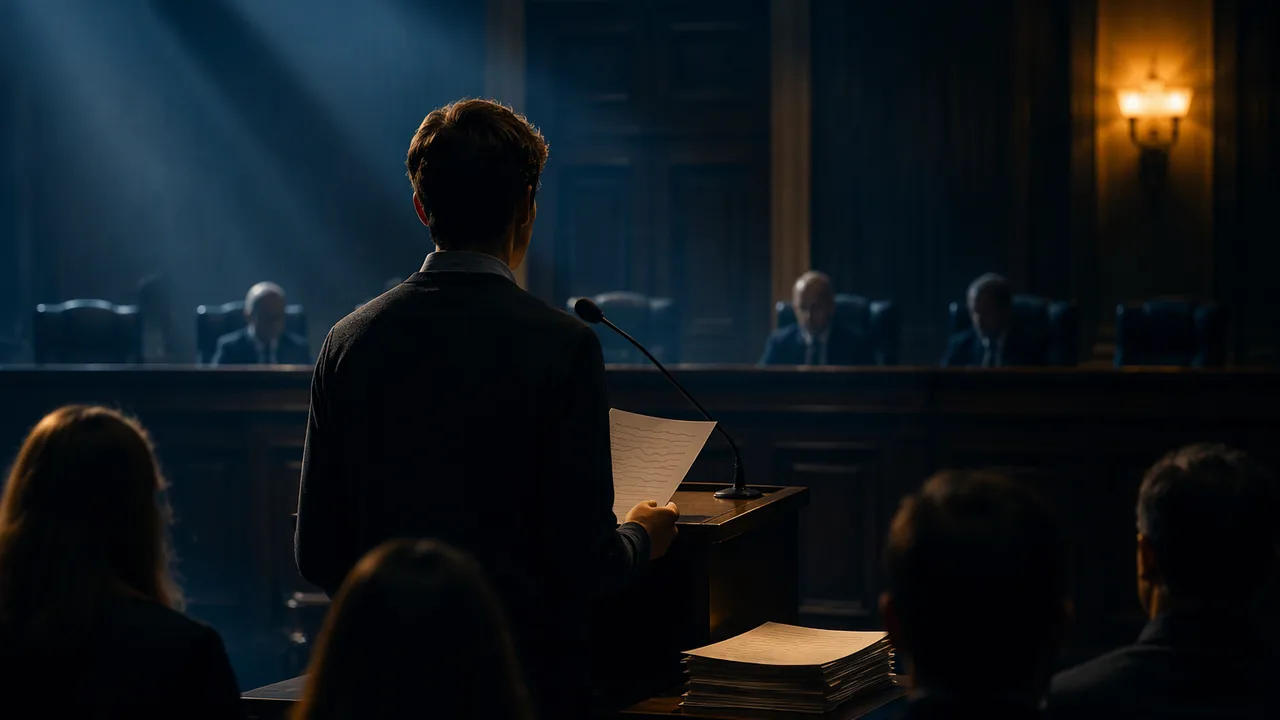
Testifying at a hearing is one of the most direct ways a citizen can take part in lawmaking, and the standard names it: citizens participate by voting, campaigning, lobbying, filing legal challenges, demonstrating, petitioning and more. Committees of the Missouri House and Senate in Jefferson City, city councils and county governing bodies all take public comment. This task prepares you to do it.
Providing evidence-based public testimony is a direct and effective way for citizens to take part in shaping Missouri law.
📖 Read for this lesson
The reading opens over the lesson; close it to come back to exactly where you were. The checks below draw on it.
What responsibilities come with the opportunity to directly influence lawmaking?
reserved powers
Tap to revealPowers kept by the states (Tenth Amendment).
Supremacy Clause
Tap to revealValid federal law prevails over conflicting state law.
initiative
Tap to revealVoters propose and enact laws by petition and ballot.
retention election
Tap to revealVoters decide whether an appointed judge stays.
regulation
Tap to revealAn agency rule implementing a statute.
Choose the proposal
Missouri House rules give the sponsor, proponents, opponents and those testifying for information “a reasonable opportunity to be heard,” and written testimony can be submitted online through the House witness form until midnight on the day the hearing adjourns.
Find a bill currently before the General Assembly on house.mo.gov or senate.mo.gov, or a measure headed for the statewide ballot on the Secretary of State’s site. Choose one that affects people your age or your community, and that you can understand fully. If the General Assembly is not in session, choose a bill from an earlier session, whose text, fiscal note and hearing record remain online.
You have two minutes of public comment and 900 words of testimony. What should you do?
Research
Answer, with sources: What would it do? Which level and branch of government would carry it out, and would it require rules under Chapter 536? What does the fiscal note say about its cost? Who supports it and who opposes it, and why? The House committee’s minute book records the proponents, opponents and informational witnesses who appeared — a primary source for the politics of the bill.
The testimony (800-1,000 words)
Address the committee formally. State who you are and your position in the first sentence. Give your reasons, supported by evidence — data, the fiscal note, testimony from people affected. Address the strongest opposing argument fairly (WHST.11-12.1.b): committees hear from both sides, and testimony that ignores the other side is easily dismissed. Close with a specific request: vote yes, vote no, or amend in a stated way.
Only powerful groups or special interests really influence lawmakers, so my testimony won’t change anything.
Public testimony, especially when supported by evidence and addressing opposing arguments, is a standard and respected channel for citizens to directly inform and influence legislative committees.
How Missouri takes testimony
The House gives the sponsor, proponents, opponents and those testifying for information “a reasonable opportunity to be heard,” and the chair may limit each speaker’s time (House Rule 27). Written testimony can be submitted online through the House witness form from the time the hearing notice is published until midnight on the day the hearing adjourns. The Senate uses a Witness Registration System in which you select your position on each bill. By statute (RSMo section 105.473) anyone testifying must give the committee secretary their name, address and the organization they represent.
The two-minute public comment
You cannot read your whole testimony in the time a chair is likely to allow. Choose your strongest reason and your answer to the opposition, and deliver them clearly, the way you would at the microphone.
Non-partisanship and respect
You may take any position. You will be assessed on evidence and reasoning, never on which side you choose. Treat opponents as fellow citizens with reasons.
Optional real participation
If the hearing is still ahead, you may submit written testimony through the House witness form or register through the Senate system, with your family’s agreement. It is not required for credit.
Unit 3 checkpoint
Do this before you start the task. It covers the whole unit and tells you what to review first.
Which is a concurrent power?
The Amendment reserves powers not delegated to the United States to the states or to the people.
When a valid federal law conflicts with a state law, which provision decides the conflict?
In a unitary system, the national government may create or abolish regional governments.
Missouri’s House of Representatives has members and its Senate has 34.
Which power does Missouri’s Governor have that the President does not?
The sales and use tax is Missouri’s largest source of gross general revenue.
In Worcester v. Georgia (1832), the Supreme Court held that:
An initiative constitutional amendment needs signatures equal to percent of the legal voters in each of two-thirds of the congressional districts.
Which lets Missouri voters reject a law the General Assembly has already passed?
Federal agencies write regulations with the force of law after publishing them for public notice and comment.
How long does the Missouri Governor have to act on a bill delivered during the legislative session?
Submit: Missouri Policy Testimony (800-1,000 words) + 2-minute recorded public comment
Task: Research a current Missouri bill or ballot measure and write and deliver testimony that takes a position, supports it with evidence and answers the opposition.
Submission workflow
- Stage 1 — Research brief. The proposal, implementing agency, fiscal note, supporters and opponents — each with a source.
- Stage 2 — Peer-reviewed draft. A partner reads it as a committee member who disagrees and names the weakest point; submit a revision note.
- Stage 3 — Final testimony. 800-1,000 words with sources.
- Stage 4 — Two-minute public comment, recorded or delivered live.
How it is scored
| Criterion | What proficient looks like |
|---|---|
| Understanding of the proposal (9-12.GV.3.GS.F) | Accurately explains what it does and how it would be implemented. |
| Evidence (WHST.11-12.8) | Uses the fiscal note or committee record and at least two other credible sources. |
| Opposition addressed (WHST.11-12.1.b) | Strongest opposing argument stated fairly and answered. |
| Civic form (9-12.GV.4.GS.B / 9-12.GV.4.CC.C) | Formal testimony format with a specific request. |
| Public comment (SL.11-12.4) | Clear, within two minutes, strongest reason and rebuttal prioritized. |
| Hypothesis testing (9-12.GV.1.CC.C / 9-12.GV.1.CC.D) | Predicted effects stated and tested against evidence. |
Whether it is a bill before a committee in Jefferson City or a measure before a city council or county governing body, public comment is part of the process, and an informed, well-sourced statement can reach the people deciding.
What challenges might arise when trying to balance evidence, opposing views, and a time limit in real-world testimony?
How confident are you that you can research a Missouri proposal and testify on it with evidence?
The Shift
- Research current policy proposals.
- Support testimony with evidence.
- Address opposing arguments fairly.
Testifying in Jefferson City: Finding the Bill, Reading the Fiscal Note, Writing the Testimony
Rules of the House of Representatives, 103rd General Assembly (adopted January 14, 2025); Missouri House Witness Testimony FAQ; Missouri Senate Witness System User Guide, How A Bill Becomes A Law, Glossary of Legislative Terms and Major Dates for 2026; Missouri Constitution, Art. III, secs. 19 and 23; RSMo secs. 105.473 and 116.175; Missouri Secretary of State, 2024 Ballot Measures; Missouri State Auditor Report No. 2024-064; retrieved November 5, 2026 · Public domain (Missouri legislative and state government text); connective text SLS original
Why this reading. Public comment at a legislative hearing is one of the few places where an ordinary person speaks on the record, to the people who will vote, before they vote. It is also formal: there is a way it is done, and testimony that ignores the form gets ignored. This reading tells you where the Missouri documents are, how to read the one document that matters most (the fiscal note and the committee record), how the House and the Senate actually take testimony, and how to build 800–1,000 words of testimony and then cut it to two minutes. Rules are quoted from the House Rules (103rd General Assembly), the Senate’s own pages and the Revised Statutes of Missouri, retrieved November 5, 2026. Chambers revise their rules at the start of each General Assembly, so check the current ones.
Step 1: choose a proposal you can actually understand
Three kinds qualify. A bill currently before the General Assembly, found on house.mo.gov or senate.mo.gov (a House Bill is HB, a Senate Bill is SB; the number is the order of introduction in that session). A joint resolution (HJR or SJR), which proposes a constitutional amendment: the Senate’s glossary calls it the “Form used in submitting a proposed constitutional amendment to a vote of the people.” And a measure headed for the statewide ballot, listed by the Secretary of State on its Ballot Measures and Initiative Petitions pages. Choose something that touches people your age or your community and that is small enough to master: a bill amending one program beats an omnibus package you will only half understand.
The session calendar matters. In an even-numbered year the Senate’s calendar showed January 7 as the first day of the 2026 session and May 15 as the last (Article III, section 20(a)). If you are working between sessions, both chambers keep the bills, hearing notices and votes of earlier sessions online, and you can choose a bill from a past session, or one prefiled for the next. The Senate’s own pages list legislation back through 2015.
Step 2: read the fiscal note and the committee record
Before and after a hearing, Missouri produces two documents you should read first. The fiscal note estimates what a bill costs or raises; the Senate’s glossary defines it:
Missouri Senate, Glossary of Legislative Terms
Fiscal note – An estimated amount of increase or decrease in revenue or expenditures and the present and future fiscal implications of pending legislation.
The State Auditor says who writes them for bills: “fiscal notes prepared for each bill by the Committee on Legislative Research – Oversight Division.” For a ballot measure, the Auditor writes the fiscal note and a fiscal note summary of no more than fifty words (RSMo § 116.175), and the official ballot title carries it. For example, the Secretary of State’s page for the November 2024 ballot gives this sentence for Amendment 2 (sports wagering, proposed by initiative petition): “State governmental entities estimate onetime costs of $660,000, ongoing annual costs of at least $5.2 million, and initial license fee revenue of $11.75 million.”
The second document is the record of who appeared. The House Rules require the committee chair to keep a minute book:
Rules of the House of Representatives, 103rd General Assembly, Rule 26(2)
the names and signed witness forms of the persons and witnesses appearing before the committee and what side of a proposition they appeared on behalf of at the committee hearing, or if the appearance was informational in nature and neither for or against the proposition.
That list of proponents, opponents and informational witnesses is a primary source for the politics of a bill: it tells you who cares enough to testify, and on which side.
Step 3: answer four questions, each with a citation
(1) What would it do? Quote the operative sentences of the bill, not a headline. A bill must have one subject, clearly expressed in its title, with an exception for general appropriation bills (Art. III, section 23). (2) Who would carry it out, and would it require rules? Name the agency and whether Chapter 536 rulemaking follows (Lesson 3.4). (3) What does it cost? Use the fiscal note. (4) Who supports it and who opposes it, and why? Use the committee record and the organizations’ own statements.
Step 4: how testimony actually works in Missouri
In the House. The rules say how the committee must treat everyone who appears:
House Rules, Rule 27(1)
All bills afforded a committee hearing shall be considered by giving the sponsor or handler, the proponents, the opponents, and those testifying for informational purposes a reasonable opportunity to be heard. Persons addressing the committee shall keep their remarks to the point and avoid repetition and are subject to call to order by the chair for failure to do so. In the discretion of the committee chair, the length of time allowed one speaker or questioner may be limited.
Written testimony can be submitted online. The House’s Witness Testimony FAQ explains:
Missouri House of Representatives, Witness Testimony FAQ
A public hearing has to be scheduled for a specific bill before written testimony can be submitted for that bill.
Written testimony can be submitted from the time the hearing notice is published up until midnight on the day the hearing adjourns.
Email verification must be completed to finalize and submit your testimony.
Regardless of whether remote testimony has been approved, committee hearings will still be livestreamed and accept in person testimony or electronically submitted written testimony.
In the Senate. Senate hearings are listed on the Senate’s hearing schedule, which links a Witness Registration System. The Senate’s user guide says:
Missouri Senate Witness System User Guide
Select your position for each bill you wish to register for.
If you are representing a company/firm, please indicate in the text field.
The Senate Rule Book for the 103rd General Assembly does not set a witness-form procedure like the House’s Rule 27, so follow each committee’s hearing notice and the registration system.
In both chambers, by statute. Anyone testifying must identify themselves and who they represent:
RSMo § 105.473, subsection 2
Each person shall, before giving testimony before any committee of the general assembly, give to the secretary of such committee such person’s name and address and the identity of any lobbyist or organization, if any, on whose behalf such person appears.
The Constitution makes it public: committee proceedings are “public meetings subject to generally applicable law governing public access to public meetings, including the Sunshine Law” and, it adds, open public meetings of legislative proceedings “shall be subject to recording by citizens, so long as the proceedings are not materially disrupted” (Article III, section 19(c)). The Senate’s page on how a bill becomes a law describes what usually happens at the hearing: “Except in the case of some unusually controversial, complex or lengthy bills, the bill is presented by its sponsor and both proponents and opponents are heard in a single hearing.”
Step 5: write the testimony (800–1,000 words)
Address the committee formally (“Chair and members of the committee”), say who you are and what you want in your first sentence, give your reasons with evidence, state the strongest opposing argument fairly and answer it, and close with a specific request: vote yes, vote no, or amend in a stated way. Cite your sources as you would in any research paper.
Step 6: cut it to two minutes
House Rule 27(1) lets the chair limit speakers’ time, so a real witness should be ready for a short slot and for being asked to avoid repetition. This task uses a two-minute limit because that is how long a clear statement of position, one strong reason and a rebuttal takes. At about 130 words a minute (a normal speaking pace), two minutes is about 260 words, so you will be cutting roughly 70 percent of an 800–1,000-word text. Keep: your position, your strongest reason, your answer to the opposition, and your request.
Optional: real participation, with your family’s agreement
If a hearing on your bill is still ahead, you may submit written testimony through the House witness form or register through the Senate’s system, as above. It is not required for credit. Whether or not you submit it, the same record you used for research will show your side, because the committee’s minute book lists witnesses.
Non-partisanship, and being wrong well
You may take any position. You will be assessed on evidence and reasoning, never on which side you choose. A good witness says what would change her mind and names the best argument against her own.
Sources: Missouri House of Representatives: Witness Testimony FAQ (house.mo.gov); Missouri House of Representatives: Rules of the House, 103rd General Assembly (PDF) (documents.house.mo.gov); Missouri House of Representatives: Hearings (house.mo.gov); Missouri Senate: Hearing Schedule (senate.mo.gov); Missouri Senate: Witness System User Guide (PDF) (senate.mo.gov); Missouri Senate: Rule Book, 103rd General Assembly (PDF) (senate.mo.gov); Missouri Senate: How A Bill Becomes A Law (senate.mo.gov); Missouri Senate: Glossary of Legislative Terms (senate.mo.gov); Missouri Senate: Legislative Information (senate.mo.gov); RSMo section 105.473, Revisor of Statutes (revisor.mo.gov); RSMo section 116.175, Revisor of Statutes (revisor.mo.gov); Missouri Secretary of State: Ballot Measures and Initiative Petitions (sos.mo.gov); Missouri State Auditor, Report No. 2024-064 (auditor.mo.gov)