If rights are secured by citizens asserting them, and obligations sustain rights, which comes first: rights or obligations?
explain the rights guaranteed by the Bill of Rights and how they are secured, the legal and civic obligations of citizens, and the naturalization process, and take and defend a position on how rights and obligations relate.
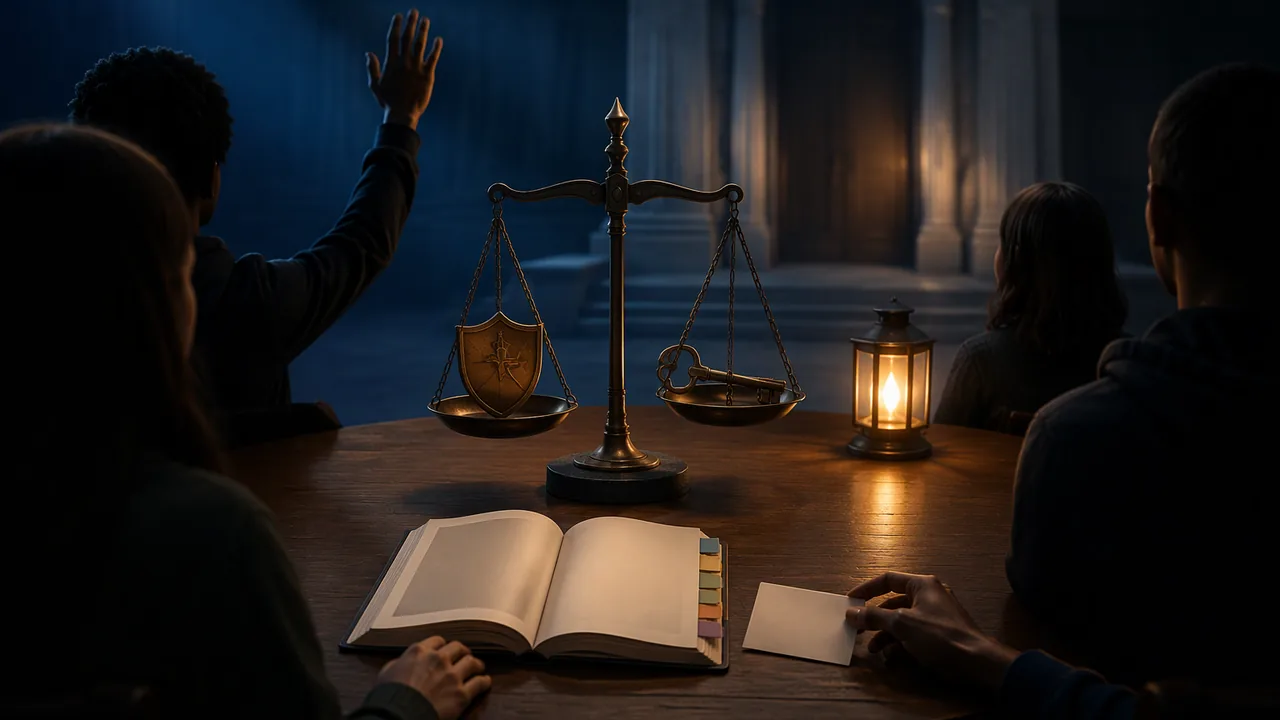
Rights and obligations are two sides of the same membership. This lab asks you to understand both, and then to deliberate — not debate — about how they relate.
Rights and obligations are interdependent; one cannot exist meaningfully without the other.
📖 Read for this lesson
The reading opens over the lesson; close it to come back to exactly where you were. The checks below draw on it.
What rights do you take for granted, and what might it take to secure them?
Which of these is a legal obligation rather than a civic one?
The rights
The Ninth Amendment clarifies that the enumeration of certain rights in the Constitution does not mean other rights retained by the people are not protected.
The First Amendment protects freedom of religion (no establishment, free exercise), speech, press, assembly and petition. The Second protects the right to keep and bear arms. The Third and Fourth protect the home and the person against quartering and unreasonable searches and seizures. The Fifth guarantees due process, protection against self-incrimination and double jeopardy, and just compensation when property is taken. The Sixth and Seventh guarantee fair criminal and civil trials; the Eighth forbids excessive bail and cruel and unusual punishment. The Ninth says the listed rights are not the only ones; the Tenth reserves powers to states and people. The Court has also recognized a right to privacy drawn from several amendments, and the scope of that right has been — and remains — contested.
Fair procedures the government must follow before depriving a person of life, liberty or property.
Applicants for naturalization must pass both an English test and a civics test.
How rights are secured
A right written down is not self-enforcing. Rights are secured by independent courts, by due process, by a free press that exposes violations, and by citizens who assert them. Missouri’s own bill of rights, Article I of its Constitution of 1945, can protect a right more broadly than the federal text: section 15 guards “electronic communications and data” against unreasonable searches, which the Fourth Amendment does not name. Cases from Missouri show the machinery working. In Shelley v. Kraemer (1948), a dispute over a house on a St. Louis block, the Court held that a state court could not enforce a racially restrictive agreement without denying equal protection of the laws. In Cruzan v. Director, Missouri Department of Health (1990), the Court assumed that a competent person has a constitutionally protected right to refuse lifesaving hydration and nutrition, yet allowed Missouri to require clear and convincing evidence of an incompetent patient’s wishes. That is how a contested right of privacy actually develops: a court assumes a liberty interest, then asks how far a state may regulate it.
Record (or write out) your 90-second deliberation position on mandatory voting, grounding it in at least one right and one obligation from this lesson. Then write two replies, one to the strongest argument for mandatory voting and one to the strongest argument against it (the reading sets out both): first summarize each in a sentence its holder would accept, then add, qualify or challenge. Save all three to your portfolio.
Economic rights
Economic rights belong here too. Missouri’s Article I, section 2 names “the enjoyment of the gains of their own industry” among natural rights, and economic rights include the right to acquire, use, transfer and dispose of property; to choose one’s work; to join or not join a labor union; and the protection of creative work through copyright and patents, which the Constitution itself authorizes. These are secured by contract law, property law and courts.
My rights are guaranteed just because they’re written in the Constitution.
Rights are not self-enforcing; they are actively secured by independent courts, due process, a free press, and citizens who assert them.
Obligations
Some obligations are legal: obeying the law, serving on a jury when summoned, paying taxes, and, for most men aged 18-25, registering with the Selective Service. Missouri law says the same of its own juries: citizens have “an obligation to serve as jurors when summoned” (RSMo 494.400). Others are civic — expected but not compelled: voting, staying informed, volunteering, public service, and military or alternative service. Missouri’s Constitution says who is “entitled to vote”, not that anyone must.
Reciprocity
The enjoyment of your rights depends on others respecting them, which depends on you respecting theirs. Free speech means little if people answer speech with violence; a fair trial requires citizens willing to serve as jurors. Rights create obligations, and obligations sustain rights.
Becoming a citizen
People born in the United States are citizens under the Fourteenth Amendment, a sentence that answers Dred Scott v. Sandford (1857), the case that began as a freedom suit in the St. Louis Circuit Court and ended with the Supreme Court declaring that people of African descent were not citizens. Others may naturalize: generally, a lawful permanent resident aged 18 or older who has lived in the U.S. for five years (three if married to a U.S. citizen), shows good moral character, passes an English test and a civics test on U.S. history and government, and takes the Oath of Allegiance. The civics test questions are public; you will try some.
Deliberation, not debate
In a debate you try to win. In a deliberation you try to reach the best-reasoned view, which requires you to represent other positions fairly (SL.11-12.1.d). The question: Should jury service, which is already a legal obligation, be joined by mandatory voting, as in Australia? Whether you work alone or with others, before you reply to any position, summarize it well enough that its holder would agree with your summary.
Key terms
The First Amendment’s bar on government establishing a religion.
The legal process by which a non-citizen becomes a U.S. citizen.
A duty expected of citizens but not legally compelled, such as voting.
The principle that enjoying one’s rights requires respecting others’ rights.
Practice
Work these on paper or in your notebook, then open Check your answer. Aim for all of Fluency and Application; try at least one Challenge.
Printable version: this unit’s practice workbook (PDF)
Fluency
Build speed and accuracy with the core skill.
- Name the amendment: (a) protection against unreasonable searches and seizures; (b) freedom of speech, press, assembly and petition; (c) the right to a fair criminal trial; (d) protection against self-incrimination and double jeopardy; (e) the listing of some rights does not deny others.
Check your answer
Answer: (a) Fourth; (b) First; (c) Sixth; (d) Fifth; (e) Ninth. - Sort each duty as a legal obligation or a civic obligation: paying taxes; voting; serving on a jury when summoned; volunteering; staying informed; obeying the law.
Check your answer
Answer: Legal: paying taxes, serving on a jury when summoned, obeying the law. Civic: voting, volunteering, staying informed.A legal obligation is enforced by law; a civic obligation is expected but not compelled. Voting is civic in the United States; the deliberation asks whether it should become legal, as in Australia. - List the general requirements for naturalization described in the lesson.
Check your answer
Answer: A lawful permanent resident aged 18 or older; five years of residence (three if married to a U.S. citizen); good moral character; passing an English test and a civics test on U.S. history and government; and taking the Oath of Allegiance.
Application
Use the skill in context. Show your reasoning.
- Scenario: police search a student’s car without a warrant and find evidence, and, separately, the city takes the student’s family’s land for a road without paying for it. Which two protections are at issue, and in which amendments?
Check your answer
Answer: The protection against unreasonable searches and seizures (Fourth Amendment), and the requirement of just compensation when government takes private property (Fifth Amendment).Whether this particular search was reasonable depends on facts and case law; the question asks you to identify the right, not decide the case. - Explain the idea of reciprocity using the right to a jury trial as your example.
Check your answer
Answer: Every accused person’s right to a fair jury trial exists only if ordinary citizens are willing to serve as jurors. My enjoyment of the right depends on others meeting an obligation, and theirs depends on me meeting it when I am summoned.A strong answer shows the dependence running both ways: rights create obligations, and obligations sustain rights. - In the deliberation on mandatory voting, one position holds: “Jury service is compulsory, so voting should be too.” Write a summary of this argument that its holder would accept, then state the strongest objection from the other side. Do not give your own verdict.
Check your answer
Answer: Model summary: “You are saying that democracy already requires citizens to do some civic work, like jury duty, because the system fails without it; voting is equally essential, so the same logic should make it a legal duty.” Strongest objection: jury service protects a specific person’s right to a fair trial, while the freedom not to vote can itself be a form of expression, so compulsion may burden liberty more than it improves representation.SL.11-12.1.d rewards a summary the other side would sign. A strong answer is fair to both positions and leaves the judgment to the discussion. - Missouri’s Constitution, Article I, section 15, protects people’s “persons, papers, homes, effects, and electronic communications and data” from unreasonable searches. Compare it with the Fourth Amendment and explain what a state may and may not do with a right the federal Constitution already guarantees.
Check your answer
Answer: The Fourth Amendment protects “persons, houses, papers, and effects”; Missouri’s section 15 adds “electronic communications and data.” A state may protect a right more broadly than the federal Constitution requires, but not less broadly, because the Fourteenth Amendment applies the federal protection against the states.The key idea is the federal floor: state constitutions can add protection, not subtract it. - In Shelley v. Kraemer (1948), owners on a St. Louis block had signed a private agreement barring occupancy by anyone not of the “Caucasian race.” What act did the Court treat as the state’s, and what did it hold?
Check your answer
Answer: The Missouri courts’ enforcement of the agreement. The Court held that in granting judicial enforcement of the restrictive agreements the States had denied the petitioners the equal protection of the laws, so the action of the state courts could not stand.The Fourteenth Amendment restrains states, not private people; the case turned on a court’s enforcement being state action.
Review
Keep earlier skills sharp.
- Review from Lesson 1.2: why did the original Bill of Rights not protect people against their state governments, and what changed that?
Check your answer
Answer: The first ten amendments originally limited only the national government. Through the Fourteenth Amendment (1868), the Supreme Court has since applied most of their protections to the states (incorporation).
Missouri’s own bill of rights can protect more than the federal text: Article I, section 15 guards “electronic communications and data” against unreasonable searches, which the Fourth Amendment does not name, showing how a state can secure a right more broadly.
How does the idea of reciprocity challenge the way you might typically think about your own rights?
How confident are you that you can explain how rights are secured and how they depend on citizens meeting their obligations?
The Shift
- Rights require active securing.
- Obligations are both legal and civic.
- Reciprocity connects rights and duties.
Rights and Obligations in the Text: The Bill of Rights, the Fourteenth Amendment, and the Law of Citizenship
U.S. Bill of Rights and Amendment XIV via the National Archives; 8 U.S.C. §§ 1423 and 1427, 28 U.S.C. § 1861 and 50 U.S.C. § 3802 via Cornell LII; the Oath of Allegiance, 8 C.F.R. § 337.1, via eCFR; Missouri Constitution, Article I sections 2, 10 and 15 and Article VIII section 2, and RSMo 494.400, via the Revisor of Missouri; Dred Scott v. Sandford, Shelley v. Kraemer and Cruzan v. Director, Missouri Department of Health, via Cornell LII · Public domain
Why this reading. This lab asks you to deliberate about how rights and obligations relate. Deliberation goes badly when people argue about what a right or a duty says without having read it. So here are the texts themselves: the ten amendments ratified on 15 December 1791, the first section of the Fourteenth Amendment (1868), and the federal statutes and regulation that set out the legal obligations and the path to citizenship. Everything below is government text, quoted exactly; the short passages in ordinary type are ours. What to look for: which duties are written as law and which are not written anywhere — and how often a right in the first list depends on someone else performing a duty in the second.
The Bill of Rights, complete
Amendment I. Congress shall make no law respecting an establishment of religion, or prohibiting the free exercise thereof; or abridging the freedom of speech, or of the press; or the right of the people peaceably to assemble, and to petition the Government for a redress of grievances.
Amendment II. A well regulated Militia, being necessary to the security of a free State, the right of the people to keep and bear Arms, shall not be infringed.
Amendment III. No Soldier shall, in time of peace be quartered in any house, without the consent of the Owner, nor in time of war, but in a manner to be prescribed by law.
Amendment IV. The right of the people to be secure in their persons, houses, papers, and effects, against unreasonable searches and seizures, shall not be violated, and no Warrants shall issue, but upon probable cause, supported by Oath or affirmation, and particularly describing the place to be searched, and the persons or things to be seized.
Amendment V. No person shall be held to answer for a capital, or otherwise infamous crime, unless on a presentment or indictment of a Grand Jury, except in cases arising in the land or naval forces, or in the Militia, when in actual service in time of War or public danger; nor shall any person be subject for the same offence to be twice put in jeopardy of life or limb; nor shall be compelled in any criminal case to be a witness against himself, nor be deprived of life, liberty, or property, without due process of law; nor shall private property be taken for public use, without just compensation.
Amendment VI. In all criminal prosecutions, the accused shall enjoy the right to a speedy and public trial, by an impartial jury of the State and district wherein the crime shall have been committed, which district shall have been previously ascertained by law, and to be informed of the nature and cause of the accusation; to be confronted with the witnesses against him; to have compulsory process for obtaining witnesses in his favor, and to have the Assistance of Counsel for his defence.
Amendment VII. In Suits at common law, where the value in controversy shall exceed twenty dollars, the right of trial by jury shall be preserved, and no fact tried by a jury, shall be otherwise re-examined in any Court of the United States, than according to the rules of the common law.
Amendment VIII. Excessive bail shall not be required, nor excessive fines imposed, nor cruel and unusual punishments inflicted.
Amendment IX. The enumeration in the Constitution, of certain rights, shall not be construed to deny or disparage others retained by the people.
Amendment X. The powers not delegated to the United States by the Constitution, nor prohibited by it to the States, are reserved to the States respectively, or to the people.
Two habits worth forming. First, notice who is restrained: the First Amendment names Congress; the others say “shall not be infringed,” “shall not be violated,” “No person shall.” None of them restrains a private person or company. Second, notice that the Fifth Amendment carries four separate protections in one sentence — grand jury, double jeopardy, self-incrimination, due process — and then a fifth, the requirement of just compensation when government takes property. A police search without a warrant raises the Fourth; a city taking land for a road without paying raises the Fifth.
Amendment XIV, section 1 (1868)
All persons born or naturalized in the United States, and subject to the jurisdiction thereof, are citizens of the United States and of the State wherein they reside. No State shall make or enforce any law which shall abridge the privileges or immunities of citizens of the United States; nor shall any State deprive any person of life, liberty, or property, without due process of law; nor deny to any person within its jurisdiction the equal protection of the laws.
This is where American citizenship is defined, and it defines it in two ways: by birth in the country, and by naturalization. It is also the provision through which most of the Bill of Rights now binds state and local officials — the process called incorporation. And note the switch from “citizens” in the first two clauses to “any person” in the last two: due process and equal protection are owed to everyone within a state’s jurisdiction, citizen or not.
How rights are secured
A right written down does not enforce itself. The Constitution provides the machinery in Article III — judges who “hold their Offices during good Behaviour” at a salary that “shall not be diminished” — so that a court can rule against the government without fearing for its pay or its post. Beyond the courts, rights are secured by due process, by a press free to expose violations, and by citizens who assert them. Every state constitution also has its own bill of rights, and Missouri’s is Article I of the Constitution of 1945. Three of its sections matter here. Section 2 states the purpose of government in terms that echo the Declaration:
That all constitutional government is intended to promote the general welfare of the people; that all persons have a natural right to life, liberty, the pursuit of happiness and the enjoyment of the gains of their own industry; that all persons are created equal and are entitled to equal rights and opportunity under the law; that to give security to these things is the principal office of government, and that when government does not confer this security, it fails in its chief design.
Section 10 repeats the due-process promise: “That no person shall be deprived of life, liberty or property without due process of law.” And section 15, as amended in 2014, extends the search-and-seizure protection to digital records:
That the people shall be secure in their persons, papers, homes, effects, and electronic communications and data, from unreasonable searches and seizures; and no warrant to search any place, or seize any person or thing, or access electronic data or communication, shall issue without describing the place to be searched, or the person or thing to be seized, or the data or communication to be accessed, as nearly as may be; nor without probable cause, supported by written oath or affirmation.
Compare section 15 with the Fourth Amendment above: the federal text names “persons, houses, papers, and effects”; Missouri’s adds “electronic communications and data.” A state may protect a right more broadly than the federal floor, never less.
Three Missouri cases that reached the Supreme Court
Because the Fourteenth Amendment makes rights enforceable against states, Missouri disputes have repeatedly become national constitutional law.
Dred Scott v. Sandford (1857). In 1846 Dred Scott and his wife Harriet, enslaved people, sued for their freedom in the St. Louis Circuit Court, claiming they had become free by living in a free territory. The suit travelled through Missouri’s courts and then the federal courts. Chief Justice Taney wrote for the Supreme Court that people of African descent were not citizens within the Constitution:
We think they are not, and that they are not included, and were not intended to be included, under the word ‘citizens’ in the Constitution, and can therefore claim none of the rights and privileges which that instrument provides for and secures to citizens of the United States.
Read that beside the first sentence of the Fourteenth Amendment above: “All persons born or naturalized in the United States, and subject to the jurisdiction thereof, are citizens of the United States.” That sentence, ratified in 1868, answers Dred Scott directly.
Shelley v. Kraemer (1948). In 1911, thirty of the thirty-nine owners of property on a block of Labadie Avenue in St. Louis signed an agreement barring occupancy by anyone not of the “Caucasian race.” In 1945 a Black family, the Shelleys, bought a house there, and neighbors sued in the St. Louis Circuit Court to remove them. The Supreme Court of Missouri enforced the agreement. The United States Supreme Court reversed:
We hold that in granting judicial enforcement of the restrictive agreements in these cases, the States have denied petitioners the equal protection of the laws and that, therefore, the action of the state courts cannot stand.
Notice how a right that restrains only government (the Fourteenth Amendment says “No State”) still protected a family from a private agreement: the court’s own enforcement of the agreement was state action.
Cruzan v. Director, Missouri Department of Health (1990). Nancy Cruzan was left in a persistent vegetative state after an automobile accident, and her parents asked that her artificial nutrition and hydration be withdrawn. Missouri law required clear and convincing evidence of what an incompetent patient would have wanted, and the Court held that the United States Constitution did not forbid Missouri to require it. The Court’s own summary notes that the Supreme Court of Missouri declined to read a broad right of privacy into the Missouri Constitution. For the question of unwritten rights, the key sentence is a careful one:
But for purposes of this case, we assume that the United States Constitution would grant a competent person a constitutionally protected right to refuse lifesaving hydration and nutrition.
That is how a contested right develops: a court assumes a liberty interest under due process, then asks how much a state may regulate it.
The obligations that are written as law
Jury service. 28 U.S.C. § 1861 states the policy of the United States for the federal courts:
It is the policy of the United States that all litigants in Federal courts entitled to trial by jury shall have the right to grand and petit juries selected at random from a fair cross section of the community in the district or division wherein the court convenes. It is further the policy of the United States that all citizens shall have the opportunity to be considered for service on grand and petit juries in the district courts of the United States, and shall have an obligation to serve as jurors when summoned for that purpose.
Read that beside the Sixth Amendment. The accused has a right to “an impartial jury”; the statute turns that right into somebody’s duty. This is the clearest example of reciprocity in American law: your right to a jury trial exists only because other citizens are obliged to serve, and theirs exists only because you are.
Missouri says the same for its own courts in section 494.400 of the Revised Statutes of Missouri: “all such citizens shall have the opportunity to be considered for jury service and an obligation to serve as jurors when summoned for that purpose, unless excused.”
Registration for the draft. 50 U.S.C. § 3802(a):
Except as otherwise provided in this chapter it shall be the duty of every male citizen of the United States, and every other male person residing in the United States, who, on the day or days fixed for the first or any subsequent registration, is between the ages of eighteen and twenty-six, to present himself for and submit to registration […]
Taxes and obedience to law are legal obligations too, imposed by statute and enforceable by penalty. Voting is not. Missouri says who may vote, not that anyone must. Article VIII, section 2 of the Missouri Constitution begins: “Only citizens of the United States, including occupants of soldiers’ and sailors’ homes, over the age of eighteen who are residents of this state and of the political subdivision in which they offer to vote are entitled to vote at all elections by the people […]” — “entitled,” not “required.” Nor is there any legal duty to volunteer, to follow the news or to enter public service. Those are civic obligations — expected, praised, argued for, but not compelled. The line between the two lists is exactly what the deliberation question about mandatory voting is about.
Becoming a citizen: the statutory requirements
A person born in the United States and subject to its jurisdiction is a citizen under the Fourteenth Amendment. Anyone else must naturalize. The core conditions are in 8 U.S.C. § 1427(a):
No person, except as otherwise provided in this subchapter, shall be naturalized unless such applicant, (1) immediately preceding the date of filing his application for naturalization has resided continuously, after being lawfully admitted for permanent residence, within the United States for at least five years and during the five years immediately preceding the date of filing his application has been physically present therein for periods totaling at least half of that time, and who has resided within the State or within the district of the Service in the United States in which the applicant filed the application for at least three months, (2) has resided continuously within the United States from the date of the application up to the time of admission to citizenship, and (3) during all the periods referred to in this subsection has been and still is a person of good moral character, attached to the principles of the Constitution of the United States, and well disposed to the good order and happiness of the United States.
The five-year period is shortened to three for an applicant who has lived in marital union with a U.S. citizen spouse; the applicant must also be at least eighteen. Then there are the two tests, in 8 U.S.C. § 1423(a):
No person except as otherwise provided in this subchapter shall hereafter be naturalized as a citizen of the United States upon his own application who cannot demonstrate— (1) an understanding of the English language, including an ability to read, write, and speak words in ordinary usage in the English language […] and (2) a knowledge and understanding of the fundamentals of the history, and of the principles and form of government, of the United States.
Both tests are required, so the lesson’s true/false check is true. Section 1423(b) exempts applicants unable to comply because of physical or developmental disability or mental impairment, and the statute provides further exemptions based on age combined with long residence.
Finally, the applicant takes the Oath of Allegiance in a public ceremony. Its form is fixed by regulation, 8 C.F.R. § 337.1(a):
I hereby declare, on oath, that I absolutely and entirely renounce and abjure all allegiance and fidelity to any foreign prince, potentate, state, or sovereignty, of whom or which I have heretofore been a subject or citizen; that I will support and defend the Constitution and laws of the United States of America against all enemies, foreign and domestic; that I will bear true faith and allegiance to the same; that I will bear arms on behalf of the United States when required by the law; that I will perform noncombatant service in the Armed Forces of the United States when required by the law; that I will perform work of national importance under civilian direction when required by the law; and that I take this obligation freely, without any mental reservation or purpose of evasion; so help me God.
Paragraph (b) of the same section provides that an applicant who by reason of religious training and belief, or other reasons of good conscience, cannot swear, substitutes “and solemnly affirm” and omits “so help me God.”
Using this in the deliberation
The oath is worth a minute of your ninety seconds. It is the one moment in American law where a person is required to state the obligations of citizenship out loud — and voting is not among them. Someone arguing for compulsory voting can say that the country already compels the civic work it cannot do without, and points to jury service and the oath as proof. Someone arguing against can answer from the First Amendment: a citizen who declines to vote is expressing a view, and compulsion at the ballot box burdens the same liberty of conscience that lets an applicant affirm instead of swear. Both arguments rest on text you have now read. Ground your position in one right and one obligation from this reading, and quote them.
Sources: The Bill of Rights: A Transcription (archives.gov); Amendments 11-27 (Fourteenth Amendment) (archives.gov); 8 U.S.C. § 1427, Requirements as to residence, good moral character (law.cornell.edu); 8 U.S.C. § 1423, Requirements as to understanding the English language, history, principles and form of government (law.cornell.edu); 28 U.S.C. § 1861, Declaration of policy (juries) (law.cornell.edu); 50 U.S.C. § 3802, Registration (law.cornell.edu); 8 C.F.R. § 337.1, Oath of allegiance (ecfr.gov); Missouri Constitution, Article I, section 2 (Revisor of Missouri) (revisor.mo.gov); Missouri Constitution, Article I, section 10 (Revisor of Missouri) (revisor.mo.gov); Missouri Constitution, Article I, section 15 (Revisor of Missouri) (revisor.mo.gov); Missouri Constitution, Article VIII, section 2 (Revisor of Missouri) (revisor.mo.gov); Section 494.400, Revised Statutes of Missouri (Revisor of Missouri) (revisor.mo.gov); Dred Scott v. Sandford, 60 U.S. 393 (Legal Information Institute) (law.cornell.edu); Dred Scott v. Sandford (1857), Milestone Documents (National Archives) (archives.gov); Shelley v. Kraemer, 334 U.S. 1 (1948) (Legal Information Institute) (law.cornell.edu); Cruzan v. Director, Missouri Department of Health, 497 U.S. 261 (1990) (Legal Information Institute) (law.cornell.edu)