How does one construct a compelling legal argument based solely on constitutional text and precedent, even for a position one might personally disagree with?
write a brief for one side of a Supreme Court case using constitutional text and precedent, argue it orally under questioning, and compare my argument with the Court’s.
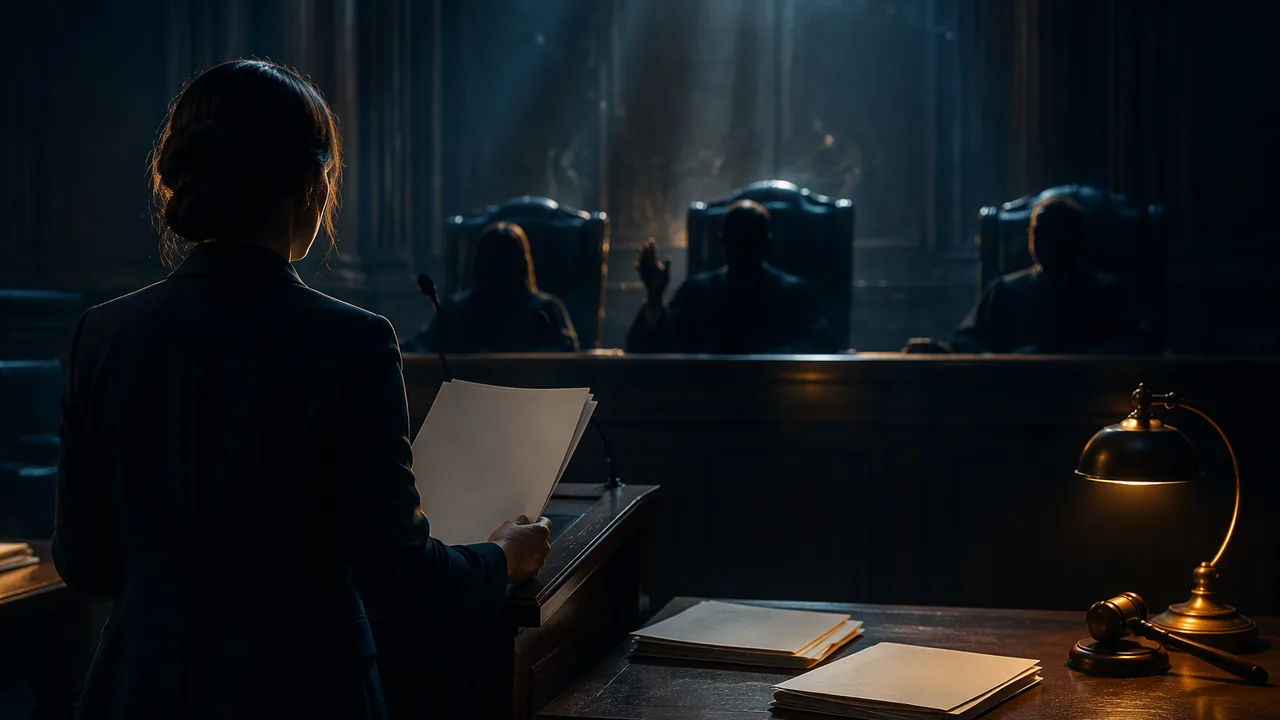
Lawyers who argue before the Supreme Court file a written brief, then stand for thirty minutes while justices interrupt with questions. This task gives you a version of that experience.
Developing a robust legal argument requires thorough constitutional research, precise application of precedent, and the ability to critically compare one’s reasoning with established judicial decisions.
📖 Read for this lesson
The reading opens over the lesson; close it to come back to exactly where you were. The checks below draw on it.
Considering you must argue a specific side, how will you approach building a strong case objectively?
Marbury v. Madison (1803)
Tap to revealJudicial review.
McCulloch v. Maryland (1819)
Tap to revealImplied powers; federal supremacy over state taxation.
Plessy v. Ferguson (1896)
Tap to reveal‘Separate but equal’ upheld.
Brown v. Board (1954)
Tap to revealSeparate educational facilities are inherently unequal.
United States v. Nixon (1974)
Tap to revealExecutive privilege is not absolute.
The case
The Supreme Court often receives ‘amicus curiae’ or ‘friend of the court’ briefs from individuals or groups not directly involved in a case but with a strong interest in its outcome.
Choose one. All three earn full credit, all three are landmark cases this course has not studied in depth, and in each the side is fixed for you, so you may well be arguing against your own view. Lawyers do this every day, and it is one of the best ways to understand an argument you disagree with. Option A — Tinker v. Des Moines Independent Community School District, argued 1968: argue for the school district — that a public school may prohibit students from wearing black armbands to protest a war. Option B — New Jersey v. T.L.O., argued 1984: argue for T.L.O. — that a vice-principal’s search of a student’s purse, without a warrant, violated the Fourth Amendment. Option C — Texas v. Johnson, argued 1988: argue for the State of Texas — that a state may punish the desecration of the American flag. The facts, the constitutional text and the precedents that existed before each case are all in free public sources: the Constitution Annotated at constitution.congress.gov, the U.S. Reports digitized at loc.gov, and the landmark-case materials at uscourts.gov.
A justice asks a question you think is off-topic. What is the best response?
The brief (900-1,100 words)
It contains the question presented — the legal question in one sentence; the constitutional provisions at issue, quoted; the relevant precedents — earlier cases and what they held; the argument for your side, applying text and precedent to the facts; and a section addressing the strongest precedent or argument against you. WHST.11-12.8 asks you to use authoritative sources and cite them; cite cases by name, volume and page.
Lawyers only argue cases they personally believe are morally right or that they agree with the outcome of.
Lawyers are obligated to present the strongest possible legal argument for their client’s assigned side, using constitutional text and precedent, regardless of their personal views on the case’s merits or desired outcome.
Do not read the actual decision yet
Research the facts, the constitutional text and the precedents that existed before your case. The point is to build the argument yourself.
The oral argument
You present your argument — about four minutes — to a bench: a parent, guardian, study partner or other adults, or a recording if no bench is available. Expect to be interrupted. The bench will ask about hypotheticals (“what if one fact were changed in favor of the other side?”), precedent (“how is your case different from X?”) and consequences (“where would your rule stop?”). SL.11-12.1.c asks you to respond to questions that probe reasoning and evidence. The best advocates answer the question asked, directly, then return to their argument. If no one can serve as your bench, write the three questions you most fear (one hypothetical, one about precedent, one about consequences), record yourself answering each in thirty seconds, and play the recording back as a critic would.
Serving on the bench
If you sit on a bench for someone else, your job as a justice is to probe, not to argue your own view: ask at least one question to each side. If you are working alone, write one probing question for each side of an option you did not choose.
The reflection (300 words)
After the arguments, read the Court’s actual majority and dissenting opinions. Compare your reasoning with the Court’s: what did you anticipate, what did you miss, and which opinion’s reasoning do you find stronger now? HR.3 asks you to evaluate debates about interpretation, including how authors use evidence.
Unit 2 checkpoint
Do this before you start the task. It covers the whole unit and tells you what to review first.
The House has members, apportioned among the states by population after each census.
Where does the 60-vote threshold to end debate on most Senate legislation come from?
Most bills that die in Congress die in committee.
A presidential candidate needs of the 538 electoral votes to win.
In Youngstown Sheet & Tube Co. v. Sawyer (1952), why did the Court rule against President Truman’s seizure of the steel mills?
The President may remove a federal judge by executive order.
Which case held that executive privilege is real but must yield to the specific needs of a criminal trial?
In McCulloch v. Maryland the Court said “the power to tax involves the power to .”
Judicial activism and judicial restraint always correspond to one political side.
What did Regents of the University of California v. Bakke (1978) hold?
Justice Harlan, the lone dissenter in Plessy, wrote: “Our Constitution is .”
Complete: Moot Court Brief (900-1,100 words), oral argument, and 300-word reflection
Task: Argue one side of an assigned Supreme Court case in a written brief and under questioning from a bench, then compare your argument with the Court’s opinions.
Submission workflow
- Stage 1 — Research plan. Question presented, provisions, three prior precedents with holdings, and your argument outline.
- Stage 2 — Reviewed brief. A parent, guardian or study partner reads your brief and names its weakest point; or, if no reader is available, write the weakest point as the other side’s lawyer would. Save a revision note to your portfolio.
- Stage 3 — Final brief. 900-1,100 words with case citations.
- Stage 4 — Oral argument and reflection. About four minutes under questioning from your bench (or the recorded self-questioning described above); then the 300-word reflection after reading the actual opinions.
How it is scored
| Criterion | What proficient looks like |
|---|---|
| Question and provisions (9-12.GV.3.CC.C / 9-12.GV.4.CC.B) | Legal question stated precisely; provisions quoted accurately. |
| Use of precedent (9-12.GV.3.GS.E / 9-12.GV.3.CC.C, WHST.11-12.8) | Relevant prior cases cited and applied, including the strongest adverse precedent. |
| Argument (WHST.11-12.1) | Coherent application of text and precedent to the facts. |
| Oral advocacy (SL.11-12.4, SL.11-12.1.c) | Answers the bench’s questions directly and returns to the argument. |
| Reflection (9-12.GV.1.CC.B) | Compares own reasoning with majority and dissent, with specific points. |
| Bench questions | Asks, or writes, probing questions of both sides. |
The skills in this task are used in Missouri courts as well, where lawyers argue from both the Missouri Constitution and the U.S. Constitution, and where the supreme court’s judges come to the bench through the nonpartisan plan described in Lesson 2.3.
How did the process of researching and arguing a case, then comparing it to the Court’s actual decision, deepen your understanding of constitutional law and the judicial process?
How confident are you that you can argue a constitutional case from text and precedent, under questioning?
The Shift
- Master constitutional text and precedent.
- Argue persuasively and respond precisely.
- Critically evaluate judicial reasoning.
How a Case Is Argued: Briefs, Precedent and the Bench
SLS reading for American Government, drawing on the Supreme Court of the United States’ own materials and the federal courts’ educational pages · SLS original
Why this reading. Your task is to argue a side of a real case before you have read how the Court decided it. That is not an artificial restriction — it is the actual position of every lawyer who ever briefed a case of first impression. This reading is about craft: how a brief is built, what a precedent is and how to use one that is against you, and how to answer questions from a bench. It deliberately says nothing about the outcomes of the three cases you choose between.
What the Court itself says the argument is for
The Supreme Court’s Visitor’s Guide to Oral Argument describes a process that should shape how you prepare. The justices have already read the briefs before anyone stands up: they are, in the Court’s words, “thoroughly familiar with the case, its facts, and the legal positions that each party is advocating.” Argument is therefore not a speech. It is the only chance the advocate gets to answer the specific things that are bothering the judges. Time is short and visibly enforced: a white light on the lectern warns the advocate of five minutes remaining, and a red light means the time is gone, sometimes mid-sentence. The Court grants review in roughly eighty of the five to seven thousand petitions filed each term, which is why a case reaching argument is usually one where the law is genuinely unsettled and both sides have something real to say.
The five parts of a brief
- The question presented. One sentence, framed as a legal question with the key facts folded in, not a topic. “School searches” is a topic. “Whether a public-school official may search a student’s belongings without a warrant when the official has reason to suspect a school rule has been broken” is a question. Advocates fight over the wording because a question framed your way makes your answer sound inevitable. Write yours, then write the version your opponent would write, and be ready for the bench to prefer theirs.
- The constitutional provisions at issue, quoted. Exactly, in full, with the article, section or amendment named. A brief that paraphrases the Constitution loses credibility on the first page. Quote the operative words and say which ones your case turns on — “unreasonable,” “abridging,” “equal protection” — because the argument will be about those words.
- The precedents. Earlier decisions, each with what it held, the facts that produced the holding, and why it governs (or does not govern) yours. Cite properly: case name, volume, reporter, first page and year — Marbury v. Madison, 5 U.S. (1 Cranch) 137 (1803). If you quote a particular sentence, give the page it is on.
- The argument. Text applied to facts through precedent, in the order that makes your best point first. Each paragraph should be able to answer the question “so what?” in one sentence.
- The answer to the strongest thing against you. Not the weakest — the strongest. A brief that ignores the adverse precedent invites the bench to assume you have no answer to it.
Precedent: what it is, and the three things you can do with a bad one
American courts decide by stare decisis — “to stand by things decided.” A decision of a higher court binds the courts below it in later cases raising the same question, so that like cases are treated alike and people can plan their affairs. A precedent is not the winner’s name; it is the rule the court announced together with the facts that rule was applied to.
When the strongest precedent runs against you, advocates have three moves, and only three:
- Distinguish it. Accept the rule and show that a fact that mattered to it is absent here. This is the ordinary move and the most persuasive. It requires you to state precisely which fact the earlier court relied on — quote the earlier opinion saying so.
- Limit it. Accept the case but argue the rule was narrower than your opponent claims — that the broad language was not necessary to the decision.
- Ask the court to overrule it. The strongest medicine, rarely granted, and you must give reasons beyond disagreement: that the rule has proved unworkable, that its factual premises have collapsed, that later decisions have eroded it, or that no one has relied on it in ways that would be upset. Brown overruling Plessy is the paradigm, and it took a change in the Court’s account of the facts, not just a change of mind.
One discipline specific to your task: research only what existed before your case was decided. If you are arguing a 1969 case, the 1969 lawyer’s shelf is what you get. Working from the later decision backward is not building an argument; it is copying one.
Where to find the raw material
- supremecourt.gov publishes opinions, the Court’s rules, argument calendars, and audio and transcripts of arguments. Listening to fifteen minutes of any real argument teaches more about tone than any description can.
- The official U.S. Reports are digitized at the Library of Congress, so you can read a decision exactly as the Reporter of Decisions published it. Note that the syllabus at the front of an opinion is prepared by the Reporter and is not part of the Court’s opinion — never quote it as if the Court wrote it.
- uscourts.gov, the federal judiciary’s own site, explains how cases move through the courts and publishes educational materials on landmark cases.
- congress.gov hosts the Constitution Annotated, which traces how each clause has been interpreted, with citations you can follow to the opinions themselves.
Standing at the lectern
Four minutes goes fast, and you will be interrupted. That is not rudeness; it is the point. Some rules that hold up under pressure:
- Open with your claim, not your gratitude. One sentence saying what you want and why, then the roadmap.
- Answer the question that was asked, first, in its first word. “Yes, Your Honor — and here is why that helps us.” Advocates who say “I’ll come to that” lose the bench. If the question seems off-topic, answer it directly anyway and then bridge back to your argument; the bridge is one sentence, not a new speech.
- Expect three kinds of question. Hypotheticals test where your rule stops (“what if the student had worn a jacket with a slogan instead?”). Precedent questions test your distinctions (“how is your case different from X?”). Consequence questions test the rule’s reach (“where would your rule stop?”). Prepare one answer to each in advance about your own case.
- Know your rule’s limit before the bench finds it. Every good advocate can state the case they would lose. Saying so out loud — “our rule would not cover that, and here is the line” — buys enormous credibility.
- Concede small things fast. Fighting a point you cannot win costs time you need for the point you can.
- Never invent a fact or a case. “I don’t know, Your Honor, but I can tell you what the record does show” is a complete and respectable answer.
When you are on the bench
Your job as a justice is to probe, not to campaign. Ask at least one question of each side. Good questions are short, concrete and answerable: a hypothetical that moves one fact, a request for the page where a precedent says what counsel claims, or a question about the consequence of the rule being urged. Asking both sides a version of the same question is the fastest way to find where the case actually turns.
The reflection
Afterward you read the real majority and dissent. The 300 words should not be a report card on yourself. Compare reasoning: which arguments did the Court make that you did not think of, which of yours did it never reach, and which opinion — majority or dissent — do you find stronger now, and on what grounds? Evaluating how an author uses evidence is the skill being assessed, so name a specific passage and say what work it is doing. It is a perfectly good answer to conclude that the dissent had the better argument and lost.
Sources: Supreme Court of the United States: Visitor’s Guide to Oral Argument (supremecourt.gov); Supreme Court of the United States: Opinions (supremecourt.gov); United States Courts: Educational resources on landmark cases (uscourts.gov); Constitution Annotated (Congress.gov) (constitution.congress.gov); U.S. Reports, digitized (Library of Congress) (loc.gov)