How can we ensure a free and responsible press in a rapidly changing media landscape, and what role should government play?
explain the meaning and importance of a free and responsible press, the roles of print, broadcast and digital media, and how officials use media to shape opinion, and take and defend a position on the media’s influence.
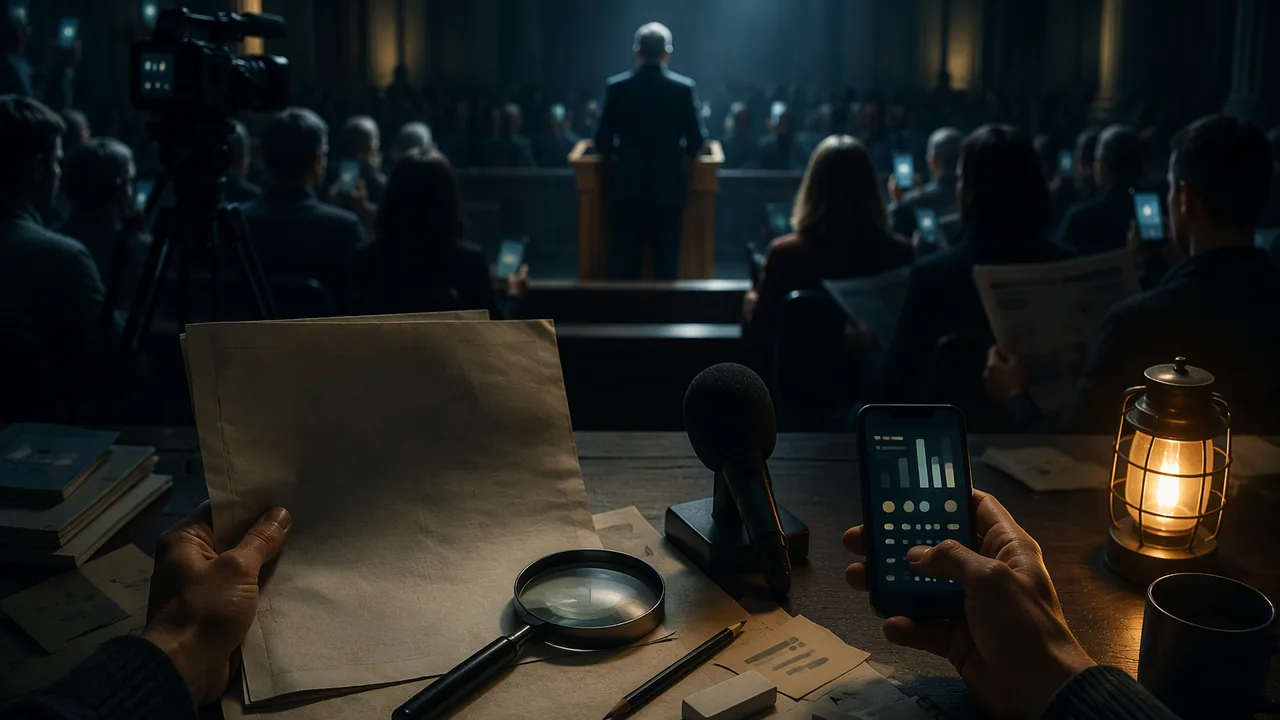
Jefferson wrote that if he had to choose between a government without newspapers or newspapers without a government, he would prefer the latter. The First Amendment protects the press because self-government depends on citizens knowing what their government does.
A free and responsible press is essential for self-government, though its roles and challenges are evolving in the digital age.
📖 Read for this lesson
The reading opens over the lesson; close it to come back to exactly where you were. The checks below draw on it.
What is one responsibility you believe the press has to its audience?
Under New York Times v. Sullivan, what must a public official prove to win a libel suit?
A free press
The press is sometimes called the ‘Fourth Estate’ because its watchdog role is seen as a check on the powers of government, alongside the legislative, executive, and judicial branches.
American law gives the press unusual protection. Government generally may not stop publication in advance (prior restraint) — in the Pentagon Papers case (1971) the Court refused to stop newspapers publishing a classified history of the Vietnam War. Under New York Times v. Sullivan (1964), a public official suing for libel must prove “actual malice”: that the publisher knew a statement was false or recklessly disregarded whether it was. The rule exists so that fear of lawsuits does not silence criticism of officials.
Government action preventing publication in advance; presumptively unconstitutional.
Knowledge of falsity or reckless disregard for truth — the standard for public officials’ libel suits.
The First Amendment prohibits social-media companies from removing users’ posts.
A responsible press
Freedom brings obligations that law mostly does not enforce: accuracy, verification, correction of errors, separation of news from opinion, and independence from those it covers. Professional ethics codes, editors and competition are the main enforcers. Readers are the last.
In Hazelwood School District v. Kuhlmeier (1988), a case from St. Louis County, what did the Court hold about a school-sponsored student newspaper?
The media’s roles in politics
The media inform, set the agenda (deciding which issues get attention), frame issues (how they are presented), and act as watchdogs. Print newspapers pioneered investigative reporting; broadcast radio and television nationalized political communication; cable news fragmented audiences by viewpoint; and digital platforms and social media have made everyone a potential publisher, weakened local newspapers, and allowed information — and falsehood — to spread without editors. The Medill School of Journalism’s State of Local News 2025 report counts 212 U.S. counties with no local news outlet and another 1,525 with only one.
The First Amendment protects me from private companies like social media platforms moderating or removing my content.
The First Amendment primarily limits government action, not the content moderation policies of private companies like social media platforms.
Keep a three-day media log comparing how two outlets and one official’s own social-media account presented the same event. Then record your 90-second deliberation position on government support for local journalism, using your log as evidence. Then evaluate the evidence and reasoning of one opposing position that you find in a published source.
How officials use media
Officials hold press conferences, issue releases, give interviews, stage events, and increasingly communicate directly through their own social-media accounts, bypassing journalists. Direct communication can increase access and transparency; it can also avoid scrutiny and questions. Officials also try to frame issues favorably and to set the agenda — the President’s “bully pulpit” is the classic example.
Missouri’s text and a Missouri case
Article I, section 8 of the Missouri Constitution protects the freedom to “say, write or publish, or otherwise communicate whatever he will on any subject, being responsible for all abuses of that liberty,” and lets the truth be given in evidence in libel suits. The Sunshine Law (section 610.011 of the Revised Statutes) declares it the public policy of the state that the meetings, records, votes, actions and deliberations of public governmental bodies be open to the public unless otherwise provided by law. And a leading student-press case began in St. Louis County: in Hazelwood School District v. Kuhlmeier (1988) the Court held that educators may exercise editorial control over school-sponsored student speech, such as a curriculum-based school newspaper, so long as their actions are reasonably related to legitimate pedagogical concerns.
Limits of protection
Speech is protected broadly but not absolutely. Under Brandenburg v. Ohio (1969), advocacy of force is protected unless it is directed to inciting imminent lawless action and likely to produce it. Platforms are private companies, and the First Amendment limits government, not private moderation — a distinction often confused in public argument.
Evaluating sources
HR.2 asks you to identify bias. Separate news reporting from opinion; check who owns or funds a source; look for named sources and corrections; compare coverage of the same event across outlets; and trace viral claims back to their origin before sharing them.
Deliberation question
Should government do anything to support local journalism — and if so, how can it do so without threatening the press’s independence from government?
Key terms
The media’s influence over which issues the public considers important.
How an issue is presented, shaping how audiences interpret it.
The press’s function of scrutinizing those in power.
Reading: Two limits on the power to punish speech
New York Times Co. v. Sullivan, 376 U.S. 254 (1964); Brandenburg v. Ohio, 395 U.S. 444 (1969) · Public domain
Each case draws a line. Where exactly is it?
Sullivan: We consider this case against the background of a profound national commitment to the principle that debate on public issues should be uninhibited, robust, and wide-open, and that it may well include vehement, caustic, and sometimes unpleasantly sharp attacks on government and public officials.
Brandenburg: The constitutional guarantees of free speech and free press do not permit a State to forbid or proscribe advocacy of the use of force or of law violation except where such advocacy is directed to inciting or producing imminent lawless action and is likely to incite or produce such action.
Practice
Work these on paper or in your notebook, then open Check your answer. Aim for all of Fluency and Application; try at least one Challenge.
Printable version: this unit’s practice workbook (PDF)
Fluency
Build speed and accuracy with the core skill.
- Define prior restraint and give the lesson’s example of the Court refusing it.
Check your answer
Answer: Prior restraint is government action preventing publication in advance, and it is presumptively unconstitutional. In the Pentagon Papers case (1971) the Court refused to stop newspapers publishing a classified history of the Vietnam War. - Match each medium to the change the lesson credits it with: print newspapers; broadcast radio and television; cable news; digital platforms and social media.
Check your answer
Answer: Print: pioneered investigative reporting. Broadcast: nationalized political communication. Cable: fragmented audiences by viewpoint. Digital and social media: made everyone a potential publisher, weakened local newspapers, and let information and falsehood spread without editors. - Name four ways public officials use the media to communicate with citizens and shape opinion.
Check your answer
Answer: Any four of: press conferences, press releases, interviews, staged events, direct posts on their own social-media accounts, framing issues and setting the agenda through the bully pulpit.
Application
Use the skill in context. Show your reasoning.
- New York Times v. Sullivan describes “a profound national commitment to the principle that debate on public issues should be uninhibited, robust, and wide-open.” Explain how the “actual malice” rule serves that commitment.
Check your answer
Answer: A public official suing for libel must prove the publisher knew a statement was false or recklessly disregarded whether it was. Honest mistakes are not enough, so fear of lawsuits does not silence criticism of officials, which keeps public debate wide-open. - Apply Brandenburg v. Ohio. Scenario A: a speaker at a rally says the government is corrupt and “someday the people will rise up.” Scenario B: a speaker urges a crowd to break into a building across the street immediately, and the crowd begins to move. Which speech may the state punish?
Check your answer
Answer: Only B. Under Brandenburg, advocacy of force is protected unless it is directed to inciting or producing imminent lawless action and is likely to produce it. A is abstract advocacy of future action; B is directed to immediate lawless action and is likely to produce it.Check both parts of the test: intent to incite imminent action, and likelihood. - A classmate says, “A social-media company deleting my post violated my First Amendment rights.” Evaluate the claim using the lesson.
Check your answer
Answer: The claim confuses public and private action. The First Amendment limits government, not private companies, so a platform’s moderation decision is not a First Amendment violation, although people may still debate whether a platform’s policies are fair or wise.A strong answer identifies the flawed premise (HR.1) without taking a side on the platform’s policy. - Apply Hazelwood School District v. Kuhlmeier (1988). A high school journalism class publishes a school-sponsored newspaper as part of its curriculum, and the principal removes an article before printing. Using the Court’s rule, what must be true for the removal to be consistent with the First Amendment, and how is this different from the school punishing a student for wearing an armband?
Check your answer
Answer: Educators may exercise editorial control over the style and content of student speech in school-sponsored expressive activities so long as their actions are reasonably related to legitimate pedagogical concerns. This differs from punishing student speech that merely occurs on school premises, the situation in Tinker, where the standard is different.
Review
Keep earlier skills sharp.
- Review from Unit 2: which 1969 case held that students do not shed their constitutional rights at the schoolhouse gate, and what was the students’ speech?
Check your answer
Answer: Tinker v. Des Moines; wearing armbands to protest the Vietnam War. - Review from Unit 1: which Tocqueville concern does the lesson’s worry about social pressure online echo?
Check your answer
Answer: The tyranny of the majority: majority opinion silencing dissent through social pressure rather than law.
Missouri’s Sunshine Law (section 610.011) declares that the meetings, records, votes and deliberations of public governmental bodies are open to the public, which matters most where local news is thin: the Medill School of Journalism’s 2025 report counts 212 U.S. counties with no local news outlet and 1,525 with only one.
How does the rise of digital platforms change your own responsibility as a consumer and potential publisher of information?
How confident are you that you can explain press freedom and its limits, and evaluate how media and officials shape opinion?
The Shift
- The First Amendment protects the press from government interference, including prior restraint and difficult libel standards.
- The press performs vital functions like informing the public, setting the agenda, and acting as a watchdog over those in power.
- Digital platforms have transformed media, making everyone a potential publisher and changing how information—and misinformation—spreads.
Prior Restraint and the Price of Criticism: Near, the Pentagon Papers, the Actual-Malice Rule, and a Missouri Student Newspaper
Near v. Minnesota, 283 U.S. 697 (1931); New York Times Co. v. Sullivan, 376 U.S. 254 (1964); New York Times Co. v. United States, 403 U.S. 713 (1971) (text carried unchanged from the verified original reading, retrieved 2026-09-22); Hazelwood School District v. Kuhlmeier, 484 U.S. 260 (1988), official U.S. Reports; Missouri Constitution Art. I sec. 8 and Revised Statutes of Missouri sec. 610.011, Revisor of Missouri; Medill Local News Initiative, The State of Local News 2025; Missouri sources and Hazelwood retrieved November 5, 2026 · Public domain
Why this reading. American press law is built on two separate protections that people often confuse. The first is against being stopped in advance; the second is against being punished afterward for honest error. Your lesson’s excerpt gives you the rules from Sullivan and Brandenburg; this reading gives you the reasoning behind the first protection, the case that tested it hardest, and the fuller statement of the second. What to look for: each case identifies a specific way that pressure on a publisher becomes pressure on the public — find the sentence where the Court explains what the public loses.
The text
Amendment I. Congress shall make no law respecting an establishment of religion, or prohibiting the free exercise thereof; or abridging the freedom of speech, or of the press; or the right of the people peaceably to assemble, and to petition the Government for a redress of grievances.
Two words are doing enormous work. “Congress” — which is why the amendment restrains government, and why it reaches state and local officials only through the Fourteenth Amendment. And “abridging,” which is broader than “prohibiting” and covers indirect pressure as well as bans.
Near v. Minnesota (1931): the state may not padlock a newspaper
Minnesota law let a court permanently enjoin any “malicious, scandalous and defamatory” periodical as a public nuisance. A Minneapolis paper that had accused local officials of corruption was shut down under it. The Court struck the statute down, and in doing so applied the First Amendment’s press guarantee against a state for the first time. Chief Justice Hughes began with the common-law inheritance:
In determining the extent of the constitutional protection, it has been generally, if not universally, considered that it is the chief purpose of the guaranty to prevent previous restraints upon publication. The struggle in England, directed against the legislative power of the licenser, resulted in renunciation of the censorship of the press. The liberty deemed to be established was thus described by Blackstone: “The liberty of the press is indeed essential to the nature of a free state; but this consists in laying no previous restraints upon publications, and not in freedom from censure for criminal matter when published. Every freeman has an undoubted right to lay what sentiments he pleases before the public; to forbid this, is to destroy the freedom of the press; but if he publishes what is improper, mischievous or illegal, he must take the consequence of his own temerity.”
Then he explained what the Minnesota scheme actually did to a publisher who had criticized officials:
[W]here a newspaper or periodical has been suppressed because of the circulation of charges against public officers of official misconduct, it would seem to be clear that the renewal of the publication of such charges would constitute a contempt and that the judgment would lay a permanent restraint upon the publisher, to escape which he must satisfy the court as to the character of a new publication. Whether he would be permitted again to publish matter deemed to be derogatory to the same or other public officers would depend upon the court’s ruling.
[…] unless [the publisher] is able and disposed to bring competent evidence to satisfy the judge that the charges are true and are published with good motives and for justifiable ends, his newspaper or periodical is suppressed and further publication is made punishable as a contempt. This is of the essence of censorship.
And the Court was careful to say what it was not holding:
[I]t is recognized that punishment for the abuse of the liberty accorded to the press is essential to the protection of the public, and that the common law rules that subject the libeler to responsibility for the public offense, as well as for the private injury, are not abolished by the protection extended in our constitutions. […] For whatever wrong the appellant has committed or may commit, by his publications, the State appropriately affords both public and private redress by its libel laws.
That is the distinction to keep: stopping publication in advance is presumptively unconstitutional; holding a publisher responsible afterward, under laws of general application, is not.
New York Times Co. v. United States (1971): the Pentagon Papers
The federal government sought injunctions to stop the New York Times and the Washington Post from publishing a classified Defense Department history of American decision-making in Vietnam. The Court ruled against the government in a brief unsigned opinion, six days after the case was filed:
“Any system of prior restraints of expression comes to this Court bearing a heavy presumption against its constitutional validity.” Bantam Books, Inc. v. Sullivan, 372 U.S. 58, 70 (1963); see also Near v. Minnesota, 283 U.S. 697 (1931). The Government “thus carries a heavy burden of showing justification for the imposition of such a restraint.” Organization for a Better Austin v. Keefe, 402 U.S. 415, 419 (1971). The District Court for the Southern District of New York in the New York Times case and the District Court for the District of Columbia and the Court of Appeals for the District of Columbia Circuit in the Washington Post case held that the Government had not met that burden. We agree.
Read what the Court did and did not say. It did not say the papers were entitled to publish anything classified; nine justices wrote separately and several stressed that the government might still prosecute afterward under criminal statutes. What it held was that the government had not carried the heavy burden required to stop publication in advance — even of a classified history of an ongoing war. That is how strong the presumption against prior restraint is.
New York Times Co. v. Sullivan (1964): room to be wrong
An Alabama city commissioner sued over an advertisement in the Times that described police conduct during civil rights protests and contained several factual errors. An Alabama jury awarded him $500,000. The Supreme Court reversed and wrote a new federal rule:
We consider this case against the background of a profound national commitment to the principle that debate on public issues should be uninhibited, robust, and wide-open, and that it may well include vehement, caustic, and sometimes unpleasantly sharp attacks on government and public officials.
The constitutional guarantees require, we think, a federal rule that prohibits a public official from recovering damages for a defamatory falsehood relating to his official conduct unless he proves that the statement was made with “actual malice”—that is, with knowledge that it was false or with reckless disregard of whether it was false or not.
A footnote to that passage explains the logic: even a false statement may make a valuable contribution to public debate, because it brings about, in John Stuart Mill’s phrase which the Court quoted, “the clearer perception and livelier impression of truth, produced by its collision with error.”
“Actual malice” is a term of art and is not about ill will. A publisher who was careless, unfair, or simply mistaken does not meet the standard; a publisher who knew the statement was false, or who published while seriously doubting it, does. The point is not to protect lies. It is that a rule holding publishers liable for honest error would make covering officials too risky to do — and the people who would lose most are readers.
What the First Amendment does not reach
Two limits worth stating precisely, because both come up in your media log.
Speech that incites imminent lawless action. Under Brandenburg v. Ohio (1969), quoted in your lesson, advocacy of force or of law violation is protected unless it is directed to inciting or producing imminent lawless action and is likely to do so. Both halves are required. A speaker who says the government is corrupt and that “someday the people will rise up” is advocating in the abstract and is protected. A speaker urging a crowd to break into the building across the street right now, with the crowd beginning to move, is not.
Private companies. The First Amendment restrains government. A social-media company that removes a post, suspends an account or ranks one story above another is not violating anyone’s First Amendment rights, because it is not the government — and the company has speech rights of its own in deciding what it carries, much as a newspaper does in choosing what to print. That does not end the argument; whether a platform’s rules are fair, consistent or good for public debate is a real question, and legislatures have tried to regulate platforms in ways that are themselves being litigated. But “my post was deleted, so my First Amendment rights were violated” confuses a private decision with a public one.
A free press and a responsible one
Almost none of what makes journalism trustworthy is required by law. Verification before publication, correcting errors promptly and visibly, separating news from opinion, disclosing conflicts, and refusing to be captured by the people you cover — these are professional norms, enforced by editors, by competition, by professional codes and, in the end, by readers. The law’s role is mostly to keep the government from deciding what may be said.
Which is why the decline of local news is a civic question and not only a business one. The Medill School of Journalism’s State of Local News 2025 report counts the counties with no local news outlet at all: “There are 212 counties in the United States with no news outlets. There are 1,525 counties with only one.” When you build your three-day media log, note not only how two outlets and an official’s own account framed the same event, but what none of them covered: the agenda item nobody reported is the clearest evidence about the watchdog role.
Missouri’s text and one Missouri case
Missouri’s own Bill of Rights protects the press more expansively than the First Amendment’s five words. Article I, section 8 of the Constitution of 1945:
That no law shall be passed impairing the freedom of speech, no matter by what means communicated: that every person shall be free to say, write or publish, or otherwise communicate whatever he will on any subject, being responsible for all abuses of that liberty; and that in all suits and prosecutions for libel or slander the truth thereof may be given in evidence; and in suits and prosecutions for libel the jury, under the direction of the court, shall determine the law and the facts.
Read the clause “being responsible for all abuses of that liberty” next to Sullivan: Missouri’s text affirms the freedom and the accountability in a single sentence, and the federal actual-malice rule then sets the bar a public official must clear to hold a publisher accountable.
Missouri also gives the public a statutory right to see its government at work. The Sunshine Law, section 610.011 of the Revised Statutes, opens with a statement of policy:
It is the public policy of this state that meetings, records, votes, actions, and deliberations of public governmental bodies be open to the public unless otherwise provided by law.
Reporters use it, but so can anyone: it is how you can ask for the minutes of your local school board or city council.
And one of the Supreme Court’s leading student-press cases began in Missouri. In Hazelwood School District v. Kuhlmeier, 484 U.S. 260 (1988), the petitioners were the Hazelwood School District in St. Louis County, and its officials, including the principal of Hazelwood East High School. The respondents were three former students who had worked on Spectrum, the school newspaper written and edited by the Journalism II class. The principal had removed two pages from the May 13, 1983 issue — including an article describing students’ experiences with pregnancy and another on the impact of divorce on students. The Court held, 5–3:
educators do not offend the First Amendment by exercising editorial control over the style and content of student speech in school-sponsored expressive activities so long as their actions are reasonably related to legitimate pedagogical concerns.
The Court distinguished Tinker v. Des Moines: the standard for when a school may punish student speech that merely occurs on school premises differs from the standard for when a school may refuse to lend its own name and resources to publishing it. Notice both limits on the holding — it concerned a public school’s curriculum-based newspaper, and it permits editorial control only for reasons related to legitimate educational concerns. Use it as a case study of the line this reading keeps drawing: government stopping a publication in advance versus a publisher deciding what it will print. Which side of the line does a public school principal occupy?
Sources: Near v. Minnesota, 283 U.S. 697 (1931), official U.S. Reports (tile.loc.gov); New York Times Co. v. Sullivan, 376 U.S. 254 (1964), official U.S. Reports (tile.loc.gov); New York Times Co. v. United States, 403 U.S. 713 (1971), official U.S. Reports (tile.loc.gov); The Bill of Rights: A Transcription (archives.gov); Hazelwood School District v. Kuhlmeier, 484 U.S. 260 (1988), official U.S. Reports (tile.loc.gov); Missouri Constitution, Article I, Section 8 (revisor.mo.gov); Revised Statutes of Missouri section 610.011, Liberal construction of law to be public policy (Sunshine Law) (revisor.mo.gov); Medill Local News Initiative, The State of Local News 2025 (localnewsinitiative.northwestern.edu)