How should we continually re-evaluate and balance the competing values at the heart of our constitutional democracy?
formulate a question about a tension within constitutional democracy, analyze a current case using primary, secondary and comparative sources, and defend a conclusion about how the balance should be struck.
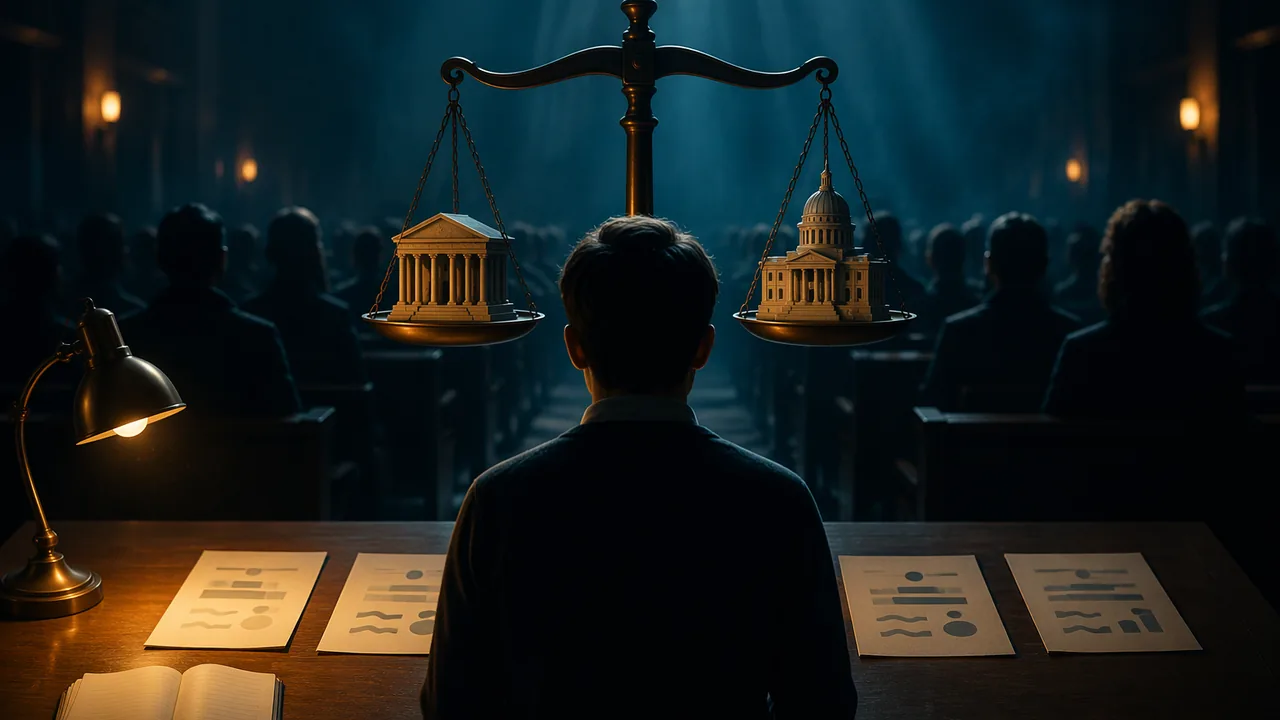
This project is the capstone of the course. It asks you to formulate questions about, and defend analyses of, the tensions at the heart of constitutional democracy — balances that no generation settles for good:
Majority rule and individual rights. Liberty and equality. State and national authority in a federal system. Civil disobedience and the rule of law. Freedom of the press and the right to a fair trial. The relationship of religion and government.
Understanding and analyzing the persistent tensions within constitutional democracy requires evaluating competing arguments and defending a nuanced conclusion about where the balance should be struck.
📖 Read for this lesson
The reading opens over the lesson; close it to come back to exactly where you were. The checks below draw on it.
What constitutional tensions have you encountered or heard discussed recently in public life or the news?
majority rule vs individual rights
Tap to revealHow far can a majority decide questions that affect a minority’s rights?
liberty vs equality
Tap to revealWhen does protecting freedom of action conflict with equal treatment or opportunity?
state vs national authority
Tap to revealWhich level should decide, and who decides who decides?
civil disobedience vs rule of law
Tap to revealWhen, if ever, is deliberately breaking a law justified?
free press vs fair trial
Tap to revealHow to keep publicity from prejudicing a jury without censoring the press?
Formulate a real question
The first ten amendments to the U.S. Constitution, known as the Bill of Rights, were added to address concerns that the original document did not adequately protect individual liberties from government overreach.
Choose one tension and find a current case that tests it: a ballot measure affecting a minority, a school-speech dispute, a federal-state conflict, a protest movement that broke laws on purpose, pretrial publicity in a high-profile case, or a dispute over religion in public institutions. Turn it into a question that reasonable people answer differently — for example, Should a state be able to decide X when the national government has decided Y? A question with one obvious answer is not a tension.
Which question best frames a tension for this project?
Sources
At least four: one primary legal or governmental source (a statute, an opinion, a constitutional text, a hearing transcript), one secondary analysis, one source representing each side, and one comparative example from another democracy — how Canada, Germany, India or another country handles the same tension. The comparison is what turns an opinion into an analysis.
Most fundamental constitutional questions have a single, correct legal answer that has been settled by past generations.
Many core constitutional questions involve ongoing tensions between competing values, requiring each generation to continually re-evaluate and re-strike balances that are rarely permanent.
The analysis (1,000-1,200 words)
Present the strongest argument on each side in terms its holders would accept. Evaluate the reasoning of each (HR.1 asks you to distinguish valid from fallacious arguments) — not only the conclusions. Then defend your own conclusion about how the balance should be struck, and acknowledge what it costs. CST.1 asks you to compare present with past: connect your case to an earlier moment when Americans struck the same balance differently. For a state-versus-national question, Missouri v. Holland (1920), in which the State of Missouri sued to stop enforcement of federal migratory-bird regulations, is a Missouri example to start from.
Civic-mindedness
The civics standards name the obligations of civic-mindedness: being informed, voting, volunteering and public service. End your analysis with one specific action a citizen who agreed with you could take — and one a citizen who disagreed could take.
The defense
Four to five minutes, with one visual that carries information your words do not, followed by questions. SL.11-12.4 asks you to address alternative perspectives: expect to be asked about the other side’s best point, and answer it directly.
Non-partisanship
Any position is acceptable. You are assessed on the quality of the question, the fairness with which you present each side, the soundness of your evaluation and the evidence behind your conclusion.
Unit 4 checkpoint
Do this before you start the task. It covers the whole unit and tells you what to review first.
The Constitution establishes the Democratic and Republican parties.
After the contested 1968 Democratic convention, what became decisive in choosing presidential nominees?
A poll result that falls within the of error is a statistical tie.
Which case held that corporations and unions may spend unlimited amounts on independent political advertising?
Drawing district lines to advantage a party or group is called .
Missouri was apportioned eight U.S. House seats after both the 2010 and the 2020 censuses.
How many members does Missouri’s Constitution give each legislative redistricting commission?
Missouri law lets a citizen who is seventeen years and six months old register to vote.
Under New York Times v. Sullivan, what must a public official prove to win a libel suit?
The First Amendment limits private social-media companies in the same way it limits government.
In a parliamentary system, how can the government be removed between elections?
Czechoslovakia’s largely nonviolent Revolution of 1989 ended Communist rule.
Submit: Civic Analysis Project (1,000-1,200 words) + 4-5 minute defense
Task: Formulate a question about a tension within constitutional democracy, analyze a current case with primary, secondary and comparative sources, and defend your conclusion.
Submission workflow
- Stage 1 — Question and sources. The tension, the case, the question, and at least four sources including a primary and a comparative source.
- Stage 2 — Peer-reviewed draft. A reviewer (a classmate, parent or guardian) who disagrees with your conclusion checks that you stated their side fairly; submit a revision note.
- Stage 3 — Final analysis. 1,000-1,200 words, with both sides evaluated and your conclusion defended.
- Stage 4 — Defense. 4-5 minutes with an information-carrying visual, and questions from a listener.
How it is scored
| Criterion | What proficient looks like |
|---|---|
| Question (9-12.GV.4.CC.C / 9-12.GV.1.CC.E) | A genuine tension, framed as a question reasonable people answer differently. |
| Both sides (WHST.11-12.1.b) | Strongest arguments stated in their holders’ terms with evidence. |
| Evaluation (9-12.GV.1.CC.B) | Reasoning on each side evaluated, not only conclusions. |
| Comparative and historical evidence (9-12.GV.1.CC.A) | Another democracy and an earlier American moment used as evidence. |
| Conclusion and civic action (9-12.GV.4.GS.B / 9-12.GV.4.CC.C) | Defended conclusion with its costs acknowledged; actions for citizens on both sides. |
| Defense (SL.11-12.4, SL.11-12.5) | Clear, timed, visual carries information; answers the other side’s best point directly. |
Missouri has been on one side of a lasting state-versus-national question: in Missouri v. Holland (1920) the State of Missouri sued to stop federal migratory-bird regulations, and in 2023 a federal district court struck down the Second Amendment Preservation Act, both examples of the tensions this project asks you to weigh.
How might your approach to political disagreements change if you actively sought to understand the strongest arguments of an opposing side before forming your own conclusion?
How confident are you that you can frame, analyze and defend a position on a tension within constitutional democracy?
The Shift
- Identify core constitutional tensions.
- Evaluate competing arguments fairly.
- Defend a nuanced, evidence-based conclusion.
Four Tensions in Their Own Words: Barnette, Thoreau, Sheppard, and Jefferson on Religion and Government
West Virginia State Board of Education v. Barnette, 319 U.S. 624 (1943) and Sheppard v. Maxwell, 384 U.S. 333 (1966), official U.S. Reports; Thoreau, “Civil Disobedience” (1849), via Project Gutenberg; Jefferson to the Danbury Baptist Association, 1 January 1802, via the Library of Congress; Missouri v. Holland, 252 U.S. 416 (1920), official U.S. Reports (retrieved November 5, 2026) · Public domain
Why this reading. Your capstone asks you to frame a question about a tension inside constitutional democracy and defend an answer. A tension is not a problem with a solution; it is a pair of goods that pull against each other, so that every settlement costs something. Below are primary texts for four of the six tensions in the standard, each chosen because its author knew perfectly well what the other side would say. What to look for: in each text, the sentence where the author names the price of their own position. Those sentences are the model for the paragraph your rubric calls “acknowledging what it costs.”
1. Majority rule and individual rights: West Virginia State Board of Education v. Barnette (1943)
In the middle of the Second World War, West Virginia required every public-school pupil to salute the flag; children who refused — among them Jehovah’s Witnesses, for whom the salute was forbidden worship — were expelled and their parents prosecuted. The Court struck the requirement down, overruling its own decision of three years earlier. Justice Jackson wrote:
The very purpose of a Bill of Rights was to withdraw certain subjects from the vicissitudes of political controversy, to place them beyond the reach of majorities and officials and to establish them as legal principles to be applied by the courts. One’s right to life, liberty, and property, to free speech, a free press, freedom of worship and assembly, and other fundamental rights may not be submitted to vote; they depend on the outcome of no elections.
[…] We set up government by consent of the governed, and the Bill of Rights denies those in power any legal opportunity to coerce that consent. Authority here is to be controlled by public opinion, not public opinion by authority.
The case is made difficult not because the principles of its decision are obscure but because the flag involved is our own. Nevertheless, we apply the limitations of the Constitution with no fear that freedom to be intellectually and spiritually diverse or even contrary will disintegrate the social organization. To believe that patriotism will not flourish if patriotic ceremonies are voluntary and spontaneous instead of a compulsory routine is to make an unflattering estimate of the appeal of our institutions to free minds. […] But freedom to differ is not limited to things that do not matter much. That would be a mere shadow of freedom. The test of its substance is the right to differ as to things that touch the heart of the existing order.
If there is any fixed star in our constitutional constellation, it is that no official, high or petty, can prescribe what shall be orthodox in politics, nationalism, religion, or other matters of opinion or force citizens to confess by word or act their faith therein. If there are any circumstances which permit an exception, they do not now occur to us.
Note the cost Jackson concedes in passing: “intellectual individualism and the rich cultural diversities that we owe to exceptional minds” come “only at the price of occasional eccentricity and abnormal attitudes.” He is not pretending the majority’s interest is worthless. He is saying what it must yield, and why. The strongest opposing case is a real one: a legislature elected by the people decided that a common civic ritual was worth requiring, and a court composed of nine unelected officials overrode them. Every defense of judicial protection for rights has to answer that.
2. Civil disobedience and the rule of law: Thoreau, “Civil Disobedience” (1849)
Thoreau spent a night in jail for refusing to pay a poll tax, in protest against slavery and the war with Mexico. The essay he wrote afterward is the founding American text on deliberate lawbreaking as a political act.
Can there not be a government in which the majorities do not virtually decide right and wrong, but conscience?—in which majorities decide only those questions to which the rule of expediency is applicable? Must the citizen ever for a moment, or in the least degree, resign his conscience to the legislator? Why has every man a conscience, then? I think that we should be men first, and subjects afterward. It is not desirable to cultivate a respect for the law, so much as for the right. […] Law never made men a whit more just; and, by means of their respect for it, even the well-disposed are daily made the agents of injustice.
If the injustice is part of the necessary friction of the machine of government, let it go, let it go: perchance it will wear smooth,—certainly the machine will wear out. If the injustice has a spring, or a pulley, or a rope, or a crank, exclusively for itself, then perhaps you may consider whether the remedy will not be worse than the evil; but if it is of such a nature that it requires you to be the agent of injustice to another, then, I say, break the law. Let your life be a counter friction to stop the machine. What I have to do is to see, at any rate, that I do not lend myself to the wrong which I condemn.
Under a government which imprisons any unjustly, the true place for a just man is also a prison.
Read the second paragraph as a test with three outcomes, not a slogan. Ordinary injustice: endure it and work through politics. Injustice with its own machinery: weigh whether the remedy is worse. Injustice that requires your participation: refuse, and accept the prison. Thoreau’s own answer to the rule-of-law objection is contained in that last clause — he does not claim exemption from the law, he goes to jail under it. Whether accepting the penalty is enough to reconcile deliberate lawbreaking with the rule of law is exactly the kind of question your project wants.
3. A free press and a fair trial: Sheppard v. Maxwell (1966)
Sam Sheppard’s murder trial was conducted amid saturation publicity: reporters occupied the courtroom, jurors’ names and photographs were published, and prejudicial material never admitted in evidence was broadcast throughout. The Court overturned the conviction — while insisting on the value of the press it was constraining.
A responsible press has always been regarded as the handmaiden of effective judicial administration, especially in the criminal field. Its function in this regard is documented by an impressive record of service over several centuries. The press does not simply publish information about trials but guards against the miscarriage of justice by subjecting the police, prosecutors, and judicial processes to extensive public scrutiny and criticism. This Court has, therefore, been unwilling to place any direct limitations on the freedom traditionally exercised by the news media […]
[…] Due process requires that the accused receive a trial by an impartial jury free from outside influences. Given the pervasiveness of modern communications and the difficulty of effacing prejudicial publicity from the minds of the jurors, the trial courts must take strong measures to ensure that the balance is never weighed against the accused.
The solution the Court reached is a model of how a tension gets managed rather than resolved: the remedy runs against the court and the lawyers — controlling the courtroom, sequestering or carefully selecting jurors, restraining what officers of the court say to reporters, continuing or moving the trial — and not against the press. That choice reflects the prior-restraint rule you met in Lesson 4.3. It also leaves a real residue: a defendant can still be tried in a community saturated with coverage no judge can undo.
4. Religion and government: the text, and Jefferson’s phrase
Amendment I. Congress shall make no law respecting an establishment of religion, or prohibiting the free exercise thereof […]
Article VI. The Senators and Representatives before mentioned, and the Members of the several State Legislatures, and all executive and judicial Officers, both of the United States and of the several States, shall be bound by Oath or Affirmation, to support this Constitution; but no religious Test shall ever be required as a Qualification to any Office or public Trust under the United States.
Two clauses, pulling in different directions from the start: government may not establish religion, and government may not prohibit its exercise. A policy that scrupulously avoids favoring religion can end up burdening someone’s practice; an accommodation that relieves the burden can look like favor. That is the tension, and it is built into the text.
In 1802 the Danbury Baptist Association — a minority denomination in a state with an established church — wrote to the new President about religious liberty. His reply gave American law a metaphor it has been arguing about ever since:
Believing with you that religion is a matter which lies solely between Man & his God, that he owes account to none other for his faith or his worship, that the legitimate powers of government reach actions only, & not opinions, I contemplate with sovereign reverence that act of the whole American people which declared that their legislature should “make no law respecting an establishment of religion, or prohibiting the free exercise thereof,” thus building a wall of separation between Church & State. Adhering to this expression of the supreme will of the nation in behalf of the rights of conscience, I shall see with sincere satisfaction the progress of those sentiments which tend to restore to man all his natural rights, convinced he has no natural right in opposition to his social duties.
Handle the quotation honestly, because it is often misused in both directions. It is a letter from one president to one religious association, not a constitutional provision; the Supreme Court has drawn on it, and has also moved away from it toward tests based on history and tradition. Note too the clause many quotations stop before: government’s powers “reach actions only, & not opinions” — which is itself a contested line, since most religious exercise is action.
The other two tensions, and where to find their texts
You have already read primary sources for the remaining pair. State and national authority: the Supremacy Clause and the Tenth Amendment, with McCulloch v. Maryland and United States v. Lopez giving you the broad and the narrow reading (Lessons 2.3 and 3.1). Liberty and equality: the Equal Protection Clause and the opinions in Lesson 2.4 — Harlan’s dissent, Brown, and Powell in Bakke — where a law aimed at equal treatment restricts someone’s freedom of action, or a freedom protected for all leaves unequal results in place.
Turning a tension into a question worth 1,200 words
Three tests a good question passes:
- Reasonable people answer it differently. “Is the Constitution important?” fails. “Should a state be able to enforce its own rule in an area where Congress has set a different national rule?” passes, because you can construct a serious argument for either answer.
- It attaches to a real, current case with a documentary record: a statute, an opinion, a ballot measure, a hearing transcript.
- It names what is on each side of the scale, so the answer has to trade one good against another rather than declaring one side unreasonable.
Then do what these four authors do. State the strongest form of each side. Evaluate the reasoning on each — separating a valid argument from a fallacious one is a distinct step from disagreeing with a conclusion. Compare the present with an earlier American moment when the same balance was struck differently: compulsory flag salutes were constitutional in 1940 and unconstitutional in 1943, with the same words in the Constitution both times. For state-versus-national cases, Missouri v. Holland, 252 U.S. 416 (1920), is a Missouri example: the State of Missouri sued the federal game warden to stop enforcement of federal migratory-bird regulations adopted under a treaty with Great Britain, claiming they invaded the rights reserved to the states by the Tenth Amendment. The Court, deciding the case on April 19, 1920, held that the treaty and the statute carrying it out were valid and did not infringe rights reserved to the states — and a century of cases since has kept asking where the balance lies. Bring in one other democracy that handles the same tension differently — Germany’s constitutional protections for human dignity, Canada’s notwithstanding clause, India’s basic-structure doctrine — because the comparison is what turns an opinion into an analysis. Defend your conclusion, and then say plainly what it costs, as Jackson does. Finish with one action a citizen who agrees with you could take, and one a citizen who disagrees could take; if you cannot name the second, you have not yet stated the other side fairly.
Sources: West Virginia State Board of Education v. Barnette, 319 U.S. 624 (1943), official U.S. Reports (tile.loc.gov); Sheppard v. Maxwell, 384 U.S. 333 (1966), official U.S. Reports (tile.loc.gov); Henry David Thoreau, On the Duty of Civil Disobedience (1849) (gutenberg.org); Jefferson’s Letter to the Danbury Baptists, 1 January 1802 (Library of Congress) (loc.gov); The Constitution of the United States: A Transcription (archives.gov); The Bill of Rights: A Transcription (archives.gov); Missouri v. Holland, 252 U.S. 416 (1920), official U.S. Reports (tile.loc.gov)