apply the Physical Activity Guidelines for adolescents to a weekly plan, explain the benefits of activity for body and mind, and analyze how home, community and online-school environments create barriers or supports.
Instruction
The guideline. The Physical Activity Guidelines for Americans, 2nd edition (HHS, 2018), recommend that children and adolescents aged 6-17 do 60 minutes or more of moderate-to-vigorous physical activity every day. As part of that hour, on at least 3 days a week, include vigorous activity, muscle-strengthening activity and bone-strengthening activity. Adults are advised to get at least 150-300 minutes a week of moderate activity (or 75-150 of vigorous), plus muscle-strengthening on 2 or more days.
Telling intensity apart. A simple test is the “talk test.” During moderate activity — brisk walking, easy cycling — you can talk but not sing. During vigorous activity — running, fast swimming, a soccer game — you can say only a few words before pausing for breath. Muscle-strengthening activities include push-ups, climbing and resistance training; bone-strengthening activities involve impact, such as jumping, running and basketball.
Why it matters. The Guidelines report that regular activity in young people improves bone health, cardiorespiratory and muscular fitness, and heart and metabolic health markers, and that it is associated with fewer symptoms of depression and with better cognitive function. A sedentary lifestyle is linked with higher risk of heart disease, type 2 diabetes and some cancers later in life. These benefits come with activity at any body size. Most teens fall short: in the 2023 national Youth Risk Behavior Survey, CDC reports that about 1 in 4 U.S. high school students were physically active for at least 60 minutes daily.
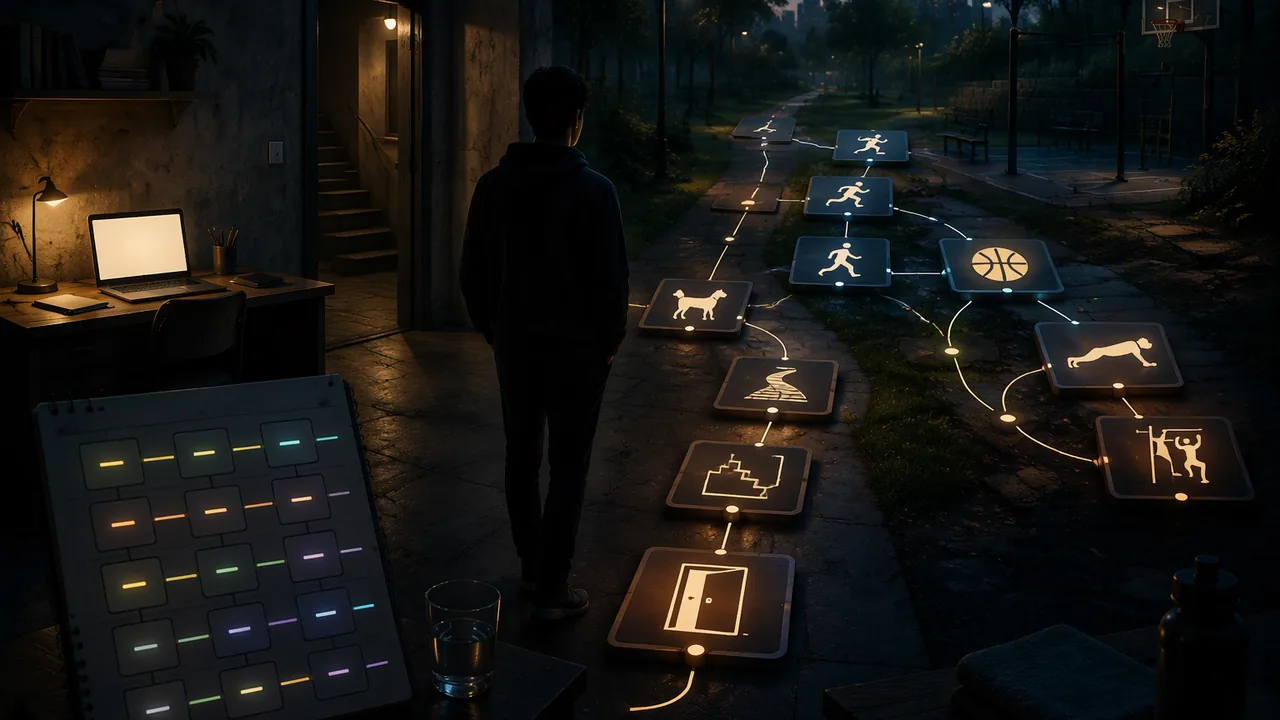
Worked planning example. Profile (fictional): Kai, 15, is an online student in Missouri. Every day he walks the family dog for 15 minutes before logging in. On weekdays he takes one 10-minute movement break between lessons. On Monday, Wednesday and Friday he follows a 30-minute workout video, and on Saturday he plays pick-up basketball at a park for 90 minutes. Tuesday and Thursday: 15 + 10 = 25 minutes, 35 short of 60. Monday, Wednesday and Friday: 15 + 10 + 30 = 55 minutes, 5 short. Saturday: 15 + 90 = 105 minutes. Sunday: 15 minutes, 45 short. A realistic plan adds a 10-minute bodyweight routine after the workout video on Monday, Wednesday and Friday (push-ups and squats, which also meets muscle-strengthening on 3 days): 65 minutes; a 40-minute bike ride or dance session on Tuesday and Thursday: 65 minutes; and a 45-minute family walk or ride on a local trail on Sunday: 60 minutes. Basketball on Saturday covers vigorous and bone-strengthening activity. You can plan for Kai or for yourself — equal credit, and you do not have to share your own routine.
Barriers are often environmental. People don’t choose in a vacuum. Is there a safe route to walk or bike to a park, store or library? Are community gyms and fields open when you are free? Is there free drinking water where people exercise? Can families afford sports fees? Does a long day at a screen include any breaks? Missouri has some strong supports: Missouri state parks charge no entrance fee, and Katy Trail State Park, built on an old railroad line, runs 240 miles and is the longest developed rail-trail in the country. The same is true of food. In Missouri, SNAP (run by the Department of Social Services) puts a monthly food benefit on an EBT card for eligible households, and WIC (run by the Department of Health and Senior Services) provides supplemental food, nutrition education and referrals to eligible pregnant, breastfeeding and postpartum women, infants and children up to age five. Public school districts that take part in federal meal programs must also have a local school wellness policy (a federal requirement, 7 CFR 210.31) that sets goals for nutrition, activity and wellness. As an online student, the environments you can study most directly are your home, your community and your online school day.
From individual to environment. A personal barrier (“I’m too tired after practice”) calls for a personal solution. A shared barrier (“there’s nowhere safe to walk to the park”) calls for advocacy. In this workshop you will analyze one barrier at each level and draft the problem statement for your Unit 2 audit: what the environment is, what the Guidelines say, and what you observed.
📖 Read for this lesson
The reading opens over the lesson; close it to come back to exactly where you were. The checks below draw on it.
Formative check
Work through these before moving on. They are not graded — they tell you whether the standard below has landed yet.
The Physical Activity Guidelines recommend that adolescents aged 6-17 get:
On Monday Kai walks the dog for 15 minutes, takes a 10-minute movement break and follows a 30-minute workout video; that is minutes, short of the guideline.
In Missouri, the WIC program provides supplemental food and nutrition education to eligible pregnant, breastfeeding and postpartum women, infants and children up to age five.
Name one personal barrier and one environmental barrier to physical activity for a teen in your Missouri community. For each, propose a solution at the right level (personal or environmental) and explain why that level fits.
How confident are you that you can apply the Physical Activity Guidelines and tell personal from environmental barriers?
Workshop File: The Physical Activity Guidelines in Their Own Words, a Second Weekly Plan Worked Out, a Barrier Analysis to Copy and the Missouri Environment
HHS, Physical Activity Guidelines for Americans, 2nd edition, 2018 (odphp.health.gov, page updated November 19, 2025; retrieved 2026-09-26); 7 CFR 210.31 (eCFR, retrieved 2026-09-26); Missouri Department of Social Services, My SNAP Benefit (mydss.mo.gov); Missouri DHSS, Women, Infants & Children (health.mo.gov); Missouri State Parks, Katy Trail State Park (mostateparks.com); KY3 News, “Fact Finders: Do other states have a better way of paying for state parks?” (July 16, 2026); Missouri sources retrieved 2026-11-06. Worked plan and barrier analysis are SLS original; Kai and Rosa are fictional. · Public domain (U.S. and Missouri government texts); worked examples SLS original
Why this reading. The workshop asks you to plan a week against the Guidelines, explain benefits, and analyze barriers. Here are the Guidelines as the federal document words them, a second fictional profile with a finished plan (Kai’s is in the lesson), a barrier-and-solution analysis to copy the structure of, and the Missouri and federal programs and places that shape the food and activity environment around you. Rosa and her town are SLS original and fictional.
1. The key guidelines for ages 6 through 17 (HHS, 2nd edition, 2018)
“Children and adolescents ages 6 through 17 years should do 60 minutes (1 hour) or more of moderate-to-vigorous physical activity daily.” The document breaks it into three parts. Aerobic: most of the 60 minutes or more should be moderate- or vigorous-intensity aerobic activity and should include vigorous-intensity activity on at least 3 days a week. Muscle-strengthening: as part of the 60 minutes, on at least 3 days a week. Bone-strengthening: as part of the 60 minutes, on at least 3 days a week.
Intensity. As a rule of thumb (the talk test), a person doing moderate-intensity aerobic activity can talk, but not sing. A person doing vigorous-intensity activity cannot say more than a few words without pausing for a breath. Bicycling or swimming can be moderate or vigorous depending on effort.
Examples for adolescents: moderate aerobic: brisk walking, bicycle riding, active recreation such as hiking or swimming; vigorous aerobic: running, sports such as soccer, basketball, swimming and tennis, jumping rope, martial arts, vigorous dancing; muscle-strengthening: resistance exercises with body weight or resistance bands, tug of war, some forms of yoga; bone-strengthening: jumping rope, running, and sports involving jumping or rapid change in direction. Some activities count in more than one category.
Meeting the guidelines. Young people who do not meet them “should slowly increase their moderate-to-vigorous physical activity in small steps and in ways that they enjoy.” Those who do should keep going, and those who exceed them should vary the kinds of activity to reduce the risk of overtraining or injury. Young people with disabilities should be as active as possible and work with a health care professional or physical activity specialist on what is appropriate.
Benefits the document rates as strong or moderate evidence for children and adolescents: improved bone health (ages 3-17), improved weight status (ages 3-17), improved cardiorespiratory and muscular fitness (ages 6-17), improved cardiometabolic health (ages 6-17), improved cognition (ages 6-13) and reduced risk of depression (ages 6-13). Adults: 150 to 300 minutes a week of moderate activity, or 75 to 150 of vigorous. The Guidelines note that as children become adolescents they typically reduce their activity, so adults should provide enjoyable opportunities.
2. A second weekly plan, worked (SLS original)
Profile: Rosa, 14. She is an online student in Missouri who works on her courses at home. On Monday, Wednesday and Friday evenings a parent drives her to practice with a community youth orchestra, so on those days she is seated for most of the day. On Tuesday and Thursday she follows a 35-minute online fitness video. On weekends she walks her dog for 20 minutes a day.
| Day | What she does now | Minutes | Short of 60 |
|---|---|---|---|
| Mon, Wed, Fri | Online lessons, orchestra | 0 | 60 |
| Tue, Thu | Fitness video | 35 | 25 |
| Sat, Sun | Dog walk | 20 | 40 |
Plan. Small steps: on Mon, Wed and Fri, take a 20-minute brisk walk around the neighborhood before logging in, and add a 40-minute bodyweight and jump-rope session at home after lessons (squats, push-ups against the wall, jumping rope), which covers muscle- and bone-strengthening on 3 days: 20 + 40 = 60 minutes. On Tue and Thu, add a 25-minute brisk walk or bike ride: 35 + 25 = 60. On Sat, add a 40-minute bike ride or dance session: 20 + 40 = 60 (the ride is vigorous when she cannot talk in full sentences). On Sun, extend the dog walk with 40 minutes of hiking at a nearby park or trail: 20 + 40 = 60. The plan meets 60 minutes on each day, vigorous activity on at least 3 days (the jump-rope sessions and the Saturday ride can be vigorous), and muscle- and bone-strengthening on at least 3 days (Mon, Wed, Fri). It builds up in steps, as the Guidelines advise.
3. Barriers: personal versus environmental (SLS original, worked)
| Barrier | Level | Solution | Why that level fits |
|---|---|---|---|
| “I’m too tired after orchestra practice.” | Personal | Do the session before lessons on two days, or use a 10-minute routine at home | Rosa controls her own schedule |
| “I sit at a screen for hours without moving.” | Personal | Set a timer for a 5-minute movement break between lessons | An online student sets her own pace through the day |
| “There is no safe way to walk to the park; the crossing on the main road has no signal.” | Environmental | Ask the city or county for a marked crosswalk and signal; present a count of how many people cross | One student cannot fix a road; a request to those who control it can |
| “The community center gym closes at 5 p.m.” | Environmental | Propose evening open-gym hours to the parks and recreation board | Hours are set by the people who run the building |
| “Club sports cost too much.” | Environmental | Ask about fee waivers or a free recreation-league program | Cost is set by the program, not the student |
4. The environment in Missouri: programs, places and policy
- Food help for families (SNAP). In Missouri the Supplemental Nutrition Assistance Program (SNAP, often still called food stamps) is run by the Department of Social Services, Family Support Division. Approved households receive a monthly benefit on an Electronic Benefit Transfer (EBT) card to use at stores that accept SNAP, and complete a mid-certification and a recertification each year to stay eligible (Missouri DSS, My SNAP Benefit).
- WIC. The Missouri WIC program, run by the Department of Health and Senior Services, provides supplemental food, health care referrals, nutrition education and breastfeeding promotion and support to eligible pregnant, breastfeeding and postpartum women, infants and children up to age five. Applicants must live in Missouri and meet income guidelines; people in SNAP, Temporary Assistance or income-qualifying MO HealthNet are automatically eligible. WIC foods are meant to be part of the diet, not all of a month’s food (Missouri DHSS, Women, Infants & Children).
- Places to move. Katy Trail State Park, built on the former corridor of the Missouri-Kansas-Texas Railroad, is 240 miles long, and Missouri State Parks describes it as the longest developed rail-trail in the country; it is open to bicyclists, walkers and equestrians. Missouri is one of the few states whose state parks charge no entrance fee; the parks are funded instead by a state sales tax for parks and soil and water conservation that voters first approved in 1984 (KY3 News, July 16, 2026). Camping and some programs have fees.
- School wellness policies. Federal rule 7 CFR 210.31 requires each local educational agency in the National School Lunch and School Breakfast Programs to establish a local school wellness policy, with specific goals for nutrition promotion and education, physical activity and other school-based activities, standards for foods and beverages, a named official responsible, and an opportunity for parents, students, school health professionals, the school board, administrators and the public to take part. The agency must assess the policy at least once every three years and make the results public. This applies to Missouri public school districts in those meal programs; for an online student, the environments you can audit are your home, your community and your online school day.
5. From barrier to problem statement (SLS original)
A problem statement has three parts: what the environment is, what the guideline says, what you observed. Model: “The main road between Rosa’s neighborhood and the city park has no marked crosswalk (environment). The Physical Activity Guidelines say young people should do 60 minutes or more of moderate-to-vigorous activity daily, and brisk walking and bicycle riding count toward it (guideline). During two 15-minute observations, 22 and 31 people crossed the road with no signal (observation, invented for this example).”
Sources: HHS, Physical Activity Guidelines for Americans, 2nd edition (odphp.health.gov); 7 CFR 210.31, Local school wellness policy (ecfr.gov); Missouri Department of Social Services, My SNAP Benefit (mydss.mo.gov); Missouri DHSS, Women, Infants & Children (WIC) (health.mo.gov); Missouri State Parks, Katy Trail State Park (mostateparks.com); KY3 News, Fact Finders: Do other states have a better way of paying for state parks? (July 16, 2026) (ky3.com)