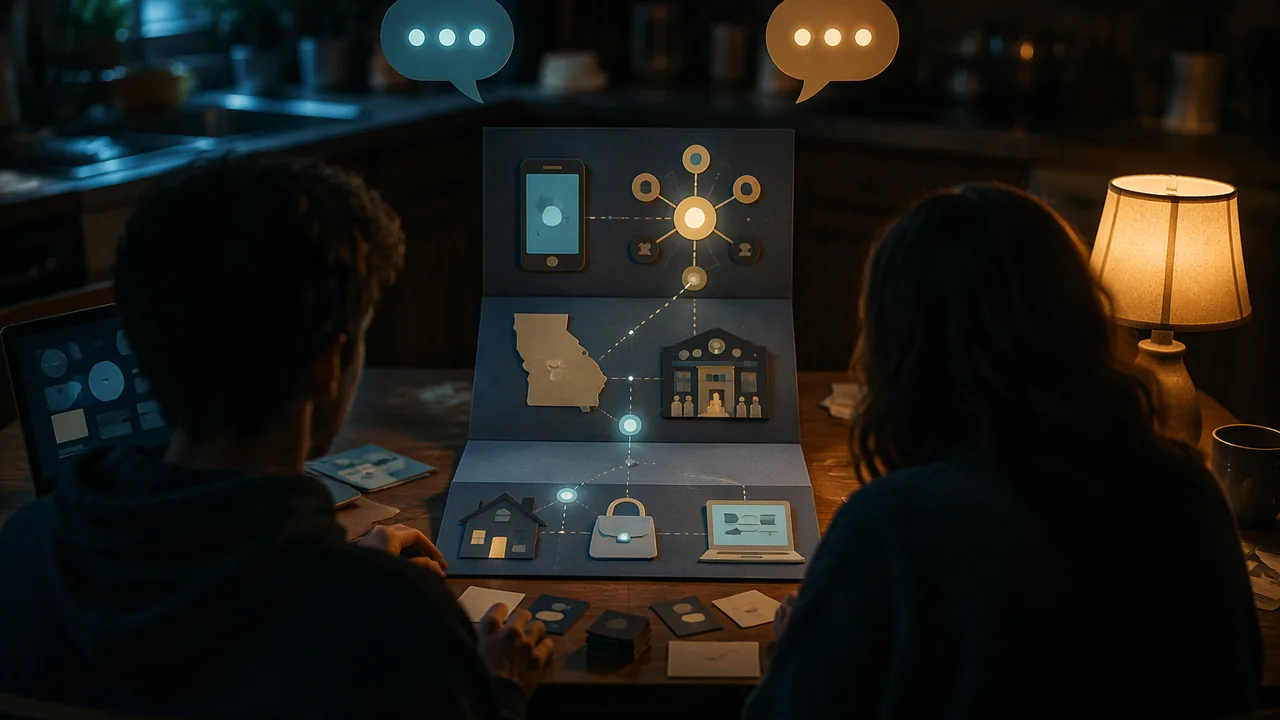
produce a verified guide to mental-health resources for an online Missouri student and family — at home, through the family’s doctor and the online school, in our county and statewide — and a stigma-reduction message grounded in data and safe-messaging practice.
Instruction
This task turns Unit 1 into something a student and a family could use on a bad day.
Who the guide is for. A student who learns online at home does not walk past a help office down the hall. Help comes from other places, so the guide is written for the student and a parent or guardian, and it is organized in three levels.
Level 1: home and online school. The trusted adults in the household; the family’s doctor or pediatrician, who can screen for depression and anxiety and refer to counseling; and the RLP student-support contact, reached through the course platform, for workload and next steps (not an emergency service).
Level 2: your Missouri county. The community mental health center that serves your county: the Missouri Department of Mental Health (DMH) reaches services through 25 service areas, and its Community Mental Health Centers page lets you select your county. DMH also lists 18 Certified Community Behavioral Health Clinics serving all 114 counties, and youth-serving crisis centers in Bridgeton, Joplin, Poplar Bluff, St. Joseph, St. Peters and Raytown. Note the nearest one and its age range.
Level 3: state and national. The 988 Suicide & Crisis Lifeline (call or text 988, or chat at 988lifeline.org); in Missouri, seven 988 centers cover every county, and a mobile crisis team can come to a person if talking is not enough. 911 is for immediate danger.
Verify every entry. Call the number or check the official website, and record for each one the cost (including whether it accepts the family’s insurance or MO HealthNet), hours, languages offered and what “confidential” means for that service. Add one honest line about consent: under Missouri’s general consent law (RSMo 431.061), a parent or guardian is usually part of starting ongoing mental health care for a minor, while 988 is free and confidential. A guide with one wrong phone number fails the student who needs it, so accuracy is scored first.
The message. Design one stigma-reduction message: a poster, a 30-second audio or video script, or a short social post for families of online students. Ground it in one accurate data point (for example, from the 2023 Missouri or national YRBS) and one fact about treatment or recovery from NIMH. Follow safe-messaging practice: point to help, describe recovery, use person-first and non-judgmental language, and never describe methods of self-harm. Test your draft on a reader you choose, such as a family member, or against the checklist in the reading: does it make asking for help feel more normal?
Advocacy is aimed at someone. Name your audience and what you want them to do. A guide aimed at a ninth grader should be short and plain; a guide for a parent should say what to do first and what to expect; a pitch to Missouri families of online students should say where the guide should be kept (on the refrigerator, saved on a phone) and why.
The pitch. Two minutes, recorded, or an equal-credit pitch letter: the gap you found (for example, a family did not know which community mental health center serves their county, or that 988 can send a mobile crisis team), what your guide and message do about it, and the evidence behind your message.
What makes it strong. Verified information; honest notes where a service has limits; a message that is accurate, specific and kind; and a clear request to a real audience. You may build the guide for your own household and county, or for the fictional Harper family in the reading; both earn full credit. You may not include any personal story about yourself or someone you know unless you choose to, and it is never required.
📖 Read for this lesson
The reading opens over the lesson; close it to come back to exactly where you were. The checks below draw on it.
Formative check
Work through these before moving on. They are not graded — they tell you whether the standard below has landed yet.
988
Tap to revealCall or text 988, or chat at 988lifeline.org — free, confidential, 24 hours
911
Tap to revealFor immediate danger to life
Safe messaging
Tap to revealPoint to help, describe recovery, no method details
Verify
Tap to revealCall the number or check the official site before listing it
Missouri crisis care
Tap to revealSomeone to talk to (988), someone to respond (mobile crisis team), somewhere to go (crisis center)
Which draft line best follows safe-messaging practice?
How confident are you that you can produce a verified resource guide and a safe, evidence-based stigma-reduction message?
Submit: Missouri Family Mental Health Resource Guide + stigma-reduction message + 2-minute pitch
Task: Research and verify the mental-health supports available to an online Missouri student and family — at home, through the family’s doctor and the online school, in the county and statewide — write a one-page guide for the student and family, design one stigma-reduction message grounded in data and safe-messaging practice, and pitch both to a named audience.
No part of the task requires you to share your own or your family’s health history. You may use the fictional Harper family in the reading instead of your own household.
Submission workflow
- Stage 1 — Plan. Audience, list of resources to verify at each of the three levels (home and online school, county, state and national), and the data point and treatment fact your message will use, with sources.
- Stage 2 — Self-checked draft. Check every number, website and claim against its source and test the message against the safe-messaging checklist, using the review sheet in the reading; a family member may review it with you if you choose. Submit a revision note.
- Stage 3 — Final guide and message. Verified one-page guide with cost, hours, languages and confidentiality noted, and one line on Missouri consent; final message.
- Stage 4 — Two-minute pitch. Recorded, to a named audience. A written pitch letter is an equal-credit alternative.
How it is scored
| Criterion | What proficient looks like |
|---|---|
| Accuracy of resources (PHW3.12.1 / MEH3.12.7 / MHA-Services 2.1 / MEH1.12.21 / MHA-Services 1.1) | Every entry verified; cost, hours, languages and confidentiality stated; Missouri consent noted accurately; 988 and 911 correctly described. |
| Data and evidence (WHST.9-10.7) | Data point accurate, dated and sourced; treatment fact from NIMH or another federal source. |
| Safe and respectful messaging (MEH1.12.40 / MEH1.12.41 / MEH1.12.42 / MHA-Stigma 2.1) | Help-seeking focus, recovery named, non-judgmental language, no method details. |
| Advocacy (PHW8.12.3) | Named audience, specific request, reasoning tied to a gap the student found. |
| Pitch (SL.9-10.4, SL.9-10.5) | Clear, within time (or a one-page letter), uses the guide or message as a visual. |
Performance Task Brief: The Missouri Family Mental Health Resource Guide, a Model Guide for a Fictional Family, the Safe-Messaging Checklist, Rubric and Review Sheet
SLS original assignment brief, exemplar and review sheet. 988 facts: 988lifeline.org (about). Missouri crisis care, 988 centers, community mental health centers, CCBHCs and youth crisis centers: Missouri Department of Mental Health (dmh.mo.gov: Crisis Services; 988 Suicide & Crisis Lifeline; Community Mental Health Centers; Certified Community Behavioral Health Clinics; Child and Teen Services). Consent: Revised Statutes of Missouri 431.061 (effective August 28, 2014), revisor.mo.gov. Coverage: Missouri Department of Social Services, Healthcare (MO HealthNet). Data: CDC MMWR Suppl 73(4) and CDC YRBSS Mental Health Indicators open data. All retrieved 2026-11-06. The fictional family, county and every local phone number in the exemplar are invented. · SLS original; facts from U.S. and Missouri public sources
Why this reading. The task asks for a verified one-page guide, written for a Missouri student who learns online and for that student’s family, and a stigma-reduction message. To do that well you need the full brief, the Missouri facts, a finished guide to compare with, the checklist for safe messaging, the rubric and a review sheet. The Harper family, Lakeview County and every local number below are SLS original and invented (the 555-01xx range is reserved for fiction). You may build your guide for your own household and Missouri county, or for the Harpers using their data sheet: both earn full credit. Either way, nothing requires you to share your own or your family’s health history.
1. The assignment in one page
- Audience. Name it: for example, a ninth grader at an online school and a parent or guardian, or Missouri families whose children learn online.
- Guide. One page listing, for each entry: what it is, how to reach it, cost, hours, languages and what “confidential” means for that service. Include three levels: home and online school (a parent or guardian, other trusted adults, the student’s doctor, the RLP student-support contact), your county or region (the community mental health center that serves your county, and the nearest crisis center that serves youth), and state and national (988 and 911).
- Message. One poster, 30-second script or post with one accurate, dated data point and one fact about treatment or recovery from NIMH or another federal source.
- Verify. Check every entry against its official source and record how and when you verified it.
- Pitch. Two minutes (or a letter): the gap, what you made, and the evidence.
2. Facts you can use without leaving this page
988 Suicide & Crisis Lifeline. Call or text 988 or chat at 988lifeline.org. Free and confidential, available 24/7 across the United States and its territories; Spanish-language service and a videophone option for people who are Deaf or hard of hearing are available. It launched nationally in July 2022, is a network of over 200 local crisis centers, and connects you with trained crisis counselors (988lifeline.org/about). 911 is for immediate danger.
Crisis care in Missouri. The Missouri Department of Mental Health (DMH) works with seven 988 Lifeline centers that together cover every county in Missouri, including the City of St. Louis. DMH describes three levels: someone to talk to (988), someone to respond (a mobile crisis team that meets the person in the community if talking is not enough) and somewhere to go (a crisis center giving more intense help for up to 23 hours). DMH lists six youth-serving Behavioral Health Crisis Centers: SSM DePaul Campus in Bridgeton (St. Louis area, ages 5 and older), Ozark Center in Joplin (16 and older), Family Counseling Center in Poplar Bluff (10 and older), Family Guidance Center in St. Joseph (5 and older), Compass Youth Behavioral Health Urgent Care in St. Peters (5 to 17) and ReDiscover in Raytown (5 and older). Check the current list on DMH’s Child and Teen Services page before you use it.
Ongoing care near you. DMH reaches mental health services through 25 service areas, each serving particular counties; its Community Mental Health Centers page lets you select your county to find the provider for your area. DMH also lists 18 Certified Community Behavioral Health Clinics serving all 114 Missouri counties, which must provide crisis mental health services, screening and assessment, and outpatient mental health and substance-use treatment; their populations of focus include children and youth with serious emotional disorders. Find your county’s provider on the DMH site and confirm its number and hours on the provider’s own website or by phone.
Paying for care. MO HealthNet is Missouri’s Medicaid program; the Missouri Department of Social Services says it may be able to help with certain medical costs for people who are approved (mydss.mo.gov/healthcare). For any service, ask whether it takes your family’s insurance or MO HealthNet, or uses a sliding-scale fee.
Missouri consent law. Missouri’s general consent statute, RSMo 431.061, lets a parent consent to treatment for a minor child in the parent’s legal custody, and lets a minor consent for themselves only in listed cases: pregnancy (excluding abortion), sexually transmitted (“venereal”) disease, and drug or substance abuse. The section does not list mental health counseling, so for most ongoing mental health care a parent or guardian is part of the decision. That is one more reason the guide is written for the family together. 988 is different: it is a free, confidential support line, and DMH says that you decide how much information to share. Do not promise readers more than the law says; for each service, note what it says about confidentiality and when a parent is contacted, and ask the service directly.
A data point you can cite. In the 2023 Missouri YRBS, 44.3% of Missouri public high school students (95% confidence interval 37.8 to 51.0) reported persistent feelings of sadness or hopelessness; nationally the figure was 39.7%, and students who felt close to people at their school had lower prevalence on every mental health and suicide-risk indicator (adjusted prevalence ratios 0.63 to 0.70) (CDC YRBSS Mental Health Indicators; Verlenden et al., MMWR Suppl 73(4):79-86). Cite the year, the population and the wording.
A treatment fact you can cite. NIMH: depression can be treated with psychotherapy, medication or a combination. NIMH also advises talking to a trusted adult if you have felt sad most of the time for a few weeks or longer (Teen Depression).
3. The Harper family data sheet (SLS original, invented)
Jordan Harper is a ninth grader who learns online at home in fictional Lakeview County, Missouri, with a parent and a grandparent.
| Entry | Details (invented except 988 and 911) |
|---|---|
| Parent or guardian (Ms. Harper) and grandparent | At home; the first people Jordan can tell; can make appointments and give consent |
| Family doctor: Lakeview Family Medicine | (555) 555-0118; weekdays 8-5; takes the family’s insurance and MO HealthNet; can screen for depression and anxiety and refer to counseling |
| RLP student-support contact | Reached through the course platform’s message tool; weekdays, school hours; can help with workload and connect a family to resources; not an emergency service |
| Lakeview Community Mental Health Center (the provider for Lakeview County) | (555) 555-0142; weekdays 8-6, with an after-hours line; fees based on income; accepts MO HealthNet; teen and family counseling; interpreters on request |
| Nearest youth-serving crisis center | Found on DMH’s Child and Teen Services list; note its age range and distance |
| 988 Suicide & Crisis Lifeline; 911 | As above |
4. A model guide (SLS original, for the fictional Harper family)
Hard day, hard week? Here is who to reach, and what happens. (For Jordan and family.)
- Tell someone at home first: Mom or Grandpa. You do not need the right words: “I haven’t felt like myself for a while and I want to talk.”
- Lakeview Family Medicine, (555) 555-0118, weekdays 8-5. Takes our insurance and MO HealthNet. The doctor can check how you are doing and refer you to a counselor.
- Lakeview Community Mental Health Center, (555) 555-0142, weekdays 8-6, after-hours line. Fees based on income. Teen and family counseling. A parent or guardian usually takes part in starting care.
- RLP student-support contact, message on the course platform, school hours. For workload and next steps; not for emergencies.
- 988: call or text 988 or chat at 988lifeline.org, any hour, free and confidential; in Missouri a mobile crisis team can come to you if needed. 911 if someone is in immediate danger.
Limits: the doctor and the counseling center are closed at night; use 988 then. Each service can tell you how it handles privacy: ask before you share. Verified November 2026 by call or the official website.
5. Safe-messaging checklist (SLS original, consistent with public guidance)
- Does the message point to help (a person, a place, 988)?
- Does it say that help works and people recover?
- Does it avoid methods, places or step-by-step detail?
- Does it avoid blame, mystery or glamor, and never make a death seem inevitable or heroic?
- Does it say “died by suicide” if needed, and describe mental illness as a treatable health condition?
- Is the number accurate, and is it the only data point?
This checklist is an SLS original summary. National safe-messaging guidance, such as the resources collected by the Suicide Prevention Resource Center, makes similar points: do not describe methods, do not reinforce hopelessness, use respectful language such as “died by suicide,” and encourage hope by showing that help is available.
Model message (SLS original): “About 4 in 10 Missouri high school students said in a 2023 survey that they had felt sad or hopeless almost every day for two weeks or more. If that’s you, you’re not the only one, and it can get better with support. Tell someone at home, talk to your doctor, or call or text 988, any time.” It has one dated statistic, one treatment-related hope, names three ways to reach help, and mentions no methods. (44.3% is a little over 4 in 10.)
6. Rubric
| Criterion | 1 | 2 | 3 | 4 |
|---|---|---|---|---|
| Accuracy of resources | Unverified entries | Most verified; gaps in cost or hours | All verified; cost, hours, languages, confidentiality stated | Plus honest limits and how verified, with date |
| Data and evidence | Number wrong or undated | Accurate but no year or population | Accurate, dated, sourced; NIMH treatment fact | Plus wording of the question and both-ways reading |
| Safe messaging | Method detail or blame | Mostly safe | Points to help; recovery; respectful | Plus tested on a reader and revised |
| Advocacy | No audience | Audience, vague ask | Named audience, specific ask | Ask tied to a found gap |
| Pitch | Over or under time | Clear in parts | Two minutes, clear, uses a visual | Persuasive and calm |
7. Review sheet (self-check; a family member may help if you choose)
Check every number, name and website against its source. Test the message with the safe-messaging checklist. Ask: Would a student at a low point, at home on a weeknight, know who to reach and what happens? Would a parent reading it know what to do next? Would it make asking for help feel more normal? Write one thing that is accurate and strong, one correction, and one question.
Sources: 988 Lifeline, About (988lifeline.org); Missouri Department of Mental Health, Crisis Services (dmh.mo.gov); Missouri Department of Mental Health, Community Mental Health Centers (dmh.mo.gov); Missouri Department of Mental Health, Certified Community Behavioral Health Clinics (dmh.mo.gov); Missouri Department of Mental Health, Child and Teen Services (dmh.mo.gov); Revised Statutes of Missouri 431.061, Consent to surgical or medical treatment (revisor.mo.gov); Missouri Department of Social Services, Healthcare (MO HealthNet) (mydss.mo.gov); Verlenden et al., MMWR Suppl 73(4):79-86 (cdc.gov); CDC, YRBSS – Mental Health Indicators (Missouri rows) (data.cdc.gov); NIMH, Teen Depression (nimh.nih.gov); Suicide Prevention Resource Center, Safe and Effective Messaging (sprc.org)