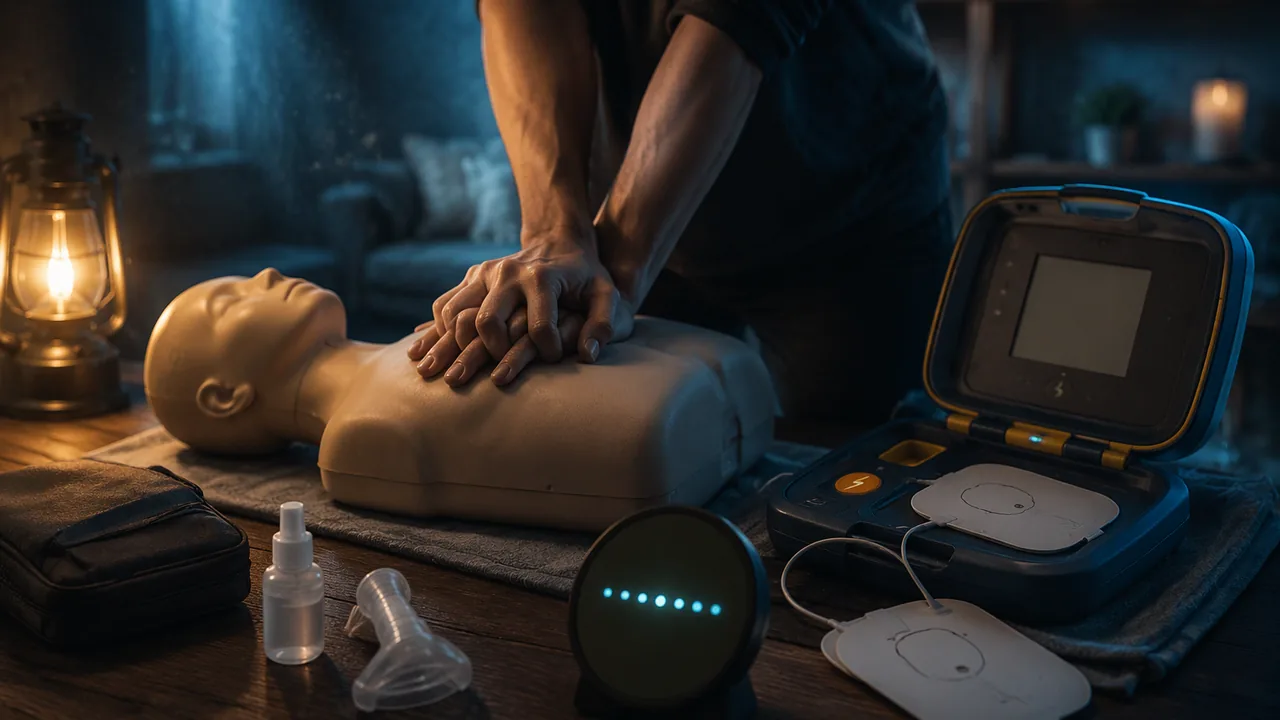
recognize cardiac arrest, choking and opioid overdose; complete Missouri’s 30 minutes of CPR and choking instruction with timed hands-on practice of hands-only CPR at the correct rate and depth; and explain the steps for using an AED and giving nasal naloxone.
Instruction
Why bystanders matter. CDC reports that more than 356,000 people in the United States have a cardiac arrest outside a hospital every year, and about 60% to 80% of them die before reaching the hospital. In cardiac arrest the heart’s electrical system fails and it stops pumping; within minutes the brain is starved of oxygen. Immediate chest compressions keep some blood moving to the brain until a defibrillator and paramedics arrive, and a bystander — often a family member at home — is almost always first on the scene.
What Missouri requires, and how you will meet it at home. Missouri law (RSMo 170.310) says that by graduation every Missouri public high school student must have received thirty minutes of CPR instruction and training in the Heimlich maneuver or other first aid for choking, based on an American Heart Association or American Red Cross program and including psychomotor skills — hands-on practice and skills testing. RLP students complete the same thirty minutes at home in this lab: you read and follow the steps, practice compressions with your own hands on a firm cushion timed to a metronome, rehearse the choking and AED steps, and test yourself, keeping a timed log that a parent or guardian signs. This is awareness and skills practice, not certification. The law itself says instruction not designed to certify does not need a certified trainer; a CPR/First Aid/AED card can be issued only by an authorized CPR trainer (for example, through the American Red Cross or the American Heart Association) after an in-person skills check, and taking such a class is a good next step.
Hands-only CPR for a teen or adult who suddenly collapses. These steps follow the American Red Cross Hands-Only CPR page and the 2025 American Heart Association Guidelines for CPR and Emergency Cardiovascular Care, in our own words.
- Check the scene is safe — traffic, fire, electricity. You can’t help if you become a second patient.
- Check the person. Tap their shoulder and shout “Are you OK?” Look for normal breathing for no more than about 10 seconds. Occasional gasps are not normal breathing; they are common in cardiac arrest.
- Call 911 and get an AED. Put the phone on speaker, or point at a specific person: “You — call 911. You — find the AED.” The dispatcher will coach you.
- Push hard and fast in the center of the chest. The person should be on their back on a firm, flat surface; kneel beside them. Place the heel of one hand in the center of the chest, the other hand on top with fingers interlaced and lifted off the chest, elbows locked and shoulders directly over your hands. Push down at least 2 inches (5 cm) but not more than about 2.4 inches (6 cm), at a rate of 100 to 120 compressions per minute. Let the chest come all the way back up between compressions — that is when the heart refills. A song at 100-120 beats per minute, such as “Stayin’ Alive”, or a free metronome app set to 110 keeps the tempo.
- Don’t stop except to let the AED analyze or shock. Keep going until paramedics take over, the person starts breathing normally, or you are physically unable to continue. If someone else knows how, switch about every 2 minutes; compressions get shallow as you tire.
The AED. An automated external defibrillator analyzes the heart’s rhythm and, if needed, delivers a shock to reset it. Turn it on and follow its voice prompts. The Red Cross steps: remove clothing covering the chest and wipe it dry if needed; place one pad on the upper right chest and the other on the lower left side, a few inches below the armpit; make sure no one is touching the person and say “Clear!” while it analyzes; if it advises a shock, say “Clear!” again and press the shock button; then start compressions again immediately. You cannot shock someone who doesn’t need it; the machine decides. AEDs are often found in gyms, churches, stores, airports and workplaces — notice where they are in the places you go.
Choking. A person who is choking severely cannot speak, cough or breathe. Ask “Are you choking?” If they nod or cannot answer, call 911 (or have someone call) and act. The 2025 American Heart Association guidance for adults and children: give 5 back blows with the heel of your hand between the shoulder blades, with the person leaning forward; if that does not clear the object, give 5 abdominal thrusts (the Heimlich maneuver) — stand behind them, make a fist and place it just above the navel, grab it with your other hand, and press in with a quick, upward thrust, each thrust a separate movement. Keep alternating 5 back blows and 5 abdominal thrusts until the object comes out or the person becomes unresponsive; if they become unresponsive, lower them to the floor and begin CPR. Infants get back blows and chest thrusts instead, a skill for a certification course. Never practice back blows or thrusts with force on a real person — you could injure them. In this lab you rehearse hand position on a cushion or pillow.
When breaths matter. For infants and children, and for people who have drowned or overdosed, CPR with rescue breaths is recommended — a skill taught in a certification course. If you are not trained in breaths, compressions alone are still far better than doing nothing.
Opioid overdose and naloxone. Signs include very small (“pinpoint”) pupils; falling asleep or losing consciousness; slow, weak or no breathing; choking or gurgling sounds; a limp body; and cold or clammy skin. CDC says naloxone blocks the effects of opioids and can restore normal breathing within 2 to 3 minutes; it is available over the counter in all 50 states (the FDA approved nasal naloxone for nonprescription use in March 2023), and stronger opioids such as fentanyl may need more than one dose. Missouri law (RSMo 195.206) allows any person to possess naloxone, lets pharmacists dispense it under a statewide standing order, requires anyone who gives it to contact emergency personnel immediately, and protects a person who gives it in good faith from prosecution and civil liability. The response: try to wake the person and shout their name; call 911; give one spray of nasal naloxone into one nostril; if they don’t respond within 2 to 3 minutes, give a second dose in the other nostril. If they are not breathing, begin CPR. If they are breathing, put them on their side in the recovery position so they won’t choke. Stay with them: naloxone can wear off before the opioid does, and CDC advises staying until emergency help arrives or for at least four hours.
📖 Read for this lesson
The reading opens over the lesson; close it to come back to exactly where you were. The checks below draw on it.
Lab: At-Home Emergency Response Lab: 30 Minutes of Hands-Only CPR, Choking, AED and Naloxone Practice
Question. Can I recognize cardiac arrest, choking and opioid overdose and perform hands-only CPR at the correct rate and depth, and the choking, AED and naloxone steps in the right order, under time pressure?
Materials
- A firm cushion, couch cushion or tightly folded firm pillow, placed on the floor (or a CPR training manikin if your family can borrow or buy one)
- A ruler or tape measure, and a marker or piece of tape to mark 2 inches and 2.4 inches on it
- A phone or tablet with a free metronome app set to 110 beats per minute, or a 100-120 bpm song, plus a timer and (optional) a phone stand to record yourself
- Two sheets of paper and tape to make practice AED pads, and a printed or drawn copy of the AED pad diagram from the reading
- The practice log, scenario cards and skills checklist from the reading
- Optional: a naloxone nasal spray training device; never use real naloxone for practice
- Practice compressions only on the cushion or a manikin; never perform compressions, back blows, abdominal thrusts or a sternal rub on a family member, friend or pet.
- Kneel on a carpet or folded towel and stop if your wrists, shoulders or back hurt; you may do compressions in shorter rounds or complete the verbal sequence and dispatcher-coaching role instead, at equal credit.
- Use no real medication and no real AED: practice pads are paper, and naloxone practice is the hand motion or a training device only.
- A parent or guardian should know you are doing the lab; if they are home, they may watch, count or film your test.
- Some students may find overdose scenarios distressing. You may pause at any time and talk with a parent or guardian, a trusted adult or the RLP student-support contact; if you need support right now, call or text 988.
Procedure
- Set up (about 3 minutes, start your log clock now): put the cushion on the floor, mark 2 inches and 2.4 inches on the ruler and stand it upright next to the cushion, set the metronome to 110, and set up your phone to record if you are filming.
- Instruction (about 7 minutes): read Sections 1-4 of the reading aloud, then say the hands-only CPR sequence from memory — scene, check, call, push, don’t stop — with the reason for each step. Check yourself against the table.
- Compression practice (about 10 minutes): kneel beside the cushion, hands in position, elbows locked, shoulders over hands. Do three 2-minute rounds of compressions to the metronome, resting 1 minute between rounds. In each round, push so the top of the cushion moves at least to the 2-inch mark but not past 2.4 inches, and let it come all the way back up. Count aloud by tens.
- Choking practice (about 4 minutes): read the choking steps aloud. Using the cushion held upright against a chair as the ‘person,’ rehearse the hand positions and the motion slowly, without force: 5 back blows with the heel of the hand between the ‘shoulder blades,’ then a fist just above the ‘navel’ with the other hand over it for 5 upward thrusts, then alternate. Then say the steps for when the person becomes unresponsive.
- AED and naloxone walk-through (about 4 minutes): run Scenario Card A aloud on the cushion — check, call 911 (role-played; do not dial), compress, ‘turn on’ the AED, place the paper pads in the diagram positions, say ‘Clear!’, resume compressions. Then run Card C: name the overdose signs, role-play the 911 call, do the nasal spray motion (or training device) for dose 1, count 2-3 minutes (compressed to 20 seconds), dose 2, and roll the cushion onto its side for the recovery position.
- Skills test (about 3 minutes): one timed 2-minute round of compressions to the metronome, recorded on video or watched and counted by a family member if one is available. Afterward, count the compressions in one 30-second stretch of the video (or have your counter do it), multiply by 2 for a per-minute rate, and score yourself on the checklist.
- Log and sign-off: write the start and end times of each part; the total must be at least 30 minutes. A parent or guardian signs the log to confirm you completed it. Keep the video only if you choose to; you may submit the scored checklist instead.
Data
| Criterion | Target | Round 1 | Round 2 | Round 3 | Test |
|---|---|---|---|---|---|
| Compression rate | 100-120 per minute (on beat with the 110 metronome) | ||||
| Compression depth | Cushion top reaches the 2-in mark but not past 2.4 in | ||||
| Full recoil | Cushion returns fully each time | ||||
| Hand and body position | Heel of hand center of chest, fingers lifted, elbows locked, shoulders over hands | ||||
| Choking sequence | Ask, call, 5 back blows, 5 abdominal thrusts, alternate; CPR if unresponsive | ||||
| Naloxone sequence | Signs named, 911, dose 1, wait, dose 2, recovery position, stay | ||||
| Total practice time | At least 30 minutes, logged and signed | ||||
Analysis
- Compare your three compression rounds and your test. What changed in rate, depth or recoil as you tired, and what does that explain about switching compressors every 2 minutes?
- Explain why full recoil and short pauses matter, using what you know about how the heart refills and pumps.
- Explain why choking care alternates back blows and abdominal thrusts, and why you must never practice them with force on a real person.
- In the naloxone scenario, why do you call 911 even if the person wakes up after the first dose?
- A cushion is not a chest. Name one thing this practice could not test and how a certified class with a feedback manikin would test it.
If you cannot do this lab in person: If kneeling or compressions are not possible for you, complete the 30 minutes with the instruction, the verbal sequence, the dispatcher-coaching role (talking an imagined bystander through each step) and the choking and AED walk-throughs, and note this on your log. If your family can arrange it, an in-person class or skills session with the American Red Cross, the American Heart Association or a local fire department adds manikin practice with rate and depth feedback, and can lead to certification.
Formative check
Work through these before moving on. They are not graded — they tell you whether the standard below has landed yet.
Under the current guidelines described in this lesson, adult chest compressions should be:
Completing this lesson certifies you in CPR.
You give naloxone to someone with overdose signs and they begin breathing after 3 minutes. What next?
Occasional after a collapse are not normal breathing; start CPR.
For an adult who is choking severely, give 5 blows, then 5 abdominal thrusts, and keep alternating until the object comes out or the person becomes .
How confident are you that you can perform hands-only CPR and give the choking, AED and naloxone steps in the right order?
At-Home Emergency Response Lab: The 30-Minute Plan, the Sequences With Their Reasons, Scenario Cards, the Practice Log and the Skills Checklist
SLS original 30-minute plan, scenario cards, practice log, checklist and explanations in our own words. Compression steps: American Red Cross, Hands-Only CPR for Adults and Adult CPR Steps; AED steps: American Red Cross, How to Use an AED (all retrieved 2026-11-06). Choking and lay-rescuer naloxone: American Heart Association, 2025 Interim Training Materials: BLS Provider Manual Changes (retrieved 2026-11-06). Compression depth upper limit of 2.4 inches: 2025 American Heart Association Guidelines for CPR and ECC, Part 7: Adult Basic Life Support (Circulation, 2025; retrieved 2026-09-26; AHA pages refused automated access on 2026-11-06). CDC, Cardiac Arrest (page dated May 15, 2024) and Naloxone; FDA, first OTC naloxone nasal spray approval, March 29, 2023; RSMo 170.310 and 195.206. This reading teaches and practices the skill; it does not certify anyone. · SLS original; facts from U.S. and Missouri public sources and American Red Cross and American Heart Association guidance summarized in our own words
Why this reading. Missouri requires 30 minutes of CPR and choking instruction with hands-on practice before high school graduation, and this lab is how you complete it at home. Here are the law, the 30-minute plan, the hands-only CPR, AED, choking and naloxone sequences with the reason for each step, three scenario cards, the practice log, the checklist with targets, and what to write in your analysis. The cards are SLS original and fictional. This does not certify you in CPR: a card can be issued only by an authorized CPR trainer after an in-person skills check.
1. Why bystanders matter, and what Missouri requires
CDC: more than 356,000 people have an out-of-hospital cardiac arrest in the United States every year, and about 60% to 80% of them die before reaching the hospital (CDC, May 15, 2024). Cardiac arrest is when the heart abruptly stops beating; a heart attack is different.
RSMo 170.310 (effective August 28, 2023), in summary: by graduation, Missouri public high school students must have received thirty minutes of CPR instruction and training in the Heimlich maneuver or other first aid for choking, at any time during high school. Instruction must be based on an American Heart Association or American Red Cross program, or another nationally recognized program based on current evidence-based guidelines, and must include psychomotor skills, which the law defines as “the use of hands-on practicing and skills testing to support cognitive learning.” Instruction that does not lead to certification does not have to be given by a certified CPR trainer; instruction designed to lead to certification must be given by an authorized CPR trainer. Schools may arrange hands-on practice with first responders. How RLP meets it: this at-home lab gives at least 30 timed minutes of instruction and hands-on practice with a skills test, logged and signed by a parent or guardian. An in-person class adds manikin feedback and can lead to a certification card.
2. The 30-minute plan and practice log
| Part | What you do | Planned minutes | Start | End |
|---|---|---|---|---|
| 1. Set up | Cushion on floor, ruler marked at 2 in and 2.4 in, metronome at 110, phone ready | 3 | ||
| 2. Instruction | Read Sections 3-6 aloud; say the CPR sequence from memory with reasons | 7 | ||
| 3. Compressions | Three 2-minute rounds with 1-minute rests | 10 | ||
| 4. Choking | Hand positions and motions on the cushion, slowly, no force | 4 | ||
| 5. AED and naloxone | Scenario Cards A and C on the cushion | 4 | ||
| 6. Skills test | One timed 2-minute round, recorded or counted, then self-scored | 3 | ||
| Total (must be at least 30) | 31 | |||
Parent or guardian signature: ____________________ Date: ________ I confirm the student completed the practice above. If you need longer, take it; the total is a minimum.
3. Hands-only CPR: the sequence and the reason for each step (adult or teen who suddenly collapses)
| Step | What you do | Why |
|---|---|---|
| 1. Scene | Make sure it is safe (traffic, fire, electricity) | A second patient does not help |
| 2. Check | Tap the shoulder and shout “Are you OK?”; look for normal breathing for no more than about 10 seconds; occasional gasps are not normal breathing | Gasping can occur in cardiac arrest and is not effective breathing |
| 3. Call | Call 911, speaker on; point to a specific person to call and one to find the AED | Help and a defibrillator take time; the dispatcher coaches you |
| 4. Push | Person on their back on a firm, flat surface; kneel beside them. Heel of one hand in the center of the chest, other hand on top, fingers interlaced and lifted; elbows locked, shoulders directly over hands. Push at least 2 inches (5 cm) but not more than about 2.4 inches (6 cm) at 100 to 120 compressions per minute; let the chest come all the way back up | Compressions squeeze blood to the brain; recoil lets the heart refill; too shallow does not circulate blood, too deep can injure |
| 5. Don’t stop | Keep going except for the AED to analyze or shock; switch about every 2 minutes if someone else can | Pauses stop blood flow; rescuers tire and get shallow |
Rate and minimum depth: American Red Cross, Hands-Only CPR for Adults (“at least 2 inches; 100 to 120 compressions per minute”). Upper limit of about 2.4 inches (6 cm): 2025 American Heart Association Guidelines, Part 7. A metronome app set to 110 sits in the middle of the range; a song at 100-120 beats per minute, such as “Stayin’ Alive,” also works.
Practicing at home on a cushion. A cushion is not a chest, so it cannot tell you exactly how deep you would push on a person. It does let you practice the parts that matter most and are hardest to keep up: hand and body position, a steady rate on the beat, pushing with your body weight through locked arms, and letting it come fully back up. Stand the marked ruler next to the cushion and watch (or film) whether the top of the cushion reaches the 2-inch mark without passing 2.4 inches. To check your rate on video, count the compressions in any 30 seconds and multiply by 2: for example, 56 in 30 seconds × 2 = 112 per minute, inside the 100-120 target; 47 × 2 = 94, too slow.
4. The AED (American Red Cross steps, in our words)
For an adult, or a child aged 8 or older who weighs more than 55 pounds: complete the check and call steps; as soon as an AED arrives, turn it on and follow the voice prompts. Remove clothing covering the chest and wipe it dry if needed. Place one pad on the upper right side of the chest and the other on the lower left side, a few inches below the left armpit (if the pads may touch, one goes in the middle of the chest and one on the back between the shoulder blades). Plug in the connector if needed. Make sure no one is touching the person and say “Clear!” while it analyzes. If it advises a shock, make sure no one is touching, say “Clear!” and push the shock button. Right after the shock, or if no shock is advised, start compressions again. The machine decides whether a shock is needed; you cannot shock someone who does not need it.
Practice pads. Draw an outline of a torso on paper or use the cushion; tape one paper pad high on the right and one low on the left below the armpit, then say each prompt aloud.
5. Choking: back blows and abdominal thrusts
Recognize it. Severe choking means the person cannot speak, cough or breathe. Ask “Are you choking?” and tell them you will help. Have someone call 911, or call yourself on speaker. 2025 American Heart Association guidance for adults and children: give 5 back blows, using the heel of your hand to strike forcefully between the shoulder blades while the person leans forward. If back blows do not relieve the choking, give 5 abdominal thrusts: stand behind the person, make a fist with one hand and place it just above the navel, grab it with your other hand, and press into the abdomen with a quick, forceful upward thrust, each thrust a separate, distinct movement. Continue alternating 5 back blows and 5 abdominal thrusts until the object is dislodged or the person becomes unresponsive. If they become unresponsive, lower them to the floor, make sure 911 has been called, and begin CPR. Infants receive back blows alternated with chest thrusts, which is taught in a certification course.
How to practice safely. Never practice back blows or thrusts with force on a person; real thrusts can injure someone who is not choking. Stand a cushion upright against a chair back as your “person.” Rehearse slowly: the lean, five gentle taps with the heel of the hand between the “shoulder blades,” then the fist just above the “navel,” the other hand over it, and the in-and-up motion five times, then alternate. Say each step aloud as you do it.
6. Opioid overdose and naloxone
Signs: small “pinpoint” pupils, falling asleep or losing consciousness, slow or shallow breathing or none, choking or gurgling sounds, a limp body, cold or clammy skin. Naloxone quickly reverses an overdose by blocking the effects of opioids; it can restore normal breathing within 2 to 3 minutes in a person whose breathing has slowed or stopped; stronger opioids such as fentanyl may require more than one dose (CDC). It comes as a nasal spray and an injectable; the FDA approved the first over-the-counter nasal spray (Narcan, 4 mg) on March 29, 2023, and CDC says naloxone is available over the counter in all 50 states. Missouri law (RSMo 195.206): any person may possess naloxone; licensed pharmacists may sell and dispense it under a statewide standing order; anyone who gives naloxone to another person must immediately contact emergency personnel; and a person who, in good faith and with reasonable care, gives naloxone to someone they believe is having an opioid overdose is immune from criminal prosecution and civil liability for giving it. What to do: try to wake the person and shout their name; call 911; give one spray into one nostril; if there is no response in 2 to 3 minutes, give a second dose in the other nostril; if they are not breathing, begin CPR (the 2025 AHA guidance says giving naloxone to someone in cardiac arrest from a suspected opioid overdose may be reasonable only if it does not interfere with high-quality CPR); if breathing, place them on their side. Stay: CDC advises staying with the person until emergency help arrives or for at least four hours, because breathing can slow again after naloxone wears off. Missouri’s Good Samaritan law is in Lesson 3.3.
7. Scenario cards (SLS original, fictional)
- Card A, community gym: A man collapses during a pickup basketball game. He does not answer, and his chest is not rising. A friend is with you; there is an AED by the front desk. Expected: scene, check, call 911, send your friend for the AED, compress, AED prompts, keep going.
- Card B, family dinner: Your uncle suddenly stands up, clutching his throat. He cannot speak or cough. Expected: ask “Are you choking?”; have someone call 911; 5 back blows, 5 abdominal thrusts, alternate; if he becomes unresponsive, lower him to the floor and begin CPR.
- Card C, a friend’s house (naloxone): A person has tiny pupils, is very hard to wake, and breathes slowly with a gurgling sound. Someone has nasal naloxone. Expected: name the signs; call 911; give the first spray; wait 2-3 minutes (compressed to 20 seconds in the lab); second dose in the other nostril; if not breathing, CPR; if breathing, recovery position; stay until help arrives.
8. Checklist and targets
| Criterion | Target |
|---|---|
| Compression rate | 100-120 per minute |
| Compression depth | Cushion reaches the 2-in mark, not past 2.4 in (on a person: at least 2 in, not more than about 2.4 in) |
| Full recoil | Returns fully each time |
| Hand and body position | Heel of hand, center of chest, fingers lifted, elbows locked, shoulders over hands |
| Hands-off time | As short as possible; count the seconds |
| Choking sequence | Ask, call, 5 back blows, 5 abdominal thrusts, alternate; CPR if unresponsive |
| Naloxone sequence | Signs named, 911, dose 1, wait, dose 2, recovery position, stay |
| Total time | At least 30 minutes, logged and signed |
9. Analysis prompts, answered in outline
- Tiring: after a minute or two, rate and depth typically drift. That is why the sequence says to switch every 2 minutes.
- Recoil and pauses: the heart refills only when the chest comes back up, and blood flow stops whenever compressions stop.
- Choking: alternating back blows and abdominal thrusts gives two different ways to dislodge the object, which is what the 2025 AHA guidance recommends. Forceful thrusts can injure a person who is not choking, so practice is hand position only.
- Why call 911 even if the person wakes: naloxone can wear off before the opioid does, so breathing can slow again; Missouri law also requires anyone who gives naloxone to contact emergency personnel.
- What a cushion cannot test: true chest depth and the stiffness of a real chest; a feedback manikin in a certified class measures rate, depth and recoil.
Sources: RSMo 170.310, CPR instruction and training, grades 9-12 (revisor.mo.gov); American Red Cross, Hands-Only CPR for Adults (redcross.org); American Red Cross, How to Perform CPR: Adult CPR Steps (redcross.org); American Red Cross, How to Use an AED (redcross.org); American Heart Association, 2025 Interim Training Materials: BLS Provider Manual Changes (heart.org); 2025 AHA Guidelines, Part 7: Adult Basic Life Support (ahajournals.org); CDC, Cardiac Arrest (cdc.gov); CDC, Naloxone (cdc.gov); FDA, Approves First Over-the-Counter Naloxone Nasal Spray (fda.gov); RSMo 195.206, opioid antagonist possession, dispensing and administration (revisor.mo.gov)