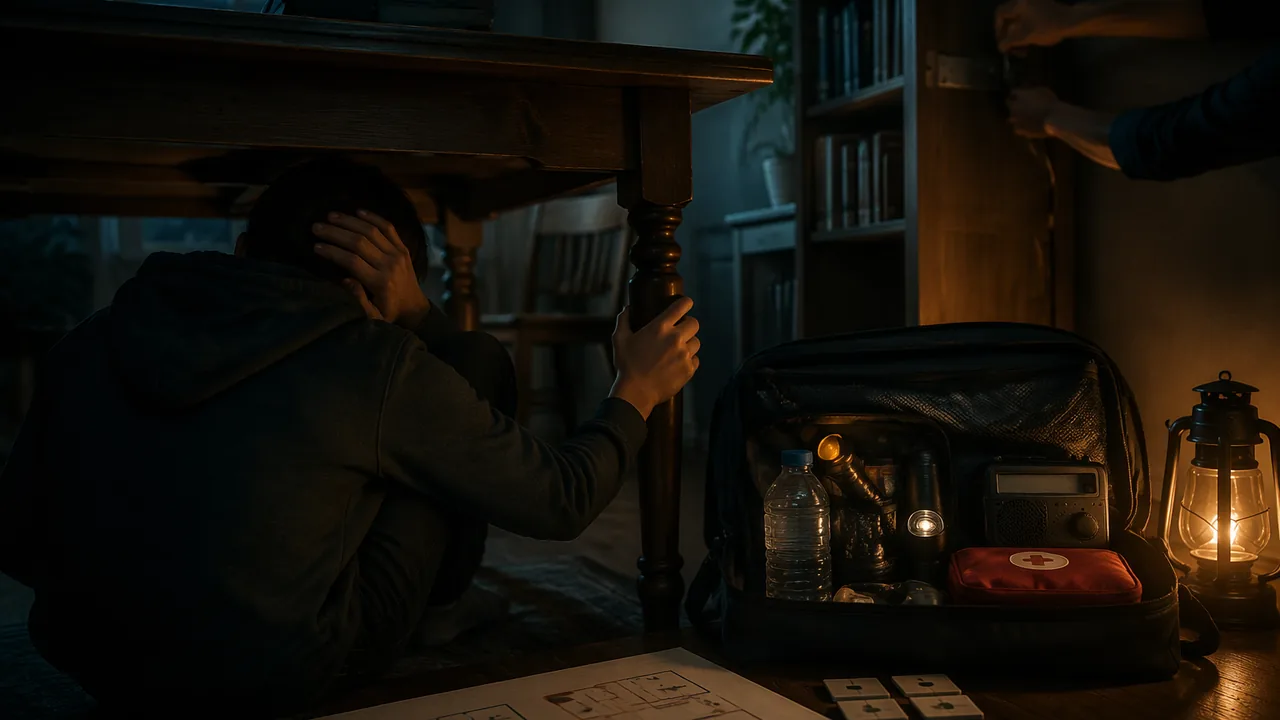
explain how to stay safe in a tornado, an earthquake, a flood, extreme heat and a sports concussion, and write an emergency plan for a household using public-agency guidance.
Instruction
Missouri’s hazards are predictable, even when their timing isn’t. Tornadoes and severe storms, river and flash floods, extreme summer heat and earthquakes from the New Madrid Seismic Zone all recur here. Injury prevention means doing the planning while things are calm, so the right action is automatic when they are not.
Tornadoes. On May 22, 2011, an EF5 tornado with winds over 200 miles per hour struck Joplin, killing almost 160 people and injuring more than 1,000 (National Weather Service). Ready.gov’s guidance: sign up for local alerts and know your sirens; pick your shelter in advance — a safe room or storm shelter, or else a small, interior, windowless room or basement on the lowest floor of a sturdy building; when a warning is issued, go there immediately, stay away from windows and outside walls, and cover your head and neck with your arms. A car is never a safe place in a tornado.
Earthquakes. USGS says the New Madrid Seismic Zone in southeastern Missouri produced three earthquakes estimated at magnitude 7 to 8 in 1811-1812, and estimates a 25-40% chance of a magnitude 6.0 or greater earthquake there in the next 50 years. The recommended action in most situations is Drop, Cover and Hold On (Ready.gov and SEMA, the Missouri State Emergency Management Agency): drop to your hands and knees, cover your head and neck under a sturdy table or desk (or against an interior wall with your arms), and hold on until the shaking stops. Do not run outside or stand in a doorway; many injuries come from falling objects and glass. To prepare, SEMA advises bolting bookcases to wall studs, securing the water heater and moving heavy objects to low shelves.
Floods. The Mississippi River at St. Louis crested at a record 49.58 feet on August 1, 1993, and flash floods can come with little warning. Ready.gov: just six inches of moving water can knock you down, and one foot can sweep a car away. Turn Around, Don’t Drown — never walk, swim or drive through flood water. Check whether your address is in a flood zone on FEMA’s Flood Map Service Center, but remember flooding doesn’t follow lines on a map.
Extreme heat and air quality. Missouri summers bring dangerous heat and humidity. Ready.gov lists the signs of heat stroke — a body temperature above 103°F; red, hot, dry skin; a rapid, strong pulse; dizziness, confusion or unconsciousness — as a 911 emergency. Don’t rely on a fan alone, find a cooling center if you have no air conditioning, drink plenty of fluids, avoid hard activity at midday, never leave a person or pet in a closed car, and check on older neighbors. On hot days, ozone and fine particles can also build up; check the Air Quality Index on AirNow.gov (EPA), especially for anyone with asthma, and limit outdoor exercise when it is unhealthy.
Sports concussions. A concussion is a brain injury caused by a blow or jolt to the head or body that makes the brain move rapidly inside the skull. CDC’s HEADS UP program lists symptoms such as headache, being bothered by light or noise, trouble concentrating, and changes in mood and sleep; loss of consciousness is not required. Missouri’s Interscholastic Youth Sports Brain Injury Prevention Act (RSMo 167.765) requires that a school athlete suspected of a concussion be removed from play for at least 24 hours and not return until evaluated and cleared in writing by a licensed health care provider trained in concussions. If you play on a club or community team, follow the same rule. Athletes often hide symptoms to keep playing; a second injury before the brain heals can be much more serious.
Everyday injury prevention. Seat belts in every seat, helmets for bikes and scooters, protective gear in sports, and protecting your eyes, ears and teeth all come from the same idea: reduce exposure before the event. Hearing damage from loud sound is permanent, so lower the volume and use ear protection around loud machinery or concerts.
The writing task. Write a household emergency plan. Choose whose. All three earn full credit, and you share only what you choose to share. Option A — your own household, at your own address. Option B — the Okonkwo household, Joplin, Jasper County: two adults, a fifteen-year-old, a seven-year-old, a grandmother who uses a walker and takes daily medication, one car, a rented single-story house with no basement, no air conditioning. Option C — the Delgado-Tran household, St. Louis: one adult who works nights, a sixteen-year-old, a ten-year-old with asthma, a cat, a third-floor apartment, no car, travel by bus. For Option B or C, the reading gives sourced hazard profiles; for your own address use SEMA (sema.dps.mo.gov), the FEMA Flood Map Service Center (msc.fema.gov), AirNow (airnow.gov), the National Weather Service (weather.gov) and Ready.gov. Do not assume which hazards apply — look them up and cite what you found. Include: the two hazards most likely where the household lives, with the official source for each; where the household shelters for a tornado warning; a meeting place and an out-of-area contact; the go-bag list; what each person does in an earthquake; how the household will handle extreme heat and check air quality; and one step to prevent a common injury at home. Write it as an explanatory text a family member could follow, citing each official source you used.
📖 Read for this lesson
The reading opens over the lesson; close it to come back to exactly where you were. The checks below draw on it.
Formative check
Work through these before moving on. They are not graded — they tell you whether the standard below has landed yet.
Strong shaking starts while you’re working at your desk at home. What should you do?
A tornado warning is issued for your county and your house has no basement. Where is the best place to go?
An athlete must lose consciousness to have a concussion.
To check whether ozone or smoke makes outdoor exercise unsafe for someone with asthma, read the Air Quality (AQI) category for the day, using the table in the lesson’s reading.
Draft the tornado, earthquake and heat sections of your household emergency plan (real or fictional household). Cite the official source for each step.
How confident are you that you can write an emergency plan for Missouri hazards using official guidance?
Workshop File: Missouri Hazard Guidance, the EPA Air Quality Index Table, Two Missouri Household Profiles With Sourced Hazards and a Model Plan
Ready.gov, Tornadoes, Earthquakes, Floods, Extreme Heat, Build a Kit and Make a Plan; SEMA news release, Missouri observes Earthquake Awareness Month (February 5, 2024); USGS, New Madrid Seismic Zone; NWS Heritage, Tragedy at Joplin: The EF-5 of May 22, 2011; NWS St. Louis, The Great Flood of 1993; EPA, Final Updates to the AQI for Particulate Matter (fact sheet, effective May 6, 2024); AirNow, AQI Basics; CDC HEADS UP (page dated September 15, 2025); RSMo 167.765. Household profiles B and C come from the lesson; the model plan is SLS original. Retrieved 2026-11-06. · Public domain (U.S. and Missouri government works); model plan SLS original
Why this reading. The workshop asks you to write a household emergency plan with a cited official source for each step. Here is the official guidance for each Missouri hazard, the Air Quality Index table, sourced hazard profiles for the two households in the lesson (so you do not have to guess what applies), and a model plan to copy the structure of. The Okonkwo, Delgado-Tran and Hart households are fictional. If you plan for your own household, use the tools named in Section 9 to look up your own address, and share only what you choose to.
1. Tornadoes (Ready.gov)
Tornadoes are fast-spinning columns of air that reach from a thunderstorm down to the ground; they can bring winds over 200 miles per hour, and the Midwest and the Southeast have a greater risk. Before: sign up for your community’s warning system, learn your siren tone, and pay attention to weather reports and NOAA Weather Radio; identify and practice going to a safe shelter, such as a safe room built to FEMA criteria or a storm shelter built to ICC 500 standards; the next best protection is a small, interior, windowless room or basement on the lowest level of a sturdy building. Signs include a rotating, funnel-shaped cloud, an approaching cloud of debris, or a loud roar like a freight train. Under a warning: go to your safe location immediately; stay away from windows, doors and outside walls; protect your head and neck with your arms and cover yourself with furniture or blankets; go to a public shelter if you cannot stay at home. In a car there is no safe option, only less dangerous ones.
2. Earthquakes: Drop, Cover and Hold On (Ready.gov and SEMA)
Drop where you are onto your hands and knees. Cover your head and neck with one arm and hand, and crawl under a sturdy table or desk if there is one. Hold On until the shaking stops. Indoors, stay put; do not run outside, and avoid doorways. In bed, turn face down and cover your head and neck with a pillow. In a car, pull over, stop and set the parking brake. Outdoors, move to an open area away from buildings, trees, streetlights and power lines. Afterward expect aftershocks, do not enter damaged buildings, and if trapped, send a text or bang on a pipe or wall and use a whistle instead of shouting. Before (SEMA): bolt bookcases to wall studs, latch cupboards and secure the water heater; move heavy objects from high shelves to low ones; assemble a kit; make a family communication plan with an out-of-area contact at least 100 miles away; learn how to shut off gas and water; and know that most homeowner insurance does not include earthquake coverage.
Missouri’s risk. USGS: the New Madrid Seismic Zone spans southeastern Missouri, northeastern Arkansas and parts of Tennessee and Kentucky. In 1811-1812 it produced three very large earthquakes estimated between magnitude 7 and 8, the first at 2:15 a.m. on December 16, 1811; they destroyed Mississippi River settlements, caused minor damage in St. Louis and were felt as far away as New Orleans. USGS estimates a 25-40% chance of a magnitude 6.0 or greater earthquake in the zone in the next 50 years and about a 7-10% chance of a repeat of the 1811-1812 sequence. SEMA says the area averages more than 200 earthquakes a year, most too small to feel, and Missouri observes Earthquake Awareness Month each February.
3. Floods (Ready.gov)
Floods can develop slowly or quickly; flash floods can come without warning. Do not walk, swim or drive through flood waters: Turn Around, Don’t Drown! Just six inches of moving water can knock you down, and one foot of moving water can sweep your vehicle away. Stay off bridges over fast-moving water. Depending on the flood, evacuate if told to, move to higher ground or a higher floor, or stay where you are. If trapped in a building, go to the highest level; do not climb into a closed attic. Check your flood risk on FEMA’s Flood Map Service Center, but remember that flooding does not follow lines on a map: where it rains, it can flood. Missouri example: the Mississippi River at St. Louis reached a record crest of 49.58 feet on August 1, 1993, nearly 20 feet above flood stage, and stayed above the previous record for more than three weeks (NWS St. Louis).
4. Extreme heat (Ready.gov)
Older adults, children and people with certain illnesses and chronic conditions are at greater risk, and humidity increases the feeling of heat. Before: do not rely on a fan as your primary cooling device; identify places to get cool, such as libraries and shopping malls, or ask your local health department about cooling options; cover windows with drapes or shades. During: never leave people or pets in a closed car on a warm day; if there is no air conditioning, find a cooling center; take cool showers; wear loose, light-colored clothing; drink plenty of fluids; avoid high-energy activity at midday; check on family, older adults and neighbors. Heat stroke signs: body temperature above 103°F; red, hot and dry skin with no sweat; rapid, strong pulse; dizziness, confusion or unconsciousness. Call 911, move the person somewhere cool and shaded, and cool them with cold, wet cloths or ice packs on the head, neck, armpits and groin. Heat exhaustion signs include heavy sweating, paleness, cramps, tiredness, weakness, dizziness, headache, nausea and fainting.
5. Air quality and the Air Quality Index
Hot, sunny days can raise ground-level ozone, and fine particles (PM2.5) from smoke or pollution can reach deep into the lungs; both matter most for people with asthma or heart and lung conditions.
| AQI color and category | AQI value | Meaning (AirNow) | Fine particle (PM2.5) 24-hour breakpoints, µg/m³ (EPA, effective May 6, 2024) |
|---|---|---|---|
| Green, Good | 0-50 | Air quality is satisfactory; little or no risk | 0.0 to 9.0 |
| Yellow, Moderate | 51-100 | Acceptable; some risk for people unusually sensitive to air pollution | 9.1 to 35.4 |
| Orange, Unhealthy for Sensitive Groups | 101-150 | Members of sensitive groups may experience health effects | 35.5 to 55.4 |
| Red, Unhealthy | 151-200 | Some members of the general public may experience health effects; sensitive groups more serious effects | 55.5 to 125.4 |
| Purple, Very Unhealthy | 201-300 | Health alert: risk increased for everyone | 125.5 to 225.4 |
| Maroon, Hazardous | 301+ | Health warning of emergency conditions; everyone more likely to be affected | 225.5 and above |
Before May 6, 2024 the Good/Moderate PM2.5 breakpoint was 12.0 µg/m³ and the upper categories were different, so an older chart may not match a current reading. A household plan can say: “On hot summer days we check the AQI each morning; at Orange or worse the child with asthma stays indoors with windows closed, and at Red or worse everyone limits outdoor activity.” Deciding your own thresholds is part of the task; the categories above are the official meanings.
6. Sports concussions
CDC HEADS UP: concussion symptoms fall into physical (such as headache, or being bothered by light or noise), thinking and remembering (such as attention or concentration problems), social or emotional, and sleep groups, and may not show up right away. Call 911 or go to the emergency department for danger signs such as convulsions or seizures, a headache that gets worse and does not go away, or loss of consciousness with increasing drowsiness or inability to wake up. Missouri law. The Interscholastic Youth Sports Brain Injury Prevention Act (RSMo 167.765) requires each school district to give every athlete a concussion information sheet each year, signed by a parent or guardian before practice or play; a youth athlete suspected of a concussion in a practice or game must be removed from competition at that time and for no less than 24 hours, and may not return until evaluated by a licensed health care provider trained in concussions and cleared in writing by that provider. The law applies to school athletic programs; if you play on a club or community team, follow the same rule.
7. Household emergency planning (Ready.gov)
Plan: meet with your household and answer five questions: How will we receive emergency alerts and warnings? What is our shelter plan? What is our evacuation route? What is our household communication plan? Do we need to update our emergency kit? Customize the plan to ages, responsibilities, medical needs, disabilities, pets and languages; establish a meeting place that is familiar and easy to find, and an out-of-area contact. Kit: water (one gallon per person per day for several days, for drinking and sanitation), at least a several-day supply of non-perishable food, a battery-powered or hand-crank radio and NOAA Weather Radio with tone alert, flashlight, first aid kit, extra batteries, whistle, dust mask, plastic sheeting, scissors and duct tape, moist towelettes and garbage bags, wrench or pliers, manual can opener, local maps, and a cell phone with chargers and a backup battery; plus prescription medications, eyeglasses, pet food and water, important documents in a waterproof container, cash, a change of clothing and sturdy shoes.
8. The two households in the lesson
Household B: the Okonkwo household, Joplin, Jasper County. Who: two adults, a fifteen-year-old, a seven-year-old, a grandmother who uses a walker and takes daily medication; one car; a rented single-story house with no basement; no air conditioning. Two hazards with sources:
- Tornadoes. On Sunday, May 22, 2011, an EF5 tornado with winds exceeding 200 miles per hour struck Joplin late in the afternoon, causing almost 160 deaths and more than 1,000 injuries in Joplin alone; the National Weather Service calls it the 7th deadliest tornado on record (NWS Heritage). Ready.gov notes the Midwest has a greater tornado risk.
- Extreme heat. With no air conditioning, a grandmother who takes daily medication and a seven-year-old, this household includes the groups Ready.gov names as at greater risk from heat. (This reading gives no Joplin temperature data; if you add local figures, cite the National Weather Service page you used.)
What the plan must handle: with no basement, the shelter is a small interior windowless room on the ground floor, or a public shelter or safe room if one is nearby (look it up and cite it); getting the grandmother and her walker there quickly, so decide who helps her the moment a warning sounds; her medication in the go-bag; a seven-year-old needs a familiar, practiced plan; a cooling plan for heat waves (a cooling center, library or mall), and who checks on the grandmother.
Household C: the Delgado-Tran household, St. Louis. Who: one adult who works nights, a sixteen-year-old, a ten-year-old with asthma, a cat, a third-floor apartment, no car, travel by bus. Two hazards with sources:
- Earthquakes. The 1811-1812 New Madrid earthquakes caused minor damage in St. Louis, and USGS estimates a 25-40% chance of a magnitude 6.0 or greater earthquake in the New Madrid Seismic Zone in the next 50 years (USGS). SEMA’s preparedness steps apply.
- Flooding. The Mississippi River at St. Louis reached its record crest of 49.58 feet on August 1, 1993 (NWS St. Louis). Whether this address is in a flood hazard area must be looked up on the FEMA Flood Map Service Center; flash flooding on streets can happen anywhere it rains hard (Ready.gov).
What the plan must handle: three floors of stairs during and after shaking, and no elevators if the power is out; no car, so evacuation on foot or by transit, and never walking or riding through flooded streets; a night-shift adult who may be away, so the sixteen-year-old needs to know the plan; a ten-year-old with asthma, so the AQI table and an inhaler in the go-bag matter; the cat’s carrier and food; each person’s earthquake action (Drop, Cover, Hold On; if in bed, face down with a pillow); a tornado shelter spot, which in an apartment is an interior hallway or room on the lowest floor available, away from windows.
9. A model plan for a fourth household (SLS original: the Hart household, a fictional house in Missouri; no place-specific claims)
- Hazards and sources. Tornado (Ready.gov, Tornadoes) and extreme heat (Ready.gov, Extreme Heat; EPA AQI table).
- Tornado shelter. Basement, under the stairs; when a warning sounds, everyone goes there with shoes on and the go-bag; parents bring the thirteen-year-old’s bike helmet for head protection. Alerts: phone emergency alerts on and a NOAA Weather Radio in the kitchen.
- Earthquake actions. Drop, cover under the kitchen table, hold on; in bed, face down with a pillow. Meet at the mailbox after shaking; text the out-of-area contact (an aunt in another state).
- Heat and air quality. On days over 95°F or with an AQI of Orange (101-150) or worse, the child with sensitive lungs stays indoors; no yard work between noon and 4 p.m.; check on the neighbor who lives alone.
- Go-bag. Water, food, flashlight, radio, first aid kit, medications, documents in a waterproof bag, phone chargers and battery, sturdy shoes, change of clothes.
- Injury prevention. Bolt the tall bookcase to the wall studs so it cannot fall in shaking (SEMA).
10. Tools for looking up your own place
SEMA (sema.dps.mo.gov), the FEMA Flood Map Service Center (msc.fema.gov), the National Weather Service (weather.gov, including your local office’s heat and severe-weather pages), AirNow (airnow.gov) and Ready.gov. If you use them, write what the tool showed for the address and the date you looked.
Sources: Ready.gov, Tornadoes (ready.gov); Ready.gov, Earthquakes (ready.gov); Ready.gov, Floods (ready.gov); Ready.gov, Extreme Heat (ready.gov); Ready.gov, Build a Kit (ready.gov); Ready.gov, Make a Plan (ready.gov); SEMA, Missouri observes Earthquake Awareness Month with emphasis on preparedness (February 5, 2024) (sema.dps.mo.gov); USGS, New Madrid Seismic Zone (usgs.gov); NWS Heritage, Tragedy at Joplin: The EF-5 of May 22, 2011 (vlab.noaa.gov); NWS St. Louis, The Great Flood of 1993 (weather.gov); EPA, Final Updates to the AQI for Particulate Matter (epa.gov); AirNow, AQI Basics (airnow.gov); CDC HEADS UP, Signs and Symptoms (cdc.gov); RSMo 167.765, Interscholastic Youth Sports Brain Injury Prevention Act (revisor.mo.gov)